
Revoked License Lawyer: Reclaim Your Driving Privilege
Facing revoked license issues in Florida? A revoked license lawyer from Ticket Shield helps you navigate the system & reclaim your driving privilege.

You checked your mail, your court notice, or your online driver record, and your stomach dropped. Your license is revoked. That hits fast. Work, school, childcare, medical appointments, military duty, delivery routes, everything gets threatened at once.
A revoked license isn't a minor inconvenience. It's a legal shutdown of your ability to drive in Florida. If you handle it casually, you can turn a fixable problem into a longer one. If you handle it strategically, you can protect your future and push toward lawful driving again.
The biggest mistake I see is delay. The second biggest mistake is trusting an automated “solution” built for routine tickets, not a license crisis. This problem needs analysis, timing, paperwork, and legal judgment. If you're trying to understand whether you need a real advocate, start with this guide on a Florida license restoration lawyer. Then act.
Table of Contents
Your License Is Revoked Do Not Panic Act Now
Panic is normal. Staying frozen is dangerous.
Florida moves fast against drivers who miss deadlines or misunderstand what happened. Florida law mandates a 30-day deadline to respond to a traffic citation. Missing that deadline results in an automatic guilty verdict and can trigger a license suspension, which is exactly why early action matters before points ever hit your record, as explained in Ticket Shield's breakdown of how to avoid license suspension for points in Florida.
That matters because revocation rarely comes out of nowhere. In many cases, the damage started earlier, with one ignored citation, one missed court date, one unpaid obligation, or one conviction you thought would “work itself out.” It won't. Florida's system rewards drivers who move quickly and punishes drivers who wait for a letter, a clerk, or an app to save them.
Practical rule: If your driving privilege is under attack, time is evidence. Every day you wait limits your options.
You need to shift from fear to control. That means stopping guesswork and getting precise about three things. What caused the revocation. Whether you can still seek limited relief. What paperwork or court obligations are blocking reinstatement.
The danger of reacting instead of planning
Many drivers do the wrong first move. They drive anyway. They call the state before they understand the file. They pay something online and assume that fixes everything. It often doesn't.
A revoked license issue is bigger than a ticket. It can affect your job, your insurance, your rideshare eligibility, and your exposure if law enforcement stops you again. If you're a delivery driver, commuter, parent, or service member, the practical fallout starts immediately.
What smart action looks like
You need a strategy, not a scramble. A real revoked license lawyer looks at the record, identifies the root cause, and builds the shortest lawful path back to driving. That's how you stop making accidental admissions, missing filing requirements, or wasting weeks on the wrong process.
You are not powerless here. But you do need to move now, and you need to move correctly.
Why Your Florida License Was Revoked
A revoked license does not happen by accident. The state made a legal decision against your driving privilege, and if you guess at the reason, you will waste time on the wrong fix.
Start with the cause. That is how a real strategy begins. Automated checklists and quick online “solutions” miss the part that matters most in a revocation case. The exact legal basis in your record. If your license was revoked because of DUI consequences, repeat convictions, missed court requirements, or an administrative block, the path back is different in each case.

If your record shows repeated moving violations, you need to find out whether the state is treating you as a repeat offender with harsher consequences. Review what a habitual traffic offender means in Florida before you assume this is just a points problem.
Points can build a revocation problem faster than expected
Drivers get into trouble by treating each ticket like a separate event. Florida does not. The state looks at the full record.
Under Florida Statute 316.187, a speed zone violation can add points to your license, and those points stay on your record long enough to combine with later mistakes, according to the Florida Statutes in Chapter 318 and related traffic provisions. That is how a driver goes from “just one more ticket” to a record the state sees as a pattern.
Point trouble is rarely the whole story. A driver may remember the speeding citation and miss the bigger issue sitting behind it, such as a habitual offender designation, an old failure to appear, or a court requirement that was never cleared.
A ticket is paperwork. A revocation is a legal threat to your freedom to drive.
Other revocation triggers can block you immediately
Some revocations start with points. Others start with a single serious event or an unresolved obligation that the state will not ignore.
Common causes include:
DUI-related consequences: Alcohol or drug-related cases often trigger harsh licensing consequences fast, and those cases usually involve multiple agencies and deadlines.
Unresolved court or agency requirements: Missed hearings, unpaid fines, ignored notices, or incomplete classes can keep your license revoked long after the original case feels old.
Insurance or financial responsibility issues: If the state demands proof of coverage or compliance and does not get it, your driving privilege can stay blocked.
False information or fraud-related licensing issues: Problems in the application process can create a separate basis for revocation.
Out-of-state conduct reported into Florida: What happened in another state can still damage your Florida record and trigger action here.
Here is the hard truth. Revocation cases punish drivers who self-diagnose. You do not need a generic tool giving you surface-level answers. You need a lawyer who reads the record, identifies the core blocker, and shields you from making the problem worse by chasing the wrong fix.
Your First 48 Hours An Urgent Action Plan
You walk out to your car, keys in hand, and then it hits you. Your license may be revoked, and one bad decision in the next hour could turn an already serious problem into a new criminal case. That is how fast this goes sideways.

Your job in the first 48 hours is simple. Stop the bleeding. Get the right facts. Do not let a website, a chatbot, or a rushed clerk push you into the wrong fix.
Start by confirming what Florida is showing on your record. If you have not done that yet, review how to check if your license is suspended in Florida. Drivers get in trouble when they rely on a letter, a memory of an old case, or something a friend looked up online. Your record controls the problem.
Stop these mistakes now
Do not drive until you know your exact status and whether any legal relief is available. If you are revoked, getting stopped can add a fresh charge that gives the state even more power over you.
Do not start paying random tickets or clicking through automated “reinstatement” steps. Revocation cases often involve more than one block. One old court case, one insurance issue, and one agency hold can sit on the same record at the same time. An app will not sort that out for you. A lawyer will.
Do not brush off a point history just because the original tickets seem minor. As noted earlier, Florida point thresholds can trigger license consequences fast. If points are part of your record, every move needs to be deliberate.
Build your file before you contact the state
Do not call agencies first and ask what to do. Get your paperwork together first, then let a lawyer decide the order of attack. That protects you from conflicting instructions and wasted trips.
Pull these documents now:
Your driving record. This is the starting point in every real review.
Every citation, notice, and court document you still have. Old papers often show the missed deadline or unresolved condition that caused the block.
Proof of compliance. Payment receipts, class certificates, court dispositions, SR-22 filings, and insurance records matter.
Work and necessity records. Pay stubs, a work schedule, employer letters, and medical appointment records can help if restricted driving becomes part of the strategy.
Insurance information after a DUI, if that applies. Review options for DUI car insurance Florida if your case involves a DUI-related insurance problem.
A short explanation of the process can help if you're trying to orient yourself before acting:
The state is not going to build your case for you. You need the record, the documents, and a lawyer who can discern the core issue before you say the wrong thing or file the wrong request.
These first 48 hours are not about speed for its own sake. They are about control. A revoked license is not a simple ticket problem. It is a legal fight over your ability to drive, work, and stay out of deeper trouble. Automated tools give generic answers. You need lawyer-led representation that identifies the underlying barrier and attacks it directly.
The Path to Reinstatement Hardship vs Full Privilege
Most drivers with a revoked license want one answer. “How do I get back on the road?”
In Florida, the answer depends on whether you qualify for hardship driving or whether you can pursue full reinstatement. Those are not the same thing. One gives limited driving for necessary purposes. The other restores broader privilege after you satisfy the legal barriers standing in the way.
If you're trying to understand the threshold requirements for restricted relief, review the requirements for a hardship license in Florida. That distinction matters because filing for the wrong relief wastes time and can set you back.
What hardship relief actually does
A hardship license is targeted relief. It exists for drivers who still can't get full privileges back but can show a legitimate need to drive for restricted purposes such as work, school, or medical obligations.
This process is technical. The verified guidance here is clear. In Florida, a lawyer handling reinstatement typically works through a three-phase methodology: review the FLHSMV record to identify the cause, satisfy legal prerequisites such as classes, fines, suspension time, and insurance requirements, and then file the reinstatement application with supporting documents. According to Randy Maultasch's Florida license reinstatement overview, failure to complete any phase results in automatic denial, and approximately 35% of first-time applications are denied because documentation is incomplete or court obligations remain unresolved.
That's why representation matters. The same source reports that success rates for hardship license petitions rise to 82–90% when counsel proactively handles the case, whereas unrepresented applicants succeed only 45–55% of the time due to procedural errors.
You don't lose these petitions only because the facts are bad. Drivers lose them because they file the wrong way.
If your revocation involves DUI-related insurance requirements, getting the coverage piece right is part of the comeback. For drivers sorting through SR-22 or FR-44 issues, this guide to options for DUI car insurance Florida can help you understand the insurance side without guessing.
Florida License Reinstatement Options at a Glance
Factor | Hardship License | Full Reinstatement |
|---|---|---|
Primary purpose | Limited lawful driving for necessary needs | Restoration of normal driving privilege once legal barriers are cleared |
Who it fits | Drivers who still face restrictions but may qualify for limited relief | Drivers who have completed all required conditions for return |
Driving scope | Restricted, not open-ended | Broader privilege, subject to any remaining legal conditions |
Typical evidence needed | Proof of need, compliance documents, supporting records | Proof all suspension or revocation requirements have been fully satisfied |
Risk if filed badly | Denial for procedural defects or missing support | Delay, rejection, or more time off the road |
Why legal guidance matters | High, because paperwork and timing are often the deciding factor | High, because hidden blockers in the record can derail the application |
Hardship relief is often the practical lifeline. Full reinstatement is the long-term objective. The right path depends on what caused the revocation, what conditions you've already met, and what Florida still requires from you.
The wrong filing can cost you months
Drivers hurt themselves when they assume “reinstatement” is one generic form. It isn't. Your record may require classes, insurance filings, proof of completed time, court clearances, or a tightly documented hardship package. If one item is missing, the state can deny the application and leave you stuck.
That's why a revoked license lawyer is valuable here. This is not paperwork theater. It's legal sequencing. The order matters. The supporting documents matter. The framing matters.
Why You Need a Lawyer Not an App
A revoked license case isn't a convenience purchase. It's a high-stakes legal problem.
Apps and ticket platforms are built to process volume. They're designed for ordinary citations, not for situations where your driving privilege is already gone and every filing choice can affect your ability to work, care for family, or stay compliant with the law.
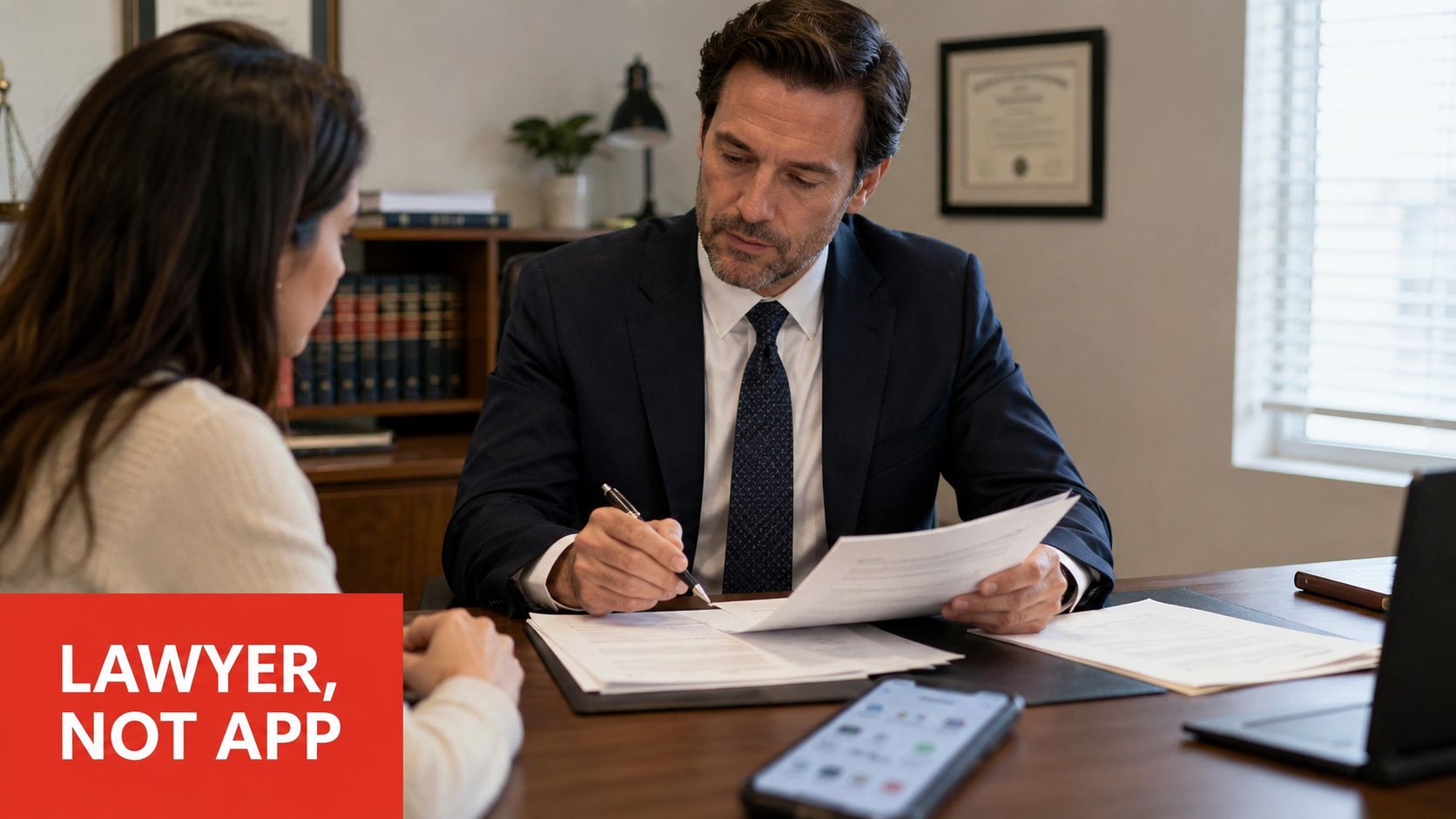
If you're comparing direct counsel with app-based handling, this discussion of why a local lawyer beats apps for traffic cases is worth your time. The difference gets sharper when the issue is revocation.
A revoked license case is not a click button problem
A real lawyer investigates the root cause. That sounds basic, but it's where many drivers lose control. The visible problem might be a revoked status. The actual cause might be an unresolved court case, a point accumulation issue, a DUI-related requirement, a failure to file proof of insurance, or multiple overlapping barriers.
An app won't spot nuance the way a lawyer will. It won't challenge assumptions. It won't catch when one clerk's answer conflicts with the actual record. It won't build a legal theory around the facts that matter most.
This gets even more important for younger drivers and families. Drivers aged 15 to 17 who accumulate 6 points within 12 months face a restriction to a “Business Purposes Only” license for 12 months or until age 18, and the restriction increases by 90 days for each additional point, as explained by Nation's Traffic School on Florida traffic ticket points. Even in cases involving younger drivers, the rules are technical and the consequences are immediate.
For readers trying to understand the broader difference between appointed criminal defense and targeted legal advocacy, this public defender guide from Express Bail Bonds gives useful general context about legal representation roles. A license restoration fight, though, requires a focused administrative and traffic defense approach.
Direct lawyer access changes outcomes
When your license is revoked, you need answers now. Not tomorrow. Not after a chatbot intake. Not after a call center sends a note to somebody else.
Lawyer-led representation matters because the work is strategic:
Record analysis: Someone has to read the file correctly and identify every blocker.
Hearing and agency advocacy: If relief requires appearances, filings, or administrative handling, legal judgment controls the approach.
Document control: Letters, class proofs, insurance records, court dispositions, and filing timing have to line up.
Risk management: A lawyer helps you avoid admissions, missteps, and unnecessary exposure.
If you can lose your freedom to drive, you shouldn't hand the case to software.
Ticket mills sell convenience. A revoked license case demands accountability. When the stakes are this high, direct access to your attorney by phone or text isn't a luxury. It's the standard you should expect.
Take Back Control of Your License Today
A revoked license can wreck your routine fast. It can threaten your income, your family responsibilities, your school access, and your peace of mind. But the worst response is passivity.
You need to treat this for what it is. A legal emergency with a legal solution. Not an app problem. Not a clerical nuisance. Not something to “wait out.”
The right response is focused and aggressive. Identify the cause. Stop the bleeding. Gather the record. Choose the correct path, whether that means hardship relief or full reinstatement. Then file it correctly the first time.
If you've been searching for a revoked license lawyer, you're already asking the right question. The next step is action. Not more browsing. Not more delay. Action.
Your goal isn't just to drive again someday. Your goal is to get back on the road legally, protect your record where possible, and avoid piling new trouble on top of the old case. That takes strategy. It takes speed. It takes a lawyer who treats your license like the shield it is for your job and your life.
Visit Ticket Shield, PLLC now for a free consultation. This is a lawyer-led Florida defense firm where you speak directly to your attorney by phone or text, not a middleman, corporate answering service, or automated chatbot. If your license is revoked, don't guess and don't wait. Get a real legal shield in place and fight for the result that matters most: No Points on your license.
