Reckless Driving Florida Speed: Laws, Penalties, and Defense
Learn reckless driving Florida speed laws, penalties, and defense strategies. Understand statutes 316.192 and 316.1922 to protect your license today.

You're driving through Florida, keeping up with traffic, when a trooper's lights appear behind you. You pull over expecting a civil speeding citation. Instead, the summons says reckless driving. That change matters. You may now be facing a criminal traffic charge, a court case, license consequences, and an accusation that the way you drove showed conscious disregard for safety.
The phrase reckless driving Florida speed raises a difficult question: when does a fast number become criminal conduct? Florida law doesn't treat every high-speed stop the same way. Ordinary speeding is a civil infraction. Reckless driving requires proof of a more serious mental state. Florida also now has a separate offense for dangerous excessive speeding, which can apply based on specific speed thresholds.
Your first move shouldn't be paying the citation or relying on an automated ticket app. Preserve the citation, avoid making statements about the stop, and get a Florida traffic defense lawyer to examine the evidence before you choose a resolution.
Table of Contents
When a Florida Traffic Stop Becomes More Than a Speeding Ticket
Florida Statute 316.192 and the Willful or Wanton Disregard Test
Penalties for Speed-Based Reckless Driving and Dangerous Excessive Speeding
How Florida Courts Evaluate Excessive Speed in Reckless Driving Cases
Common Fact Patterns Behind Speed-Related Reckless Driving Charges
Comparing Civil Speeding, Divorce Driving, Reckless Driving, and Dangerous Excessive Speeding
Building a Strategic Defense Against Speed-Based Reckless Driving
Protect Your License with a Lawyer-Led Florida Reckless Driving Defense
When a Florida Traffic Stop Becomes More Than a Speeding Ticket
A driver sees flashing lights on a Florida interstate and pulls over. The officer says the vehicle was traveling at a dangerously high speed. The driver expects a fine, but the summons uses the words reckless driving. That driver may assume the paperwork is a more serious speeding ticket. It isn't.
The officer's description of the conduct can determine whether the stop becomes a civil citation, a reckless-driving charge, or a dangerous-excessive-speeding case. The report may describe traffic conditions, lane changes, following distance, braking, nearby vehicles, weather, and the driver's response to the officer. The State may later rely on those details to argue that the driver showed willful or wanton disregard for safety.
The number is important, but it isn't the entire case
Florida officers may consider extreme speed when deciding what to charge. A driver who exceeds the posted limit by 50 mph or more may fall within the dangerous excessive speeding statute, and driving at 100 mph or more can create another statutory exposure when the conduct threatens safety or interferes with another vehicle. Those rules are separate from the traditional reckless-driving test. Florida Statute 316.1922 establishes the dangerous excessive speeding offense.
The trooper's narrative, radar or lidar evidence, body-camera footage, and any witness accounts can all shape the case. A speed reading that looks alarming on paper may still need to be proven through reliable equipment, proper operation, and admissible records. Conduct surrounding the speed can either strengthen the State's theory or undermine it.
Practical rule: Don't treat a reckless-driving summons like a ticket you can resolve with a quick online payment. Find out what charge was filed, what court handles it, and what evidence supports it.
Florida's traffic fatality data show why officers and prosecutors take excessive speed seriously. The Insurance Institute for Highway Safety reported that speeding was involved in 11% of Florida motor-vehicle crash deaths in 2024, while speeding-related crashes accounted for 29% of motor-vehicle crash deaths nationwide that year. The IIHS state-by-state fatality data provides that context, but crash statistics don't eliminate the State's burden to prove the specific charge against you.
Florida Statute 316.192 and the Willful or Wanton Disregard Test
Florida Statute 316.192 defines reckless driving as operating a vehicle in willful or wanton disregard for the safety of persons or property. The State must prove a conscious disregard for safety, not merely that your speed exceeded the posted limit.
That distinction protects you from having every serious speeding allegation treated as reckless driving. Speed alone generally doesn't satisfy the reckless-driving standard. Civil speeding establishes an unlawful speed. Reckless driving requires proof that your driving created a serious safety risk and that you acted with the required disregard for safety.
What the State must prove
The prosecutor may rely on traffic, lane movement, road conditions, nearby vehicles, braking, passing, or other conduct surrounding the speed. Those facts must show more than carelessness, inattention, or a mistake. They must support a finding that you knowingly drove in a manner showing willful or wanton disregard.
Florida courts have treated excessive speed by itself as insufficient in some cases. In Harris v. State, the court held that driving more than 50 mph over the limit remained only a civil speeding infraction on the facts presented. Excessive speed alone did not prove reckless driving without additional dangerous conduct. The statutory language appears in Florida's reckless-driving statute, and our Florida Statute 316.192 and willful or wanton disregard test explanation examines how courts apply that language.
A new 100 mph trigger changes the charging calculus when the driving threatens safety or interferes with another vehicle. That trigger belongs to Florida's separate dangerous excessive speeding offense. It can create a separate charge, but it does not automatically prove the willful-or-wanton-disregard element required for traditional reckless driving.
How ordinary speeding differs
Section 316.183 addresses unlawful speed. It requires a reasonable and prudent speed under existing conditions and sets default maximum speeds of 30 mph in business or residence districts and 55 mph elsewhere unless a lawful local limit applies. A violation is a noncriminal traffic infraction under Chapter 318. Florida's Chapter 316 statutory text shows how Florida separates unlawful speed from reckless driving.
Section 316.192 also makes fleeing a law-enforcement officer in a motor vehicle reckless driving per se, which changes the State's proof burden for that specific allegation.
Penalties for Speed-Based Reckless Driving and Dangerous Excessive Speeding
A reckless-driving conviction can carry consequences far beyond a fine. Under Florida Statute 316.192, a first conviction can result in up to 90 days in jail and a fine from $25 to $500. A second or subsequent conviction can result in up to six months in jail and a fine from $50 to $1,000. These are statutory maximums, but they show why you should not treat the charge as a routine traffic matter.
Dangerous excessive speeding creates a separate layer of exposure. Under Section 316.1922, the offense applies when a driver exceeds the posted limit by 50 mph or more, or drives at 100 mph or more in a way that threatens safety or interferes with another vehicle. A first conviction can carry up to 30 days in jail or a $500 fine. A second or subsequent conviction can carry up to 90 days in jail or a $1,000 fine.
License consequences can become the central problem
If a second or later dangerous-excessive-speeding violation occurs within 5 years of a prior conviction, Florida law provides for license revocation of 180 days to 1 year. That revocation is separate from the arguments surrounding reckless driving.
The statutes can overlap. The State may claim that the speed meets the dangerous-excessive-speeding threshold while also alleging that the surrounding conduct proves reckless driving. No accident is required for either charge. The State can proceed based on the alleged driving itself.
Charge | Classification | Max Jail | Max Fine | License Action | Points |
|---|---|---|---|---|---|
Reckless driving, first conviction | Criminal traffic offense | Up to 90 days | $25 to $500 | Depends on the case and disposition | Must be evaluated from the citation and disposition |
Reckless driving, second or subsequent conviction | Criminal traffic offense | Up to 6 months | $50 to $1,000 | Depends on the case and disposition | Must be evaluated from the citation and disposition |
Dangerous excessive speeding, first conviction | Criminal offense | Up to 30 days | $500 | No second-offense revocation provision applies | Must be evaluated from the citation and disposition |
Dangerous excessive speeding, second or subsequent conviction within 5 years | Criminal offense | Up to 90 days | $1,000 | Revocation from 180 days to 1 year | Must be evaluated from the citation and disposition |
The statutory structure is discussed in this explanation of Florida reckless-driving penalties. Don't assume that a reduction is automatic. The charge, your driving history, the evidence, and the prosecutor's position all matter.
How Florida Courts Evaluate Excessive Speed in Reckless Driving Cases
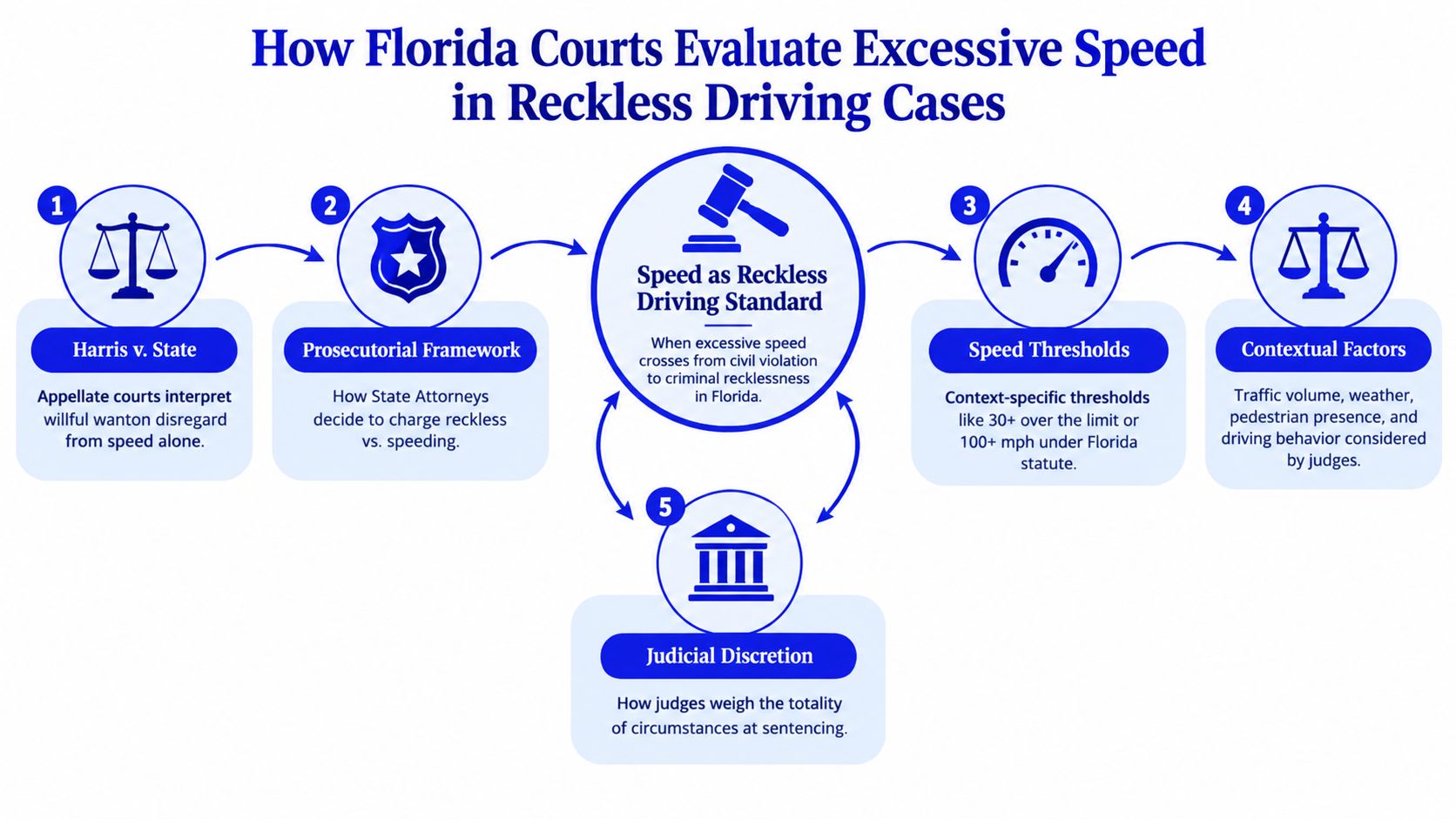
Florida courts don't decide reckless-driving cases by looking at a speedometer reading in isolation. They examine whether the evidence shows both dangerous operation and the required disregard for safety. The prosecution may use the speed as an important fact, but the surrounding conduct often determines whether that fact supports a criminal conviction.
Harris v. State is an important boundary point. The court held that driving more than 50 mph over the posted limit remained a civil speeding infraction by itself. That ruling doesn't mean speed is irrelevant. It means the State generally needs additional evidence showing why the driving crossed from unlawful speed into willful or wanton disregard.
Evidence that can change the analysis
The State may present dashcam footage, body-camera video, radar or lidar records, officer testimony, witness statements, and statements made during the stop. A report that says you were speeding is not necessarily enough. A report supported by weaving, racing, tailgating, wrong-way travel, or dangerous lane movements creates a different litigation problem.
Your lawyer should also examine the reliability of the measurement. That includes the device used, calibration and maintenance records, officer training, line of sight, and whether the officer used a pacing method. A disputed speed reading can weaken both the reckless-driving theory and any charge built on a statutory threshold.
The dangerous excessive speeding statute changes the practical calculus because it provides a speed-based criminal offense. When the alleged facts meet the 100 mph pathway and the safety or interference requirement, the State may not need to prove reckless driving through exactly the same willful-or-wanton theory. That can affect plea negotiations and the defense strategy.
Speed can be powerful evidence. It isn't automatically the whole case.
For a related explanation of criminal speeding issues, review what Florida drivers should know about criminal speeding.
Common Fact Patterns Behind Speed-Related Reckless Driving Charges
The same speed can produce different legal exposure depending on what happened around it. A vehicle moving quickly on an open road presents one set of facts. The same vehicle moving quickly beside pedestrians, entering a school zone, or forcing other drivers to brake presents another.
Highway conduct
On a Florida interstate, the State may focus on following distance, rapid lane changes, passing behavior, and whether other vehicles had to react. A driver who was merely traveling quickly may have a stronger argument that the case is ordinary speeding. A driver who followed closely behind a commercial vehicle, moved across lanes, or caused evasive reactions faces a more difficult reckless-driving defense.
Triple-digit speed
A speed of 100 mph or more can trigger dangerous excessive speeding when the driving threatens safety or interferes with another vehicle. If the alleged speed also exceeds the posted limit by 50 mph or more, the statute provides another route to the charge. The State may pursue dangerous excessive speeding and reckless driving together when the evidence supports both theories.
School-zone conduct
School zones create separate financial consequences even when the conduct doesn't rise to reckless driving. Florida law sets a $50 fine for speeding up to 5 mph over the limit in a legally posted school zone, and it doubles the base fine for speeding in a school zone or designated school crossing. Florida's Chapter 318 provisions explain those enhanced penalties.
Scenario | Likely Charge | Key Evidence | Penalty Range |
|---|---|---|---|
High speed with no additional dangerous conduct | Civil speeding, depending on the proof | Speed reading, posted limit, device records | Civil traffic consequences |
High speed with weaving or close following | Reckless driving may be alleged | Video, officer observations, witness accounts | Up to 90 days and $25 to $500 for a first reckless-driving conviction |
50 mph or more over the posted limit | Dangerous excessive speeding may apply | Posted limit and reliable speed evidence | Up to 30 days or $500 for a first conviction |
100 mph or more with threatened safety or interference | Dangerous excessive speeding may apply | Speed evidence and surrounding vehicle conduct | Up to 30 days or $500 for a first conviction |
Second or later dangerous-excessive-speeding conviction within 5 years | Dangerous excessive speeding with license exposure | Prior conviction and current charge | Up to 90 days or $1,000, plus 180-day to 1-year revocation |
Your citation may fit more than one category. This comparison of careless and reckless driving can help you identify the legal distinction, but it can't replace an examination of the actual report and evidence.
Comparing Civil Speeding, Divorce Driving, Reckless Driving, and Dangerous Excessive Speeding
The citation's exact statutory section matters more than the officer's casual description at the roadside. Florida separates ordinary unlawful speed from careless driving, reckless driving, and dangerous excessive speeding.
Offense Tier | Statute | Classification | Max Penalty | License Impact |
|---|---|---|---|---|
Civil speeding | 316.183 | Noncriminal traffic infraction | Moving-violation penalties under Chapter 318 | Depends on the disposition and applicable license rules |
Careless driving | 316.1925 | Civil traffic offense | Traffic penalties under Florida law | Depends on the disposition |
Reckless driving | 316.192 | Criminal traffic offense | First conviction, up to 90 days and $25 to $500; later conviction, up to 6 months and $50 to $1,000 | Must be evaluated from the charge and disposition |
Dangerous excessive speeding | 316.1922 | Criminal offense | First conviction, up to 30 days or $500; later conviction, up to 90 days or $1,000 | Second or later conviction within 5 years can bring revocation from 180 days to 1 year |
Calling an offense “divorce driving” doesn't identify a Florida traffic offense. If that phrase appears in a conversation or online search, check the actual citation. The relevant categories are careless driving, reckless driving, civil speeding, and dangerous excessive speeding.
Careless driving and reckless driving aren't interchangeable. Reckless driving requires the willful-or-wanton disregard standard. Civil speeding under Section 316.183 is different because the State generally needs to establish that you exceeded a lawful speed under the statute.
Dangerous excessive speeding is also distinct. A driver facing a very high speed may have two separate statutory concerns, not one enhanced speeding ticket. That is why the citation, charging document, and evidence should be reviewed before any plea or payment.
Building a Strategic Defense Against Speed-Based Reckless Driving
A serious defense starts with evidence, not a payment screen. Your lawyer should determine exactly how the officer measured speed, what the officer observed, and whether the facts support the mental-state element of reckless driving.
Audit the measurement
Radar and lidar evidence should be examined for calibration, maintenance, operating procedures, and officer training. If the officer used pacing, the defense should examine the patrol vehicle's speed, distance, duration, and ability to maintain a reliable pace. A number without a reliable foundation is vulnerable.
Challenge the willful-or-wanton theory
The defense should separate the speed allegation from the State's broader narrative. Daylight, light traffic, dry pavement, no lane weaving, no racing, and no evasive reaction by other drivers may all matter. Those facts don't guarantee dismissal, but they can directly challenge the claim that you consciously disregarded safety.
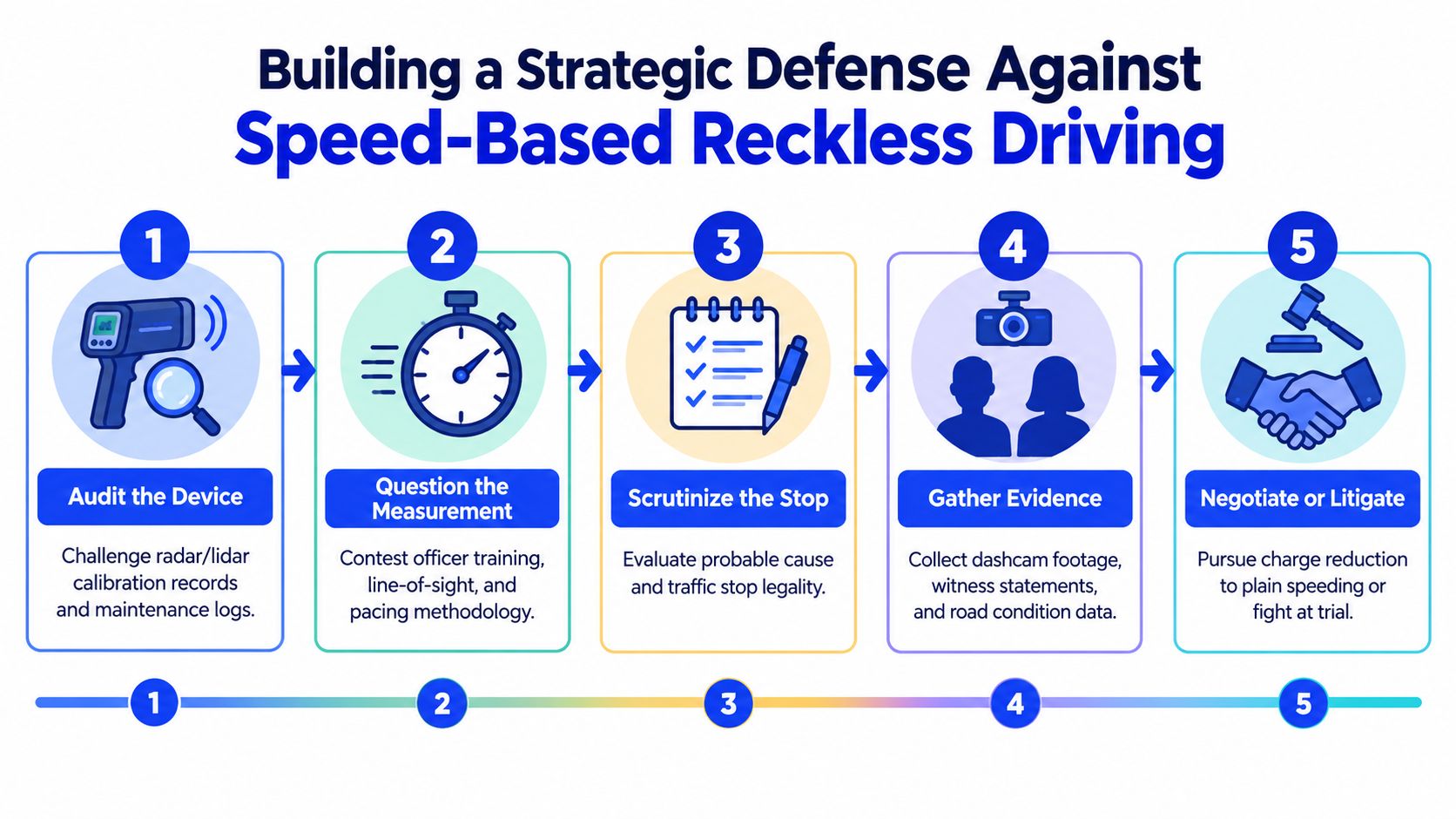
A lawyer may also request available video, inspect the citation and report, evaluate the legality of the stop, and identify inconsistencies between the officer's written account and the recording. If the State cannot prove the charge as filed, counsel can seek dismissal or negotiate a reduction to a noncriminal disposition.
The alternative is an automated ticket mill that routes you through a chatbot or middleman, takes a narrow payment approach, and may not investigate the speed device or the reckless-driving allegation. That process doesn't give your case the individualized review it needs.
Before choosing traffic school, a plea, or any other resolution, ask what happens to your record and license. This guide to lidar ticket defense explains why measurement evidence deserves focused scrutiny.
Protect Your License with a Lawyer-Led Florida Reckless Driving Defense
Paying a reckless-driving charge to make it disappear is a dangerous assumption. Payment may resolve the case in a way that leaves you with a criminal disposition, financial consequences, and a driving record problem that lasts beyond the original stop.
You also shouldn't assume that a high speed makes the case unwinnable. Florida's legal standard requires the State to prove the charged offense. Harris v. State shows why speed alone can be insufficient for reckless driving, while the dangerous excessive speeding statute means high-speed cases require a separate and careful analysis.
Automated service versus direct legal representation
An automated service may offer convenience, but convenience isn't the same as defense. A lawyer-led firm can speak with you directly by phone or text, examine the officer's evidence, identify weaknesses in the State's theory, and negotiate with the prosecutor based on the actual facts.
That distinction matters most when the citation uses criminal language or alleges a speed at 100 mph or more. You need someone reviewing the charge, the measurement, the road conditions, and the driving conduct together. Don't make your first major decision by clicking “pay.”
Ticket Shield, PLLC offers lawyer-led Florida traffic defense, including direct attorney communication by phone or text, review of reckless-driving allegations, and representation in Florida traffic matters. The firm's stated goal is to pursue a resolution that protects your license and works toward No Points when the facts and law allow it.
Visit Ticket Shield, PLLC for a free consultation before you pay or plead to a Florida reckless-driving or dangerous-excessive-speeding charge. Speak with a lawyer-led defense team about your options and pursue the ultimate goal of achieving “No Points” on your license.