New to Florida Car Registration: Your 2026 Walkthrough
New to Florida car registration? Follow our 2026 step-by-step guide for deadlines, documents, fees, military rules, and online vs in-person options.

You just moved, or you're packing the last box and staring at a Florida title, an old insurance card, and a deadline that nobody in your household wants to miss. New to Florida car registration is not just a clerical errand, it's the point where Florida starts treating your vehicle like a Florida vehicle, and if there's a ticket, a suspension, or a lienholder in the way, the counter can shut you down fast.
Florida does not make this process optional once you're operating the car on state roads. Chapter 320 says the owner or person in charge has to register the vehicle in Florida, and the application has to go through the department or an authorized agent on the proper form, while a vehicle that is not operated on Florida roads during the registration period doesn't need registration under that statute. That means the trigger is actual road use after you establish residency, not wishful thinking or a garage full of out-of-state paperwork. Florida Statutes Chapter 320, section 320.02 puts the legal duty on the owner, not the moving company, not the dealer, and not the county clerk.
If you're still sorting out what residency looks like in practice, Florida's own new-resident guidance makes the workflow clear. You need Florida insurance, you need to title and register promptly, and the first registration is done in person at a local service center, not as an online-only move-in task. Florida's new resident guidance is the right place to start if you want the state's sequencing straight before you waste a trip.
Table of Contents
What New Florida Residents Must Know Before They Register
Residency starts the obligation
Why the first registration is not a quick online renewal
Documents and Proof You Need to Bring
Your core file
Keep the insurance proof clean
Don't make the clerk fix your errors
Fees and Taxes New Residents Should Budget For
Estimated First-Year Florida Registration Costs for a New Resident
Budgeting the first year
Where to Register and How the Process Works
The in-person flow
Why appointments beat walk-ins
Handling Financed, Leased, and Out-of-State Vehicles
Financed cars need the title chain cleaned up
Leased cars are handled through the lessor
The common failure point
What Can Block Your Registration Without Warning
Tickets and suspension exposure are not separate from registration
Why this is a legal checkpoint
Special Rules for Military, Students, and Snowbirds
Active-duty military stationed in Florida
Full-time students and seasonal residents
Why misclassification backfires
What New Florida Residents Must Know Before They Register
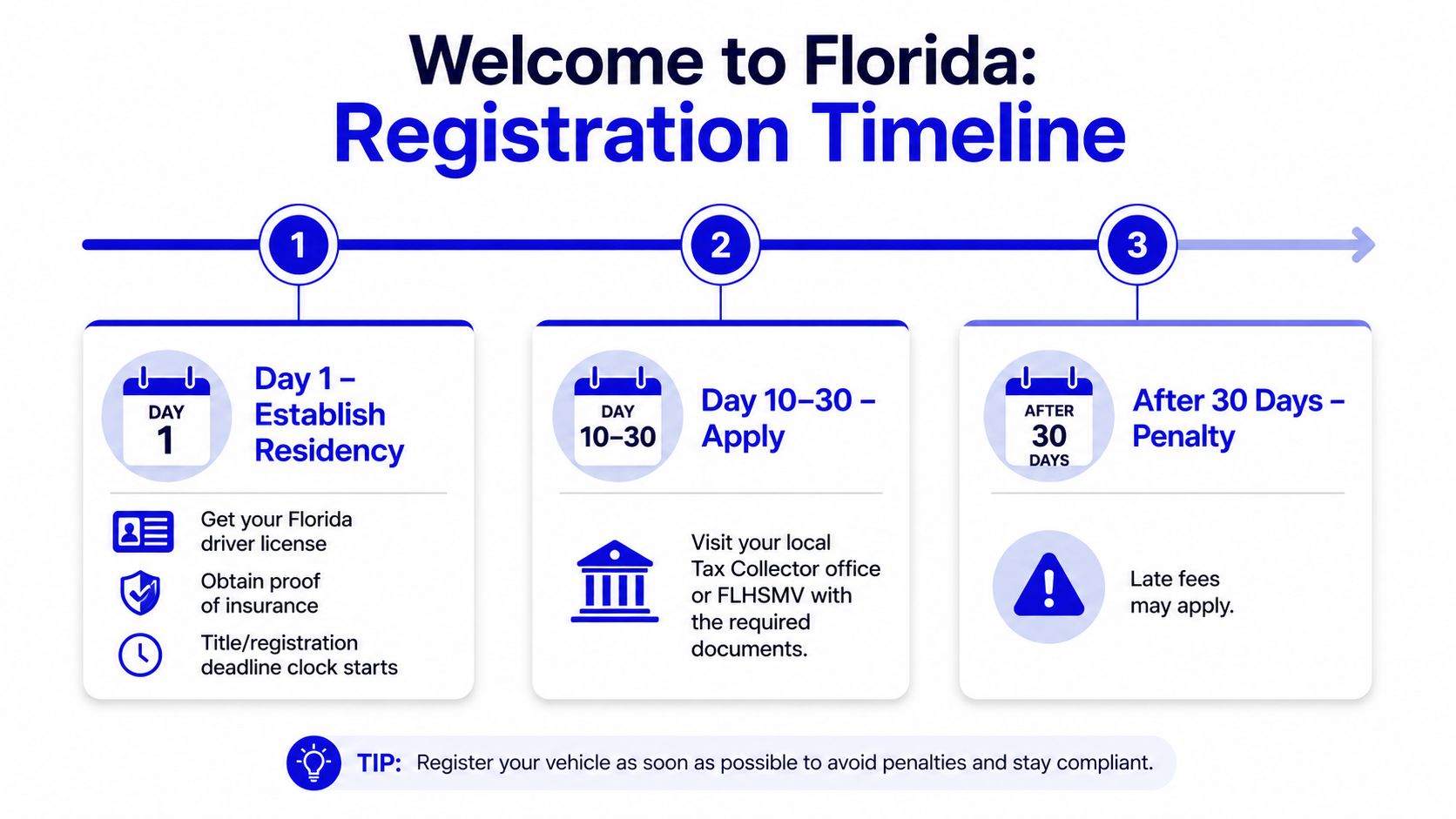
Florida starts the clock the moment you establish residency and begin operating the vehicle here. The state's new-resident guidance says you have to secure Florida insurance and title and register within 10 days of establishing residency, while another Florida-facing guide describes a 30-day window. Treat that gap as a warning, not permission to wait. The paperwork, insurance, and title transfer all have to line up before the clerk will finish the job, and the practical reality is simple, the window is short. Florida car registration complete guide and Florida's new resident guidance point you to the same outcome, act fast or get stuck.
Residency starts the obligation
The legal trigger is residency plus Florida road use. Under Chapter 320, if you own or control a vehicle operated on Florida roads, you owe Florida registration. If the car is not being operated here during the registration period, the statute gives you an out, but that will not help once you are commuting, running errands, or driving the family around every day. Chapter 320.02 is the authority the clerk is following, not your moving timeline.
Proof of residency usually means a Florida address on a bill, lease, or similar document tied to you, along with Florida insurance in force before you walk in. If you moved across the country and are still closing out the old home, a practical moving checklist helps you stay organized before the DMV visit. Use the Boston to Florida moving guide if you need a planning reference while you line up the move, insurance switch, and registration deadline.
Practical rule: the day you establish Florida residency is the day you stop treating your old-state paperwork like it can carry you through one more week.
Why the first registration is not a quick online renewal
Your first Florida registration is different from a renewal. Florida's own guidance says initial registration has to be handled in person at a local service center when titling is involved, and that matters because the clerk has to verify the title chain, the VIN status, and your identity before plates are issued. If you already have driving-record exposure, read the Florida DMV point system guide for out-of-state drivers, because the registration desk is a bad place to discover you are already carrying a problem.
Delay does more than risk a late filing. It can create insurance confusion, title issues, and household friction if one person on the title is eligible and another is not. In Florida, this is a compliance event requiring careful preparation.
Documents and Proof You Need to Bring
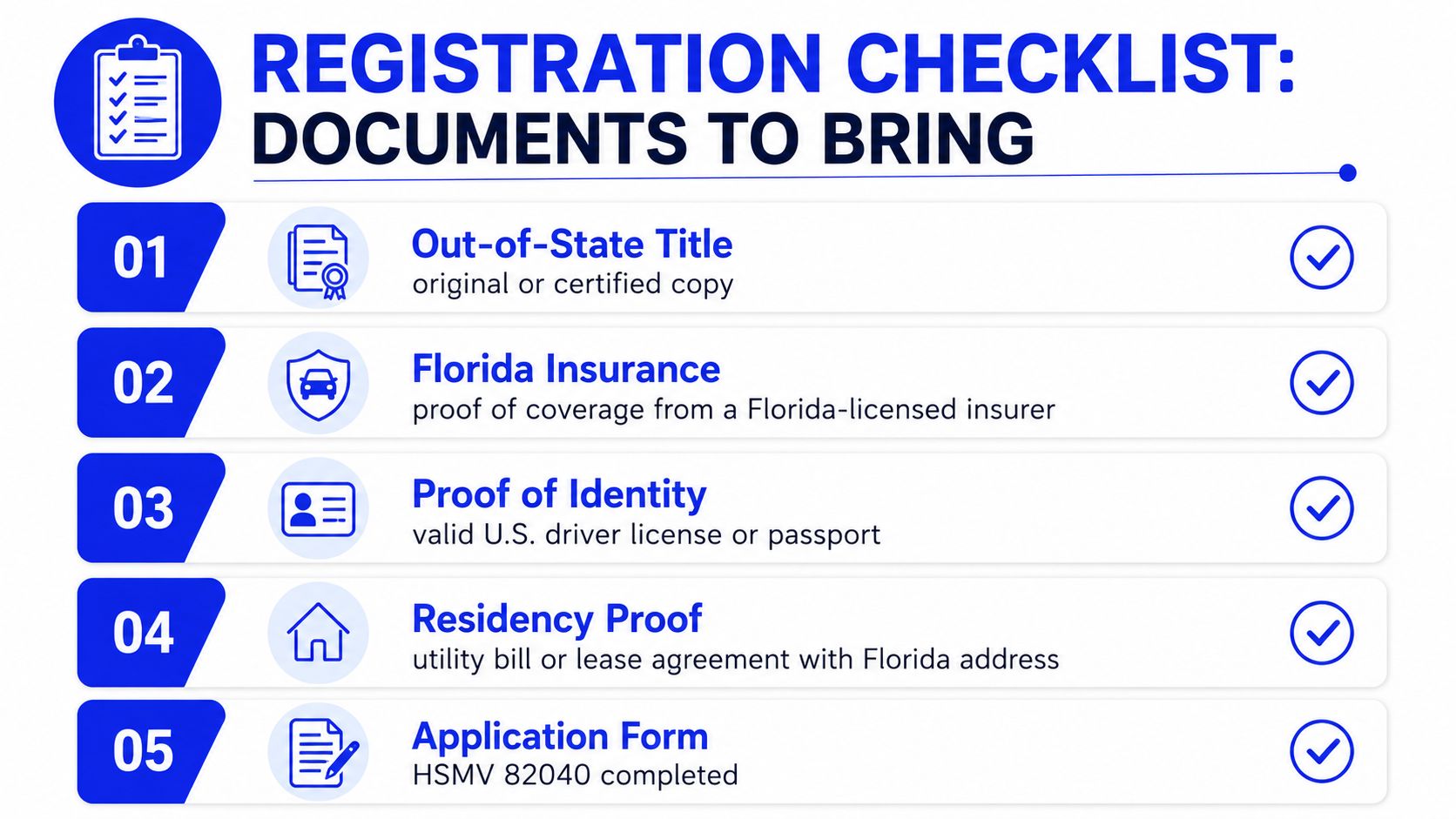
Walk in unprepared and you'll walk back out without plates. Florida wants the registration file to match the title file, the insurance file, and the identity file, and the clerk will reject a stack that does not line up. If your name changed, your title is held by a lender, or your VIN paperwork is missing, the window closes fast.
Your core file
Bring the original out-of-state title or the current title paperwork if the vehicle is already titled somewhere else. Add proof of Florida insurance from a Florida-licensed carrier, a valid government-issued photo ID, and Social Security verification if the clerk asks for it in your transaction type. A bill, lease, or similar proof of Florida residence belongs in the folder too, because the office needs to see that you live here.
If the vehicle was previously titled outside Florida, expect a VIN verification requirement. That step confirms the car you are presenting is the same car reflected on the title, and it is one of the fastest ways to stop a fraudulent, incomplete, or mismatched file before plates are printed. The travel document service overview is a useful reminder that document prep saves time when the paperwork has to be exact.
Florida clerks do not care that you are tired from the move. They care whether every number, name, and signature matches.
Keep the insurance proof clean
Bring current proof of insurance, not a card that expired, not a screenshot you never checked, and not coverage that was written for an old address or the wrong vehicle. If your insurer has not updated the policy to reflect the Florida move, fix that before you go to the counter. The clerk is checking for clean, current proof that ties back to the vehicle you are registering.
If insurance status is already tangled with a registration problem, use a registration proof of insurance service to get the paperwork straight before you waste a trip. That matters when the file is held up by a missing insurance record, a bad policy date, or a document mismatch that keeps the transaction from getting processed.
Don't make the clerk fix your errors
If the seller signed the wrong line, the name on the title does not match your ID, or the title still shows a former owner, the office will not treat that as a small defect. It is a failed transaction. Bring a complete packet, not a partial packet you hope to finish later.
A traffic citation, unpaid fine, or suspended license can also drag the process into a deeper review when the state checks your record. If that problem exists, handle it before you stand in line, because paperwork alone will not save a blocked registration.
Fees and Taxes New Residents Should Budget For
Florida's fee structure is where new residents get surprised, because the number on the base fee is never the final number on the receipt. The big one is the $225 Initial Registration Fee when you do not have a Florida plate to transfer, and that fee lands before you even get to the regular registration amount. Florida also uses weight-based base fees, so the first-year total changes depending on the vehicle.
Estimated First-Year Florida Registration Costs for a New Resident
Fee Component | Typical Amount | When It Applies |
|---|---|---|
Initial Registration Fee | $225 | When you do not have a Florida plate or transferable Florida registration in your name |
Annual Base Fee | $27.60 | Lower-weight private passenger vehicles |
Annual Base Fee | $35.60 | Many private passenger vehicles in the middle bracket |
Annual Base Fee | $45.60 | Heavier private passenger vehicles in the next bracket |
County Charges and Related Filing Costs | Varies | Added during the local transaction |
Renewal Range After County Charges | Roughly $30–$52 | Typical renewal experience after local charges |
Florida's own vehicle and vessel statistics portal shows the scale of the market, and that matters because a state that registers this many cars is not improvising its fee system. The state portal publishes official registration reports, and the Alliance for Automotive Innovation reports 19.52 million registered vehicles for Florida in its market snapshot, while state and industry datasets place the total roughly between 15.9 million and 19.5 million depending on method and year. Florida's vehicle and vessel reports and statistics show the official reporting structure behind that scale.
Budgeting the first year
If you're bringing in a standard sedan and you don't have a Florida plate to transfer, expect the one-time $225 fee on top of the annual base fee and local charges. If you're registering a heavier SUV or truck, the base amount moves up with the weight bracket, so the first-year bill can climb even before title work and county charges are added. The right move is to budget for the filing, not just the plate.
Candid advice: if your application is wrong, the office can send you back for a correction and you may eat the delay twice.
Mistakes that trigger a return trip are usually boring, and that's what makes them expensive. Wrong weight class, a missed county fee, or an unrecorded lien can cause duplicate visits and duplicate stress. If you're trying to clean up a registration problem after the fact, the expired registration ticket guide is worth a look because late paperwork and traffic enforcement tend to collide.
Where to Register and How the Process Works
Use the local tax collector when your title situation is straightforward, and use the FLHSMV service center when the file is messy. That's the cleanest decision rule. The tax collector acts as an authorized agent, while the service center is where more complicated title work gets handled, especially when a lien, an out-of-state title issue, or an identity mismatch is sitting on the file.

The in-person flow
You pull a ticket or check in at the counter, hand over the file, and wait for the clerk to review the title, insurance, identity, and VIN details. If the vehicle came from another state, the office may require VIN verification before it finalizes the transaction. If you're also converting your driver license, plan on doing that visit carefully, because your ID file and vehicle file should match the same Florida residence story.
Payment methods vary by office, so don't assume you can show up with cash and a half-complete packet. Bring a complete file and be ready to pay the fees that apply to your transaction. If you've got driving-record concerns already, the how to check driving record guide is the kind of pre-visit review that can save you from an ugly surprise at the counter.
Why appointments beat walk-ins
An appointment is the safer play. Walk-ins can be fine for a simple renewal, but new-resident titling is not a casual errand, and the last thing you want is to spend the afternoon in line because one document was left at home. Give yourself enough time for the clerk to review the packet, especially if a lienholder or title transfer issue forces the file into a slower lane.
MyDMV is useful for renewals and some updates, but it's not the answer for a first-time move-in that involves titling. Initial registration belongs in the office, where the paperwork can be checked and the plate issued in the same transaction.
Handling Financed, Leased, and Out-of-State Vehicles
The ownership structure changes the whole script. A car you own outright is one filing. A financed car with a lender on the title is another. A leased car is a different animal entirely, because the leasing company is the legal owner and you are filing under its paperwork, not yours.
Financed cars need the title chain cleaned up
If the lender still holds the title, Florida wants the ownership paper trail cleared before registration moves ahead. That usually means a written lien release on letterhead or a duplicate title from the originating state. The clerk cannot finish a registration when the title still sits under lender control.
Out-of-state financed vehicles can also trigger VIN verification and odometer review as part of the title work. Do not assume the old paperwork will carry over unchanged just because the car already has plates from somewhere else. It often will not. If the title shows a branded status or another history issue, the safest move is to check a Cararam branded title overview before you walk into the office, so you know whether the file is already carrying baggage.
Leased cars are handled through the lessor
With a lease, the leasing company usually has to sign the Florida title application, and the file needs the lessor assignment handled correctly. If you are near the end of a lease, or you are thinking about an early termination, check what the lease company expects before you file anything. If the lessor's name and the Florida paperwork do not line up, the application can bounce.
The common failure point
The most common reason new-resident applications get rejected at the counter is a title problem that was never cleared before the visit. People show up with insurance, ID, and a Florida address, then learn the title is still controlled by a lender or leasing company. That is a hard stop requiring title documentation before the clerk proceeds.
If you are also dealing with a citation on an out-of-state license, do not treat that as a separate issue. A traffic case can spill into the registration file, especially if points, fines, or suspension exposure are still open. The speeding ticket in Florida with out-of-state license guide explains why that cleanup matters before you expect the plates to go through.
Don't assume “my lender knows I moved” is enough. The clerk needs title proof, not your explanation.
What Can Block Your Registration Without Warning
A lot of new residents get blindsided. You can have the title, the insurance, and the address, then hit a wall because the state sees a separate compliance problem tied to the owner or co-owner. Florida's FAQ says registration or re-registration must be withheld if the owner or co-owner has a license suspension, and that fines and violations must be paid regardless of which co-owner committed them. That means one household member can wreck the transaction for everyone on the title. Florida's registration FAQ is the rule source here.
Tickets and suspension exposure are not separate from registration
A traffic citation is not just a courtroom problem. It can turn into a registration problem, especially when it's unresolved and attached to your driving record. Florida Statute 316.187 covers speeding, and an unpaid speeding ticket, an unresolved red-light violation, or a stop-sign violation can bring points and insurance consequences while also making the registration counter a lot less forgiving. If a co-owner on the title has an active issue, the office can withhold the registration even if you personally did nothing wrong.
Renewal notices don't save you either. Florida treats them as a courtesy, not a guarantee, and they can be lost in the move or never sent by a county office. That means you need to check status before you assume the mail is going to catch the problem for you.
The Cararam branded title overview is a useful reminder that title status matters, because the word “clean” on your paperwork means more than people think once a clerk starts reviewing the file.
Why this is a legal checkpoint
Registration is where old driving-record problems surface. If you've got a citation hanging over you, the office may not care that you just moved and haven't unpacked the kitchen yet. It sees an unresolved compliance issue, and that can stop the plate from being issued until the problem is fixed.
Bottom line: registration can expose the ticket you thought was buried, so check your record before you show up.
Special Rules for Military, Students, and Snowbirds
Florida registration rules shift fast when your residency is tied to military orders, school enrollment, or a seasonal stay. The burden is on you to prove why your car can stay registered somewhere else, and Florida will look at the actual facts, not just what you say on a form.
Active-duty military stationed in Florida
A service member stationed in Florida can usually keep a home-state registration while driving the vehicle here, as long as the military status is documented. Orders, leave papers, and a non-resident military license can support that status. If you are not changing domicile, do not let a temporary assignment get treated like a residency switch.
Full-time students and seasonal residents
A college student enrolled full-time in a Florida university may keep an out-of-state registration if the student remains a nonresident for legal purposes. The same general idea applies to snowbirds who keep a vehicle in Florida for a short seasonal stay and do not cross the threshold that would trigger Florida registration. The key point is not the hotel receipt or the condo key, it is the legal status attached to the car's use and the driver's residency.
Paper trails matter here. If your school records, lease, utility setup, or military paperwork does not line up, a clerk can question the exemption and send you back to fix the file.
Why misclassification backfires
If you vote, register to vote, or take a Florida job, the state can reassess the residency issue later. That can expose you to a retroactive registration problem, which is exactly why you should document your status before you assume you qualify for an exemption. Florida treats residency as a real-world fact pattern rather than a self-applied label.
The majority of new residents handle registration without drama, but anyone with an unresolved citation, a points risk, a suspension issue, or a co-owner's unpaid violation is walking into a higher-risk file. That is where a lawyer-led team matters, because Ticket Shield, PLLC works directly with clients by phone or text, without the middlemen, automated apps, or ticket mills that leave you guessing. If your registration issue overlaps with a traffic citation or a suspended record, direct attorney review can protect your license, your record, and your insurance.
Visit TicketShield.com for a free consultation so you can fight for No Points on your license before a Florida paperwork problem turns into a driving-record problem.
Visit Ticket Shield, PLLC for a free consultation today. If your new Florida registration is tangled up with a ticket, a suspension, or a title problem, their lawyer-led team can review the issue directly and help you protect your license, record, and insurance rates. Do not wait until the clerk, the court, or the insurer forces the next move.