Expired Registration Ticket in Florida: A Guide
An expired registration ticket in Florida can mean dismissal after renewal, or up to a $500 misdemeanor if the tag is over 6 months late.
An expired registration ticket in Florida isn't just a simple fine; it's a citation that can range from a minor inconvenience to a serious criminal charge. The difference all comes down to how long your registration has been expired. If it’s been less than six months, you're looking at a non-moving violation. But if it's been over six months, the situation escalates to a second-degree misdemeanor criminal traffic violation, which brings much harsher penalties.
To put it in perspective, let’s quickly break down how this works.
Florida Expired Registration At a Glance
The table below gives you a quick snapshot of what you're facing based on how long your registration has been expired. This is the first thing you need to figure out after getting a ticket.
Time Expired | Violation Type | Potential Penalties | Your Immediate Priority |
|---|---|---|---|
Less Than Six Months | Non-moving violation (Civil Infraction) | A fine, court costs, and a small administrative fee. | Renew your registration immediately. |
More Than Six Months | Second-degree misdemeanor (Criminal Charge) | Up to a $500 fine, 60 days in jail, and a criminal record. | Contact a traffic defense attorney. This is serious. |
As you can see, crossing that six-month threshold changes everything. A civil infraction is a headache, but a criminal charge can have a lasting impact on your life.
How We Reviewed Florida Expired Registration Rules and Penalties
Primary Florida sources, not general traffic-ticket advice, were consulted: the text of Fla. Stat. 320.07, the renewal guidance and portal used by the Florida Department of Highway Safety and Motor Vehicles, and county-level clerk or traffic fine pages that show what drivers pay once local court costs and dismissal fees are added.
We also compared how counties describe proof-of-compliance dismissals, because that is where many articles become too vague. The statewide rule tells you whether the case is civil or criminal; the county clerk usually controls the practical details on deadlines, dismissal paperwork, and the amount of the compliance fee. When we compared county guidance, the pattern was consistent: renewing quickly can change the outcome, but the exact out-of-pocket amount still varies by county schedule.
What could change the advice? The main variables are how long the registration was expired, whether the stop also involved a failure to carry proof of registration, whether a court date was already set, and whether the county requires an in-person appearance for criminal traffic matters. We do not list one "universal" Florida fine because counties assess different totals. Instead, this article focuses on the parts that are stable statewide and flags where local amounts differ.
What to Do Right After Getting the Ticket

Seeing flashing lights in your rearview mirror is a feeling nobody enjoys. Receiving a ticket for an expired registration can be especially frustrating if it was an honest oversight. But how you act in those first few moments during the traffic stop really matters. The most important thing you can do is stay calm.
Cooperate with the officer, provide your license and documents, and accept the ticket without arguing. Arguing on the side of the road will not make the ticket disappear—it can only make things worse and complicate your case later on.
Understanding the Citation You Received
Once the officer has driven away, take a good look at that ticket. In Florida, an expired registration citation falls into two very different categories, and the distinction is critical because it dictates the penalties and the legal path forward.
Expired Less Than Six Months: If you’re in this window, you’ve been cited for a non-moving violation. Think of it like a parking ticket, it's a civil infraction that needs to be handled, but it's not a criminal offense.
Expired More Than Six Months: Consequences escalate. If your registration is over six months out of date, the ticket is for a second-degree misdemeanor. This is a criminal traffic violation, a far more significant charge with major consequences.
Knowing which type of ticket you have is the first step toward figuring out your next move. A criminal charge requires a much more careful and immediate response, as it can result in a permanent criminal record if not handled properly.
Key Takeaway: The severity of an expired registration ticket in Florida hinges on a single factor: whether the lapse is more or less than six months. A non-moving violation is an inconvenience, while a misdemeanor is a criminal charge that can impact your future.
Your Immediate Next Steps
Don't just toss the ticket in your glove compartment and try to forget about it. Your priority now is to assess the situation and get ready for what comes next. The deadlines for responding are strict, and missing them can lead to even bigger problems, like a suspension of your driver's license.
First, find the response date on the ticket. You'll need to either pay the fine, show proof of renewed registration to the court clerk, or set a court date before this deadline passes.
If your court date is coming up faster than you’d like, you might need to act quickly to get things in order. Our guide on how to ask for a continuance in court has some valuable information on how to manage court timelines. The goal is to tackle this issue head-on to protect your license and your record. Past results do not guarantee future outcomes.
Expired Registration Ticket Cost in Florida: Fine, Dismissal Fee, and Record Impact
For most drivers, the first practical question is simple: what will this cost? In Florida, the honest answer is that the total depends on two things, whether the registration was expired for less than or more than six months, and which county is processing the citation. The legal framework comes from section 320.07; the dollars often come from local fine schedules and clerk policies.
One Florida wrinkle matters immediately: there is no grace period that lets you drive indefinitely after expiration, but the statute ties enforcement to the end of the birth month and allows a civil citation to be dismissed after proof of renewal in many cases. Under the same statute, a tag expired less than six months is a noncriminal infraction, while a tag expired six months or more becomes a criminal offense with a maximum fine of $500. Florida's birthday-based system also catches many drivers off guard; a recent state reporting overview noted both the scale of expired tags in Florida and that tags generally expire at midnight on the owner's birthday.
In our review of Florida clerk procedures, the biggest cost swing was not the base citation itself. It was whether the driver renewed fast enough to qualify for a clerk dismissal instead of paying the full ticket.
Situation | What the law says | What drivers often pay in practice |
|---|---|---|
Expired less than 6 months | Noncriminal traffic infraction under Fla. Stat. 320.07 | Often a county-set civil fine roughly in the $50–$150 range before local costs, or a lower dismissal/compliance fee if you renew and qualify through the clerk |
Expired 6 months or more | Second-degree misdemeanor under Fla. Stat. 320.07(3)(c) | Court costs plus whatever sentence the court imposes, with a statutory fine ceiling of $500 and possible jail/probation exposure |
No registration / cannot show registration | May be charged separately depending on the citation and documents available | Can involve an additional payable citation or proof-of-compliance issue; outcome depends on what was actually charged |
County pages show why online answers about price often conflict. For example, the Miami-Dade Clerk traffic schedule and the Orange County Clerk traffic payments page each publish local payment information, but totals and compliance procedures are not identical. Some counties also allow dismissal on proof of correction with a modest clerk fee rather than the full payable amount. That is why two drivers with the same underlying problem can walk away with different bills.
There is another cost many people miss: renewing late triggers delinquent registration fees separate from the ticket. Florida reporting summarizing the statute explained that those delinquent fees can range from $5 to $250 depending on the vehicle's license tax, with the higher amounts hitting more expensive vehicles hardest; see that Miami Herald summary. In plain terms, the ticket may be only one part of the total you spend.
As for record impact, a civil non-moving citation usually does not add points. A dismissal after proof of renewal is usually the cleanest outcome because the case is resolved without a conviction. A criminal conviction for six months or more expired is different: it can create a criminal record because the offense is a misdemeanor. In our view, that is the line where the case stops being an administrative nuisance and starts becoming a record-protection problem.
Understanding the Penalties and Long-Term Consequences
Florida does not use one flat statewide price for an expired registration ticket, so the better way to think about penalties is by category. The law decides whether the case is civil or criminal; the county determines much of the payable amount, dismissal fee, and scheduling process.
What You May Pay if the Registration Is Expired Less Than Six Months
If the tag is expired by days, weeks, or even a few months, the case is generally a noncriminal, nonmoving infraction under Fla. Stat. 320.07. Florida sources and local schedules commonly place the payable fine in a broad band of about $50 to $150 before county-specific add-ons. That range lines up with the statewide reporting cited above and with what clerks publish on their traffic pages.
What you pay usually falls into one of two buckets:
Full payable citation amount: the county fine plus court costs and administrative assessments.
Dismissal/compliance amount: a smaller clerk fee if you renew in time and the county permits dismissal on proof of correction.
When we compared county guidance, the practical difference was substantial. A driver who renews immediately and qualifies for a dismissal often pays far less than a driver who pays the ticket online without checking eligibility first.
What Changes Once the Tag Is More Than Six Months Expired
At the six-month mark, the case is no longer a simple civil ticket. Under Fla. Stat. 320.07(3)(c), it becomes a second-degree misdemeanor. That changes both the cost and the risk.
The statute exposes the driver to:
A fine of up to $500
Up to 60 days in jail
Up to 6 months of probation
A potential criminal record if convicted
The ceiling matters because online summaries often mention only the fine. In reality, the bigger issue is that this is a criminal case, not just a payable traffic infraction.
No Registration or No Proof of Registration: Related but Not Always the Same Problem
Drivers sometimes use "expired registration" and "no registration" interchangeably, but they are not always the same citation. If the vehicle was registered but the tag had expired, your main issue is the timeline under section 320.07. If the officer also cited you for failing to carry or produce registration documents, that can create a separate proof problem with its own payable amount or compliance process depending on the ticket issued.
That distinction matters because renewing the tag may solve only part of the case. If the stop also involved not having the current registration in the vehicle, read the citation line by line and confirm with the clerk what must be corrected.
County Variation, Clerk Dismissals, and Why the Cheapest Option Is Not Always "Pay It"
The least expensive path is often to renew first and then ask whether the clerk can dismiss the civil citation on proof of compliance. The Broward Clerk traffic page and other county clerk sites commonly describe traffic payment and compliance procedures, but each county presents the details a little differently. In our review, that is where many drivers lose money: they pay the ticket before checking whether proof of renewal would have produced a better result.
If your registration is still within the under-six-month category, the total out-of-pocket number usually depends on:
the county's civil schedule,
any local court costs,
whether a dismissal/compliance fee is available,
and whether you renewed before the clerk deadline.
If the registration is more than six months expired, the total depends far less on a standard schedule and far more on how the criminal case is resolved.
The Impact on Your Driving Record and Insurance
A civil expired tag citation is generally a non-moving violation, so it usually does not add points to your Florida license. A dismissal after proof of renewal is better still, because it avoids the normal consequences of paying the ticket. A misdemeanor conviction for a tag expired more than six months is different because it may leave you with a criminal record even if it is not a classic moving violation.
Points and insurance are not the same thing. Even where no points are assessed, an insurer can still treat repeated administrative violations as part of its underwriting risk review. For a broader insurance explainer, see Select Insurance Group, Inc.'s site. For the Florida record side, our guide on how long traffic tickets stay on your record gives more context. Our goal is to protect your license and record from these long-term consequences. Past results do not guarantee future outcomes.
How to Renew Your Florida Vehicle Registration
After getting that ticket for an expired registration, your first and most urgent job is to get your vehicle current. This one move is the foundation for everything that comes next, whether you’re facing a simple non-moving violation or something more serious. Thankfully, the Florida Department of Highway Safety and Motor Vehicles (FLHSMV) gives you a few straightforward ways to get it done.
One key question is, how fast do you need proof? Your choice of renewal method depends on the deadline on your ticket, since each option has a different timeline.
Choosing Your Renewal Method
Florida offers a few different paths to renew your registration. It really just depends on your schedule and how quickly you need that receipt in hand.
Online: The fastest and easiest route is usually the FLHSMV's online portal, GoRenew.com. You can complete the process in a few minutes and print a receipt right away. That receipt can serve as temporary proof that you've handled it.
In-Person: This is your best bet for instant, official proof. Walking into a local county tax collector's office or a licensed service center means you walk out with the new registration certificate and decal. No waiting, no questions.
By Mail: You can do it, but renewing by mail is by far the slowest option. You have to send in your renewal notice, proof of insurance, and payment. This may not be a suitable option if you have a ticket deadline approaching quickly.
For anyone trying to resolve an expired registration ticket, it is often recommended to renew in-person or online. You need that proof of renewal immediately, and these are the only ways to guarantee you get it.
Documents and Information You Will Need
To make the renewal process go smoothly, have your information ready before you start. It will save you significant time.
You’ll typically need to provide:
Your license plate number or the Vehicle Identification Number (VIN).
Proof of your valid Florida auto insurance policy.
Payment for the renewal fees.
Crucial Tip: That proof of renewal—whether it's the official receipt or the new registration certificate—is the most important document you have right now. It is key to potentially getting the citation dismissed or the penalties reduced. Make copies and keep the original somewhere safe.
The Importance of Proof of Renewal
Once you've renewed, that official document you receive is more than just a piece of paper. It is the primary evidence you'll show the court clerk or judge to prove you fixed the problem.
Without this proof, you can't even begin to explore the options that could lead to a dismissal. You must present this document to the clerk of court within the timeframe listed on your ticket. If you lose it, you could be stuck paying the full fine or facing even worse consequences. Our goal is to protect your license and your record, and securing this proof is an essential first step.
Past results do not guarantee future outcomes.
How to Handle Your Expired Registration Ticket
The right response depends on which Florida case you have. A tag expired by a few days or weeks is usually a civil cleanup problem. A tag expired more than six months is a criminal case-management problem. Those are not the same thing, and treating them the same is where drivers make expensive mistakes.
Florida Decision Path: Start With the Six-Month Line
Use this sequence:
Read the citation carefully and confirm whether the registration was listed as less than six months expired or six months or more.
Renew the registration immediately through FLHSMV's renewal system or in person if you need same-day paperwork.
Save every document: receipt, renewal confirmation, updated registration, and any insurance proof used in renewal.
Call or check the clerk's traffic page in the county that issued the ticket and ask whether proof-of-compliance dismissal is available.
Do not assume paying online is harmless. For a civil case, payment may waive a better dismissal option. For a criminal case, payment can amount to a conviction.
Appear in court or hire counsel if the charge is criminal, if the clerk says dismissal is unavailable, or if your deadline is close and the county requires a hearing.
In our review, the best practical outcome for an under-six-month citation was usually: renew first, document it, and confirm dismissal eligibility before paying anything.
If the Tag Is Only Days or Weeks Expired
This is the scenario where a clerk dismissal is most realistic. Florida law allows a civil expired-registration citation to be dismissed on proof that the registration has been brought current, and many counties process that through the clerk if it is done on time. The driver usually still pays a small compliance or dismissal fee, but that is often better than paying the full ticket and accepting the normal case outcome.
The short version is:
renew immediately,
keep the receipt,
contact the clerk before the response deadline,
ask exactly what proof is required,
and get confirmation that the case was dismissed or closed.
Do not rely on an assumption that the system will update automatically. We have seen enough county guidance to say this confidently: keep proof and verify the disposition yourself.
This flowchart lays out the basic steps for getting your registration up to date, which is your key to getting the citation dismissed.
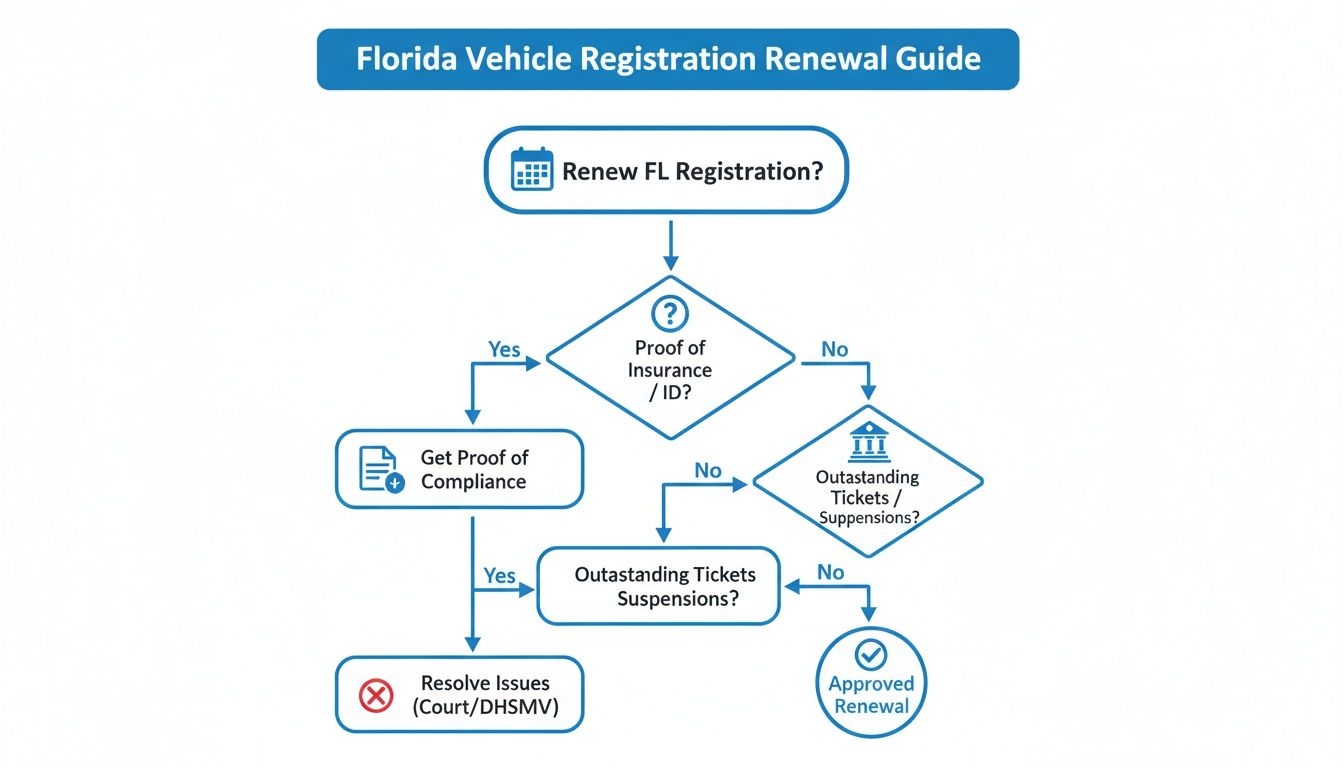
As you can see, it's a straightforward process: renew your registration, get the proof, and then present that proof. That final step is the key to resolving the issue.
What Changes at Six Months or More
Once the registration is expired by six months or longer, paying is usually the wrong default move. At that point, the case is a misdemeanor under Florida's statute. The safer route is usually to treat the case like any other criminal traffic charge: calendar the court date, preserve proof that you renewed, and prepare for a court appearance or legal representation.
Renewing still matters because it shows correction and may help negotiations or sentencing, but it does not automatically erase the criminal charge. That distinction is one of the most important on this page.
When Paying the Ticket Is a Bad Idea
Paying may be a poor choice when:
the tag was expired more than six months,
the county offers a dismissal route you have not explored yet,
the citation includes additional allegations you do not understand,
or the stop created a risk to your driving or criminal record that is larger than the fine itself.
For a criminal citation, "just pay it" can mean "just accept a conviction." For a civil citation, it can mean giving up a dismissal that might have been available for a smaller fee.
If the Stop Also Involved No Proof of Registration
If you were current later but did not have the registration document available during the stop, ask the clerk whether the ticket is an expired-registration case, a no-proof case, or both. Some drivers fix the expiration and assume the matter is over, only to learn there was a separate document-related citation still open.
Bring:
your renewed registration,
the receipt,
your insurance card,
your driver license,
and the citation itself.
If the paperwork on the ticket is confusing, our guide on a no registration criminal citation explains why document issues can turn into something more serious than drivers expect. Making the right decision here is critical, as past results don't guarantee future outcomes. Talking to an attorney can help you figure out the strongest strategy for your specific case.
When to Consider Assistance from a Traffic Attorney
A simple ticket for a tag that’s a few weeks out of date might feel like something you can handle on your own. But the game changes completely once that citation crosses into criminal territory.
A charge for a registration expired over six months isn't just a ticket. It's a second-degree misdemeanor, a criminal offense that can leave you with a permanent record.
This is the exact point where getting help from a law firm that focuses its practice on traffic defense goes from a good idea to a necessity. Going through the criminal court system alone is stressful, confusing, and full of pitfalls. Our goal is to take that burden off your shoulders, save you time, and work to protect your license and your record.
When a Misdemeanor Demands a Strategic Defense
With a criminal citation, you don't have the option to just pay a fine and move on. Paying it is an admission of guilt, resulting in a conviction. Avoiding that conviction becomes the single most important goal.
Our firm’s approach starts the moment you hire us. We dig into the details of your citation and the specific circumstances of the traffic stop. From there, we represent you in court, handling every communication and appearance so you don't have to.
This is especially critical in areas where local enforcement campaigns can lead to a flood of tickets for residents. For example, some Florida cities issue thousands of these citations a year. If they go unresolved for months, the consequences escalate from fines to having your vehicle towed, which tacks on hundreds more in fees.
Attorney Advertisement: This article is for informational purposes. Submitting information through our website forms does not create an attorney-client-relationship. Our practice handles traffic and DUI defense matters across Florida from our office in Broward.
How We Can Help With Your Case
Our focus is on finding the best possible path to resolve the criminal charge against you.
We work to uncover any potential defenses and enter into negotiations with the prosecutor, always aiming to secure a favorable outcome for your specific situation. Whether that means pushing for a complete dismissal, getting the charge reduced, or finding an alternative solution, we manage the legal heavy lifting.
It can be tough to know if you really need a lawyer. To make it clearer, we put together a guide that answers the question, do I need a lawyer for a traffic ticket?
We offer a free consultation to go over the details of your expired registration ticket and explain your options. Remember, past results do not guarantee future outcomes.
Common Questions About Florida Expired Tag Tickets
Getting pulled over for an expired tag can leave you with a handful of questions and a whole lot of uncertainty. Let's clear up some of the most common concerns Florida drivers have after receiving a citation.
This information is for educational purposes and should not be considered legal advice. This is an attorney advertisement. Office in Broward.
Does an Expired Registration Ticket Go on Your Driving Record?
Usually, an expired registration citation for less than six months is treated as a non-moving infraction, which means it generally does not carry points. If you renew and the clerk dismisses the case on proof of compliance, that is usually the cleanest result because the matter is closed without the same record consequences as paying it.
A registration that was expired for six months or more is different. Under Fla. Stat. 320.07, that offense is a misdemeanor. If you are convicted, the issue is no longer just a traffic record question—it can create a criminal record.
Does It Add Points to My License?
For the standard civil version of this ticket, points are generally not assessed because it is a non-moving violation. That is one reason drivers should not confuse an expired tag with a speeding ticket or other moving offense.
The more serious six-month-plus case carries bigger risks than points. The main danger is the criminal conviction itself, along with any sentence imposed by the court.
Can My Insurance Go Up Even if There Are No Points?
Yes, it can. Points are a licensing concept; insurance pricing is an underwriting decision. A civil expired tag case may not carry points, but an insurer can still consider your overall driving and compliance history at renewal. Repeated administrative violations may look different to different carriers.
Many online explanations oversimplify the issue. "No points" does not always mean "no insurance effect." It just means the state is not assessing license points for that citation.
Can I Get the Ticket Dismissed After I Renew?
If the registration was expired for less than six months, often yes. Florida law allows dismissal of the civil citation after proof that the registration was brought current, and county clerks commonly process that if you act by the stated deadline and pay any required compliance fee. Check the county clerk's instructions carefully because documentation rules vary.
If the registration was expired six months or more, renewal is still important, but it does not create the same automatic clerk-dismissal path. That case usually has to be resolved in court.
What Happens If I Ignore the Ticket?
Ignoring the ticket is one of the fastest ways to turn a manageable problem into a license problem. For a civil citation, missing the response deadline can lead to additional consequences, including license suspension steps through the court and FLHSMV process. For a criminal citation, failing to appear can trigger far more serious court action.
An expired registration ticket can be more complicated than it looks, especially when it crosses into criminal territory. Don't put your license or your record at risk. The team at Ticket Shield, PLLC is here to help you understand your options and work toward the best possible outcome. For a free, confidential consultation, visit us at https://www.ticketshield.com.