Motorcycle Speeding Ticket Defense: Your 2026 Florida Guide
Need motorcycle speeding ticket defense in Florida? Discover 2026 strategies to protect your license and reduce fines. Act fast!

You saw the lights. You pulled over. The officer walked up already assuming the bike, the speed, and the story. That moment hits differently when you're on a motorcycle. You're exposed, easy to single out, and one bad decision after the stop can follow you for years.
If you're thinking about just paying the ticket, stop. In Florida, paying a speeding ticket is a guilty plea. For a rider, that's often the worst move you can make. Motorcycle speeding ticket defense isn't generic traffic work. It requires someone who understands how officers clock bikes, how radar and LIDAR can misread a narrow target, and how visual speed estimates break down when the vehicle is a motorcycle.
Table of Contents
That Ticket Is More Than Just a Fine
A motorcycle stop is never just paperwork. The officer has less body around the rider to track, a faster visual approach to interpret, and often a split-second observation to turn into a charge. That creates risk before you even look at the citation.
What makes this worse is how many riders underestimate the consequences. They focus on the fine. They miss the record impact, the insurance fallout, and the negotiating power they give away the second they pay it. If you're trying to figure out the immediate cost, review this breakdown of how much speeding tickets can cost in Florida. Then remember that the listed amount on the citation is usually the smallest part of the problem.
Why motorcycle cases are different
Motorcycles create problems for enforcement that cars don't. Your bike has a smaller profile. It can be harder to isolate in traffic. It accelerates quickly, and officers often rely on brief observations they later present as certainty.
That means a real defense isn't built around excuses. It's built around pressure points in the state's proof.
Vehicle targeting issues: A bike can be confused with another vehicle in adjacent lanes, especially in dense traffic.
Profile-related detection problems: The smaller reflective surface matters when radar or LIDAR is used.
Assumption bias: Officers often fill gaps in their observation with conclusions about speed, noise, or riding style.
Practical rule: Never treat a motorcycle speeding ticket like a routine errand. Treat it like a record-protection problem from day one.
Paying the ticket helps the state
Once you pay, the case is effectively over. You don't get discovery. You don't test the officer's memory. You don't examine the speed-measuring device. You don't force the court to make the state prove anything.
That is why legal guidance isn't optional in a serious rider case. A strong defense starts before any court date. It starts with preserving your options.
Understanding Florida Speeding Laws for Riders
Florida gives officers a legal framework. Your defense starts by understanding exactly where the state thinks its case is strongest. In most speeding cases, that foundation is Florida Statute § 316.187.
The hard cap on limited access highways
Under Florida Statute § 316.187(2)(b), the maximum allowable speed limit on limited access highways is explicitly set at 70 miles per hour, and exceeding this limit constitutes a moving violation. That matters on roads like I-95, I-75, and the Turnpike because it removes the common “reasonable speed” argument once you're over that posted maximum.
If an officer says you exceeded that threshold, your defense shouldn't be built on “I was keeping up with traffic” or “the road was open.” Those arguments usually go nowhere. A serious defense attacks identification, measurement, procedure, or proof.
What riders misunderstand about reasonable speed
Florida Statute § 316.187 also includes “reasonable and prudent” language, but that doesn't give you a free pass to exceed the maximum speed limit. The statute doesn't rescue a rider who says speeding was necessary because of road conditions or a momentary hazard. Above the posted maximum, that argument is weak.
Your strongest legal path is usually one of these:
Challenge the speed reading itself
Challenge whether the officer identified the correct vehicle
Challenge whether the stop and citation were properly documented
Why this matters before you choose a strategy
Riders often mix up equipment rules, licensing issues, and speeding law. Keep them separate. If you're unsure whether your endorsement status adds another problem to the stop, read this explanation of whether you need a motorcycle endorsement in Florida.
And if you ride other two-wheeled vehicles too, this guide to Florida electric bike rules is useful for understanding how Florida treats different categories of bikes on public roads.
The state wins when you argue fairness. You gain traction when you argue proof.
The True Cost Points Insurance and License Suspension
Paying a motorcycle speeding ticket can stain your record long after the fine is gone. Riders learn that too late, usually when the insurance renewal shows up or the DMV sends a suspension notice.
That is the trap. The state closes the case fast. You keep paying for it.
Florida attaches points to moving violations, and those points can trigger license suspensions if they stack up. If you want the exact breakdown for a speeding charge, review this guide on Florida speeding ticket points.
Why riders get hit harder
A motorcycle stop is rarely viewed in a neutral way. Officers often describe a rider as aggressive, weaving, or accelerating hard, even when traffic conditions were mixed and vehicle identification was less clear than they claim. That matters here because the insurance company does not see the road. It sees the conviction.
One conviction can create three separate problems at once:
Points on your license
Higher insurance premiums
A shorter runway before suspension if you get stopped again
If you ride to work, ride year-round, or already have points, this is not a small administrative hassle. It is a record problem, a money problem, and a mobility problem.
The thresholds that change the case
Some speeding allegations carry more risk than riders expect.
Speeding 15 mph or less over the limit: usually 3 points
Speeding more than 15 mph over the limit: usually 4 points
Accumulating 12 points in 12 months: 30-day suspension
Accumulating 18 points in 18 months: 3-month suspension
Accumulating 24 points in 36 months: 1-year suspension
The Florida Highway Safety and Motor Vehicles department explains the state's point suspension thresholds and driver license consequences.
Then there is the court issue. A charge alleging 30 mph or more over the limit usually requires a court appearance in Florida. A claim of 50 mph or more over the limit can expose you to much steeper penalties under Florida law, including a required appearance and a much more serious negotiation posture.
What riders miss when they “just pay it”
Motorcyclists often get generic online advice built for drivers in sedans. That advice overlooks the fundamental danger. Your case is not only about speed. It is about how the stop gets framed, how the officer identified your bike, and whether the final result gives your insurer and the state a clean conviction to use against you.
Outcome | Paying the Fine (Pleading Guilty) | Hiring a Lawyer with Ticket Shield |
|---|---|---|
Immediate result | Fast resolution, permanent record risk | Early case review before you lock in damage |
Points risk | Points are imposed if the charge stands | Defense can pursue a reduction, withhold, or dismissal |
Insurance impact | Insurer prices the conviction, not your explanation | A lawyer works to protect the record insurers look at |
Court posture | You accept the officer's version | You challenge proof, identification, and procedure |
Long-term cost | Short-term convenience, ongoing fallout | Focus on protecting your license and future rates |
Professional legal guidance is not optional if points put your license or insurance at risk. The right question is not whether you can pay the ticket. The right question is whether you can afford the conviction.
Strategic Defenses Against Radar and Officer Error
Most riders lose because they argue the wrong case. They explain. They apologize. They talk about traffic flow. None of that fixes bad measurement or weak observation.
A strong motorcycle speeding ticket defense goes after the state's evidence.
Attacking the machine
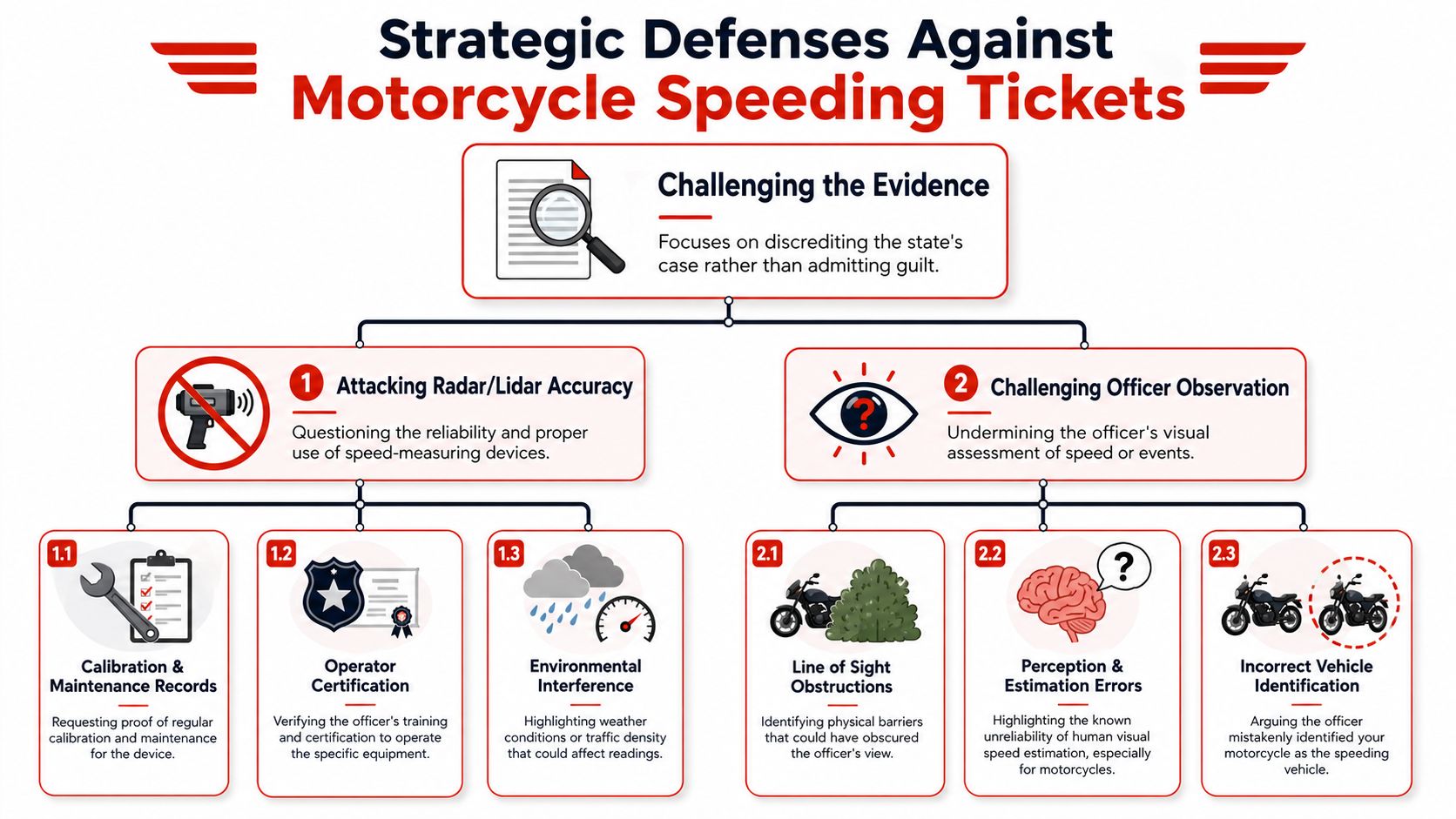
A primary technical defense involves challenging radar calibration. Motorcycles present a smaller reflective surface, increasing the risk of misidentification. If the laser, or LIDAR, beam hold time, often 0.5-1.0 seconds, isn't met due to rapid acceleration, the reading can be inadmissible, as discussed in this analysis of realistic speeding ticket defense strategies.
That matters because officers often assume the device is right if it flashes a number. Court doesn't work that way. The reading has to be reliable.
Where the state gets vulnerable
Use this plain-English overview of how radar speed guns work so you understand what your lawyer is attacking.
Then focus on the weak points:
Calibration records: The device should have proper certification and maintenance history.
Operator training: The officer must know how to use that specific unit correctly.
Target isolation: On a motorcycle, narrow profile and surrounding traffic can create confusion about which vehicle produced the reading.
Cosine and alignment issues: If the angle is off, measurement problems follow.
Beam hold time: A quick lane change or hard acceleration can disrupt a valid LIDAR lock.
Officer observation fails too
Machines don't testify alone. Officers add narrative. That's where many bike cases break open. If the officer didn't have a clean line of sight, confused your motorcycle with another, or made assumptions based on sound and approach angle, the state has a proof problem.
Good defenses don't beg for mercy. They force the officer to explain details most tickets never survive.
Evidence Collection and The Courtroom Process
Once you've decided to fight, the next move is evidence. Not your memory alone. Not a general complaint about being targeted. Actual evidence.
What you should preserve immediately
If you have it, save everything now. Don't wait until the court date is close.
Helmet cam footage: Preserve the original file, not a clipped social post.
Bike-mounted camera footage: Keep the full segment before and after the stop.
Photos of the roadway: Lane layout, signage, curves, visual obstructions, and traffic conditions matter.
Your written recollection: Note where the officer was positioned, what other vehicles were nearby, and what the officer said.
Citation details: Check for mistakes in location, speed allegation, vehicle description, or statute citation.
Why visual estimation is attackable
Defense attorneys can counter an officer's visual speed estimation, which has a 15-20% higher error rate for motorcycles compared to cars according to National Institute of Justice data, as described in this traffic ticket defense overview. That pushes the prosecution to prove the officer's qualifications and the device's accuracy.
This point is especially strong in motorcycle cases. Bikes don't present the same width cues as cars. Officers can misjudge distance, closing speed, and target identity.
What happens in court
Court isn't just a date on the ticket. It's a sequence of strategic choices.
Review the charge carefully. Your lawyer identifies whether the allegation, statute, and facts line up.
Demand the underlying proof. That may include officer notes, calibration material, and available video.
Assess negotiation value. Some cases should be pushed hard. Others should be reduced before the state fixes weak spots.
Challenge admissibility and credibility. If the reading or the observation doesn't hold up, the negotiating position changes.
Bring facts, not feelings. Judges hear explanations all day. They respond to flaws in proof.
In many cases, the right legal result is one that protects the record and keeps points off your license. That's why courtroom preparation matters. Riders who show up alone often argue the stop. Lawyers argue the evidence.
Why a Lawyer-Led Defense Crushes Automated Apps
You get pulled over on your bike, the officer says the radar caught you, and by that night an app is promising a fast fix for a small fee. That pitch is built for convenience, not protection. Motorcycle cases in Florida are too exposed for that.
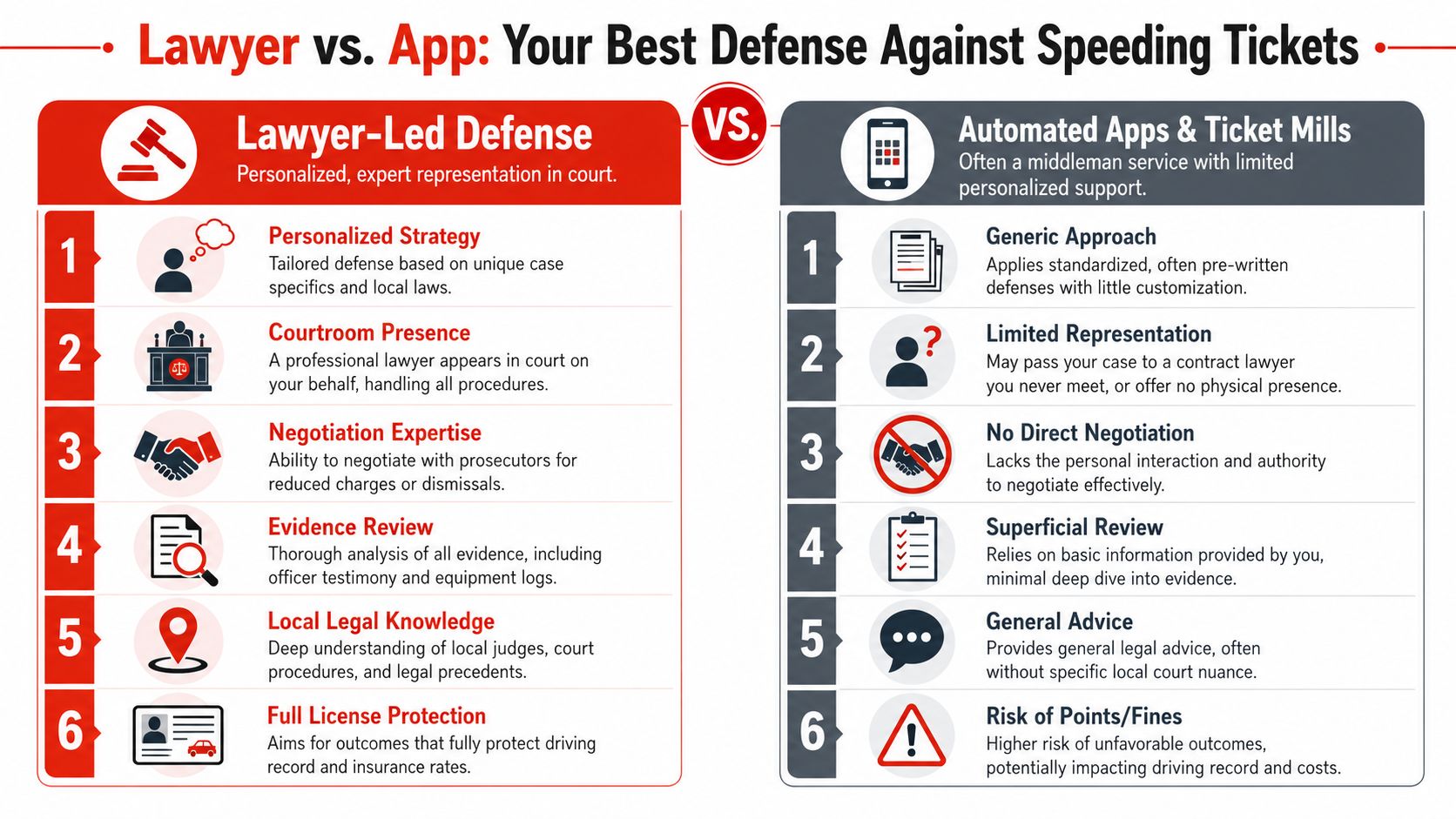
Riders deal with problems generic ticket services do not handle well. Officers often form quick impressions about motorcycles. Speeding. Aggressive riding. Risk-taking. Those assumptions can shape the report, the stop, and the prosecutor's view of the case before anyone examines whether the reading was tied to your bike at all.
Apps do not fix that. They process volume. They collect basic information, route files, and push standard responses. A motorcycle speeding defense needs a lawyer who can spot issues unique to bikes, including target misidentification, poor visual tracking in traffic, bad lane positioning for a clean reading, and officer bias that turns a weak stop into an overcharged one.
If you are weighing your options, read this explanation of why choosing a local lawyer over apps matters in traffic court.
A real lawyer makes judgment calls that software cannot make.
Your lawyer looks for the pressure point. That may be a bad radar foundation, a weak visual estimate, inconsistent notes, or facts that support a reduction before the state tightens its case.
Your lawyer deals with how riders are perceived. That matters. A polished legal presentation can defuse the assumption that the motorcycle itself proves reckless behavior.
Your lawyer works the local court, not a script. Prosecutors, judges, filing practices, and hearing habits vary. Local experience changes outcomes.
Your lawyer protects the result that matters. The goal is not a prettier ticket. The goal is protecting your license, your insurance, and your record.
Florida law treats higher-speed allegations more seriously, and some charges trigger a required court appearance. That is exactly why strategy matters early. In the right case, lowering the charged speed or changing the disposition can protect you from consequences that an app will not even explain clearly. You need a lawyer who sees the charging threshold, the proof problem, and the best exit.
Motorcycle cases are not clerical work. They are credibility fights.
A software workflow cannot cross-examine an officer's assumptions about your bike, challenge whether the device tracked your motorcycle, or make a sharp record in front of a judge. A lawyer can, and that difference is often the whole case.
A motorcycle speeding ticket is not a form to submit. It is a threat to your record that needs a lawyer-led response.
Take Control Now Get Your Free Consultation
You don't have unlimited time to make this right. The wrong move is usually the fast move. Paying the ticket feels easy. It's also how riders lock in points, insurance trouble, and avoidable damage to their record.
Handle this like it matters, because it does. If the allegation is serious, the state already has momentum. You need a defense built around the specific stop, the specific device, and the specific weaknesses in the officer's proof. That's how riders protect their license and avoid turning one citation into a long financial problem.
Professional guidance isn't a luxury in a motorcycle speeding case. It's the difference between reacting and defending. It's the difference between hoping for mercy and forcing the state to prove its case.
If you want the right outcome, focus on one objective. No Points on your license. That should drive every decision from this point forward.
Visit Ticket Shield, PLLC right now for a free consultation. Submit your ticket, speak directly with your attorney by phone or text, and fight for the result that matters most, No Points on your license.