
Motorcycle Speeding Ticket Defense: Beat Your Charge
Got a Florida motorcycle speeding ticket? Learn top 2026 motorcycle speeding ticket defense strategies. Protect your record & license. Get expert help now.

Yes. A motorcycle speeding ticket in Florida can often be challenged, and you should fight it fast. Paying it can put points on your license, raise insurance, and damage your record. Strong defenses often focus on radar flaws, officer error, and unfair biker-targeted enforcement.
You're probably reading this with the citation sitting next to you. Maybe the stop happened fast. You rolled past traffic, an officer lit you up, and suddenly a ride home turned into a legal problem. That feeling is common. So is the mistake riders make next. They treat the ticket like a simple bill.
It's not.
A motorcycle speeding citation in Florida can hit your license, your insurance, and your work. Florida is writing speeding tickets at a staggering pace. Speeding is the number one driving violation in Florida, and in 2025, nearly 1 million speeding tickets were issued statewide, a 29% surge from 2024's 744,000 citations, according to Florida speeding ticket enforcement trend data. Riders are in the crosshairs.
The answer isn't panic. It's strategy.
A serious motorcycle speeding ticket defense starts with one question. Did the officer prove your speed in a way that will hold up under Florida law? In many cases, the answer is weaker than you think. Radar records may be missing. LIDAR use may be flawed. The officer may have estimated speed instead of measuring it. Or the stop may have started over something else entirely, like your exhaust or lane position, and then turned into a speeding charge because “speeding” is easier to write.
Table of Contents
Your Guide to Motorcycle Speeding Ticket Defense in Florida
A motorcycle speeding ticket defense in Florida has to be aggressive from the start. Riders don't get the benefit of the doubt very often. Officers, prosecutors, and judges see speed cases every day. If you want a real chance at protecting your record, your defense has to focus on weaknesses in proof, not excuses.
Why this ticket is more serious than it looks
A lot of riders think the danger is the fine. It isn't. The fine is often the smallest part of the damage. A conviction can stay with you, affect your driving status, and create insurance trouble that lasts long after you've paid the citation.
Florida traffic law also gives the state a structure to punish speeding through Chapter 316. One important statute is Florida Statute §316.187, which governs lawful speed on many roads and helps define when excess speed turns into a much more serious court problem.
Practical rule: Never assume the officer's version is final. A speeding ticket is an accusation. It's not proof that survives scrutiny.
What a strong defense actually looks like
A useful motorcycle speeding ticket defense usually does one of three things:
Attacks the measurement by challenging radar, laser, calibration, or the officer's operation of the device
Attacks the observation by exposing visual estimation problems, traffic interference, or poor vantage points
Attacks the reason for the stop when the speeding charge looks like a pretext tied to a motorcycle-specific issue
This matters for riders in major Florida courts, whether your case lands near the Richard E. Gerstein Justice Building in Miami or another county traffic division. Traffic court moves fast. Good defenses don't.
If you just received a citation, your next move should be to preserve evidence, stop talking casually about the stop, and treat the case like a record-protection problem. Because that's exactly what it is.
What Are the Real Penalties for a Motorcycle Speeding Ticket
A lot of riders make the same mistake after a stop. They look at the fine, grumble, and pay it. That is how a manageable ticket turns into points, insurance pain, and a license problem.

How many points can one ticket add
Florida punishes speeding through points, not just money. A speeding conviction usually adds points to your license, and higher alleged speeds can add more. If you ride often, drive for work, or already have prior citations, that point hit matters fast.
Florida also suspends licenses based on total points in a set time period. According to Florida point system guidance tied to §§316.187 and 316.189, speeding 30 mph or more over the limit is a 4 point violation, and 12 points within 12 months can trigger a 30 day suspension. If you want a cleaner breakdown of how the state records these violations, read this guide to Florida speeding ticket points.
One ticket can also become the excuse for closer scrutiny later. That matters to motorcyclists because officers who already view a rider as aggressive often write the next stop harder, especially if the first citation stayed on the record.
When does speeding become more than a civil ticket
Some speed allegations force you into court. You do not get to treat those like a routine mail-in citation.
Florida Statute §316.187(2)(a) sets a maximum speed of 70 miles per hour on limited access highways, and going 50 mph or more above the limit requires a mandatory court appearance under §316.1926, according to the Florida statute text on speed limits. Once that happens, the case gets more dangerous. The judge sees the allegation before anyone has tested the officer's reading, the stop, or the motive behind the citation.
That last point gets ignored online. It should not. Riders in Florida often get stopped for something an officer already dislikes, loud exhaust, lane filtering behavior, weaving around slow traffic, or the general look of a sport bike. Then the stop grows into a speeding ticket built on a rushed estimate or a shaky reading. If you pay that ticket, you hand the state a clean conviction built on biker bias.
Paying the ticket is a legal admission. You give up defenses, accept the violation, and make the record damage official.
Why insurance is often the worst part
Insurance companies focus on convictions. They do not care that the road was open, the weather was clear, or the officer started the stop because he was irritated by your bike. Once the violation posts to your driving record, your carrier can price you as a bigger risk or make it harder to keep affordable coverage.
A speeding conviction can also stay on your Florida driving record for years. According to Florida record and dismissal guidance, a speeding ticket may remain on the record for up to five years, and getting rid of it usually requires fighting the case by challenging the evidence.
The fine is the smallest problem on the page. The primary threat is what the conviction lets the state, the court, and your insurer do after you pay it.
Was the Officer's Speed Reading Accurate
Officers often speak about radar and laser readings as if the machine settled everything. It didn't. The reading is only as good as the device, the testing, the operator, and the conditions at the scene.
What radar and LIDAR records matter
Radar and LIDAR devices must have a valid calibration certificate, typically issued within 30 to 60 days of the traffic stop. A key defense is proving the device was out of compliance or that environmental factors like rain or signal bounce from your bike's chrome created a false reading, according to technical guidance on speeding ticket defenses. If you want a plain-language explanation of the technology officers rely on, this overview of how radar speed guns work is worth reading.
There's a second layer most riders never request. If a citation is based on radar or laser, the case can be dismissed if the officer wasn't properly certified, if there is no record of shift testing, or if the device wasn't on the approved list of authorized speed-measuring equipment, according to Florida radar and laser defense grounds.
A strategic defense asks for the paperwork. Then it reads every line.
Why motorcycles create unique reading problems
Motorcycles don't reflect signals the same way larger vehicles do. Your bike is narrower. It has irregular surfaces. Chrome and nearby objects can interfere with the signal path. That matters because a device doesn't measure “you” in the abstract. It measures reflected data.
Here are common weak points:
Signal bounce: A reading can reflect off chrome, nearby vehicles, or roadside objects instead of locking cleanly onto your motorcycle
Angle issues: If the officer is positioned poorly, the reading may not represent your actual speed accurately
Weather interference: Rain, fog, and road debris can affect the signal and create room to question reliability
Traffic contamination: In a cluster of vehicles, the device may capture a different target than the officer claims
If the state can't prove the device was compliant and properly used on your motorcycle under those conditions, the number on the ticket isn't nearly as solid as it looks.
How Can Biker Bias Create an Invalid Speeding Ticket
Some motorcycle stops aren't really about speed at all. They start with attitude, appearance, noise, lane position, or an officer deciding your bike drew attention. Then the paperwork gets written as speeding because it's easier to process and harder for riders to challenge without preparation.
When a stop starts over something other than speed
This is where biker bias matters. Data shows Florida motorcycles receive 3x more citations per mile than cars in urban areas, yet 70% of these “speeding” tickets rely on legally vulnerable officer estimation rather than radar validation, often stemming from pretextual stops for exhaust or lane filtering, according to Florida motorcycle citation patterns and estimation-based speeding charges.
If your stop started with comments about your exhaust, your riding posture, your bike's appearance, or how you moved through traffic, don't ignore that. It may reveal the underlying motive behind the citation.
That's especially important in places like Fort Lauderdale, where cases move through the Broward County Judicial Complex and officer credibility often becomes central in traffic hearings. A judge may listen differently when the state's speed proof turns out to be subjective from the start.
Why officer estimation can be attacked
Florida cases based on visual estimation are not automatic wins for the state. They're vulnerable because they depend on memory, angle, distance, lighting, and the officer's training. When there's no independent radar or laser record, the defense can press hard on what the officer observed.
A good cross-examination can focus on:
Issue | Why it matters |
|---|---|
Officer position | A bad angle limits reliable speed observation |
Traffic volume | Nearby vehicles can distort visual judgment |
Initial reason for stop | If speed wasn't the first concern, the charge may be pretextual |
Time of observation | A brief glance is weaker than sustained tracking |
Device use | No radar or laser means the state leans heavily on opinion |
Riders get cited for what officers think they saw. Courts still require evidence that holds up when tested.
If your ticket came after a stop that felt personal, selective, or disconnected from actual speed measurement, that instinct may be right. It should be investigated, not brushed aside.
What Evidence Should You Collect to Defend Yourself
You can help your own defense immediately. Evidence disappears fast. Road conditions change. Signs get moved. Your memory softens. The officer's report gets cleaner with time. Yours won't unless you preserve it now.
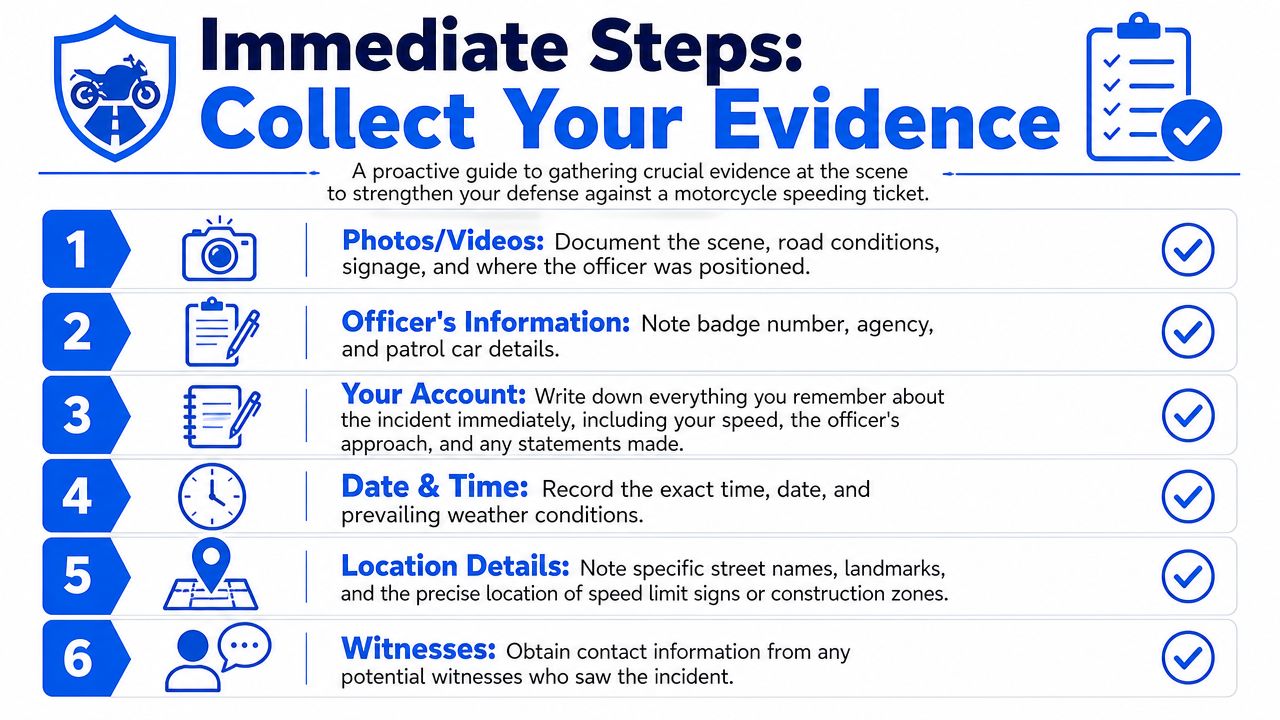
Immediate Steps to Take
Use this checklist as soon as possible. Then keep everything in one folder.
Save helmet-cam footage: Download and back up the full clip, not just highlights. If you need help understanding the citation details before you organize evidence, use this guide on how to read a traffic citation.
Photograph the scene: Get clear photos of speed limit signs, intersections, shoulder position, the officer's likely vantage point, and anything that blocked visibility.
Write your account immediately: Include your speed, lane position, traffic flow, what the officer said first, and whether the stop began with anything other than speed.
Record weather and road conditions: Rain, glare, congestion, debris, or poor sightlines can all support a technical challenge.
Identify witnesses: If anyone saw the stop or the road hazard that caused your movement, get names and contact information.
Preserve bike details: If chrome, fairings, or other features could affect signal reflection, photograph them before anything changes.
When necessity becomes a real defense
Sometimes your speed wasn't careless. It was reactive. A necessity defense is a valid strategy where you demonstrate your speeding was legally justified to avoid immediate harm, like swerving around a sudden road obstacle. Evidence like helmet-cam video or witness statements is essential to proving this in court, according to guidance on fighting traffic tickets with necessity evidence.
That defense works best when the evidence is concrete.
Preserve what the road looked like, not what you remember it looked like.
If a pothole, loose debris, a vehicle drifting into your lane, or another sudden danger forced you to accelerate or reposition, document it now. That's how necessity stops sounding like an excuse and starts looking like a legal defense.
How Will Your Case Proceed Through the Florida Courts
Most riders worry about court because they don't know what happens next. That uncertainty leads people to pay tickets they should fight. The process is more manageable when you understand the choices.
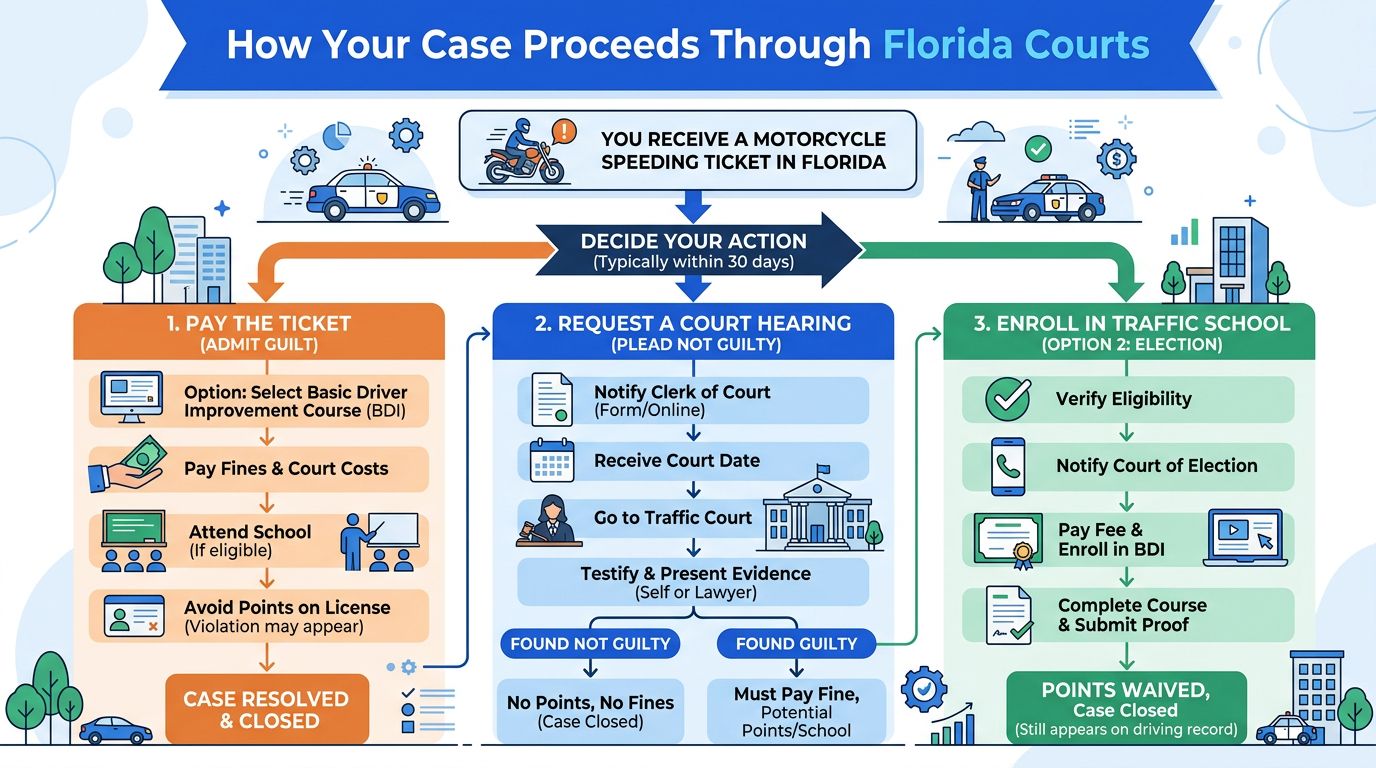
What are your three choices after the ticket
In Florida, you usually face three paths.
Pay the fine. This is the fastest option and usually the worst for your record because it amounts to admitting the violation.
Elect traffic school. This can help in some situations, but it isn't a cure-all. It still involves cost and may not solve the underlying record problem for every driver.
Contest the ticket. This is the only path that creates a genuine chance at dismissal or another outcome that protects your record more effectively.
If your case is set in Hillsborough County, for example, the process may run through the Edgecomb Courthouse in Tampa. That makes the case feel very real, very quickly. Court dates, filings, and procedural rules don't wait for you to get comfortable.
What happens when you contest the citation
When you fight the ticket, the case becomes about proof. The defense reviews the officer's affidavit, device records if any were used, and the legal sufficiency of the charge. You can learn the basics from this guide on what to expect in traffic court.
A contested case often involves:
Reviewing the citation for errors: Small mistakes don't always kill a case, but some mistakes matter
Demanding supporting records: Calibration, certification, and testing documents can become central
Evaluating negotiation options: Some cases can be resolved before hearing if the weaknesses are obvious
Preparing for a hearing: If needed, the defense challenges the officer's testimony and the state's evidence in front of the judge
There's one more point many drivers miss. For gig workers, “no points” may not be enough if the underlying violation still appears and affects platform eligibility. That's why the target outcome should be chosen carefully from day one.
Why a Lawyer-Led Defense Is Your Strongest Shield
A motorcycle speeding ticket in Florida rarely stays just a speeding ticket. One officer hears your exhaust, sees your bike, decides you were “riding aggressively,” and suddenly a subjective speed claim appears in the narrative. That is how biker bias creeps into a case, and it is exactly why riders get hurt by cheap, high-volume defense services.
Serious traffic defense requires legal judgment. A case can turn on missing calibration records, a weak visual estimate, a bad viewing angle, or a stop that started with irritation over the bike itself and ended with a speed allegation the officer cannot properly support.
Why direct attorney access matters
You should avoid automated apps and ticket mills. They sell convenience, but convenience does not expose a biased stop or a weak speed case. You get intake staff, recycled status messages, and surface-level handling when your defense needs someone who can spot why the officer focused on you in the first place.
A lawyer-led model gives your facts to the person who can put them to use. If the stop began with an exhaust complaint, if the officer mentioned lane filtering before mentioning speed, or if your helmet-cam shows the officer had a poor line of sight, your attorney needs that information immediately. Delay weakens defenses. Distortion kills them.
Riders who need a focused Florida speeding ticket lawyer should insist on direct communication. Phone and text access are not perks. They help build the defense before the state hardens its version of events.
The best motorcycle cases are often won by exposing why the rider was targeted before speed was ever seriously proven.
Why no-points alone isn't always enough
A no-points result can still leave you with damage. Insurance companies care about the underlying event. Employers care. Any rider with a commercial responsibility, a professional license, or a record that is already carrying risk should aim higher if the facts support it.
The right lawyer sets the target early. That may be dismissal. It may be a resolution that protects your record better than a quick plea ever could. The point is to match the outcome to the actual risk, not to push every rider into the same assembly-line result.
That takes strategy. Your attorney should examine whether the state can prove speed at all, whether the officer relied on estimation, whether the device records hold up, and whether biker bias infected the stop from the start. A rider cited near the Orange County Courthouse in Orlando, or anywhere else in Florida, needs a lawyer who reads the report closely, attacks the weak points, and refuses to let a stereotype do the prosecution's work.
The right motorcycle speeding ticket defense is personal, technical, and fast. It should feel like someone is protecting you, not processing you.
If you want a lawyer-led defense where you speak directly with your attorney by phone or text, skip the automated apps and ticket mills. Ticket Shield, PLLC handles Florida motorcycle speeding cases with a clear focus on protecting your license, insurance, and record. Visit TicketShield.com for a free consultation and fight for the NO POINTS outcome.
