Martin County Traffic Ticket Guide for Florida Drivers
Got a Martin County traffic ticket? Learn the 30-day deadline, your pay-or-contest options, court contacts, and how to keep points off your license.

You got pulled over in Martin County, maybe on US-1, I-95, Kanner Highway, or leaving Stuart at the wrong time with flashing lights in your mirror. The paper the deputy handed you is not a receipt and it's not a parking ticket. It is a legal deadline that starts running the day the citation is issued, and what you do next can affect points, insurance, and your license for years.
A Martin County traffic ticket should be treated like a time-sensitive case file, not a bill to shove in a drawer. The Martin County Clerk's official guidance says you generally have 30 days from the citation date to choose an approved resolution, and missing that window can trigger a late fee and possible license consequences (Martin County Clerk Traffic Citation Guide). If you wait, you shrink your options. If you act early, you keep control.
Table of Contents
What Just Happened on Martin County Roads
You were stopped, the officer wrote the citation, and the clock started. That is the part drivers miss. In Martin County, the citation date controls your options, not how irritated you feel or how fast you can pay.
Treat the citation like a legal notice
The clerk's rules make the timeline plain. You do not get to delay the decision because life is busy, the stop happened on a holiday weekend, or the portal has not updated yet. The county says to allow 5 to 7 days for the citation to be received and processed, but the 30-day deadline runs from the citation date, not from the date you first see it online (Martin County Traffic Citation Guide).
That deadline matters because the wrong move at the wrong time can cost you. Pay too soon, and you may lock in a conviction. Miss the deadline, and you invite fees and suspension risk on top of the ticket. For a concrete example of deadline pressure handled well, review this Palm City result.
Practical rule: Stop asking, “What is the fine?” Ask, “What decision do I need before day 30?”
The charge also has statutory weight. Florida's traffic code gives the state authority to regulate speed zones and speed violations through Florida Statutes 316.187, 316.183, and 316.189 (Florida Chapter 316 index). That means the exact statute number on the face of the ticket matters. It can change your point exposure and the way you should handle the citation.
A Martin County traffic ticket is a deadline problem first. The fine is only one part of the decision. If you want a quick framework for a traffic stop in Florida, this overview explains why the first choice carries so much weight.
The Three Resolutions on Every Martin County Citation

A Martin County citation gives you three paths, and only one of them is right for your situation. You can pay it, elect school if the charge qualifies, or ask for a hearing. The mistake is treating those choices like they all mean the same thing.
Pay, school, or hearing
Pay the civil penalty only if you are ready to accept the conviction and the record impact that comes with it. It is the fastest administrative move, and it is often the most expensive in the long run.
Elect a driver-improvement course if the violation is eligible and you want to protect your record. Florida allows this option when it is properly elected and completed under the rules, and the Florida driver-improvement course FAQ explains the basic process.
Request a hearing if you want to fight the citation or if the facts give you a real defense. That is the path for disputed stops, bad officer observations, and citations that carry more risk than a quick payment is worth.
A citation is a record problem first. The fine is only the price tag.
The statute number on the ticket can change the strategy. A speeding citation under 316.187, 316.183, or 316.189 is not just a generic ticket label, and the exact section matters because it affects how you assess the exposure and the next move. The Chapter 316 index is the place to confirm what the statute number means before you choose a path.
If you want a plain-English explanation of how Florida traffic tickets are handled, this guide to Florida traffic tickets gives the bigger picture without the legal fog.
First-Week Actions Before the 30-Day Clock Expires
The first few days after the stop are for cleanup, not guessing. If you're in Stuart, Indiantown, Palm City, or anywhere else in Martin County, your job is to preserve the citation, verify the charge, and stop yourself from mailing money before you know what you're doing.
Lock down the facts immediately
Start with the citation itself. Photograph it, save the original, and read every line. You need the citation date, the statute number, the court location, and the due date. If the ticket is hard to read or the paper gets misplaced, you've created your own problem.
Then check your driving history. The Martin County Clerk says drivers can obtain license-history records showing accumulated points, and the clerk charges $14.25 for a three-year driving-history printout and $16.25 for a complete history (Martin County Clerk FAQ). That record tells you whether this ticket lands on a clean slate or pushes an already fragile license closer to trouble.
Keep every piece of proof. If you mail anything, save the receipt and the tracking info. If you submit online, save the confirmation screen. If you speak with the clerk, write down the date, time, and name of the person who helped you.
A good checklist looks like this:
Preserve the citation: Don't toss it, and don't rely on memory.
Confirm the statute: The number tells you what law the officer used.
Identify the court location: Martin County processes citations through its traffic division.
Request your driving record: You need to know whether points already exist.
Decide before you submit: Once money or an election is sent, you may narrow your options.
The clerk also says mailed payments generally need an eligible check or money order, not cash or card. That's a common failure point because people assume “sent” means “received.” It doesn't. Delivery time can eat into the deadline.
The county's own traffic guidance explains the workflow and the accepted channels, including online, phone, in person, and mail (Martin County Traffic Citation Guide). If you're thinking about fighting the ticket, checking eligibility, or making sure your paperwork is right the first time, this resource is a smart next stop.
Don't let paperwork outrun the deadline
Bottom line: A missing form can hurt you as much as a bad court date.
The hardest mistake is assuming that a mailed payment or election is enough because you dropped it in the mail. The clerk has to receive the required item within the deadline. If that doesn't happen, the county can treat the matter as missed, even if you acted in good faith.
Use the first week to prepare, not to procrastinate. If you're going to contest the citation or elect school, you need the paperwork cleaned up before the 30-day clock runs out.
Paying the Fine Versus Contesting in Martin County
You got stopped in Stuart or Indiantown, and now the clock is running. The citation is not just a bill. It is a deadline problem, and what you do before the 30-day window closes can change whether the stop turns into points, a court date, or a clean resolution.
The published speeding schedule is only the starting point
Martin County's published speeding schedule lists $128 for speeding 6 to 9 mph over, $203 for 10 to 14 mph over, $253 for 15 to 19 mph over, and $278 for 20 to 29 mph over, with mandatory court at 30 mph or more (Martin County Traffic). That is the sticker price. It is not the full cost of doing nothing.
Paying fast can look efficient, but it can also lock in the conviction that hurts you later. A moving violation can affect insurance, and some charges carry point exposure that matters more than the fine itself. If the statute number on your ticket puts you in a higher-exposure category, you need to treat the citation as a license problem, not a parking receipt.
Martin County Speeding Fine Schedule Versus Hidden Costs | |||
|---|---|---|---|
Speed Over Limit | Civil Penalty | FL Points | Typical Insurance Impact |
6 to 9 mph | $128 | 3 points | Can rise for years after conviction |
10 to 14 mph | $203 | 3 points | Can rise for years after conviction |
15 to 19 mph | $253 | 3 points | Can rise for years after conviction |
20 to 29 mph | $278 | 3 points | Can rise for years after conviction |
30 mph or more | Mandatory court | 4 points under higher-exposure statutes | Needs individualized review |
The decision is simple. Paying ends the case quickly, but it also accepts the result. Contesting gives you a chance to attack the charge, the speed measurement, or the way the stop was written before the deadline closes. A conviction that should have been challenged can cost more than the fine, especially once insurance enters the picture (TicketShield insight on traffic-ticket costs).
If the citation can be handled without points, that deserves serious attention before you hand over the money.
A ticket that sends you to mandatory court needs a lawyer's review, not an automatic payment. The same is true if your driving record already has old points on it. At that point, you are not deciding whether to pay one citation. You are deciding whether to protect the license you already have.
Traffic School Eligibility and How to Elect It Correctly
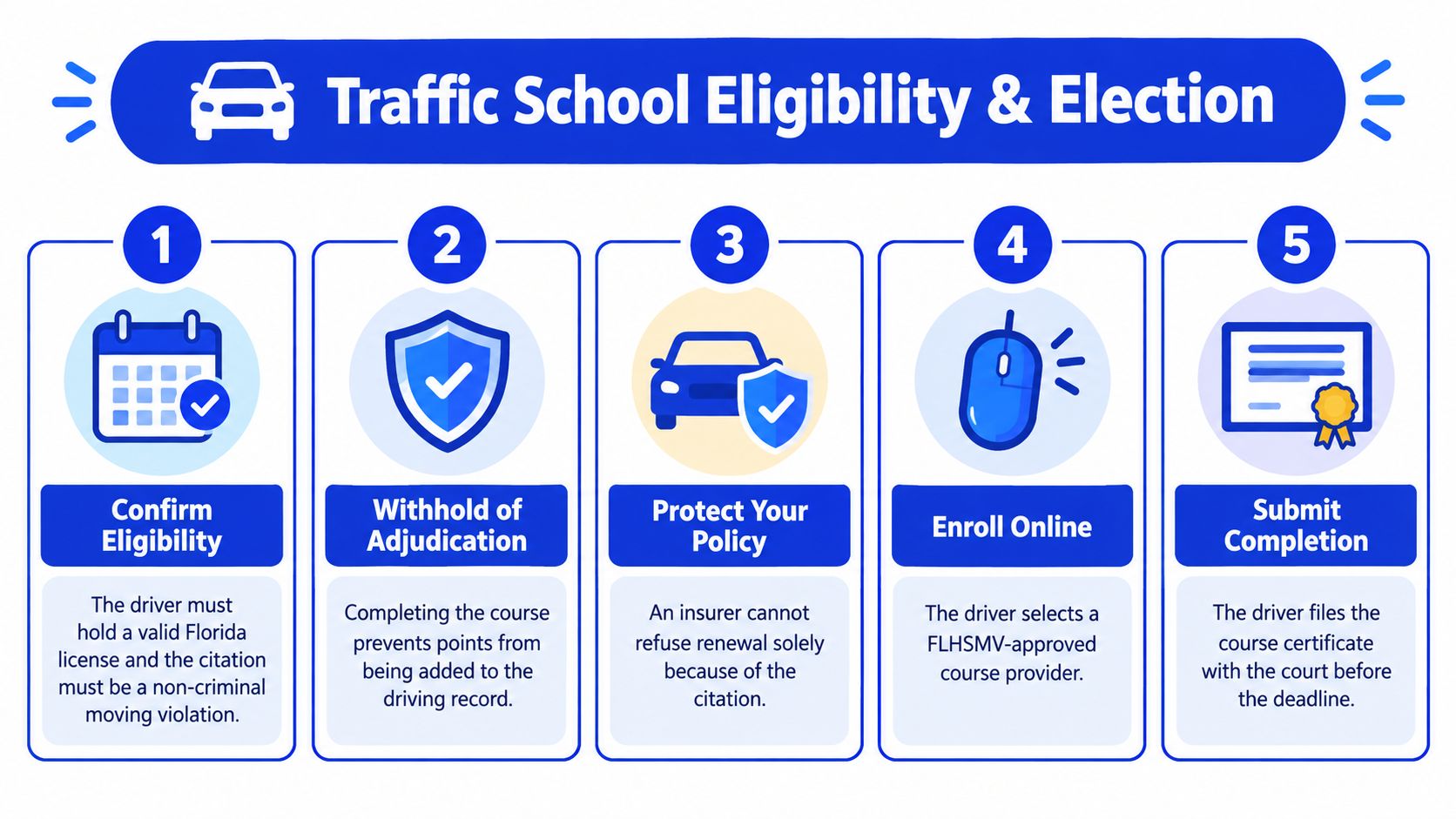
Driver-improvement school is the best exit when it is available and chosen correctly. The trap is treating eligibility as automatic or assuming the class alone protects your record.
The election has to be done on time
Use the course only if the citation qualifies and you elect it before the clerk's deadline. The election is filed with the clerk, not with the course provider. Martin County's traffic citation instructions explain the local process, including the clerk's accepted submission channels for the election form and payment.
Once the election is made, finish an approved course by the court's deadline and make sure the completion record reaches the clerk. If you miss either step, you can lose the benefit you were trying to protect.
The common mistake is simple. Drivers sign up for class and stop there. That does not complete the election. Others finish the course and assume the clerk already has proof. That is a bad assumption. If the citation is not eligible, or if it is a criminal charge, traffic school is off the table.
Eligibility is narrow for a reason
The citation itself controls the choice. If the charge is not one that can be elected for driver-improvement school, the course will not help. If you miss the court deadline, the election can turn into an admission with a conviction attached. That is the point where a deadline problem becomes a license problem.
For a clear walkthrough of how traffic violator school works, this guide is useful.
Keep the completion certificate, the payment proof, and the clerk confirmation. If anyone questions the election later, your file should answer it fast.
Points, Suspensions and the Long-Term Cost to Your License
A Martin County citation can hurt long after the stop ends. The ticket turns into a deadline problem first, then a license problem if you ignore what the charge says. The statute number, the speed alleged, and your driving history all affect what happens next.
The statute number changes the exposure
Florida's point schedule treats a standard speeding violation as 3 points, but a violation under 316.187, 316.183(2), or 316.189 involving speed more than 50 miles per hour carries 4 points (Florida point schedule). That difference matters. Two tickets that both say “speeding” can carry different point exposure depending on the statute printed on the citation.
Read the citation like a deadline notice, not just a fine. If the officer wrote a higher-exposure statute, your point risk changes before you ever mail anything back. See our breakdown of how Florida driver license points accumulate and trigger suspensions.
A clean record can absorb more than a damaged one. Once prior violations are already in play, a conviction can push you toward driver-improvement school or suspension pressure, and your insurance can take the hit too (TicketShield insight on insurance impact). Paying quickly does not erase that problem.
If you are trying to renew your license and need to handle vision requirements at the same time, the eye exam for license renewal resource from Style Site Optical can help you line up that piece before the deadline closes in.
Watch for this: If the ticket cites a higher-exposure speeding statute, do not treat it like a simple payment case.
Mandatory school and suspension risk are warning signs
When the citation points toward school you did not expect, or when the likely point total looks too high for your record, stop and reassess. Check the driving history, read the exact statutory charge, and measure the insurance risk before you make the wrong move.
I would rather see a driver spend time checking the statute and the record than spend years carrying a bad conviction. That is how a deadline problem becomes a license problem in Florida.
Why Ticket Shield Handles Martin County Tickets Differently
Most drivers don't need a call center. They need a lawyer who can read the citation, spot the deadline, and tell them what to do before the clock runs out. That's where the difference is.

Direct lawyer contact beats ticket mills
Ticket Shield, PLLC handles Florida traffic citations statewide, including Martin County, and the firm's model is lawyer-led. Clients communicate directly with their attorney by phone or text, not through a chain of middlemen or an automated app. That matters when a 30-day deadline is already moving.
The practical value is simple. You send the ticket, the attorney reviews the charge, and the firm handles the filings and court process when appropriate. That's a cleaner approach than getting shuffled through a corporate intake system while the deadline keeps running.
Ticket Shield also serves all 67 Florida counties, and the firm says more than 99% of its clients never appear in court. That makes sense for drivers who want a controlled, low-friction resolution rather than a public court appearance that could have been avoided with the right strategy.
If you're weighing options, use a lawyer-led firm, not a ticket mill pretending to be a shortcut. A flat-fee, value-driven arrangement is easier to plan around than uncertainty, especially when the goal is protecting your record and avoiding points.
Visit Ticket Shield, PLLC for a free consultation and take the first step toward a No Points outcome on your license.