Manatee County Speeding Ticket: How to Fight and Win
Got a Manatee County speeding ticket? Learn how to fight it, protect your record, and pursue No Points. Get a free consultation with Ticket Shield today.

You have 30 calendar days from the issue date of a Manatee County speeding ticket to pay, plead not guilty and request a hearing, or elect Basic Driver Improvement. Paying without electing eligible traffic school is an admission of guilt that results in points.
You're sitting in your car in Bradenton or Palmetto, reading the citation while the officer pulls away. Before you reach for your credit card, slow down. Your next decision should protect your driving record, not just get the paperwork off your dashboard.
Table of Contents
What Just Happened on a Manatee County Road
The lights came on along SR-64, Cortez Road, or US-41. You pulled over, handed over your documents, and left with a citation you may not fully understand. The immediate priority is identifying what you received and preserving your options.
An officer-issued Florida Uniform Traffic Citation isn't interchangeable with a mailed school speed-zone camera notice. Look at the document's title, issuing agency, alleged violation, and response instructions. Don't assume every document mentioning speeding belongs in the same payment system.

Preserve the Details Before They Fade
Your memory of the stop is useful now. Write down where you were traveling, which direction you were headed, what the officer said about measuring your speed, and whether traffic or signage affected your view.
Save the citation: Keep the original and a readable digital copy, including the reverse side.
Record the issue date: Use the date on the citation, not the day you finally open a reminder.
Document the location safely: Photograph relevant signs and roadway conditions without stopping somewhere dangerous.
Preserve your own footage: Save dashcam recordings before your device overwrites them.
Keep the discussion private: Don't turn your explanation into a public social-media post.
The Manatee County Clerk's traffic instructions establish the 30-calendar-day response window and require a written not-guilty request to reach the Clerk within that period. That's a filing deadline, not permission to wait until a future hearing date.
Immediate priority: Keep the paperwork, preserve the evidence, and choose your response before paying anything.
If you live outside Florida, don't treat the distance as a reason to postpone action. Preserve proof of every submission and ask how your case will be handled before making travel arrangements. You need a documented response, not an assumption that someone received your paperwork.
The Law Behind Your Citation
Read the statute number before deciding how to defend the ticket. The legal allegation matters more than the officer's shorthand description of the stop.
Florida Statutes Sections 316.187 and 316.183 address different aspects of speed enforcement. Section 316.187 governs the establishment and enforcement of state, county, and municipal speed limits, with violations treated as moving violations punishable under Chapter 318. Section 316.183 prohibits driving faster than is reasonable and prudent under existing conditions and hazards.
Don't confuse those standards. A defense should address the statute cited, the alleged speed, the applicable limit, and the evidence connecting your vehicle to the allegation.

Match the Allegation to the Fine Schedule
The Manatee County Clerk's official traffic-fine schedule lists the following standard speeding penalties, including a mandatory appearance instead of a simple published payment amount at the highest band shown.
Alleged speed above the limit | Standard listed civil penalty |
|---|---|
6–9 mph | $131 |
10–14 mph | $206 |
15–19 mph | $256 |
20–29 mph | $281 |
30 mph or more | Mandatory court appearance; court costs and fees apply |
Use that schedule as a starting point, not a promise that your citation carries the standard amount. The same published schedule contains higher classifications and distinct zone penalties. Location and violation classification can change the financial exposure.
Check the citation against the road segment where the officer says the violation occurred. A posted limit elsewhere on US-41 doesn't establish the limit at your location, and a photograph taken later needs enough context to be useful.
For background on how speed-limit terminology affects the analysis, review what a prima facie speed limit means. Then focus on your own allegation. General arguments about how fast everyone else was driving aren't a substitute for examining the applicable rule and the officer's evidence.
Pay, School, or Fight
Don't choose a resolution solely by comparing today's payment amounts. Compare what each choice does to your record, what obligations it creates, and whether it addresses a defensible allegation.
Payment is the simplest administrative route, but simplicity isn't the same as protection. The Clerk's traffic frequently asked questions state that payment constitutes an admission of guilt, that eligible Basic Driver Improvement must be elected with payment within 30 days, and that proof of completion must reach the Clerk within 90 calendar days of the election payment. Without that election, payment is reported as adjudicated guilty and points are assessed.
Manatee County Speeding Ticket Resolution Paths
Option | What You Submit | Points on License | Record Impact |
|---|---|---|---|
Pay | Payment through the authorized process | Points assessed without eligible BDI election | Reported as adjudicated guilty |
Elect BDI | Payment and school election, followed by completion proof | Avoids points when eligible and requirements are satisfied | School disposition, not a dismissal |
Contest | Written not-guilty plea and hearing request | Depends on the outcome | Opportunity to challenge the allegation; dismissal isn't guaranteed |
BDI is a compliance commitment. Confirm eligibility before electing it, use an approved course, and retain both the completion certificate and proof that the Clerk received it. Finishing the class isn't enough if you never submit the required documentation.
Contesting makes sense when you dispute the allegation, need an evidence review, or face substantial license exposure. It also requires a realistic assessment: an attorney should explain the available issues rather than promise that every citation contains a fatal mistake.
Don't pay first and ask about your defenses afterward. Get the record and eligibility review before choosing the disposition.
Choose According to Your Risk
If your record is clear and you qualify for school, BDI may be a practical option. If you already have points, hold a commercial license, or face a mandatory appearance, get individualized advice before using the ordinary payment workflow.
Insurance belongs in this decision, too. Ask your insurer how the potential disposition would affect your policy rather than relying on an advertised premium estimate or assuming the fine is your entire exposure.
Use this overview of Florida speeding-ticket resolution options to prepare questions. Your recommendation should ultimately depend on your citation, driving history, eligibility, and evidence, not a generic instruction to pay or fight everything.
Filing Your Response With the Clerk of Court
A good defense can be undermined by careless filing. Use the Manatee County Clerk's official traffic process for an officer-issued citation, and keep proof of what you submitted.
Start with the citation number, issue date, statutory allegation, and any mandatory-appearance language. Compare those details with the Clerk's instructions before selecting a form or payment option.
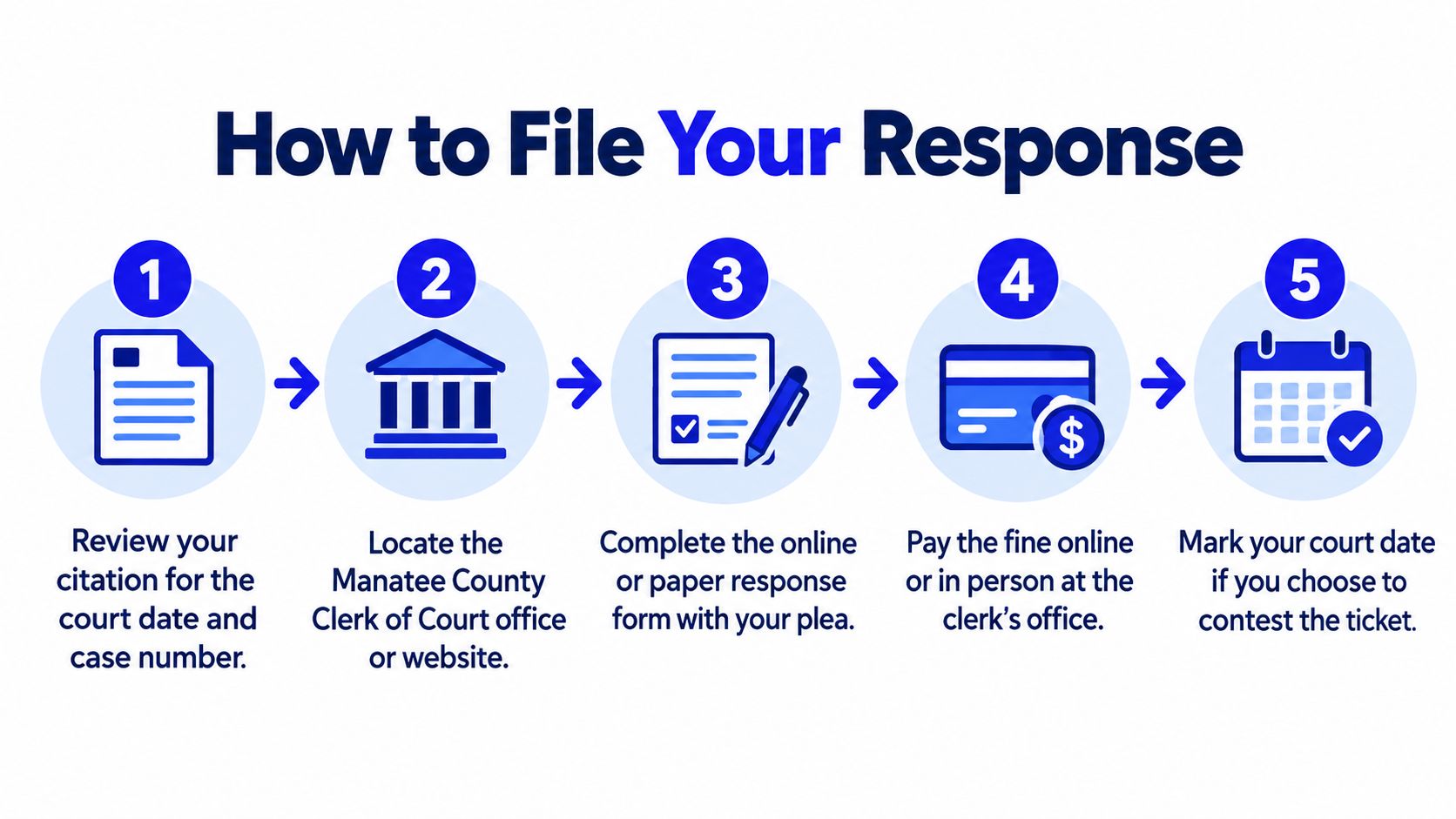
File the Option You Actually Intend to Choose
For payment: Confirm the amount and whether you intend to elect school before completing the transaction.
For BDI: Submit the required election with payment. Create a separate reminder for submitting the completion certificate.
For a hearing: Prepare the written not-guilty request using the Clerk's current instructions. Keep a copy and confirmation of receipt.
For a mandatory appearance: Follow the court instructions rather than assuming ordinary payment will resolve the case.
The Clerk's traffic department guidance warns that failure to pay can trigger suspension reporting and late fees, and failure to provide school-completion proof within 90 days can also result in suspension reporting, late fees, and points. A course receipt and a filed completion certificate serve different purposes.
The online-payment fee listed in the Clerk's previously cited FAQ is 3.5% and nonrefundable. Account for it before authorizing payment, but don't let convenience determine your plea.
Filing safeguard: Save the submitted form, payment receipt where applicable, and confirmation showing the Clerk received your response.
Prepare for the Next Notice
The Clerk processes filings; a contested hearing addresses the allegation. Don't treat a conversation with administrative staff as a ruling on your defense or an extension of your deadline.
If you receive a hearing or arraignment notice, read its specific instructions and ask your attorney what appearance is required. Bring or provide the citation, court notices, relevant photographs, saved recordings, and an organized account of the stop.
Ask counsel whether the case warrants a request for measurement-device records, officer records, or available video, and how those materials should be requested. Don't assume a casual email automatically obtains evidence or postpones the hearing. Verify the case status and any new deadlines after filing.
Defending the Ticket in Court
Fighting a ticket means testing the allegation against evidence, not hoping the officer won't appear. Start with how the speed was measured and whether the evidence identifies your vehicle reliably.
For radar or lidar allegations, ask counsel about relevant calibration, maintenance, and operator records. For pacing or visual estimates, discuss vehicle identification, observation conditions, distance, and surrounding traffic. These are issues to investigate, not automatic grounds for dismissal.

Build an Evidence-Based Challenge
Photographs of an obstructed sign may help explain a location dispute, but preserve the date, direction, and context. An emergency explanation also needs careful legal review. Section 316.183's reasonable-and-prudent standard isn't blanket permission to exceed a posted limit.
Review radar-gun speeding-ticket defense considerations with those limits in mind. If video is central to a disputed observation, AI Video Detector's resource on forensic video examination explained offers background to discuss with counsel, not a substitute for evaluating the recording itself.
Legacy Camera Notices Require a Different Analysis
Manatee County ended its School Speed Zone Camera Program at 12:01 a.m. on March 6, 2025, but notices issued through March 5 remained valid. Program termination did not erase earlier notices.
The county's speed-zone camera FAQ describes a $100 registered-owner penalty and 30 days from the notice date to pay, request a hearing, or pursue an applicable affidavit-based dismissal option; inaction may lead to a Florida Uniform Traffic Citation. That later-published FAQ shouldn't be read as proof that the terminated county program resumed.
A legacy camera notice may identify a special-magistrate hearing process, unlike an officer-issued citation handled through the Clerk's traffic process. Check the document and current case status before deciding where to respond.
Don't deliberately ignore a camera notice to force escalation. Have counsel identify the document, applicable process, and remaining options. Your defense should preserve rights, not create avoidable procedural trouble.
Points, Insurance, and Your License
Your existing driving record should influence the decision before you resolve the new ticket. A driver approaching suspension has a different risk profile from someone with no prior points.
Florida's official points and suspension framework generally assigns 3 points for speeding, assigns 4 points for speeding more than 50 mph over the limit under the listed statutory categories, and states that points remain on the record for at least five years from disposition. The same framework establishes these accumulation thresholds:
Points accumulated | Measurement period | Suspension |
|---|---|---|
12 points | 12 months | 30 days |
18 points | 18 months | Three months |
24 points | 36 months | One year |
The record-retention period and suspension measurement periods aren't interchangeable. Review both the point totals and the relevant dates rather than assuming every old entry has stopped mattering.
Review the Record Before Committing
Existing points: Obtain your driving record and identify the entries relevant to the suspension windows.
Pending citations: Tell your attorney about unresolved cases, not just completed dispositions.
License status: If your license is already suspended, determine the reason and required compliance steps separately from defending this citation.
Commercial driving: Ask about your specific eligibility and professional exposure instead of assuming ordinary school options apply.
Insurance concerns: Request policy-specific guidance before assigning a dollar value to a possible premium change.
Don't confuse resolving a citation with completing license reinstatement. If you're already dealing with a suspension, verify the remaining requirements and your license status before driving.
Measure the Full Cost
The fine is a known starting expense. A possible insurance change, disruption to work, and license consequences require a broader assessment. No responsible recommendation should attach a universal premium increase to your ticket without information about your policy and disposition.
This guide to Florida's points system, tickets, license, and insurance can help you organize that review. My recommendation is direct: if your record puts your license at risk, get legal advice before making an irreversible payment decision.
Why a Lawyer-Led Defense Changes the Outcome
Direct access to the attorney handling your case matters. You need someone who can explain the allegation, review your record, identify evidence worth pursuing, and tell you what a proposed resolution means.
An automated app may make uploading a citation easy. That doesn't answer who evaluates the defense, who responds when a court notice arrives, or whether you can discuss a license concern with the lawyer responsible for the case.
Ask Who Will Handle Your Questions
Attorney access: Can you communicate directly by phone or text, or must questions pass through middlemen?
Case strategy: Will someone review the statutory allegation, evidence, and driving history before recommending a disposition?
Appearance requirements: Will counsel explain whether you must attend, especially if your citation requires court?
Fee scope: What does the quoted fee cover, and what court costs or other obligations remain separate?
Ticket Shield, PLLC offers lawyer-led speeding-ticket representation with direct attorney communication by phone or text. That's an option alongside self-representation and eligible traffic school, particularly when you need an individualized defense rather than an automated payment recommendation.
The value is informed representation, not a guaranteed result. Ask about dismissal, reduction, and no-points possibilities, but expect an honest explanation of the evidence and available outcomes. Nobody should promise that you can skip a mandatory appearance without reviewing the case.
If you work in Bradenton, commute through Palmetto, hold a commercial license, or live outside Florida, clear communication is practical protection. Choose a service that tells you what's been filed, what happens next, and what you still need to do.
Visit Ticket Shield, PLLC at TicketShield.com for a free consultation about your Manatee County speeding ticket and direct access to an attorney by phone or text. Bring your citation and driving-record concerns so your defense can focus on the ultimate goal of achieving “No Points” on your license.