License Suspended but Case Dismissed in Florida
Is your license suspended but case dismissed in Florida? Learn how to clear administrative holds, restore your driving privilege, and avoid points.
You won your Florida traffic case. The judge dismissed the charge, and you left court believing the problem was over. Then you checked your driving status, tried to renew your registration, or received notice that your license is still suspended.
That situation is more common than drivers expect. A license suspended but case dismissed problem usually means the court resolved one matter while the Florida Department of Highway Safety and Motor Vehicles, or DHSMV, still shows a separate administrative hold. Your courtroom victory matters, but it doesn't automatically make your driving privilege valid.
Driving before DHSMV clears the suspension can create a new legal problem. Treat the dismissal as the first victory, not the final clearance.
Table of Contents
The Courtroom Victory That Leaves You Stranded
You appear in court, your attorney challenges the citation, and the judge dismisses the case. You reasonably assume the dismissal travels everywhere, including your driver record. A few days later, you discover the suspension remains active. Your employer needs you on the road, your registration issue is unresolved, and you still can't legally drive.
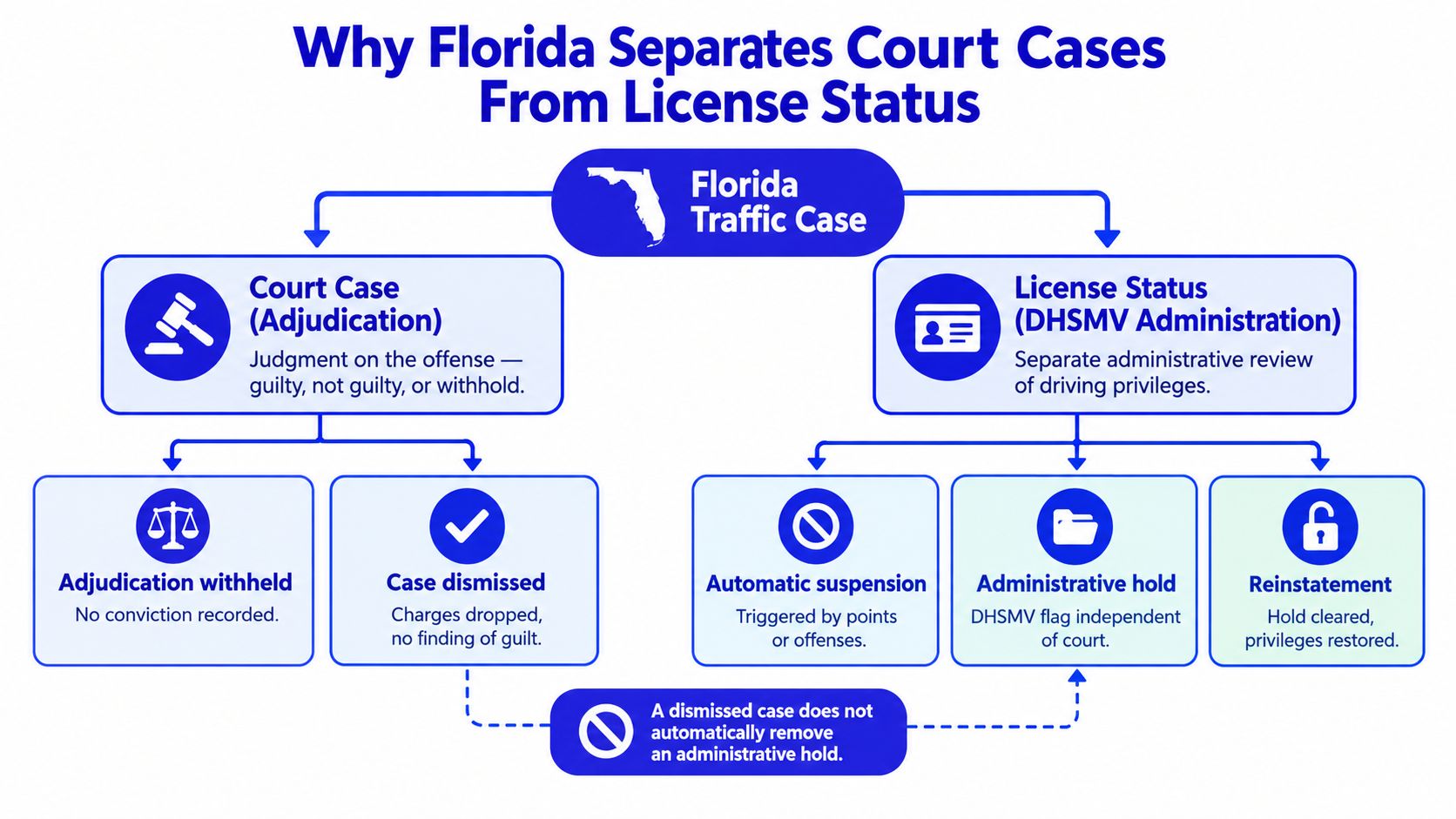
This isn't necessarily a clerical glitch. Florida treats the court case and the driver-license record as separate matters. The judge controls the disposition of the citation. DHSMV controls the status of your driving privilege. One system may receive the dismissal before the other updates, or the suspension may have originated from a separate event connected to the case.
Protective rule: Never drive based only on what happened in court. Verify that DHSMV shows restored driving privileges first.
A dismissal means the prosecution or civil case ended without the result the government sought. It doesn't necessarily erase a failure-to-appear notice, a payment-related hold, an insurance compliance issue, or another administrative action. If the court dismissed your matter through a disposition such as a nolle prosequi, you still need to understand what that outcome means and what remains on your record. Learn what nolle pros means in court.
The practical danger is assuming the systems communicate automatically
The most serious mistake is simple. You get in the car because you won, then an officer or licensing agency treats your privilege as suspended. The courtroom result may help defend the original case, but it doesn't give you permission to ignore an active DHSMV record.
Your next move should be deliberate:
Check the current status: Confirm whether DHSMV lists the license as suspended, revoked, or otherwise restricted.
Identify the cause: Find out whether the hold relates to the dismissed citation or a separate administrative event.
Collect proof: Obtain the dismissal order, court affidavit, or other court documentation showing compliance.
Complete reinstatement: Submit the required proof and pay any applicable fees through the proper Florida process.
Confirm clearance: Verify the status again before driving.
A dismissed case can protect your record from the original charge, but only administrative clearance restores practical driving legality. Waiting for the system to fix itself leaves your job, transportation, insurance position, and future traffic defense exposed.
Why Florida Separates Court Cases From License Status
Florida law distinguishes the traffic proceeding from the state's administration of driving privileges. Florida Statute Chapter 316 defines a suspension as the temporary withdrawal of a licensee's privilege to drive a motor vehicle, which frames suspension as a legal status affecting your privilege, not as a conviction by itself. Read Florida Statute Chapter 316.
That distinction explains the result many drivers find confusing. A court decides what happens to the citation. DHSMV determines whether you currently meet the conditions to drive. Those decisions can occur on different timelines and may rely on different records.
The administrative trigger may survive the dismissal
A suspension can arise from a failure to appear, an unpaid court obligation, an insurance-related compliance issue, points, or another statutory basis. The original citation may later be dismissed, but the separate administrative record can remain open until someone provides the required proof and DHSMV processes the release.
That is why a judge's order doesn't always function as a reinstatement order. The court may have completed its work while DHSMV still needs documentation, payment, or confirmation that a condition has been satisfied.
The correct question isn't only, “Was my case dismissed?” Ask these questions instead:
Question | Why it matters |
|---|---|
What is the exact suspension reason? | The reinstatement requirements depend on the basis for the hold. |
Which agency or court created the hold? | You may need court documentation before DHSMV can act. |
Has the suspension period ended? | Expiration doesn't always complete reinstatement automatically. |
Does DHSMV show an active restriction? | You must confirm legal driving status before operating a vehicle. |
Court relief and license relief require separate action
Florida's statutory framework makes the suspension a withdrawal of driving privilege. It doesn't make the court's dismissal irrelevant. The dismissal may remove the underlying case exposure or satisfy the court obligation, but the licensing agency still needs an administrative record showing why the hold should be removed.
If you need a formal hearing or help presenting the right evidence, review the options for an administrative license suspension hearing. The objective is not merely to prove that you won in court. The objective is to connect that victory to the specific DHSMV record that continues to block your license.
Your Step-by-Step Reinstatement Roadmap
Start with the record, not assumptions. A dismissal order is useful, but it may not identify every reason your license remains suspended. Get the current DHSMV status and determine the exact effective date, suspension basis, and remaining requirements.
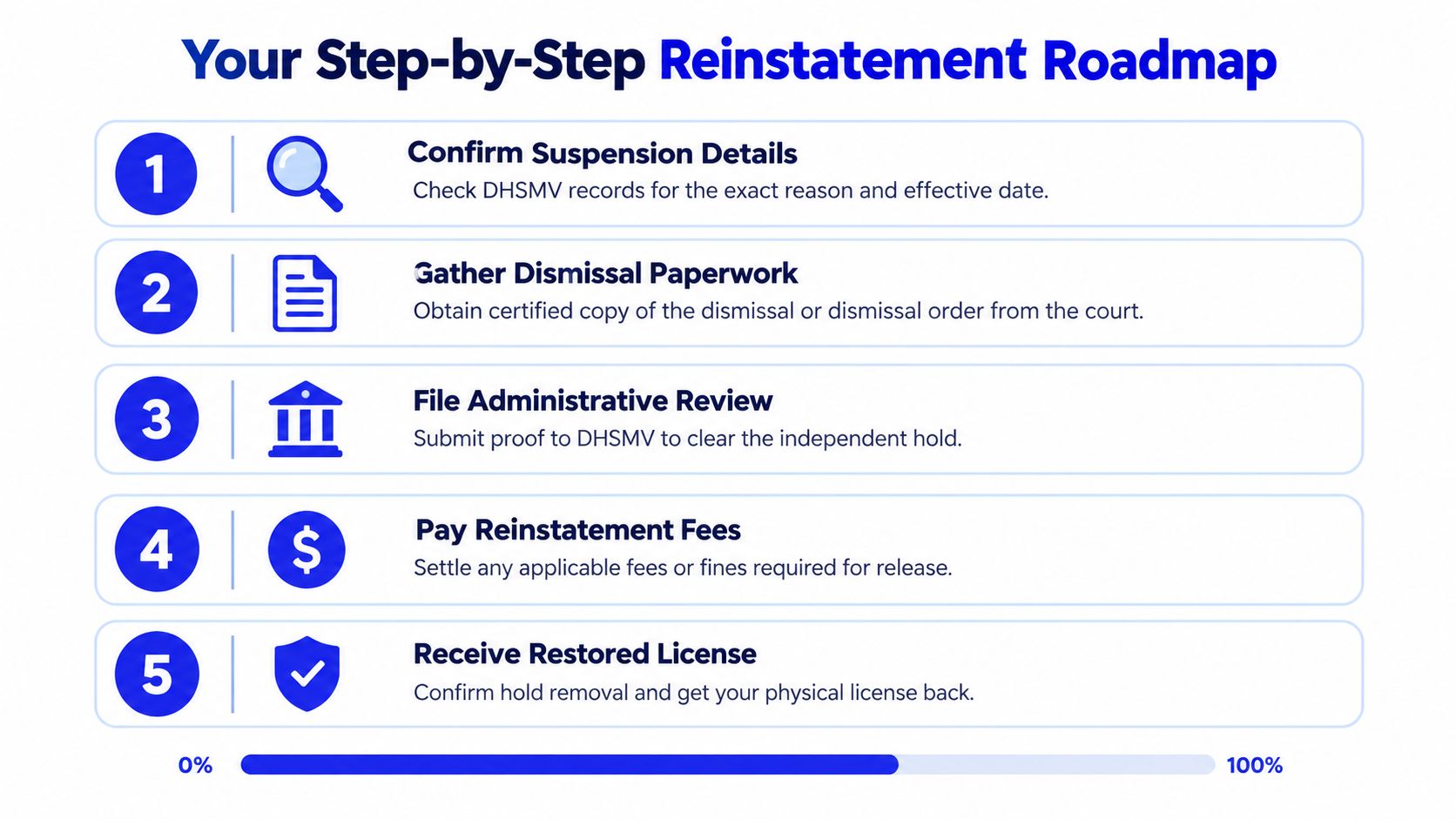
Step one, confirm the suspension details
Look for the precise reason listed by DHSMV. Don't rely on a court clerk, an old notice, or a general online message. A driver may have more than one issue, and clearing one doesn't necessarily clear every restriction.
Write down the effective date, the agency connected to the hold, and any stated documents or fees. That information determines what comes next.
Step two, obtain the court proof
Get a certified dismissal order or another official record showing the case disposition. If the suspension was court-ordered, Florida DHSMV says a driver may bring a court affidavit showing proof of compliance within 30 days, along with a reinstatement fee for each suspension if applicable, to a Florida driver-license service center. Review Florida DHSMV reinstatement guidance.
Don't submit an informal screenshot when the agency requires a certified document. A technically incomplete filing can delay clearance.
Step three, connect the court result to the administrative record
Submit the proof through the channel DHSMV requires. Depending on the suspension basis, that may involve a service center, an online process, or additional documentation. Your filing should clearly identify the dismissed case and the administrative hold you want removed.
Step four, resolve the financial requirements
Florida fees can depend on the statutory basis and your reinstatement history. Under Florida Statute section 324.0221, covered suspensions carry a first reinstatement fee of $150, a second fee of $250, and each subsequent fee during the next 3 years is $500. If both the license and registration are suspended under the covered provisions, the statute says only one reinstatement fee is required to reinstate both. Check the fee rules in section 324.0221.
Other applicable license fees or conditions may still apply. Don't assume payment alone proves that the license has been restored.
Step five, verify the result before driving
If the suspension period has expired, Florida DHSMV says you may apply for full reinstatement by paying the applicable reinstatement fee and any other license fees. Obtain confirmation that the hold is removed and that your privilege is valid before you drive.
For a more detailed Florida-focused overview, see how to reinstate a suspended license in Florida. The key point is operational: a completed suspension period and a dismissed case don't eliminate the need to verify reinstatement.
The Hidden Risks of Navigating Reinstatement Alone
The court may update its docket quickly while DHSMV still shows the old status. That administrative lag can leave you with a dismissal in hand and no valid driving privilege in practice. Online portals can also display limited information, leaving you unsure whether the agency cleared the correct hold or whether another restriction remains.
A driver who treats the dismissal as automatic clearance can create avoidable consequences. The record may still contain a suspension entry, an unresolved filing, or a compliance notation that affects later licensing and insurance reviews. A dismissal ends the prosecution, but it doesn't guarantee that every motor-vehicle record is automatically corrected or expunged.
Reinstatement and record cleanup are different jobs
Handle the issues in the right order:
Legal driving status: Confirm whether DHSMV still prohibits you from driving.
Administrative release: Submit the required documents and satisfy the conditions tied to the hold.
Record accuracy: Check whether the dismissed matter or related suspension still appears.
Insurance communication: Ask your insurer how it evaluates the updated motor-vehicle record.
Future protection: Preserve the dismissal and reinstatement confirmations.
Maryland's motor-vehicle agency materials illustrate the broader record principle that a cleared traffic matter may require a separate driving-record expungement process rather than a simple annotation. That example doesn't control Florida procedure, but the operational lesson applies: court disposition and record correction are distinct tasks. Your Florida lawyer should determine what correction or removal is available under the facts of your case.
Compare the two approaches
Handling it alone | Lawyer-led handling |
|---|---|
You interpret a general status message. | Counsel identifies the specific suspension basis. |
You may submit incomplete paperwork. | Counsel matches proof to the agency requirement. |
You wait without knowing whether the hold cleared. | Counsel tracks the administrative result. |
You risk driving before confirmation. | Counsel gives you a clear status-based plan. |
A service that files only a ticket response may not address the separate DHSMV hold. For drivers facing this problem, a Florida suspended-license lawyer can investigate why the license remains suspended and pursue the administrative work needed after the court result.
Why Direct Attorney Access Beats Automated Ticket Mills
An automated app can accept payment and send status notifications. That isn't the same as analyzing why your license remains suspended after dismissal. Your problem may involve a court disposition, a separate administrative trigger, a missing affidavit, and a record that still needs correction. A chatbot can't take responsibility for connecting those pieces.
You need a lawyer-led process when the result affects whether you can legally drive. At Ticket Shield, PLLC, clients communicate directly with their attorney by phone or text rather than relying on a corporate answering service or a chain of middlemen. The firm describes more than 25 years of experience, former prosecutor insight, service across all 67 Florida counties, and pricing starting at $39.99. See why direct access to a local lawyer matters.

Your lawyer should address the complete problem
A ticket mill may focus on getting a disposition in court. That can be useful, but it doesn't answer the question that matters after dismissal: what exactly is preventing DHSMV from restoring your privilege?
A dedicated attorney should be prepared to:
Review the court outcome: Confirm what the dismissal resolved and what it didn't.
Trace the suspension: Identify the administrative basis and effective date.
Prepare the evidence: Match certified court documents to DHSMV requirements.
Protect the record: Pursue available correction or expungement options when appropriate.
Give direct answers: Tell you whether you can legally drive, based on verified status.
The difference is accountability. An app can move a file through a workflow. A lawyer can evaluate conflicting records, communicate with the court or agency, and adjust the strategy when the first submission doesn't clear the hold.
Ticket Shield, PLLC presents its service as direct, lawyer-led representation rather than automated processing. That model is particularly relevant when your case was dismissed but your license record still says otherwise. You aren't buying a message from a middleman. You're seeking a legal plan for the court result and the administrative consequence.
Secure Your No Points Victory Today
A dismissal is valuable, but it isn't complete protection if DHSMV still lists your license as suspended. You need the court record, the administrative record, and your driving status to tell the same story.
Don't wait for an agency update you haven't verified. Don't drive because a judge dismissed the case. Confirm the suspension basis, submit the correct proof, resolve the applicable reinstatement requirements, and check the result before you return to the road.
Your broader objective should be clear: protect your license and pursue No Points on your license. A strategic traffic defense can address the underlying citation while preserving the evidence and documentation needed for the administrative cleanup that follows.
Visit Ticket Shield, PLLC for a free consultation about your dismissed case and remaining suspension. Speak directly with a lawyer-led Florida traffic defense team focused on clearing the administrative problem and pursuing the ultimate goal of No Points on your license.