
Jacksonville DUI Attorney: Your Guide to a Strong Defense
Arrested for a DUI? A Jacksonville DUI attorney can protect your license. Our guide covers penalties, defenses, and steps to take now. Get a free consultation.

Hiring a Jacksonville DUI attorney fast is critical. A lawyer's job is to challenge the stop, tests, and paperwork, then fight to reduce penalties that threaten your license, record, job, and future.
In Florida, a DUI conviction can trigger a mandatory fine from $500 to $1,000, up to 180 days in jail, and a license revocation of at least 180 days. In Duval County, DUI enforcement is constant, and if your BAC is 0.08 or higher, the lab number alone can support conviction.
If you were arrested on I-95, Atlantic Boulevard, or coming home through Jacksonville after dinner or a work shift, you're probably dealing with panic, embarrassment, and one urgent question. What do I do right now?
Start with this. An arrest is not a conviction. What you do next can protect your license, your livelihood, and your record. If you drive for Uber, Lyft, or DoorDash, or if you're stationed at NAS Jax and your career depends on a clean file, this charge can reach far beyond court.
Table of Contents
What Happens After a Jacksonville DUI Arrest
It is 2:00 a.m. You are out of jail, your phone is full of messages, your car may still be in impound, and you are wondering whether this is just a traffic case. It is not. A Jacksonville DUI can hit your license, your job, your security clearance, and your reputation before you ever stand in front of a judge.
Duval County sees steady DUI enforcement, and the State handles these cases every day. The Florida Department of Highway Safety and Motor Vehicles publishes statewide DUI enforcement and administrative license information through its official DUI and administrative suspension resources. The point is simple. You should expect speed, paperwork, and pressure from the start.
What should you focus on first
Get control of the facts.
Save every document you received at the jail or from the officer. Write down the location of the stop, the time, what you ate, what you drank, whether bodycam or dashcam appeared to be running, whether you were asked to perform roadside exercises, and whether you gave a breath, blood, or urine sample. If you are a rideshare driver, delivery driver, CDL holder, or service member tied to NAS Jacksonville or another command, write down that work impact too. Your case is not only about court. It is also about income, base access, reporting duties, and professional fallout.
Practical rule: The first clear written account should go to your lawyer, not into a text thread, group chat, or social media post.
If your booking photo is already spreading online, deal with that problem separately so it does not keep damaging your name while the case is pending. A useful resource on getting booking photos removed online can help you limit that damage.
Why the first 24 hours matter
People damage their own defense by trying to explain the stop to police, coworkers, command staff, or insurance adjusters before they understand what happened. Every extra statement creates another piece of evidence for the prosecution to sort through and use.
A better approach is to get a clean overview of the immediate timeline, then let your lawyer take over communication where possible. This guide on what happens after a DUI arrest in Florida gives a solid outline of the first procedural stages.
Do not hire a ticket mill that pushes you to a case manager and treats your arrest like a file number. If your livelihood depends on driving, or if a command notification could affect your military career, you need direct access to the lawyer building your defense. In Jacksonville, that difference matters fast.
What Are the First 5 Steps to Take After a DUI Arrest
Act fast. Don't improvise. The first hours matter.
What should you do immediately
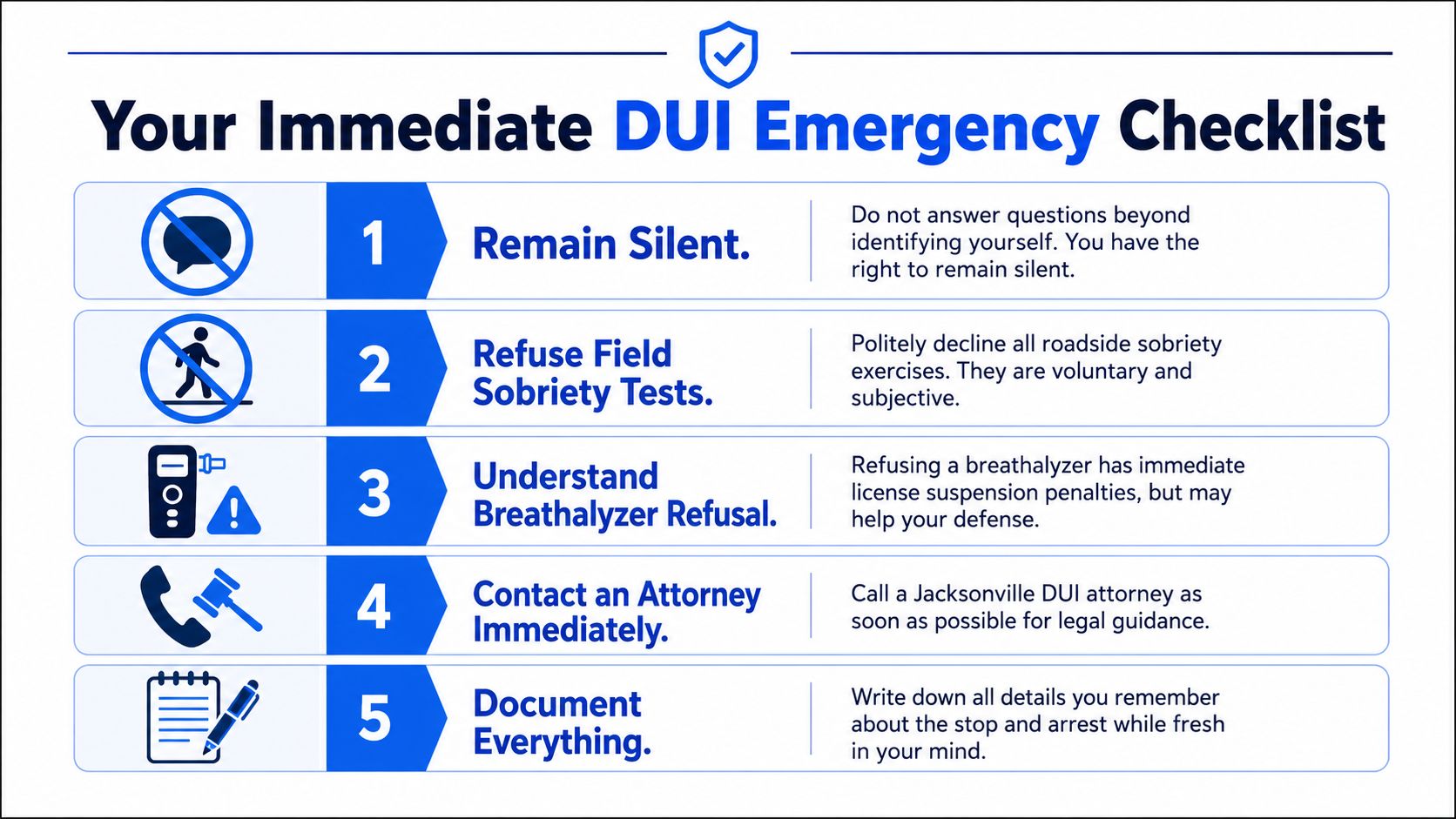
Step 1. Remain silent. Give identifying information, then stop talking. You have the right to remain silent, and casual statements often become evidence.
Step 2. Refuse field sobriety tests. Roadside exercises are voluntary and subjective. They are built to create evidence, not to clear you.
Step 3. Understand breath test refusal. Refusal has license consequences in Florida, but the decision can still affect the defense strategy in important ways.
Step 4. Contact an attorney immediately. Time matters because evidence can disappear, and deadlines begin right away.
Step 5. Document everything. Write down the stop, the weather, road conditions, your physical condition, and every interaction you remember.
Why these five steps matter
Silence protects you from giving the State extra evidence. Roadside exercises create subjective observations that are hard to undo later. Your memory fades quickly, and so do opportunities to preserve video and witness details.
Florida also treats chemical test refusal seriously. Under Florida DUI law, a second refusal to submit to breath, blood, or urine testing can be charged as a first-degree felony punishable by up to one year in jail or probation and a $1,000 fine, as explained in this summary of Florida DUI refusal penalties. That's one reason you should stop guessing and get legal advice tied to your actual history.
The right move after a DUI arrest is almost never to explain more. It's to preserve evidence and limit damage.
What should you avoid doing
Don't post online. Prosecutors can use screenshots, messages, and timestamps.
Don't talk about “how much you had.” That statement rarely helps.
Don't assume the officer got it right. Officers make factual and procedural mistakes.
Don't wait. Delay weakens your case.
If you need a clearer breakdown of the immediate legal issues, review this guide on DUI charges in Florida.
What Penalties Am I Facing for a DUI in Duval County
You got arrested. Now you need to know what can happen to your license, your record, your paycheck, and your future in Jacksonville.
Florida DUI law is strict, and the statute that controls your case is Florida Statute 316.193. Read that charge as a threat to every part of your life that depends on a clean record, especially if you drive for income or work on a military installation.
What does Florida Statute 316.193 mean for you
Under Florida Statute 316.193, a BAC of 0.08 grams per 100 milliliters of blood is enough to support a DUI charge. The State does not need a perfect video or dramatic roadside behavior if it has a test result at or above the legal limit.
That changes how your case should be handled. A DUI charge is an evidence case. The fight is over the stop, the officer's observations, the testing procedure, the machine records, the time gap between driving and testing, and whether the State can prove every required step.
A high BAC allegation makes the risk worse. Florida law increases exposure when the State claims your BAC was 0.15 or higher, and that matters in Duval County because prosecutors treat those cases more aggressively. If you are a gig driver, that allegation can put platform eligibility at risk fast. If you are assigned to NAS Jacksonville or another military command, it can trigger command reporting problems long before your criminal case is finished.
How fast do penalties get worse
For a first conviction, the penalties are serious from day one. A Florida DUI penalties overview explains that a first DUI conviction can bring a fine of $500 to $1,000, up to 180 days in jail, and a license revocation of at least 180 days. If the State alleges a BAC of 0.15 or higher, the court can also require an ignition interlock device for at least six months.
That is the baseline.
Penalties climb with prior convictions, refusal issues, property damage, injuries, child passengers, or a high BAC allegation. The court sees those facts as aggravating. Prosecutors do too.
Florida DUI penalties at a glance
Penalty | First Conviction | Second Conviction | Third Conviction |
|---|---|---|---|
Fine | $500 to $1,000 | Higher penalties apply | Higher penalties apply |
Jail exposure | Up to 180 days | Increased jail risk | Increased jail risk |
License consequence | Revocation of at least 180 days | Longer loss of driving privileges | Longer loss of driving privileges |
Ignition interlock | At least 6 months if BAC was 0.15 or higher | More likely and often longer | More severe consequences possible |
Here is my advice. Do not focus only on the maximum jail number and assume everything else is secondary. In Jacksonville, the practical punishment often starts with losing the ability to drive to work, losing a rideshare or delivery account, triggering problems with base access, or creating a record that follows you into background checks and professional licensing reviews.
If you want a tighter breakdown of the sanctions tied to this charge, review Florida DUI penalties explained.
How Does a DUI Attorney Protect My License and Freedom
You get released from jail, check your phone, and then panic sets in. Your rideshare account is at risk. Your boss may find out. If you work on base, report to base, or hold a clearance, one DUI arrest can trigger problems that have nothing to do with the final court result.
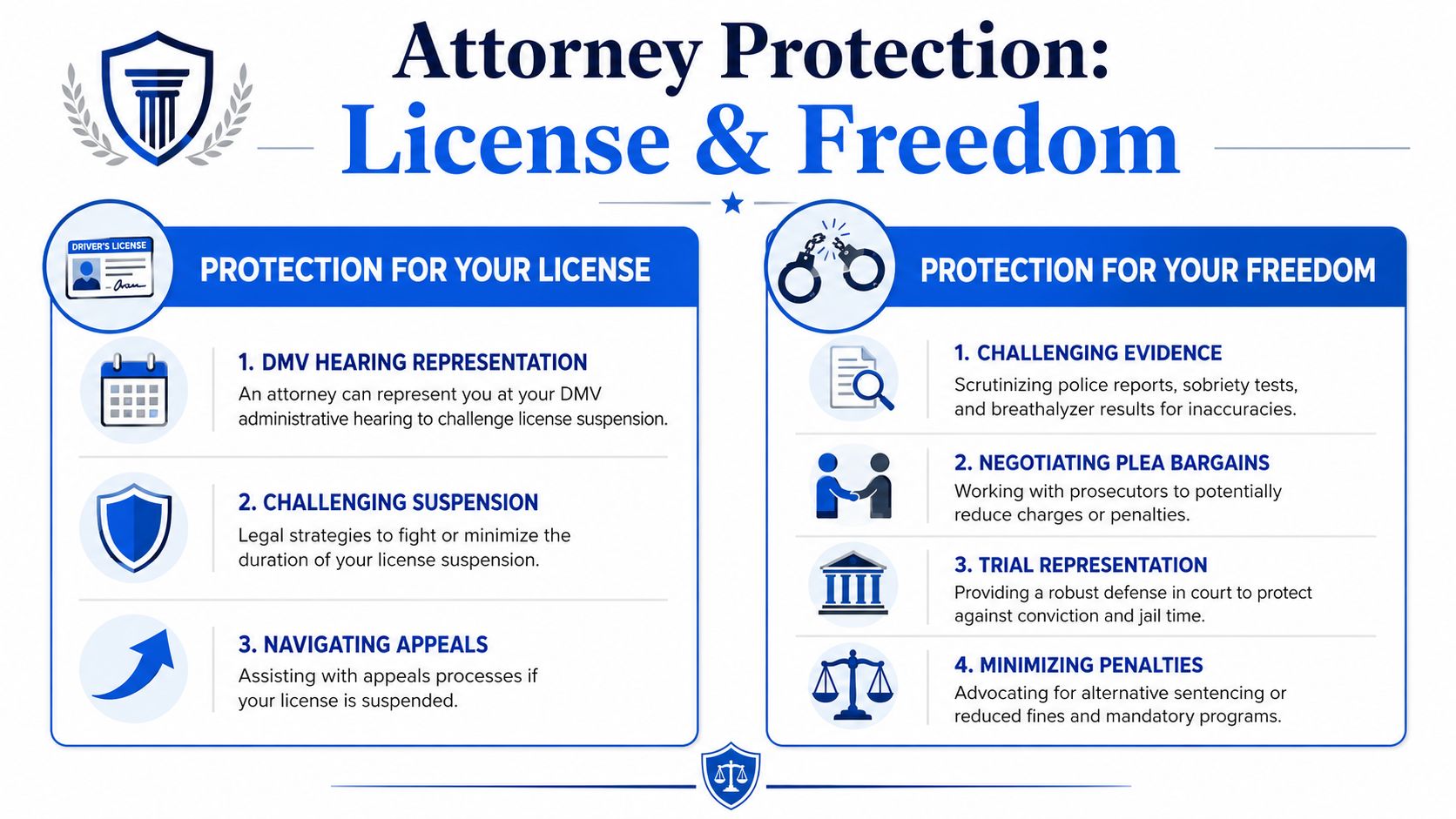
That is why you do not hire a lawyer just to show up in court. You hire one to protect your ability to drive, protect your job, and cut off damage before it spreads.
A good DUI lawyer works two cases at once
One case is in criminal court. The other is your life.
If you drive for Uber, Lyft, DoorDash, Instacart, or any delivery platform, a DUI arrest can threaten your income fast because these companies screen driving history and criminal allegations aggressively. The broader business impact of DUI allegations on app-based drivers has been covered by The Rideshare Guy's review of DUI and deactivation risks for rideshare drivers.
If you are stationed at NAS Jacksonville, work as a civilian on base, or hold a job tied to security access, the stakes are different but just as serious. Command reporting duties, base access restrictions, and clearance questions can start long before your criminal case ends. That is why your defense has to be built for Jacksonville, not handled like a file in a volume shop.
A lawyer who understands these pressure points will address the license issue early, control what gets filed and challenged, and look for weaknesses in the stop, arrest, testing, and officer reports. In some cases, that includes filing motions to exclude bad evidence. If you want a plain-English explanation, read how a motion to suppress evidence can weaken a DUI case.
Direct attorney access protects you better than a ticket mill
You need to talk to the lawyer handling your case. Directly. Early.
Ticket mills and intake-heavy firms move DUI cases through staff, forms, and callbacks. That model misses facts that matter. A real lawyer catches the detail that your stop happened after a vague BOLO, that your field exercises were done on uneven pavement, that your medical history affected balance, or that the officer's timeline does not add up.
Those details can affect your license, plea options, suppression strategy, and trial posture.
For military clients and gig workers, speed matters even more. You may need advice on what to report, what not to say, and what documents to gather before your employer, platform, or command starts making decisions. Waiting a week to speak with the actual attorney is a mistake.
Here is my recommendation. Hire a Jacksonville DUI lawyer who gives you direct access, knows Duval County practice, and treats your case like a threat to your future, not a citation to process.
How Do You Build a Strategic DUI Defense
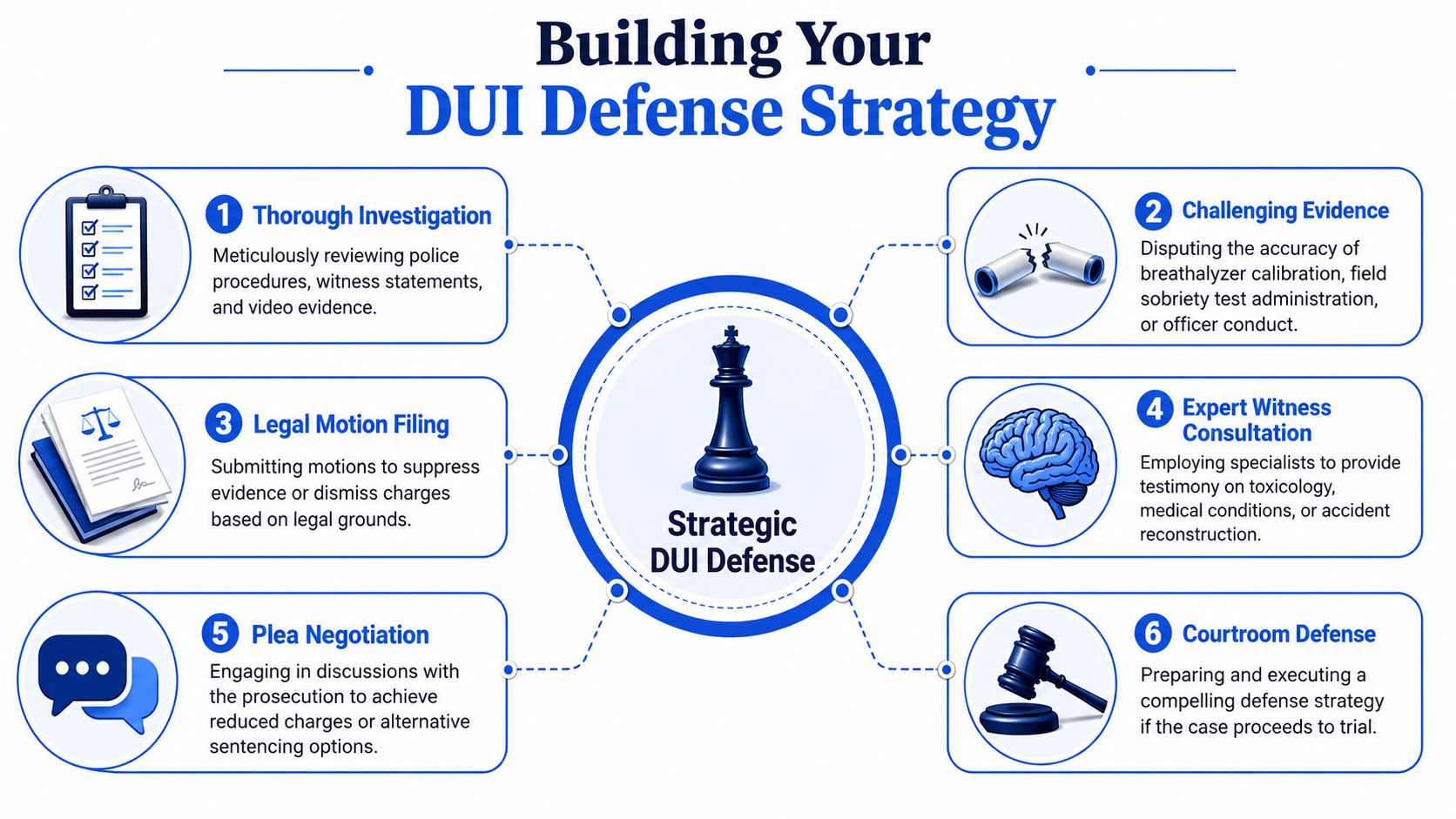
The State builds a DUI case in layers. Your lawyer should tear it down the same way, fast, methodically, and with a clear theory from day one.
Can the stop itself be challenged
Start with the traffic stop. If the officer lacked a valid reason to pull you over, prolonged the detention without legal grounds, or arrested you without probable cause, the case may weaken before anyone argues about breath results.
That fight matters because bad police work can keep key evidence out of court. A judge can suppress statements, test results, and observations that came from an unlawful stop or arrest. If you want the plain-English version, read what a motion to suppress evidence does.
Are field sobriety tests really reliable
Field sobriety exercises are persuasive in police reports and far less impressive on close review.
Officers often treat them like science. They are not. Balance, nerves, fatigue, age, old injuries, footwear, roadside slope, flashing lights, and passing traffic can all affect performance. In Jacksonville, that matters on bridge approaches, narrow shoulders, wet pavement, and uneven parking lots.
A strong defense tests the details:
The location. Was the surface level, dry, and safe for the exercises?
The instructions. Did the officer explain each step clearly and demonstrate it correctly?
Your condition. Did a medical issue, physical limitation, or anxiety affect how you looked on camera?
The video. Does the footage match the officer's written description?
For NAS Jax personnel, this part of the case carries extra weight. A shaky field exercise on bodycam can trigger command attention long before the court decides guilt. For gig workers, the same footage can put platform access and income at risk if the case drags on.
What is a rising BAC defense
Timing can decide a DUI case.
A rising BAC defense argues that your alcohol level was lower when you were driving and climbed later, by the time breath or blood testing occurred. That issue comes up when there is a gap between driving, the stop, the investigation, and the chemical test.
This defense requires real analysis. Your lawyer has to line up the timeline, examine the testing records, review what and when you drank, and compare that evidence to the officer's observations. Sloppy timeline work loses this argument. Precise timeline work can create reasonable doubt.
A strategic defense should also examine the parts of the case that prosecutors expect people to ignore:
Breath or blood test maintenance and administration records
Bodycam and dashcam footage
The gap between driving and testing
Medical explanations for speech, balance, or eye issues
Weak points that support a reduction or dismissal
That is also why you need to organize your documents early. Use the CasePulse client intake form guide to gather timelines, medical information, work records, and other facts your lawyer can use immediately.
The right defense is built for your risk, not just your charge. If you drive for Uber, Lyft, DoorDash, or a delivery fleet, protecting your record and driving status has to shape the strategy. If you serve at NAS Jax or work in a job with security clearance concerns, your lawyer needs to build the case with those professional consequences in mind from the start.
How Do I Hire the Right Jacksonville DUI Attorney
You get out of jail, check your phone, and see the fallout starting. Your rideshare account is at risk. Your base command may need notice. Your commercial boss wants answers before your first court date is even set. This is when people make a bad second mistake. They hire the first firm with a loud ad and end up in a case mill where they barely speak to the lawyer handling their future.
Hire a Jacksonville DUI attorney who treats your case like a threat to your income, license, and record, not just a file number. If you drive for Uber, Lyft, DoorDash, or a delivery service, your lawyer should talk about protecting your ability to keep working. If you serve at NAS Jax or hold a job tied to security clearance, firearms, or reporting requirements, your lawyer should already understand that a DUI can trigger problems far beyond court.
What questions should you ask before hiring
Start with access. Ask who you will speak to after you sign and who will stand next to you in court. If the answer is a case manager, intake team, or “one of our attorneys,” keep looking.
Then ask how the lawyer evaluates a DUI case in Duval County. You want a direct answer about the stop, bodycam, breath testing, timeline gaps, witness issues, suppression motions, and negotiation strategy. You also want to hear whether the lawyer has a plan for your job-related risk. A generic DUI pitch is not enough if your paycheck depends on driving or your command structure expects disclosure.
Ask these questions in plain English:
Will I have direct access to my attorney after I hire the firm?
Who appears in court for me and handles negotiations?
How do you review the stop, the arrest, and the chemical testing?
How do you handle DUI cases for gig workers, CDL-related jobs, military personnel, and licensed professionals?
What do you need from me today to start protecting my case?
If the lawyer cannot answer those questions clearly, do not hire them.
If you want to organize your records before that first call, a CasePulse client intake form guide can help you collect the right facts and documents efficiently.
What should pricing and communication look like
Fees matter, but fee structure matters just as much. A low quote can mean limited work, quick pleas, or very little lawyer contact. A higher quote may include motion practice, contested hearings, and direct attorney involvement. Ask what the fee covers, whether trial is included, how often you will get updates, and how fast calls are returned.
Do not accept vague billing. Get a clear explanation of the scope of representation and the communication process. If the firm cannot explain that before you hire them, communication will not improve after you pay.
The bigger issue is model, not marketing. Some firms run high-volume traffic and DUI dockets like a ticket mill. Your case gets pushed through fast, often with little attention to the work consequences that matter most to you. A direct-to-lawyer model is better. You need the attorney making strategy decisions early, especially if your clearance, military position, or driving-based income is on the line.
For broader hiring guidance, review how to compare DUI attorneys in Florida.
What Is the DUI Process at the Duval County Courthouse
The process feels intimidating because you don't see the road ahead. Once you do, the panic usually drops and the decision-making improves.
What does the timeline usually look like
Your case usually starts with arrest and booking, then a first appearance before a judge. After that comes arraignment, pretrial work, negotiation, and possibly trial. If there's a conviction, sentencing follows, along with court-ordered obligations.
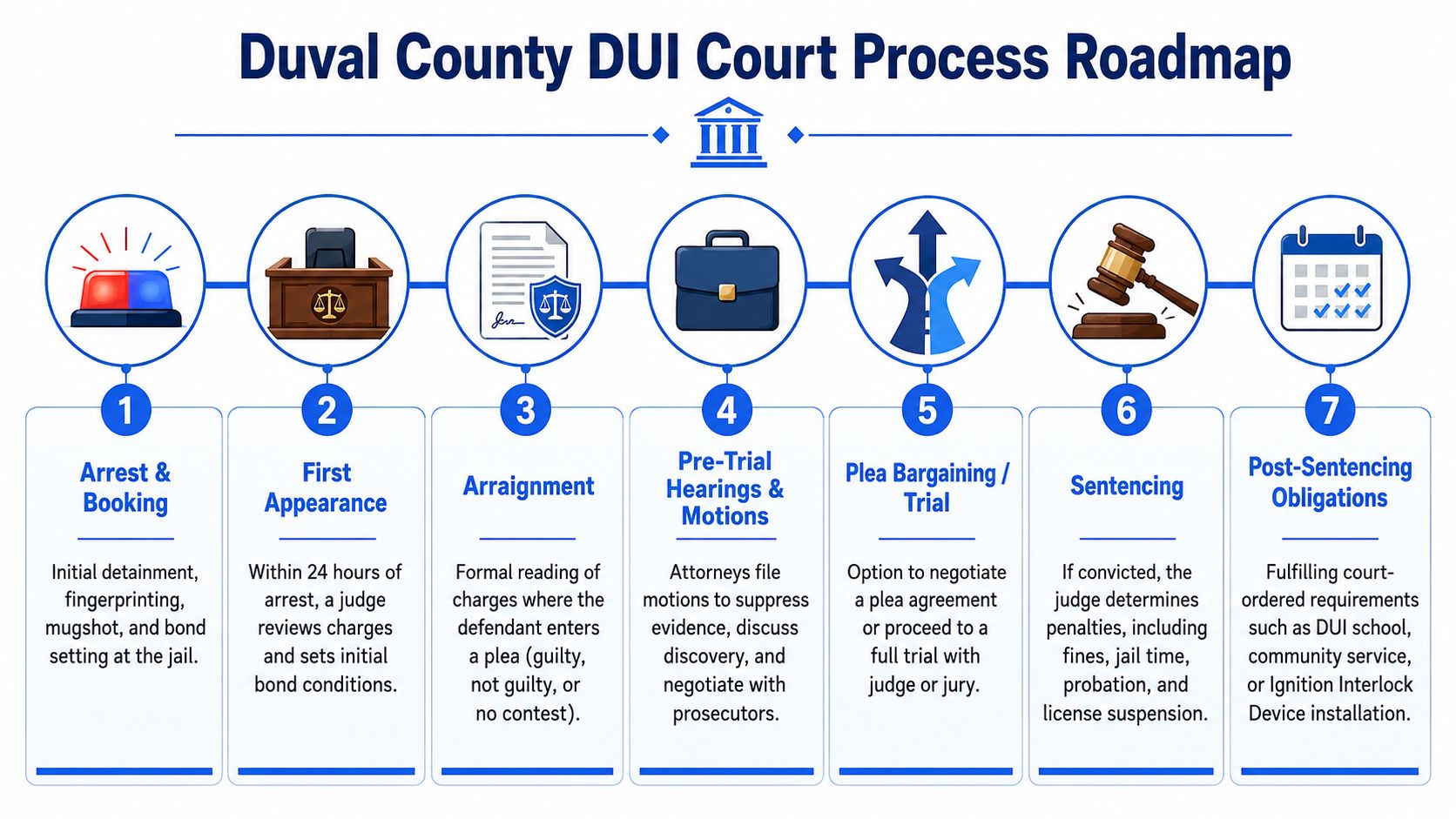
A typical DUI case at the Duval County Courthouse includes:
Arrest and booking
First appearance
Arraignment
Pretrial hearings and motions
Plea negotiations or trial
Sentencing if convicted
Post-sentencing obligations
The judge may review release conditions early. Your lawyer then starts obtaining reports, video, testing records, and witness information. Motions may be filed if the stop, arrest, testing, or evidence handling was flawed. Many cases resolve through negotiation. Some should not.
This overview video helps visualize the general process:
One more point matters here. In Florida, many traffic and criminal matters can be handled with limited client disruption. The right legal strategy is designed to protect your time as well as your record.
If you were arrested for DUI in Jacksonville, stop waiting and get real legal help now. Visit Ticket Shield, PLLC for a free consultation and fight for the result that matters most, protecting your license, protecting your record, and pursuing the strongest possible No Points outcome.
