Is a Traffic Citation a Ticket in Florida? Full Guide
Is a traffic citation a ticket in Florida? Learn how citations and tickets differ, what they mean for your license, and what to do next.

Yes, a traffic citation is a ticket in everyday Florida speech. But the paper in your hand is a formal legal document, and whether it is civil or criminal controls how you must respond.
You may be staring at it after a stop on I-95, US-19, or a side street and wondering if this is just a fine you can pay and move on from. That assumption is exactly where drivers get burned, because the word on the paper is not the whole story.
Table of Contents
What Most Florida Drivers Think When They Hear Citation or Ticket
Why the Same Paper Can Be a Civil Infraction or a Criminal Charge
What Most Florida Drivers Think When They Hear Citation or Ticket
A driver gets stopped, takes the paper, and hears the officer say something like, “Sign here.” Nearly everyone looks down, sees a date, a violation, and a payment box, then assumes they've received a simple ticket and can deal with it later. That reaction is normal. It's also incomplete.
The problem is that citation is the formal legal label, while ticket is the everyday word drivers use. In Florida, that paper is not just a roadside note, it starts an official traffic case and tells you what the state says happened and how you must respond. If you want a plain-language reference point for how terms are used in legal and service documents, see the terms page.
Practical rule: Don't focus only on the price printed on the citation. Focus on what the paper requires you to do next.
That distinction matters because a driver who treats the document like a casual invoice can miss the actual deadline or choose the wrong response. Some people want to pay fast, some want to fight, and some think ignoring it buys time. It doesn't. It usually buys trouble.
If you're trying to decide whether you're facing something minor or something more serious, start with the classification printed on the citation itself. The rest of the answer turns on that, not on the word “ticket” alone. For a broader format reference on Florida's uniform citation form, review the Florida Uniform Traffic Citation form details.
Defining Citation and Ticket in Everyday Language
A traffic citation and a traffic ticket mean the same thing in Florida conversation. Citation is the formal legal term, and ticket is the word drivers use for that same enforcement document.
What gives the paper legal force is the form and what it demands from you. Florida's Department of Highway Safety and Motor Vehicles treats a Uniform Traffic Citation as the document issued for an alleged traffic violation and expressly refers to UTCs as traffic tickets. Florida law also requires the citation to include a notice to appear, use prenumbered forms, and follow state traffic laws and court procedures, with electronic issuance allowed. For the format itself, see the Florida Uniform Traffic Citation form details.
That means the document is not a warning slip and not a casual invoice. It opens an official case, shows the deadline, and tells you which response the state expects. For ordinary civil infractions, the driver generally may pay the penalty, contest the citation, or elect an approved driver-improvement course.

What the paper does
The paper tells you three things at once. It says you have been accused of a violation. It sets a response deadline or court date. It also tells the court system how to process your choice if you pay, fight, or use another allowed option.
The danger is not the word “ticket.” The danger is assuming every ticket can be handled the same way.
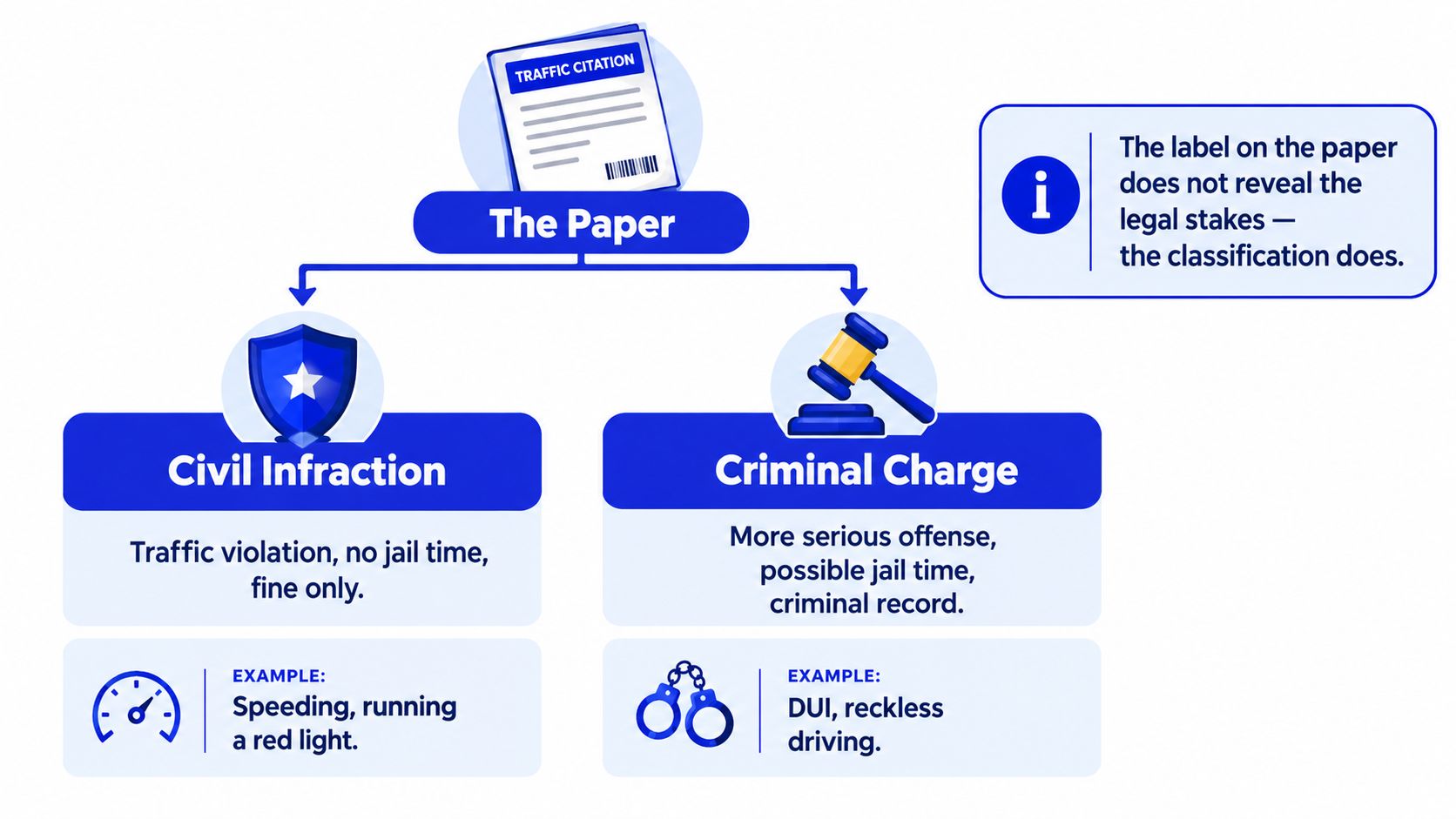
Florida makes the legal consequences turn on the offense classification. A civil traffic infraction is noncriminal, while a criminal traffic case is not. That difference decides whether payment is enough or whether you must appear in court and defend yourself.
If you want a tighter read on the form and the paperwork it carries, this Florida citation guide is a useful reference. The paper may look simple. The consequences are not.
Why the Same Paper Can Be a Civil Infraction or a Criminal Charge
A traffic citation can look like routine paperwork and still carry very different consequences. In Florida, the label on the form matters less than the offense classification. That classification decides whether you can handle it by mail or online, whether you must appear in court, and whether the case is civil or criminal.
A civil traffic infraction is noncriminal. It usually does not carry jail exposure, and it does not give you the same rights you would expect in a criminal case, such as court-appointed counsel. A criminal traffic offense is a different situation. It requires a court appearance and can bring criminal penalties, including possible jail time.
Read the citation, not your assumptions
Check the violation code, the offense description, the appearance box, and the court date. Those details tell you whether the citation is a payment option, a hearing notice, or a mandatory court appearance. Drivers who treat every citation as a simple payable ticket make mistakes fast, especially if they are from out of state, recently moved to Florida, or already dealing with a suspension.
A citation that says you must appear demands attention before you do anything else. Paying online without checking that requirement can create a bigger problem than the stop itself.
Florida courts handle these cases differently because the stakes are different. Civil infractions may be resolved by payment, a hearing, or a driver-improvement election. Criminal traffic charges require a more careful response, and the usual “just pay it” move can backfire. If you need a clearer explanation of that criminal side, read the Florida criminal traffic violation guide.
The paper may look the same on your windshield or in your hand. The classification is what tells you whether you are dealing with a civil matter or a criminal one. Miss that distinction, and you choose the wrong response.
How Florida Statute 316.187 Shapes Most Speed Citations
Florida Statute 316.187 is the backbone for many speed citations. It authorizes the Florida Department of Transportation to establish reasonable and safe speed limits after an engineering and traffic investigation, and those speed zones must be posted with clearly legible signs. It also sets maximum limits of 70 miles per hour on limited-access highways, 65 miles per hour on certain divided highways outside urban areas, and 60 miles per hour on other roads under the department's authority.
That matters because a speeding citation is tied to a defined legal rule, not just an officer's opinion. A violation of a speed limit established under 316.187 must be cited as a moving violation and is punishable under Chapter 318. So when you get a speed ticket, the question is not whether it "feels" like a ticket. The question is which statute the officer used and what penalty path that statute triggers.
What to check on the citation
Look at the alleged speed, the posted limit, the road type, and the statute number. Those details matter because they determine the legal category of the offense and can shape the defense. For example, the difference between an ordinary speed citation and a higher-level speed allegation can change how the case is treated.
If you want a focused explanation of speed-limit law, this Florida speed-limit guide gives useful context. The key takeaway is that 316.187 turns speed enforcement into a statutory process. The ticket is the paper trail, but the statute is the authority behind it.
What Paying the Ticket Quietly Does to Your License
Paying a Florida civil traffic citation is not the same as “making it go away.” The state treats payment of the civil penalty as a conviction, and if the violation is point-accessible, points get assessed. That's the hidden cost most drivers miss when they rush to clear the screen online.
Those points matter because they can stay on your driving record for at least five years from disposition, and accumulation can trigger suspension thresholds. Florida lists 12 points within 12 months for a 30-day suspension, 18 points within 18 months for a three-month suspension, and 24 points within 36 months for a one-year suspension. Florida also assigns points to specific violations, including certain speeding offenses and reckless driving. For a deeper Florida-specific breakdown, see the traffic violation points guide.
The practical cost is bigger than the fine
A fine is the immediate cost. A conviction is the longer tail. Insurance, record impact, and suspension risk are where drivers get hurt later, often after they thought they'd handled the matter responsibly.
Paying fast is convenient. It is not the same thing as protecting your license.
If you want a point comparison from another jurisdiction to understand how point systems work in practice, Ontario demerit points explained is a useful outside reference, but Florida's rules control your case. Your decision should be made with your license exposure in mind, not just the amount on the citation.

Paying the Fine Versus Contesting With a Lawyer
You really have two paths. You can pay and accept the legal consequences, or you can contest the citation and fight for a better outcome. Don't confuse convenience with protection.
Factor | Paying the Fine | Contesting With a Lawyer |
|---|---|---|
Immediate effort | Fast and simple | More deliberate, case-specific |
Legal result | Usually a conviction | Can target dismissal, reduction, or better resolution |
Point exposure | May trigger points if the violation is point-accessible | Aims to avoid points when possible |
Insurance impact | Can follow the conviction | May reduce the long-term fallout |
Court appearance | Usually avoided if payment is allowed | Often handled with legal representation |
A lawyer-led defense is not the same as an automated app or a ticket mill. In a firm like Ticket Shield, PLLC, clients can communicate directly with their attorney by phone or text instead of being routed through layers of middlemen, corporate answering services, or chatbots. That direct access matters when you need a real answer about your specific citation, not a generic script. The firm also states that over 99% of Ticket Shield clients never appear in court, and service is available statewide across all 67 Florida counties starting at $39.99.
If you want a practical side-by-side explanation of the choice, this page on paying a ticket versus hiring a lawyer is worth reading. The right choice depends on what's printed on the citation and what it can do to your record. If you care about No Points, contesting deserves serious consideration.
What to Do Right Now After You Get a Citation
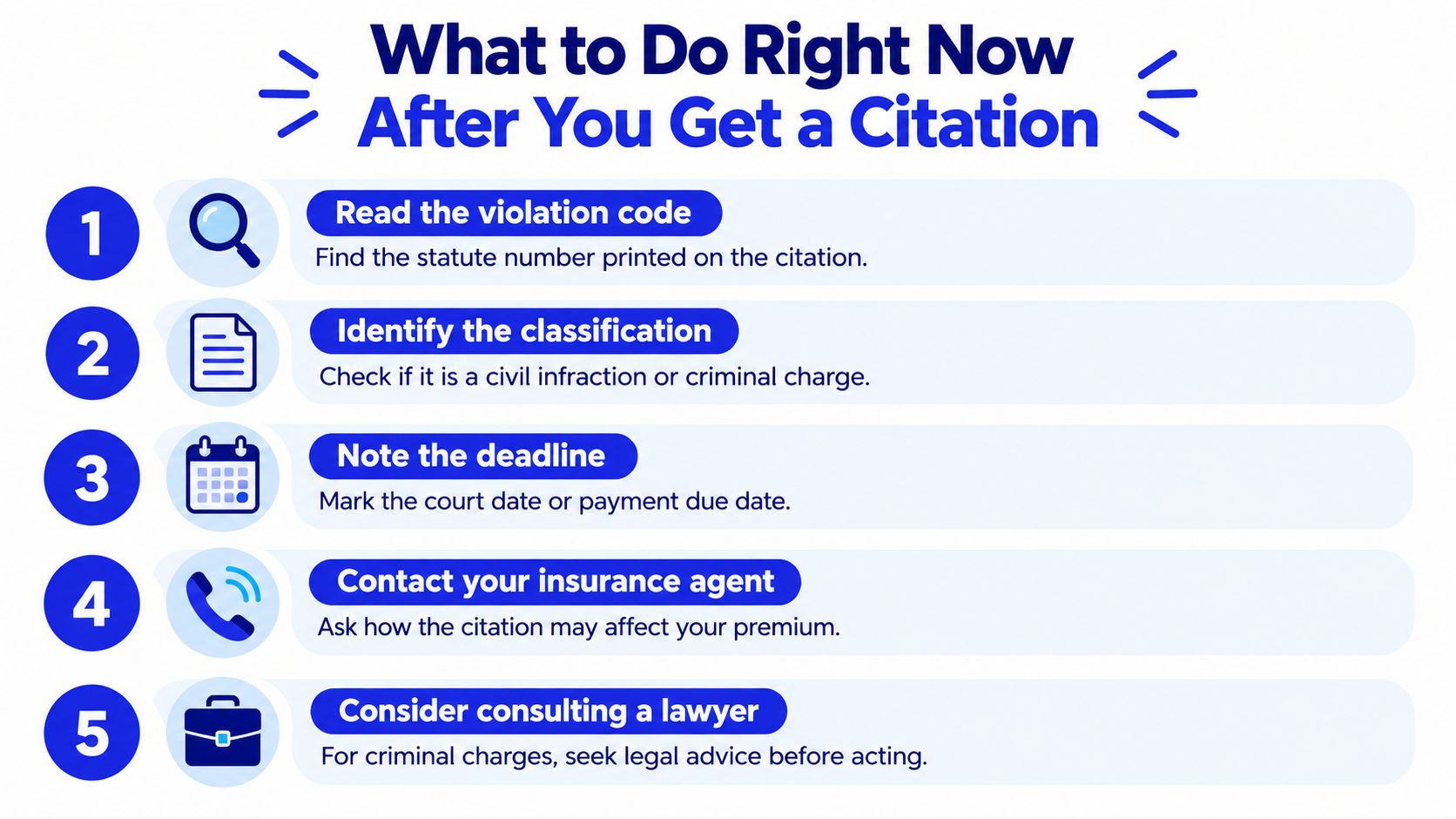
Start with the citation itself. Read the violation code, the offense description, and the court date or payment deadline. If the paper says it's a criminal charge or requires an appearance, don't treat it like a routine civil ticket.
Next, identify whether the case is a civil infraction or something more serious. Then decide whether you're paying, contesting, or electing an approved driver-improvement option if one is allowed. Don't make that choice before you understand the effect on your license.
A short checklist that protects you
Read the violation code: Find the statute number printed on the citation.
Check the classification: Confirm whether it's civil or criminal.
Mark the deadline: Put the court date or payment date on your calendar immediately.
Think about the record impact: Ask how the citation may affect your license and insurance.
Talk to a lawyer before paying: Especially if the case is criminal or you already have a suspension history.
If you're out of state or newly relocated to Florida, take the citation seriously. If you already have prior suspensions, treat every new ticket as a threat to your driving privilege, not a routine inconvenience.
For a road-rule resource outside Florida that shows how drivers often need plain guidance, Driving Test Cancellations on road rules is a helpful example of why clear legal direction matters. Florida drivers need that same clarity here, because the deadline and classification on your citation control your next move.
Protect Your License and Aim for No Points
Yes, a traffic citation is a ticket in everyday language, but in Florida it carries real legal weight. If you handle it wrong, you can end up with a conviction, points, and a problem that lasts long after the roadside stop is over.
If you want a lawyer-led review with direct phone or text access to your attorney, Ticket Shield, PLLC is built for that kind of case. Don't guess about your response, and don't pay first just because the paper looks simple.
Ticket Shield, PLLC helps Florida drivers fight citations with a lawyer-led approach aimed at protecting licenses, records, and insurance. If you want a direct review of your ticket and a real shot at No Points, visit Ticket Shield, PLLC for a free consultation.