
Fighting Your Illegal U Turn Ticket in Florida, 2026
Received an illegal u turn ticket in Florida? Understand penalties, points, & defense options. Our attorneys help you fight your ticket for no points in 2026.

You just got the ticket, and now the question is simple, do you pay it and absorb the hit, or do you fight it before it starts touching your record, your insurance, and your peace of mind? A Florida illegal U-turn ticket is not something I'd shrug off. Under Florida Statute § 316.1515, the issue is safety and traffic flow, not just whether a sign was posted, and that gives you room to fight if the officer got it wrong or the roadway conditions didn't support the citation Florida U-turn legality in Chapter 316.
Ticket Shield, PLLC is built for drivers who want a lawyer, not a chatbot. You should be speaking directly with the attorney handling your case, not waiting on a corporate middleman or a generic app response. If you've got a citation in your hand right now, treat it like a real legal problem, because that's what it is.
Table of Contents
That Sinking Feeling When You See Flashing Lights
You make the turn. A patrol car appears in the mirror. The lights go on, and your stomach drops. That moment is usually when drivers realize the day just got expensive, stressful, and inconvenient.
The good news is that a citation is not the same thing as a conviction. You still have a defense, and in Florida the facts around the turn matter a lot more than commonly assumed. A quick review of the stop itself can change the entire approach, especially when the officer's view was limited or the roadway was unclear. If you want a plain explanation of what happens during a stop, read the firm's overview of what a traffic stop looks like.
A ticket is a starting point, not the final word.
What people get wrong is assuming the paper in their hand proves everything. It doesn't. The officer has to justify the stop and the citation, and that means the scene, the lane layout, the signs, and the visibility all matter.
If you drive for work, commute daily, or rely on your license for anything important, you need to treat this as a defensive case from minute one. Paying it ends the fight and starts the fallout.
What Makes a U-Turn Illegal in Florida

Florida does not make U-turns illegal just because they're inconvenient. The law turns on safety and whether the maneuver disrupts traffic. Under Florida Statute § 316.1515, a driver may make a U-turn only when it can be done safely and without disrupting traffic Florida U-turn rule in Chapter 316.
Safety is the real test
That language matters because it gives police and prosecutors room to argue over conditions. If your turn forced another driver to brake hard, changed the flow of traffic, or happened in a spot where visibility was poor, the officer may say it was unsafe. If the lane geometry, sightlines, or traffic volume tell a different story, that becomes your opening.
The point is simple. Florida law is not just about a painted sign. It is about what the road looked like, what you could see, and whether anyone was put at risk.
Practical rule: if the turn was clean, visible, and did not interfere with traffic, the state still has to prove otherwise.
The roadside facts matter more than the citation language
You need to look at the intersection the way an attorney would. Was the view blocked by a curve, a hill, parked vehicles, landscaping, or heavy traffic? Was there a sign, and if so, was it obvious and properly placed? Was the turn made from a location where a reasonable driver could have believed it was permitted?
That is why Florida U-turn cases often rise or fall on the scene itself. For a related look at traffic-control enforcement, see Florida traffic control device violations. If the scene doesn't support the officer's version, the citation becomes much easier to challenge.
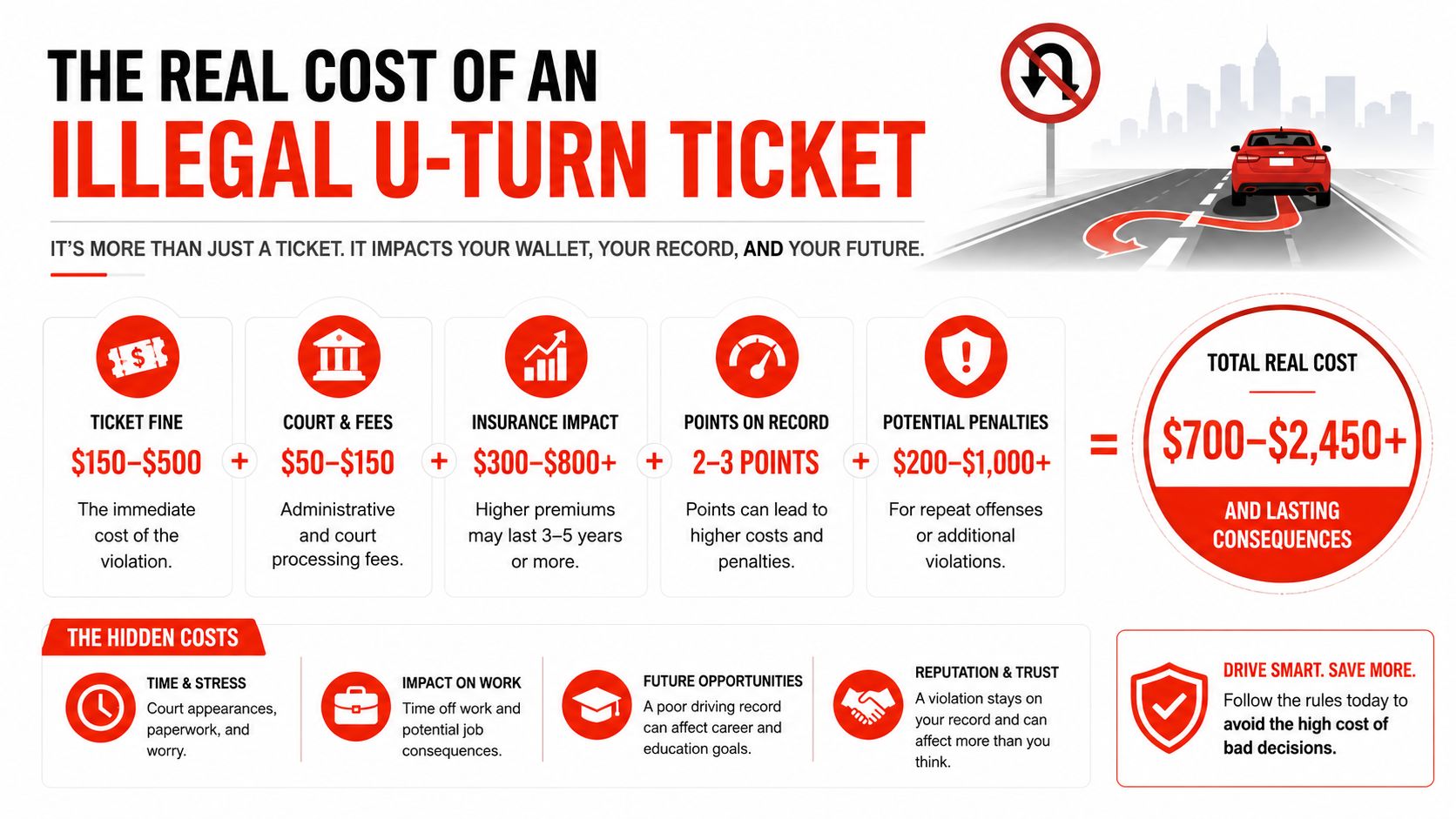
The Real Cost of an Illegal U-Turn Ticket

The number on the ticket is not the total cost. The more significant expense arises after the clerk records the conviction and your insurer sees it. In California, a published legal summary says an illegal U-turn citation can carry a typical fine of about $234 plus court costs and one DMV point, with some sources placing the fine in the roughly $200 to $400 range depending on the circumstances California illegal U-turn penalty summary. Florida doesn't mirror California's point system, but the lesson is the same. A moving violation follows you.
What the hidden costs actually look like
An illegal U-turn ticket can create a chain reaction. Your insurance company may treat it as a risk marker. If you drive for work, a citation can make your profile less attractive to platforms and employers that monitor driving history. And if you ignore it, you invite late fees, court trouble, and a worse outcome than the original stop.
That's why this is not a “pay it and move on” situation. It is a financial decision. The cheapest outcome is often the one where the ticket gets challenged early and strategically.
For a broader explanation of points and what they mean for your record, see Florida traffic violation points.
Penalty Type | Typical Consequence |
|---|---|
Initial citation | Immediate fine and court costs if you plead or are found guilty |
License record impact | A moving violation can affect your driving history |
Insurance impact | Potential premium increase after conviction |
Court process | Time, filing, and the hassle of appearing or responding |
Work consequences | Risk for drivers whose jobs depend on a clean record |
Why this matters even more for working drivers
If your job depends on driving, every mark on your record counts. That is especially true for delivery, rideshare, and fleet work. For a practical comparison on how employers and commercial operators think about compliance risk, the Fleetalyse driver hours guidance is useful background on how small violations can become larger operational problems.
Building Your Strategic Defense
Do not just show up and hope the court sees it your way. That is not a strategy. A real defense starts with preserving the scene before anything changes.
Gather the evidence immediately
Take photos from multiple angles. Get the sign, the lane markings, the curb line, the approach path, and the view from the driver's seat. If there was dashcam footage, save it now and back it up more than once.
Photograph the intersection: Capture the full area, not just the spot where you turned.
Record the sightlines: Show what you could see from the car.
Document the signage: Note whether the sign was visible, blocked, faded, or missing.
Save dashcam video: Preserve the file before it gets overwritten.
Write down the details: Time, traffic level, weather, and what the officer said.
Those details matter because they let an attorney argue facts, not guesses. If the turn was safe and the road conditions were unclear, that's not a loophole. It's your defense.
Attack the weak points in the stop
An experienced lawyer will look at the officer's vantage point first. Could the officer see your lane clearly? Was the car behind you, across the intersection, or too far away to observe the full maneuver? Did the citation match what really happened?
If the road design was confusing, that helps too. A narrow approach, limited sight distance, or poor signage can all undercut the state's version. For a broader approach to fighting traffic cases, see how traffic tickets are challenged.
Bottom line: the best defense is built from photographs, timing, and a clean legal argument, not from excuses.
This is also where lawyer-led help matters. Ticket Shield, PLLC handles traffic cases with direct attorney communication, which means you can ask questions by phone or text instead of waiting on an app queue. That difference matters when your record is on the line.
Why Automated Apps Are a Gamble You Cannot Afford
A ticket app sounds easy until you realize nobody is really steering the case. You upload a citation, answer a few prompts, and hope someone behind the curtain knows what they're doing. That's not representation, that's a gamble.
Direct attorney access changes the quality of the defense
You need someone who can read the citation, spot the weak facts, and decide whether to push for dismissal or reduction. Automated services tend to flatten every case into the same process. Traffic defense does not work that way.
If you want to understand how to separate real legal help from gimmicks, the guide to spotting AI video is a useful reminder that polished output is not the same as reliable judgment. The same logic applies here. A slick interface is not a strategy.
Protective rule: if you can't talk to the attorney handling your case, you don't really control the defense.
What you should demand instead
You should want direct access, clear communication, and a real plan. You should know who is reviewing the citation, who is preparing the argument, and how your case is being handled. That is the model clients get from Ticket Shield's local-lawyer approach.
Not every service is built the same. Some are just intake pipelines. Others are lawyer-led and client-facing from the start. If your license matters, choose the one where the attorney knows your name, your facts, and your goals.
Your Next Step to Protect Your License and Get No Points
Paying the ticket is the easy path, and it's the wrong one. It locks in the conviction, and it leaves you with no room to fight the fallout. You do not have to accept that outcome.
Visit TicketShield.com now for a free consultation. Submit your ticket, get direct attorney review, and put a real Florida defense in motion. If your goal is No Points on your license, the time to act is right now, not after the court deadline passes. For the consultation process, see free traffic ticket consultation help.
A CTA for Ticket Shield, PLLC.
