Hardship License Florida
Hardship license florida. A step-by-step guide to getting a hardship license in Florida: eligibility rules, documents, the FLHSMV hearing, fees, denial reasons

You're looking at a suspended license, a work schedule you can't abandon, and a transportation problem that could become an employment problem. You may have heard that a hardship license Florida process can get you back on the road. That's only partly true.
Florida doesn't issue restricted driving privileges merely because driving would make life easier. You must first determine whether the reason for your suspension is eligible. Then you must complete the required steps in the correct order, document a genuine need, and present the case through the proper Florida Department of Highway Safety and Motor Vehicles process. A suspended license, a revoked license, and a hardship-eligible license are not interchangeable terms.
Table of Contents
What a Florida Hardship License Actually Allows
A Florida hardship license is a restricted driving privilege. It isn't a full return to normal driving. The Florida Department of Highway Safety and Motor Vehicles generally describes this privilege as limited to employment or business purposes, which means your approved driving must relate to maintaining work or supporting yourself and your family. You can't treat it as permission to drive whenever you choose.
Florida Statute 322.271 authorizes a person whose license has been suspended, canceled, or revoked to seek a restricted license by proving a serious hardship that prevents normal work and that limited driving is necessary for support. The standard is necessity, not convenience. The fact that public transportation is frustrating, a ride is expensive, or errands are difficult may not establish the economic burden the hearing officer needs to see. Read the statute directly through the Florida Legislature's text of Section 322.271.
The privilege is narrow
Your application should explain exactly why you need to drive and where that driving fits into your employment or livelihood. A vague statement such as “I need my license for everything” is weak. A work schedule, employer letter, job duties, and reliable proof of the consequences of missed transportation are much stronger.
The state process runs through a formal hearing. Relief isn't automatic, and paying a fee doesn't decide the case. You must prove that losing driving privileges creates a serious hardship and that restricted driving is necessary to support yourself or your family.
Practical rule: Treat the restricted license as a legal exception with conditions, not as a replacement for an unrestricted license.
The Florida system also requires administrative preparation. Depending on the reason for the suspension, you may need an approved course, financial-responsibility documentation, reinstatement payments, and a hearing request through the appropriate local office. The exact reason on your driving record controls what path is available. Ticket Shield's overview of Florida hardship license restrictions can help you understand why the privilege is narrower than ordinary driving.
If your underlying issue involves another legal or administrative matter, keep those proceedings separate. A resource discussing bringing back a case after stricken off addresses a different procedural problem, but it illustrates an important point: legal status depends on the specific reason and procedural posture, not on a general label such as “closed” or “suspended.”
Determining Whether You Qualify for a Hardship License
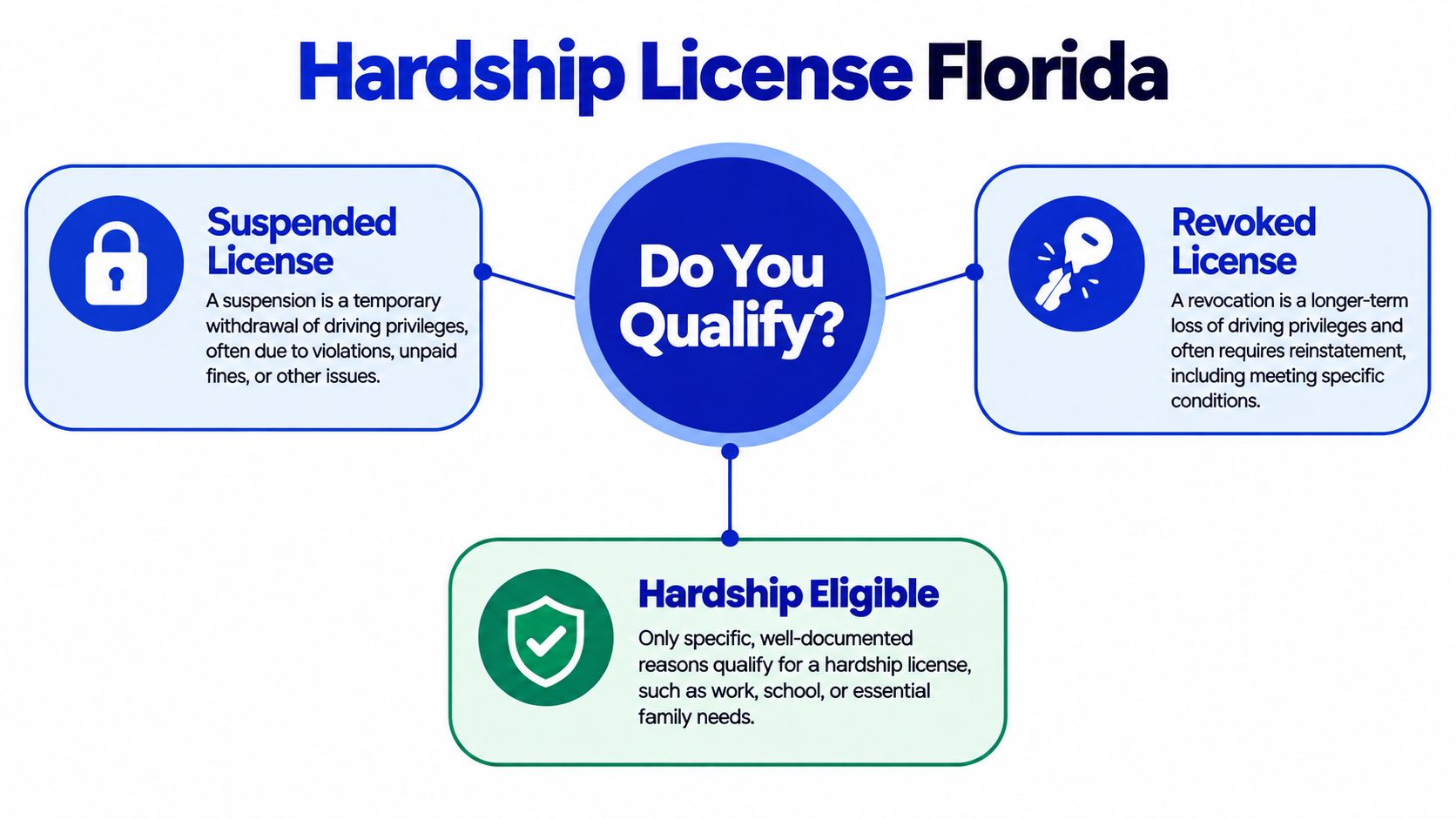
Start with the reason for the loss of your driving privilege. Don't start by gathering generic hardship letters or paying for assistance. Florida treats suspended, revoked, and hardship eligible as separate categories, and the reason attached to your record may end the inquiry before a hearing is available.
Florida's traffic-law backdrop is Chapter 316, the Vehicle and Traffic Control code. A specific provision such as Florida Statute 316.187 addresses traffic regulation, while the restricted-license rules are located in Chapter 322. The underlying violation and the later license action are connected, but they aren't the same legal question.
Reasons that may block the process
The Florida Department of Highway Safety and Motor Vehicles states that traffic citations and court suspensions aren't eligible for hardship consideration through the administrative hardship process. That's where many applications fail before the applicant even discusses hardship. A person can have a real transportation crisis and still lack access to this particular remedy.
Some other suspensions or revocations may be considered through a Bureau of Administrative Reviews office. That doesn't mean approval is guaranteed. It means the reason may fit a process in which you can present proof of serious hardship and necessity.
Review your driving record and suspension notice. Look for the legal reason, the effective date, the status of the license, and any conditions already listed. Don't rely on a verbal description such as “my license is suspended.” Ask what caused the suspension and whether the state identifies that reason as eligible for administrative hardship review.
Timing and eligibility limits
Some categories carry waiting periods before restricted driving can be considered. Other categories carry firm bars. Florida's administrative guidance explains that eligibility can depend on the type of action and the driver's prior history, so you need the precise record before choosing a filing strategy.
Use this quick self-audit:
Identify the action: Determine whether the record says suspended, canceled, or revoked.
Identify the cause: Separate a traffic citation or court action from an administrative license action.
Check the office: Confirm which local Bureau of Administrative Reviews or Administrative Reviews Office handles the matter.
Confirm conditions: Find out whether coursework, insurance filings, payments, or a waiting period apply.
Test necessity: Ask whether you can prove a direct connection between restricted driving and your employment, education, treatment, or family support.
Your points history may help explain how the state reached its decision, but it doesn't answer the hardship question by itself. For background on how Florida treats points and license actions, review this guide to Florida driver's license points.
Building a Document-Driven Hardship Case
A sympathetic story isn't enough. Hearing officers need evidence that connects your loss of driving privileges to a concrete hardship and shows why restricted driving is necessary.
Start with employment. Obtain a letter from your employer identifying your position, work location, schedule, required driving, and the consequences of missing shifts. Add recent pay records or other proof showing how your income depends on continued employment. If you work at multiple locations or must carry tools, equipment, or materials, document that requirement instead of assuming the hearing officer will infer it.
Build the packet around necessity
School and medical records may matter when they directly support the hardship claim. Use enrollment documentation, attendance requirements, appointment records, treatment schedules, or provider documentation where relevant. Don't submit unrelated personal material merely to make the packet thicker.
Your file should typically address:
Employment: Employer verification, work hours, location, job duties, and required on-the-job travel.
Financial dependence: Pay records or other documentation showing the harm caused by losing the job or reducing work.
Education: Enrollment and attendance records when school is part of the necessity argument.
Medical needs: Appointment records and treatment documentation when transportation is essential.
Course completion: Proof of the required Advanced Driver Improvement school or other mandated coursework.
Compliance documents: Any insurance filing, reinstatement receipt, or official form required for your specific suspension.
Organize the documents in the order a hearing officer will ask questions. Put a short written explanation at the front, then support each factual statement with a document. Your work schedule should match the employer letter. Your claimed financial hardship should match your employment evidence. Contradictions create doubt.
A clean packet doesn't replace eligibility. It proves the eligible hardship clearly.
Broad statements such as “my family needs me to drive” rarely carry the same force as a documented schedule showing why alternative transportation won't preserve employment. Don't exaggerate. Don't submit altered records. If a document doesn't support a specific point, leave it out.
You can also use a practical preparation checklist before appearing in any administrative setting. Ticket Shield's guide on what to bring to traffic court concerns a different forum, but the underlying discipline is useful: bring organized, relevant records and know what each document proves.
Filing Your Application and the FLHSMV Hearing Process
The order matters. A strong hardship case can stall if you request the wrong hearing, use the wrong administrative district, or complete a required condition after the filing deadline.
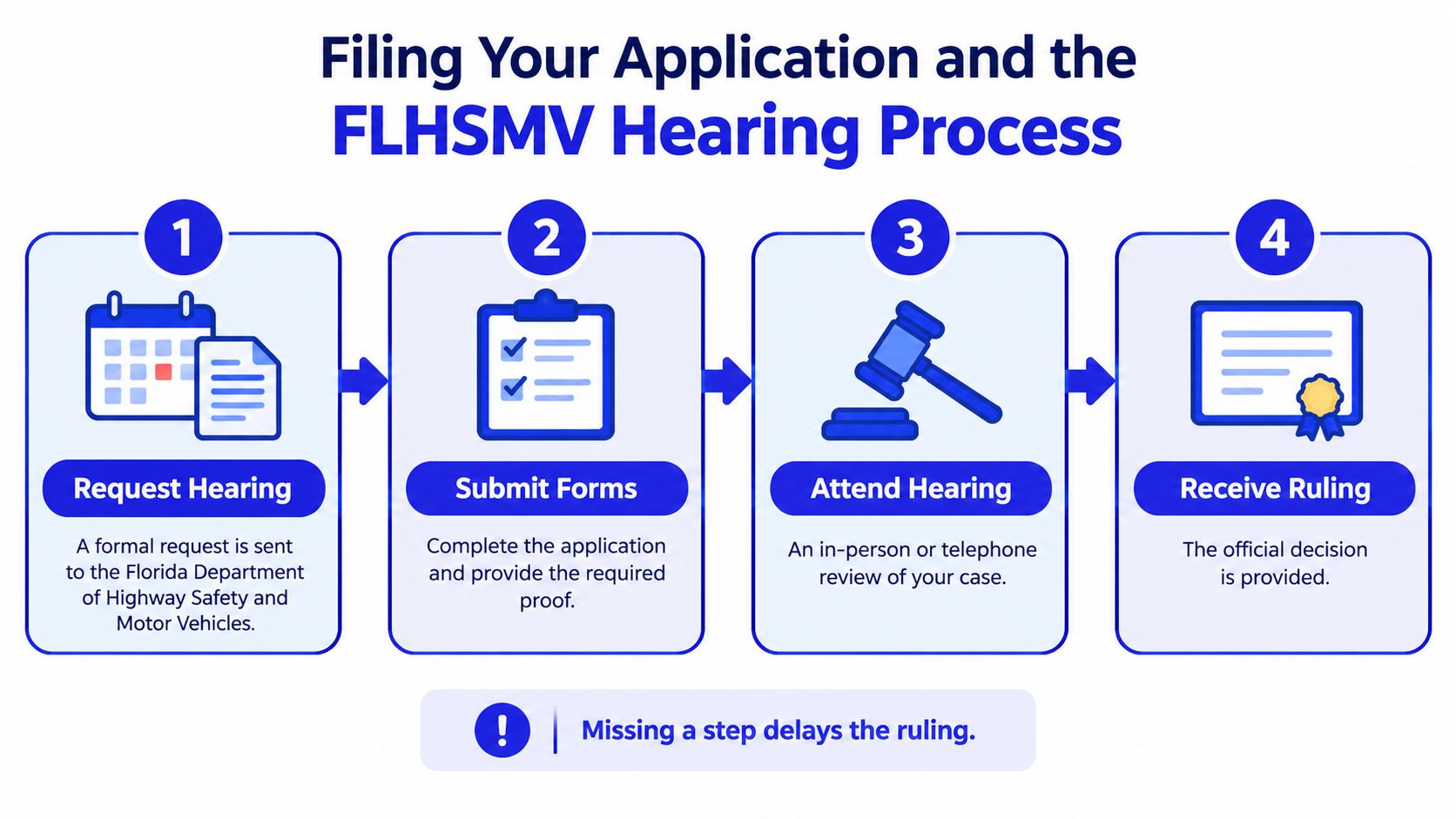
Begin with the Florida Department of Highway Safety and Motor Vehicles and the local Administrative Reviews Office handling your record. Request the appropriate hearing and confirm the filing requirements before submitting anything. Under the hearing process described in the Florida Senate bill analysis, the department must hold the hearing within 30 days after the request. That window doesn't excuse incomplete paperwork, so use the time to assemble the evidence rather than waiting until the hearing date.
Complete the compliance gates
Florida requires proof of completion of an Advanced Driver Improvement school for many hardship-license applicants. You also need to pay the reinstatement fee and any other applicable license fees. The state charges a $12 hardship hearing filing fee, as explained by FLHSMV's guidance on other suspensions and revocations.
The sequence should look like this:
Confirm eligibility. Verify the suspension reason, status, district, and any waiting period.
Complete required education. Finish the mandated Advanced Driver Improvement school and obtain proof.
Confirm financial responsibility. Determine whether your record requires an SR-22 or FR-44 filing, then verify that the correct filing is active.
Pay required charges. Pay the reinstatement fee, applicable license fees, and the hardship hearing filing fee.
Request the hearing. File through the proper local Administrative Reviews Office.
Submit supporting proof. Provide employment, school, medical, insurance, and compliance documentation that directly supports necessity.
Attend and answer precisely. Explain what you need to drive for, when you need to drive, and why the hardship is serious.
At the hearing, the burden is on you. You must show serious hardship preventing normal business, occupation, trade, or employment, and demonstrate that driving is necessary to support yourself or your family. Don't turn the hearing into a general complaint about inconvenience. Focus on facts, documents, and the restricted driving you need.
The hearing officer reviews eligibility and the evidence before issuing a decision. If the privilege is granted, follow every condition. FLHSMV states that a restricted privilege can still be revoked if you violate its terms.
For more detail about preparing for the administrative process, see Ticket Shield's explanation of an administrative license suspension hearing.
Before the hearing, write down the exact trips you expect to make. If you can't explain how each trip supports employment, education, medical treatment, or another approved necessity, don't assume the restricted privilege covers it.
Why Hardship License Applications Get Denied
Paying fees doesn't automatically restore driving privileges. Florida treats reinstatement as a compliance process, and one missing requirement can stop the application even when the hardship is genuine.
Audit the common failure points
Wrong suspension reason: Traffic citations and court suspensions aren't eligible for this administrative hardship path. Confirm the cause before filing.
Incomplete coursework proof: Saying you completed Advanced Driver Improvement school isn't enough if the state can't verify it. Obtain the official completion documentation.
Unpaid charges: Reinstatement fees and applicable license fees must be addressed. Keep receipts and confirm that the payment posted.
Missing insurance filing: Some pathways require SR-22 or FR-44 financial-responsibility coverage. Confirm which filing applies and make sure it's active before the relevant step.
Wrong administrative district: Filing with the wrong office can delay or derail the request. Confirm the office serving your record.
Weak hardship evidence: A general statement about inconvenience won't replace work schedules, employer proof, school records, or medical documentation.
Violation after approval: A restricted privilege remains conditional. Driving outside its permitted purpose can lead to revocation.
The most common mistake is bad sequencing. Applicants complete a course but fail to activate the required insurance filing. Others pay charges but never request the proper hearing. Some gather persuasive employment records but discover that the suspension reason isn't eligible.
Before you file: Confirm the reason, complete the course, activate the correct insurance filing, pay the required charges, and verify the proper administrative district.
For a separate overview of reinstatement documentation and compliance planning, you can review this reinstatement guide. The legal rules differ, so don't substitute another jurisdiction's process for Florida's requirements.
When to Hire a Lawyer for Your Hardship License
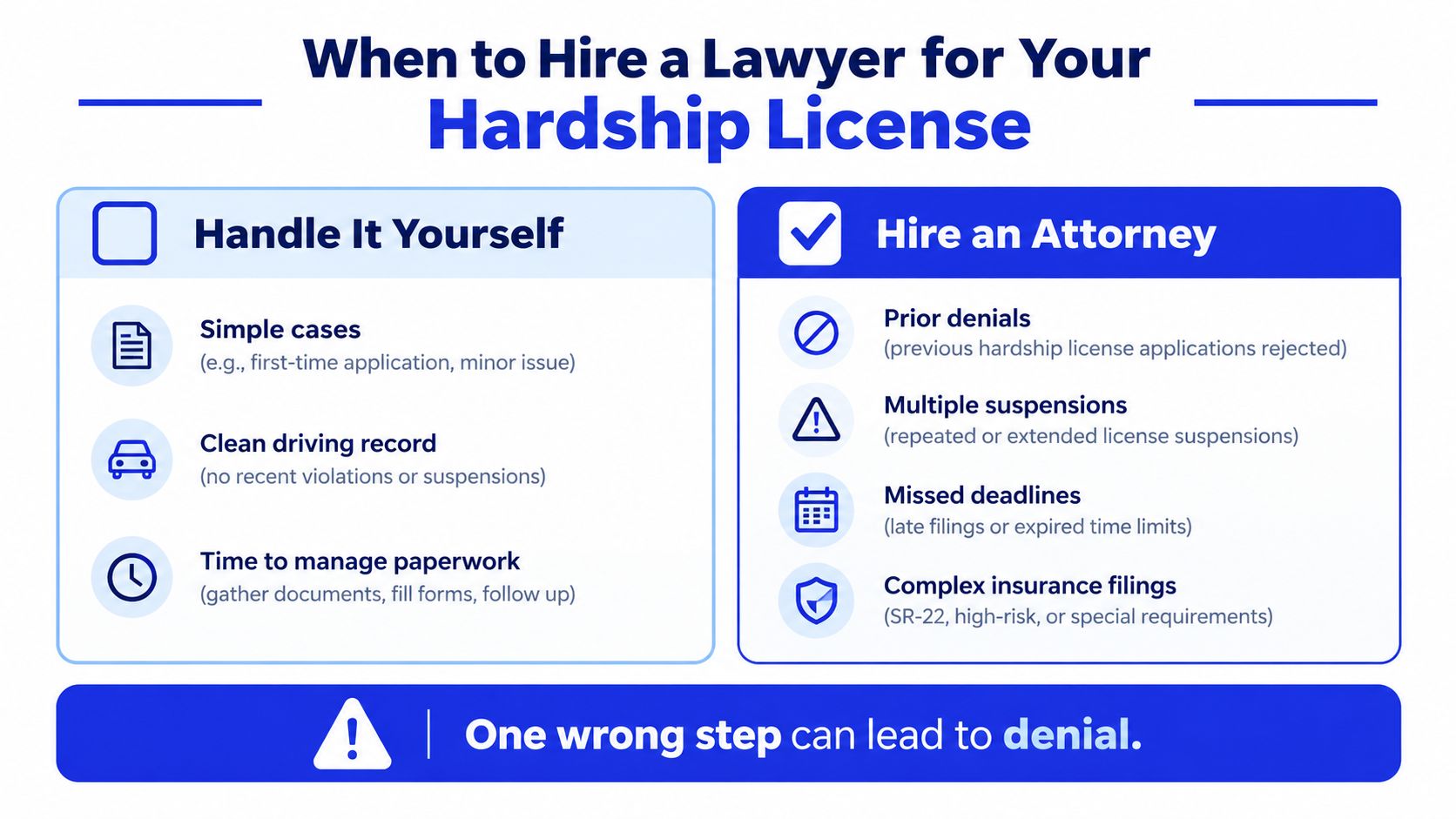
Handle the process yourself only when the record is straightforward, the eligibility question is clear, the documentation is complete, and you have time to manage every administrative detail. If you've already been denied, have multiple license actions, face a complicated insurance filing, or can't determine which office has authority, professional help becomes a practical safeguard.
One missed sequence can stall the application. A lawyer can identify the reason for the suspension, separate an eligible matter from an ineligible one, prepare evidence around necessity, and address procedural defects before they cost you more driving time.
Don't confuse automation with representation
Automated apps and ticket mills often place a middleman between you and the person handling the file. Corporate answering services and automated chatbots may collect information, but they don't replace direct legal judgment at a hearing. A hardship-license case requires someone to understand your record, challenge unclear assumptions, and tell you what you can legally do next.
A lawyer-led firm should let you communicate directly with your attorney by phone or text. That direct access matters when an administrative deadline is approaching, an insurance filing is rejected, or the hearing officer raises a question your initial paperwork didn't anticipate.
Use this hiring checklist:
Florida-only experience: Confirm that the lawyer regularly handles Florida license suspensions and administrative reviews.
Direct attorney access: Ask whether you'll speak with your attorney by phone or text instead of a call center.
Value-driven pricing: Request a clear explanation of what the fee covers, including preparation, filing, and hearing representation.
Local familiarity: Ask whether the lawyer understands the Administrative Reviews Office handling your record.
Hearing strategy: Demand a specific plan for proving serious hardship and necessity.
Compliance review: Confirm that someone will verify coursework, payments, insurance filings, and eligibility before filing.
Ticket Shield, PLLC is one Florida option that describes a lawyer-led service with direct attorney communication by phone or text rather than middlemen, corporate answering services, or automated chatbots. Before hiring any firm, compare its scope of work, pricing, communication policy, and plan for your suspended license matter in Florida.
Don't hire someone merely because the office promises a quick approval. No lawyer can guarantee that result. Hire counsel when you need a reason-specific eligibility analysis, an organized evidentiary packet, correct sequencing, and a person who will answer for the strategy.
Protect Your Driving Privilege Starting Today
The strongest hardship-license strategy is preventing the suspension from becoming your problem. Address the underlying traffic matter early, protect your record, and avoid points whenever Florida law allows a strategic defense. The ultimate goal is “No Points” on your license, not a restricted privilege after the damage is done.
Review your record now. Identify the reason for any suspension, preserve every notice, and don't drive until you know exactly what your current status permits.
Visit Ticket Shield, PLLC for a free consultation about your Florida license situation. A lawyer-led team can review the underlying matter, explain the hardship process, and pursue a strategy focused on protecting your driving privilege and achieving “No Points” on your license.