FL Seat Belt Law: What to Know to Protect Your Record
Confused by the FL seat belt law? Learn the rules, penalties, and how a ticket impacts your record. A dedicated attorney can help you fight to avoid points.

A seat belt ticket in Florida can cost more than a small fine. Under Chapter 316, it can put points on your license, affect insurance, and hurt future claims. Don't just pay it. Review the citation fast and fight it strategically.
You were probably driving home, heading to work, or moving through traffic when the stop happened. Then the officer handed you a citation that looked minor. It isn't.
A Florida seat belt ticket starts a legal process under Chapter 316 of the Florida Statutes. If you handle it badly, you can create a record problem, an insurance problem, or both. If a child was involved, the stakes are even higher. I've seen drivers treat these citations like parking tickets. That's a mistake.
Florida has enforced seat belt rules for decades. By 1986, Florida had enacted its own Safety Belt Law, codified in Chapter 316 of the Florida Statutes, which initially focused on children. Over time, Florida expanded this to cover all drivers and front-seat passengers, and then to all occupants under 18 by the 2009 primary enforcement update, part of a trend that raised U.S. seat belt use to 89.7% by 2017 according to this Florida seat belt law history overview.
If your stop came after a crash, your records matter even more. Medical paperwork often uses abbreviations that confuse people, so this plain-English guide on MVA medical terms explained can help you read your treatment notes correctly while your ticket and insurance issues are unfolding.
Table of Contents
Your Guide to the Florida Seat Belt Law
The Florida seat belt law is stricter than many drivers realize. Once an officer writes the citation, your goal is simple. Protect your record and avoid points if possible.
The legal backbone is Fla. Stat. § 316.614, part of Chapter 316. That statute controls who must be restrained, when the stop can happen, and how enforcement works. If your ticket involves a child restraint issue, Fla. Stat. § 316.613 also comes into play. Those two statutes are where a real defense starts.
Practical rule: If you've already started thinking, “It's only a small ticket,” stop. Paying first and asking questions later is how drivers create permanent problems from fixable citations.
A seat belt case also turns on details that many people miss. Where were you seated? Who was in the car? Could the officer see what they claim they saw? Was there a lawful exemption? Was the child seat compliant and properly installed? Those facts decide whether the ticket is straightforward or defensible.
If your case is set near Miami, these issues are handled in places like the Richard E. Gerstein Justice Building. Judges there see drivers every day who waited too long and weakened their ability to negotiate.
What Are Florida's Core Seat Belt Requirements
Florida doesn't leave much room for guesswork on the main rule. The statute tells you who must be restrained and when law enforcement can stop a vehicle based on that issue alone.
Under § 316.614(4), it is a primary offense for any person to operate a motor vehicle unless each passenger and the operator under 18 are restrained by a seat belt or child restraint. For adults in the rear seat, however, it is a secondary-enforcement issue, as stated in the text of Fla. Stat. § 316.614.
Who has to wear a seat belt
Start with the clearest categories.
Drivers: You're required to wear a seat belt.
Front-seat passengers: They must be properly restrained.
Anyone under 18: They must be restrained, no matter where they're sitting.
Adult rear-seat passengers: Their situation is different. That issue is not primary enforcement.
That last point matters because many drivers hear “rear seat” and assume “no law applies.” That isn't accurate. It means enforcement works differently. It does not mean the issue disappears.
What primary enforcement actually means
Primary enforcement means the officer does not need some other reason to stop the vehicle first. If the officer claims they observed an unrestrained person in a category covered by primary enforcement, that observation alone can trigger the stop.
That creates two immediate defense questions. First, could the officer see what they say they saw? Second, does the citation match the seating position and age of the person involved? Those points often get lost when drivers use a form-based service instead of getting legal review.
If you're trying to sort out whether this kind of citation is treated as a moving offense and why that matters to your record, read is a seat belt ticket a moving violation. It helps frame the risk before you decide how to respond.
Officers don't win these cases just because they wrote them. They still need a legally supportable observation that fits the statute.
What Are the Immediate Penalties for a Violation
The first cost you see on a seat belt ticket is rarely the full problem. The citation amount gets your attention, but the damage can spread into points, court handling, and insurance consequences.
The major enforcement shift happened in 2009, when the Dori Slosberg and Katie Marchetti Safety Belt Law made violations a primary offense. Violations typically carry a base fine of $30 for an adult, $60 for an unrestrained child, and Florida courts may assign up to three points on a driver's license, according to this summary of Florida seat belt penalties.
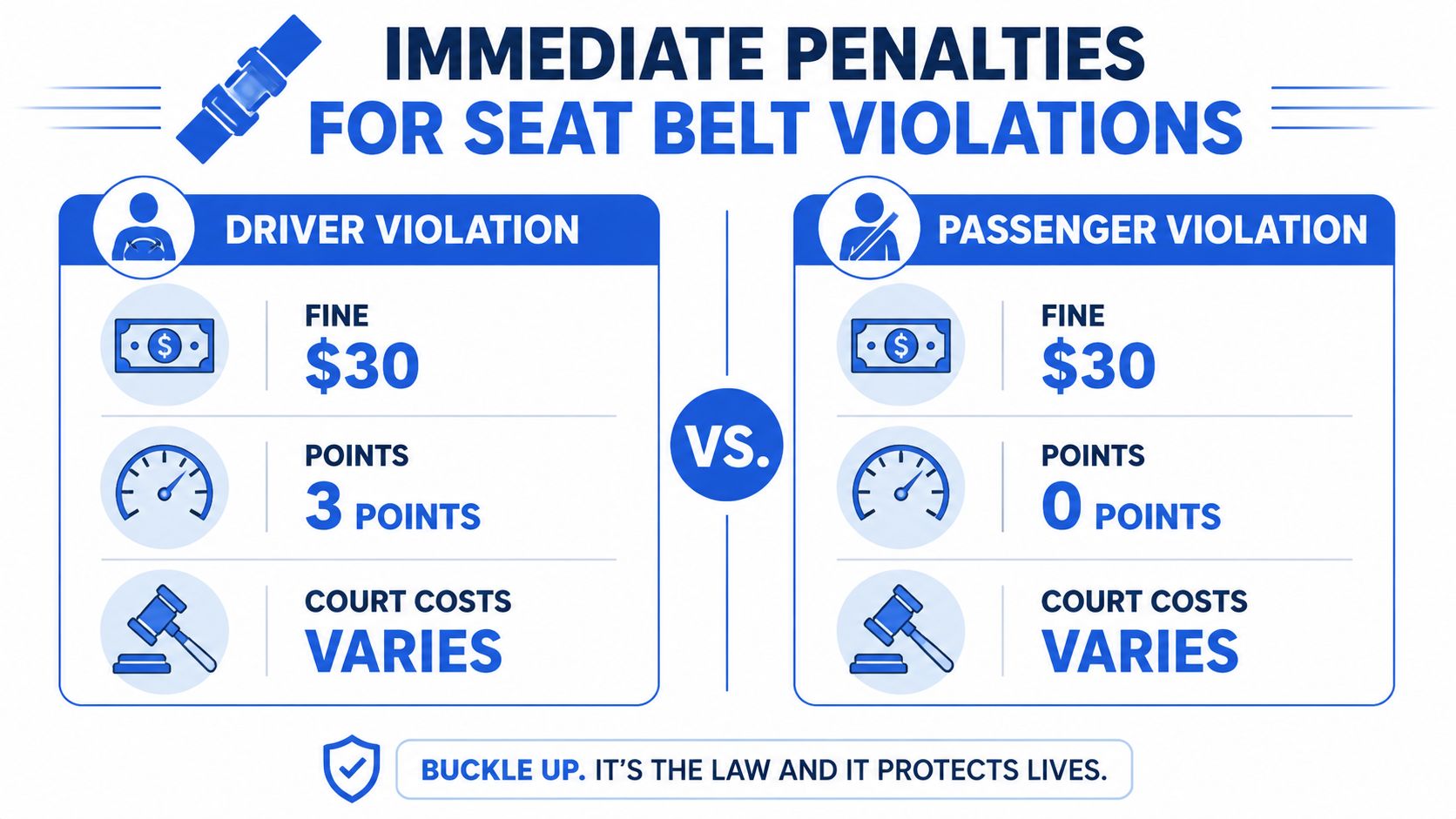
What the ticket can cost right away
The base fine is the headline. It shouldn't be your focus.
What matters is this:
Adult violation: The base fine is typically $30.
Child restraint related violation: The base fine is typically $60.
License exposure: Courts may assign up to three points.
Financial spillover: Court costs can add more expense, and the record impact can follow you.
That's why paying a citation quickly is often the wrong move. You're not just resolving a bill. You're closing the door on defenses you haven't explored yet.
If you want a clearer breakdown of how these tickets can add up beyond the face amount, review what seat belt tickets cost in Florida.
Florida seat belt violation penalties at a glance
Violation Type | Enforcement Level | Base Fine | License Points |
|---|---|---|---|
Adult seat belt violation | Primary offense under the 2009 enforcement change | $30 | Up to 3 points |
Unrestrained child violation | Primary offense | $60 | Up to 3 points |
Adult rear-seat passenger issue | Secondary-enforcement issue | Qualitatively depends on citation circumstances | Qualitatively depends on charge handling |
A seat belt citation looks small on paper. On a driving record, it can become much more expensive.
Are There Any Legal Exceptions to the Law
Yes, but don't assume you have one. In seat belt cases, “I thought I was exempt” is not a defense unless the facts and documentation support it.
Where drivers get confused
Most exemptions are narrow. The ones that matter usually involve specific vehicle categories or a valid medical basis supported by proper certification. In child restraint cases, the technical compliance of the device itself can become important too.
Common areas where exemption arguments may arise include:
Medical issues: A claimed medical exemption needs proper support. If you don't have the right documentation, that argument can collapse fast.
Certain work vehicles: Some limited vehicle-use situations can create exceptions under the statutory framework.
Older vehicles: Vehicle age and factory equipment can matter in some cases, but drivers often overread this point.
Rear-seat adults: This is not a free pass. It's a different enforcement posture.
Why the rear seat issue still matters
Florida does not treat adult rear-seat passengers the same way it treats drivers, front-seat occupants, or people under 18. But drivers make a serious mistake when they turn that into “it doesn't matter.”
While Florida law exempts adult rear-seat passengers from primary enforcement, insurers often cite non-use in post-accident negotiations. IIHS data shows rear-seat injuries are disproportionately severe for unbuckled occupants, and insurers use this data in their internal claim-adjustment models regardless of the law's mandate, as explained in this discussion of rear-seat seat belt risk in Tampa cases.
That means the courtroom issue and the insurance issue can move in different directions. You might avoid one problem and still face another. A real lawyer spots that split early. An automated system usually doesn't.
How Do Child Restraint Laws Increase the Stakes
A child-related citation is not a routine version of an adult seat belt ticket. It's a more technical case, a more exposed case, and a case that can go bad quickly if you handle it casually.
Under Florida Statute § 316.613, children age 5 and younger must be in a federally approved child restraint device. Specifically, ages 0–3 must use a separate carrier or integrated seat, while ages 4–5 may use a carrier, integrated seat, or booster. Noncompliance triggers heightened fines and points, according to this explanation of Florida child restraint requirements.
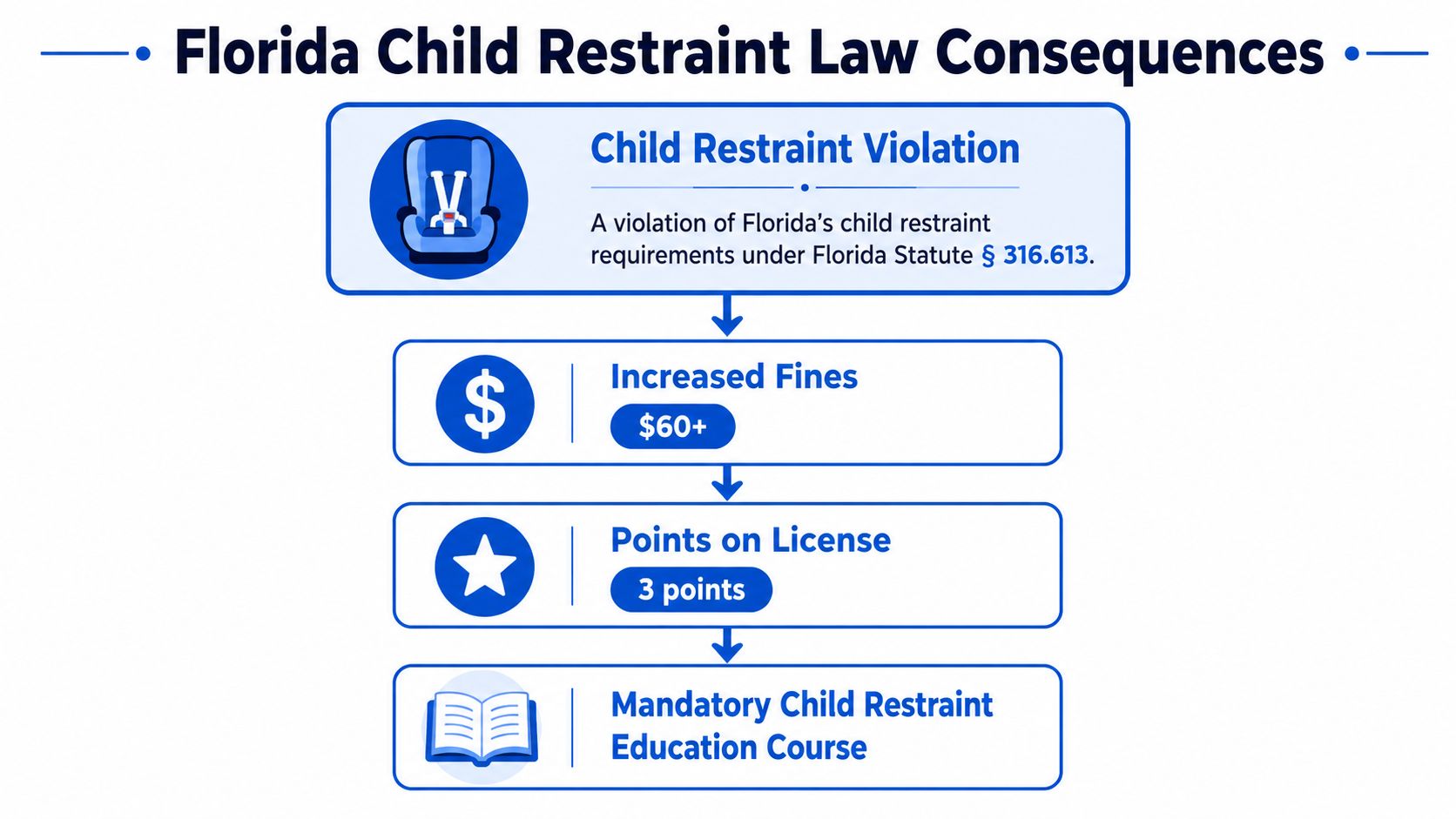
The age based rules are technical
Drivers often find themselves in a bind. They know the child was “in a seat,” but they don't know whether the seat fit the statute, the child's age bracket, or the installation requirements.
Use this framework:
Ages 0 through 3: Separate carrier or integrated child seat.
Ages 4 through 5: Carrier, integrated child seat, or booster.
Approved equipment matters: The device must be federally approved.
Installation matters too: A good seat used badly can still create a citation problem.
If you're trying to figure out whether your child was developmentally ready to transition, this practical guide on determining booster seat readiness is useful context. It won't replace legal advice, but it can help you evaluate whether the issue was fit, age, or officer misunderstanding.
For a Florida-specific look at booster seat rules and how they intersect with enforcement, read booster seat age in Florida.
Why these cases are harder to fix after the fact
Once a child restraint citation is written, your defense often depends on facts you need to preserve immediately. Photos of the seat. Model information. Installation position. Harness setup. The child's age. The officer's actual viewing angle.
Child restraint tickets are won or lost on details. Drivers who wait usually lose the details first.
These cases also carry a public-safety dimension that courts take seriously. Judges don't like vague explanations. They want specifics. If your argument is strong, it needs documents and facts behind it.
How Can This Ticket Damage Your Driving Record and Insurance
Most drivers fixate on the fine. That's not where the long-term damage lives. The main threat is your record.
Your record is the real battlefield
A citation tied to license points can follow you into insurance underwriting, employer screening, and future traffic stops. If you drive for work, your risk gets worse. If you already have prior citations, your margin for error shrinks.
That's why you need to understand Florida's points structure before making any payment decision. This guide to the Florida license point system is a good starting point if you're trying to see the bigger picture.
The insurance side is less transparent, but it's very real. Carriers review driving history, not your personal explanation. They see conviction data. They price risk. Once the record is there, undoing the damage is much harder than preventing it.
Gig drivers face a different level of risk
If you drive for Uber, Lyft, DoorDash, or another platform, a seat belt issue can create more than a ticket problem. It can become an income problem.
For gig-economy drivers, seat belt non-use can complicate injury claims. While Florida's comparative negligence statute (§ 768.81) applies, insurers aggressively argue non-use worsened injuries, and drivers must counter this by highlighting work-related risk factors like fatigue or unfamiliar vehicles, as discussed in this analysis of seat belt defense and Florida comparative negligence.
That matters even if your immediate concern is just the citation. Why? Because one event can branch into two files fast. A traffic case and an insurance claim. Drivers using automated services often get a narrow, checkbox response to one issue while the other issue gets ignored.
If you earn money behind the wheel, your driving record is part of your livelihood. Treat it that way.
What Should You Do Immediately After Getting a Ticket
If you just got cited, act like the next few days matter. They do.
Paying the ticket is usually the worst first move because it can function as an admission that closes off strategic options. In places like the Orange County Courthouse in Orlando, judges see the same pattern all the time. Drivers act first, think later, then call a lawyer after the damage is done.

Immediate steps to take
Don't pay it yet: Payment can lock in consequences that might have been avoidable.
Read the citation carefully: Check the statute number, seating position, and any notes about age or restraint type.
Write down what happened: Do it while your memory is fresh. Time, lighting, where everyone sat, what the officer said, and whether tinted glass, angle, or movement could have affected visibility.
Preserve physical evidence: If the ticket involved a child restraint, photograph the seat, labels, installation, and vehicle interior.
Pull related records: Registration, medical exemption paperwork if any exists, and any documents that show vehicle configuration.
Get legal review fast: Delay helps the state, not you.
If you want a basic checklist before speaking with counsel, this guide on what to do when you get a ticket is worth reading.
Florida courts take child restraint citations seriously. Violations of child restraint rules under Fla. Stat. §316.613 are primary offenses with increased fines and points. These citations are strictly enforced in jurisdictions like the Main Judicial Center in West Palm Beach and the Duval County Courthouse in Jacksonville, according to this FDOT occupant protection FAQ. That should tell you exactly how casually not to treat this.
If you like comparing how different traffic statutes carry different consequences, this outside explainer on 2026 22348 b vc penalties is a useful example of how technical citation language can hide bigger practical consequences. It's not Florida law, but it does show why reading the code section matters before you plead out to anything.
Why a real lawyer beats an automated system
An automated app can collect your payment and route your file. It can't cross-examine an officer's observation. It can't evaluate whether the seating position alleged on the ticket even matches the statute. It can't text you after reviewing the citation and tell you what is important.
Some ticket services run like mills. You don't speak to the lawyer handling the case. You deal with intake staff, middlemen, or chatbots. That's efficient for them. It's not protective for you.
With Ticket Shield, PLLC, you're dealing with a lawyer-led Florida defense firm where clients speak directly with their attorney by phone or text. That matters in a seat belt case because the useful facts are often small, specific, and time-sensitive. A real lawyer can spot a line-of-sight issue, an exemption issue, a charging mismatch, or a proof problem that an automated system will miss.
Watch this short video if you want a quick sense of why immediate action matters:
Your objective is simple. No Points if possible. That starts with not handing the case away.
If you want to protect your record, avoid points, and get a real legal strategy instead of an automated response, visit Ticket Shield, PLLC for a free consultation. Go to TicketShield.com now and fight for the No Points outcome.