Is a Seat Belt Ticket a Moving Violation in Florida? | Ticket Shield
Is a seat belt ticket a moving violation in Florida? Usually no—adult citations typically mean no points, but they can still affect your record.

No. In Florida, an adult seat belt citation is generally treated as a non-moving violation rather than a moving violation, so it usually does not add standard license points. The more important follow-up is practical: paying the ticket can still create a conviction record, and that record may matter to employers, insurers, or anyone whose driving history is closely reviewed.
Before you decide whether to pay or contest it, focus on three things: what the citation alleges, the response deadline listed on the ticket, and whether a conviction could create bigger problems than the fine itself. A common misunderstanding is assuming “no points” means “no consequences.” That is not always true.
At Ticket Shield, PLLC, our attorneys fight these citations across Florida. We review the ticket itself, the stop narrative, and whether the alleged violation fits the statute the officer cited. Our goal is to help drivers avoid unnecessary convictions while giving a clear answer about what is at stake.
Under Florida Statute 316.614, a seat belt citation is a non-moving violation in the usual adult case. That means a fine is common, but points usually are not. The distinction matters because "non-moving" describes how Florida classifies the offense for traffic purposes; it does not mean the ticket is invisible.
How We Reviewed Florida Seat Belt Ticket Consequences
We reviewed the current text of Florida Statute 316.614, Florida traffic-violation guidance on points and records, public safety guidance on seat belt enforcement, and insurer/public-agency explanations of how violations can affect underwriting. We also drew on our firm's experience reviewing Florida traffic citations to identify the questions drivers ask after receiving this kind of ticket.
We did not treat every seat belt citation as interchangeable. One thing we repeatedly see is that drivers lump together adult seat belt offenses, child-restraint allegations, and out-of-state rules even though they can be handled differently. That is why the answer here is specific to Florida and why the record-and-insurance discussion is separate from the points discussion.
What is the Real Danger of a "Non-Moving" Ticket?
A non-moving violation means the offense is not classified the same way as speeding, running a red light, or other violations tied to the operation of the vehicle while it is moving. In Florida, an adult seat belt ticket is generally in that non-moving category under section 316.614. That usually means no standard points for most adult drivers, even though the ticket still carries a fine and can still appear as a conviction if you pay it.
That distinction is why drivers ask about this so often. A conviction record is not the same thing as license points. Points are part of Florida's administrative system for suspensions and repeat-offender tracking; a conviction entry is part of the driver history insurers, employers, and background reviewers may examine. In our experience, many clients only learn that difference after they have already assumed a non-moving ticket is harmless.
So what should you worry about? Usually not immediate point accumulation. Instead, the main concerns are whether the citation becomes part of your driving history, whether your insurer treats it as relevant during underwriting or renewal, and whether your work requires a clean record. The CDC's explanation of primary enforcement seat belt laws helps explain why these citations are common: in states with primary enforcement, officers can stop a driver solely for observed seat belt nonuse.
All traffic violations fall into one of two categories.
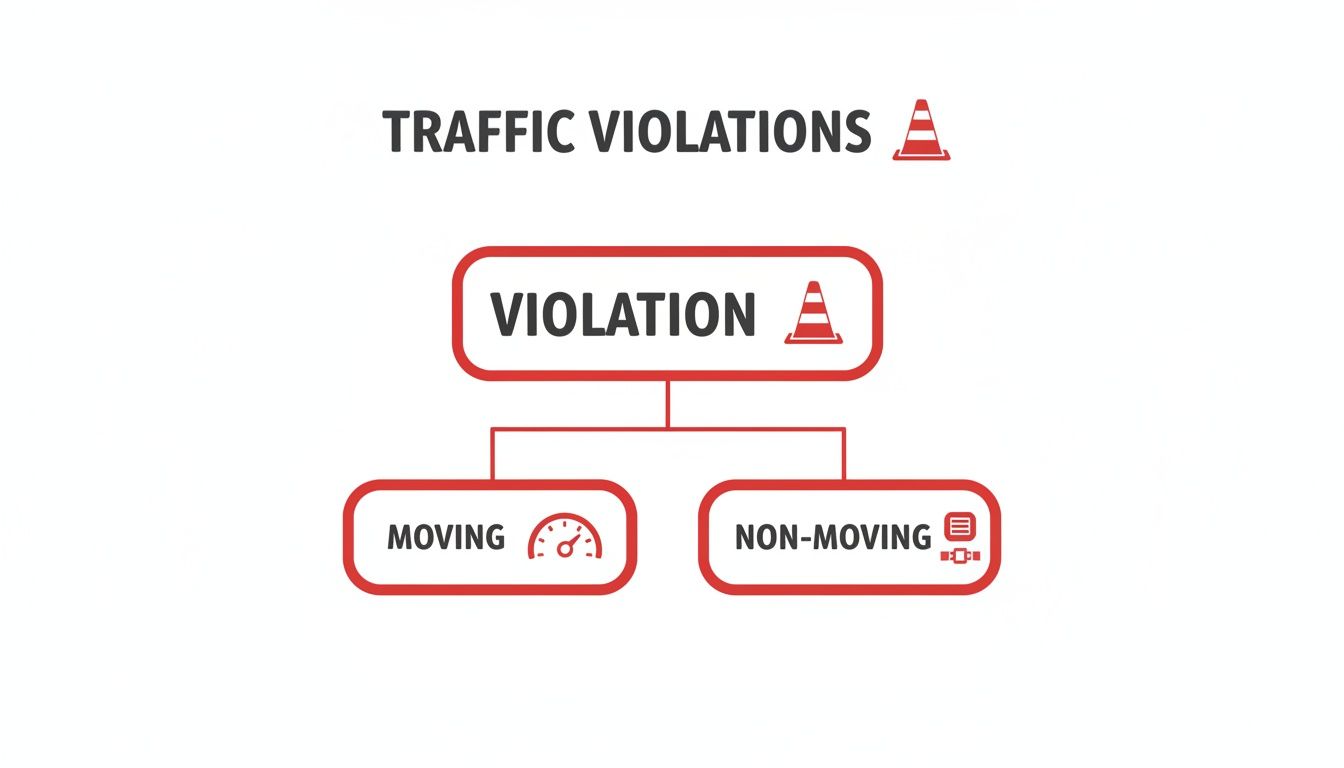
While the immediate penalties differ, both types of violations create long-term problems. The table below shows you exactly what is at stake.
How Do Moving vs. Non-Moving Violations Affect You in Florida?
Consequence | Moving Violation (e.g., Speeding) | Non-Moving Violation (Seat Belt) |
|---|---|---|
Points on License | Yes (typically 3-4 points) | No (unless you are a driver under 18) |
Immediate Fine | Yes, varies by severity | Yes, a standard fine |
Insurance Impact | High risk of rate increase | Can still trigger a rate increase at renewal |
Impact on Record | A permanent conviction on your record | A permanent conviction on your record |
CDL/Employment Risk | High risk to your employment | High risk for professional drivers |
For most adult Florida drivers, the key takeaway is simple: a seat belt ticket is usually non-moving and usually does not carry points. The notable caveat, already reflected above, is that youth-related situations and other restraint-related offenses can be treated differently. Nationwide, these classifications are not uniform; DrivingLaws notes that some states assign points or treat certain child-restraint violations differently depending on the passenger's age and the exact statute.
The second clarification is about insurance. Florida's point system and an insurer's underwriting system are not the same thing. An insurer may decide a non-moving conviction matters even if the state assigned no points, and public-facing insurer guidance commonly explains that traffic violations can affect premiums based on company rules and risk models rather than the DMV point total alone. You can learn more about what a non-moving violation is in our detailed guide.
This is also why context matters. We often tell drivers to stop thinking only in terms of the fine amount. If you drive for work, hold a CDL, or are already carrying prior violations, even a non-moving conviction may deserve closer review than the phrase “no points” suggests.
What is Florida Statute 316.614?
Florida Statute 316.614 is the state's Safety Belt Law. The current statute requires the operator of a motor vehicle, every front-seat passenger, and all passengers under 18 to be restrained by a safety belt or child restraint device when applicable, subject to the statute's specific definitions and exceptions in the current statutory text. In plain English, adult front-seat use is mandatory, and the driver's legal responsibility extends further when minors are in the vehicle.
The law also places direct responsibility on the driver for passengers under 18. That matters because some drivers assume each passenger is only responsible for themselves. Under the statute, that is not how it works for minors. In our review of these tickets, that is one of the most frequently overlooked details, especially when a parent, older sibling, or family member was driving.
Just as important, this is a primary enforcement law. That means an officer does not need a separate violation first. If the officer says they observed an unbelted driver or front-seat passenger, the seat belt violation alone can justify the stop. The CDC seat belt law overview uses the same primary-enforcement concept nationally: officers in primary-law states may stop and ticket for seat belt nonuse without another traffic offense.
What does the citation usually allege? In the ordinary adult case, it typically alleges that the driver or front-seat passenger was not restrained as required by section 316.614. The ticket may be brief, but the exact subsection, description, and location still matter. We regularly review whether the citation clearly matches the seating position, age, and circumstances the law covers.
What facts can matter in a defense review? Seating position is one. Age is another. Vehicle type can matter because not every vehicle situation is identical under Florida law. The officer's observation also matters: where the officer was positioned, lighting conditions, window tint, distance, and whether the observation was made before or after the stop can all affect how strong the allegation is. None of those facts guarantee a result, but they are the kinds of details a lawyer checks before advising whether a challenge is worthwhile.
What Are Your Immediate Steps After Getting a Seat Belt Ticket?
Your first decisions matter more than most drivers realize. Instead of treating the ticket as something you either instantly pay or instantly fight, use a short decision path.
Read the citation carefully. Confirm the statute listed, the alleged conduct, the county, and whether the ticket describes you as the driver or references a passenger-related violation.
Verify the deadline and court information. A missed response date can create extra problems that are far more serious than the original ticket.
Write down what you remember now. Note where you were seated, who else was in the car, what the officer said, where the officer was positioned, and anything unusual about visibility or the stop.
Compare the fine with the possible long-term cost. The immediate amount may look small, but the better question is whether a conviction could affect insurance renewal pricing, employer review, or your commercial driving risk.
Decide whether to contest it based on your record and job exposure. A clean driving history, a work vehicle policy, prior violations, or a CDL can all change the value of fighting the citation.
This is the practical question behind “is it worth it to fight?” Sometimes the answer is yes even when the fine itself is modest. We especially recommend a closer review for CDL holders, drivers who already have other violations, anyone whose employer monitors motor vehicle records, and anyone shopping for or renewing insurance soon. In our experience, those drivers have more to lose from a conviction entry than they initially assume.
You should also avoid making the mistake of treating payment as an administrative shortcut. Paying usually closes the case, but it also usually means accepting the violation rather than testing whether the officer's allegation is accurate or legally sufficient. Unlike generic ticket services, legal review can focus on factual issues in the stop and procedural issues in the citation itself. You can learn more about what’s at stake from the true cost of a seat belt ticket in our guide.
Why Should You Hire an Attorney for a 'Simple' Seat Belt Ticket?

It is easy to dismiss a seat belt ticket as "no big deal." Since it is a non-moving violation, many drivers believe paying the fine is the simplest option. But the better question is whether convenience today is worth a conviction entry on your record.
An experienced traffic attorney from Ticket Shield can review the citation, the officer's observations, and whether the statute was applied correctly. The goal is to identify whether there is a sound basis to challenge the ticket and, where possible, avoid an unnecessary conviction on your driving record.
When you hire our firm, a real lawyer—not an automated app—personally reviews your citation for legal errors. We handle all negotiations and court appearances for you, whether in Tampa's Edgecomb Courthouse or elsewhere in Florida. You never have to go to court.
At Ticket Shield, you communicate directly with your dedicated attorney by phone or text. We provide a personalized, strategic defense that automated “ticket mill” services cannot match.
While seat belts save lives, Florida's primary enforcement law makes these citations common. To understand the value of a professional defense, it's worth learning why you should hire an attorney for any traffic ticket.
How Can You Protect Your Driving Record?
Direct answer: In Florida, a seat belt ticket is generally a non-moving violation, not a moving violation, for an adult driver. That usually means no standard points, but it does not automatically mean no record consequences.
What the consequences usually are: the ticket can carry a fine, and paying it can create a conviction entry on your driving history. That record issue is separate from points. Depending on the insurer, a non-moving conviction may still be considered during underwriting or renewal, which is why many drivers worry about premium changes even when the state assigned no points. For context, seat belt penalties and classifications vary sharply by state; the California Office of Traffic Safety's seat belt campaign page highlights how fine amounts can differ dramatically across jurisdictions.
Your options: pay the ticket and resolve it quickly, or contest it if the record impact matters more than the convenience of immediate payment. A legal review can help identify factual or procedural defenses, such as whether the officer's observation was reliable, whether the statute fits the seating and age facts, or whether the citation was completed correctly. If you want to understand how Florida separates points from other traffic consequences, review the Florida traffic ticket point system.
If you want a lawyer to review the citation before you decide, Ticket Shield can assess the ticket and explain whether contesting it makes sense in your situation.
Frequently Asked Questions
Is a seatbelt ticket a moving violation in Florida?
Usually no. For an adult driver or adult front-seat passenger, a seat belt citation under Florida law is generally treated as a non-moving violation. That typically means no standard license points, although the citation can still matter as part of your driving history.
Does a seatbelt ticket go on your record?
If you pay the ticket and the case is resolved as a conviction, it can appear on your driving record. That is separate from whether points were assessed. In our experience, this is the part drivers miss most often because they assume “non-moving” means the ticket disappears.
What kind of violation is a seatbelt ticket?
In Florida, it is generally a safety-related non-moving violation for adults rather than a classic moving offense like speeding. The exact treatment can change in other states or in cases involving minors or child-restraint laws, which is why out-of-state advice is often misleading.
Is it worth it to fight a seatbelt ticket?
It can be, especially if you drive for work, hold a CDL, already have prior violations, or are concerned about insurance renewal pricing. The smaller the fine, the more tempting it is to pay immediately—but the better question is whether a conviction could cost more over time than the ticket itself.
Does a seat belt ticket add points in Florida?
For most adult drivers, it usually does not. Florida generally treats an adult seat belt citation as a non-moving violation with no standard points, though youth-related or different restraint offenses can involve different consequences.
Can an officer pull you over only for not wearing a seat belt in Florida?
Yes. Florida's seat belt law is a primary enforcement law, which means an officer can stop a vehicle based solely on an observed seat belt violation. That is one reason these tickets are common even when no other traffic offense is alleged.