Booster Seat Age Florida: Laws & Risks 2026
Confused about the booster seat age florida in 2026? Know F.S. 316.613, risks, points, and fines. Our defense firm can help. Contact us for guidance.
In Florida, booster seat rules changed. Before July 1, 2026, the legal minimum generally stopped after age 5. As of July 1, 2026, children ages 6 through 8 must use a booster unless they're at least 4'9" tall. A ticket can mean points, fines, and insurance pain.
You're probably here because you're trying to do the right thing for your child and stay out of trouble. That should be simple. In Florida, it hasn't been.
The problem with booster seat age florida searches is that drivers often find mixed answers, old pages, and half-explanations. One site talks about age. Another talks about height. Then an officer writes a citation based on what they believe should have happened in your back seat. That is where careful drivers get trapped.
I see this issue the same way I see many Chapter 316 tickets. The law looks minor. The consequences aren't. A child restraint citation can hit your license, your insurance, and your wallet. If you drive for work, it can also threaten your income.
Florida Statute §316.613 is the starting point. It is not the end of the risk. The gap between the legal minimum and real-world enforcement is exactly where drivers get burned.
If you're already holding a citation, treat it seriously. Paying it without a defense is usually the wrong move. If you're trying to avoid one, you need the law, the practical rule, and the enforcement reality.
Table of Contents
What Are Florida's Exact Booster Seat Requirements By Law
A lot of Florida drivers get this wrong because they rely on old advice, a store clerk, or a quick search result instead of the statute. That is how a routine school pickup turns into a traffic stop and a citation.
Start with the rule that applied before the July 1, 2026 change. Under Florida Statute §316.613, children aged 4 through 5 years must be secured in a crash-tested, federally approved child restraint device, including a booster seat, separate carrier, or integrated child seat under Florida Statute 316.613(1)(a)2.
What the law required by age
Under age 3: Florida required a separate carrier or a built-in child seat.
Ages 4 through 5: Florida required a federally approved child restraint device, which could include a booster seat, separate carrier, or integrated child seat.
Age 6 and older under the old rule: A properly fitted seat belt could satisfy the legal minimum.
Starting July 1, 2026: The rule will change. Children ages 6 through 8 will have to use a booster seat unless the child is at least 4'9" tall.
Read that carefully. The legal minimum and the safest choice are not always the same thing. That gap is where drivers get exposed.
A child can be old enough to fall outside the old minimum rule and still be too small for an adult belt to fit correctly. That matters in real life because roadside decisions are fast, subjective, and often based on what the officer sees in a few seconds. If your child is close to the line, do not treat the statute like a safety guarantee.
My advice is simple. Use the law as the floor, not the finish line. If your child still sits low, slouches, or has a shoulder belt cutting across the neck, keep the booster seat in place longer and verify any legal updates through this overview of new driving laws in Florida.
For practical safety guidance beyond the bare minimum, review this parent's guide to booster seat safety.
If you are guessing, you are exposed. Florida gives drivers enough ambiguity to make a mistake, and officers use that ambiguity to write tickets.
Why Is the Legal Requirement a Trap for Drivers
The trap is simple. The law used to say one thing. Safety guidance said another. Drivers got caught in the middle.
Before the 2026 change, Florida's legal minimum generally let many children move to a regular seat belt after age 5. But safety benchmarks from national authorities recommend booster use until 4 feet 9 inches tall, typically ages 8 to 12, because 80% of children ages 6 to 8 show improper seat belt fit, according to this review of Florida booster seat laws and safety guidance.
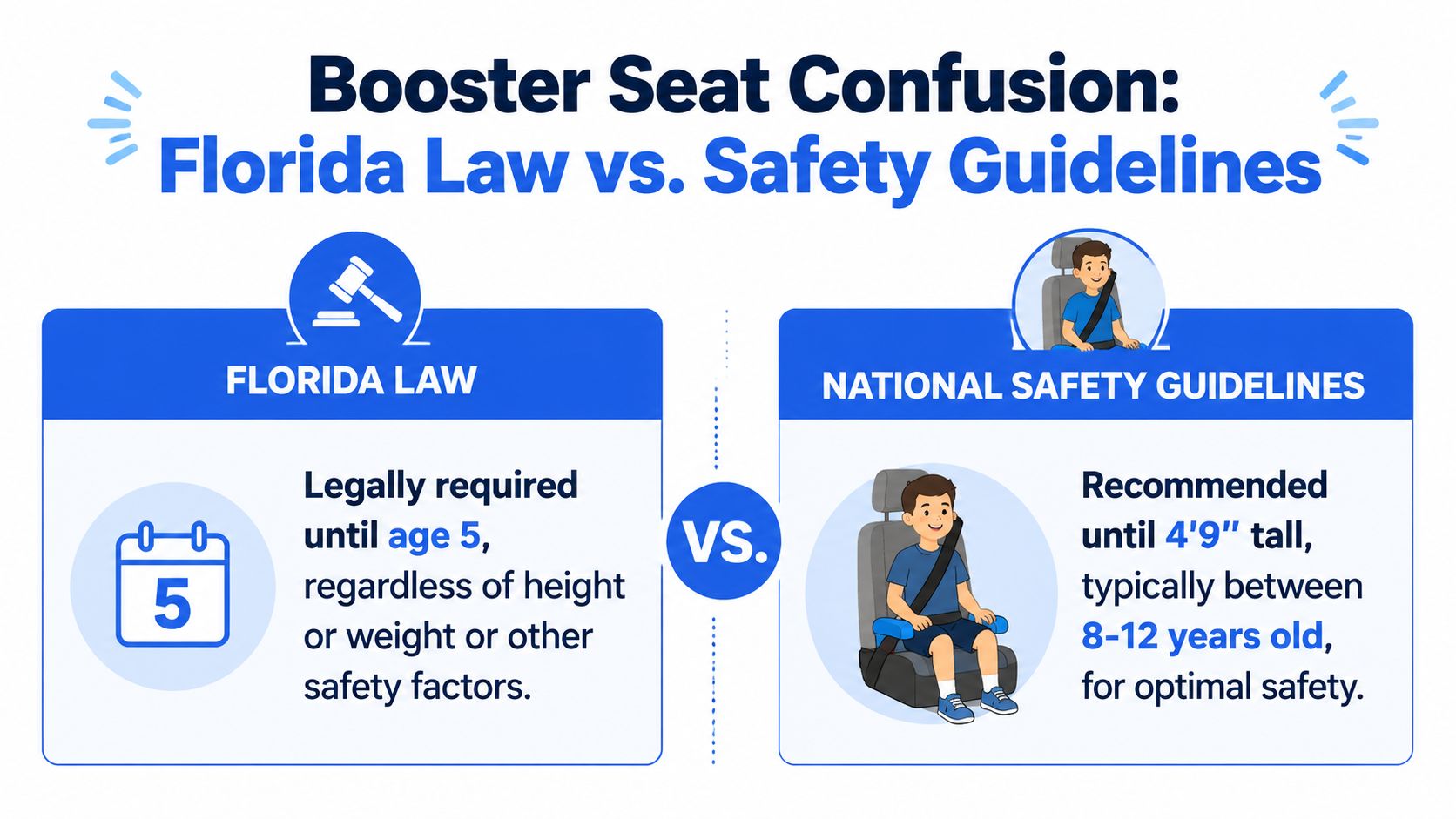
What the statute said and what changed
That gap created confusion for years. A parent could follow the old legal minimum and still have a child who plainly did not fit an adult belt well.
The 2026 update closes much of that gap by extending mandatory booster use to children 6 through 8 unless they are 4'9" tall. That's a smarter rule. But confusion doesn't disappear overnight, and traffic stops rarely happen in a calm setting.
Why officers still have room to write tickets
Officers make roadside judgments. They look at the child, the restraint, the seat belt position, and your explanation. If they think the restraint was improper, they may write the citation first and leave you to fight it later.
That's why this issue overlaps with the broader problem of discretionary traffic enforcement. If you want to understand how that works in practice, read this discussion of whether police have a ticket quota.
If a rule is confusing at the curb, the driver carries the risk, not the officer.
The phrase booster seat age florida sounds like a simple age question. It isn't. It's an enforcement question too. Age matters. Height matters under the current rule. Officer interpretation matters in practice.
Here's my blunt advice. If your child is under 4'9", keep the booster in use unless you are certain the law no longer requires it and the belt fits correctly. The old gap in Florida law was a citation trap. The new law is clearer, but drivers still need to protect themselves before a stop happens.
What Are the Penalties for a Booster Seat Violation
Many drivers make the expensive mistake. They see a child restraint ticket and think, “I'll just pay it.”
Don't do that until you understand what you're accepting.
A booster seat violation in Florida is a noncriminal moving violation with fines up to $60 plus court costs. It also adds 3 points to your driver's license and can trigger an average insurance rate increase of 20-30% for up to five years, according to this explanation of Florida booster seat ticket penalties.
Why paying the ticket is a mistake
When you pay, you usually lose your advantage. You're not just ending the case. You're accepting the consequences that come with it.
That matters even more if you drive for Uber, Lyft, DoorDash, or any job that reviews your motor vehicle record. It also matters if you already have points.
Bottom line: A “small” ticket can become a long-term insurance bill.
What the real cost looks like
The fine is only the first hit. The license points can affect your record. The insurance impact often lasts much longer than the traffic stop itself.
That's why I tell drivers to look at the whole picture:
Court costs add up: The posted fine isn't the full out-of-pocket number.
Points follow you: A moving violation changes your driving record.
Insurance companies notice: A booster seat citation can cost more over time than the ticket itself.
Employment risk is real: Commercial and app-based drivers can't treat points casually.
If you want a broader sense of how quickly these violations become expensive, this breakdown on what seat belt tickets cost in Florida is worth reading.
A quick overview of traffic ticket consequences can also help frame the issue:
If your first instinct is to pay and move on, stop. That reaction is exactly why these citations keep hurting careful drivers.
What Immediate Steps Should You Take if Cited
You get stopped on the way home. Your child is in the back seat. The officer says the restraint was not legally sufficient, and now you are holding a citation that looks minor but can follow you long after that traffic stop ends.
That is the trap. Florida's child restraint rules leave room for confusion, and officers still write the ticket. Your job at that moment is simple. Protect yourself. Protect your record. Do not try to win the case on the roadside.

Your Immediate Steps
Stay calm and respectful: Keep the stop from getting worse. Arguing with the officer does nothing to help your defense.
Do not explain or guess: Avoid statements like “I thought she was tall enough” or “we usually use a booster.” Those admissions can be used against you.
Sign if required: Signing usually confirms receipt of the citation, not guilt.
Write down the facts right away: Record the child's age, height, weight if relevant, the exact seat used, where the shoulder belt and lap belt sat, and anything the officer said about the alleged violation.
Take photos as soon as you can: Get clear images of the seat, the belt routing, the seating position, labels on the restraint, and the ticket itself.
Check the deadline the same day: Waiting limits your options and gives up time your lawyer could use to build the defense.
Review the process before you pay anything: This guide on what to do when you get a ticket lays out the steps clearly.
Who you should talk to first
Talk to a lawyer first. Child restraint citations are fact specific, and the gap between the legal minimum and what people believe is safest creates exactly the kind of confusion that leads drivers to say the wrong thing or pay too fast.
These cases often turn on details the officer may have missed or oversimplified. The child's size. The type of restraint. The seating position. The officer's wording. The statute's exceptions. Small facts decide traffic cases.
Our firm, Ticket Shield, PLLC, treats that early conversation seriously because direct attorney communication matters. You should not be explaining a legally sensitive ticket to a chain of intake staff before a lawyer reviews it.
Explain the facts once. Explain them to your lawyer.
If you are the parent, grandparent, rideshare driver, or family friend who got cited, move quickly. Early legal review gives you the best chance to challenge the ticket before a bad roadside judgment turns into a lasting problem on your record.
How a Dedicated Attorney Defends Your Record
You can follow Florida's bare minimum rule and still end up holding a citation in your hand. That is the trap. The law leaves room for confusion between what is legally required, what officers believe is required, and what safety guidance recommends. Drivers pay for that confusion unless a lawyer steps in and forces the court to look at the actual facts.
A dedicated attorney defends your record by attacking the ticket from every angle that matters. The stop. The officer's understanding of the child restraint statute. The child's height, age, and seating position. The type of seat used. The wording on the citation. The existence of any exception. Small details decide these cases, and officers often write them as if those details do not matter.
That problem gets sharper with the upcoming rule change. Starting July 1, 2026, House Bill 233 will extend Florida's mandatory booster seat requirement to older children unless they meet the height exception, as noted earlier in this article. New rules create more roadside mistakes, not fewer. Officers apply incomplete training. Parents and caregivers rely on old assumptions. A lawyer's job is to separate the legal rule from the officer's shortcut.
If you are comparing counsel, look for someone who handles these cases as record-protection work, not as a quick plea mill. This guide to Florida traffic ticket lawyers explains what that representation should specifically include.
What gets challenged in these cases
A real defense is specific.
Your attorney may challenge whether the officer had a valid basis for the stop, whether the statute was applied correctly, whether the child fell within the legal requirement on the date of the citation, and whether the paperwork creates doubt the court cannot ignore. The state still has to prove the violation. It does not get a free pass because the ticket involves a child seat.
Why local court experience matters
Courtroom habits vary across Florida. So do prosecutors, hearing officers, and judges. A lawyer who regularly appears in the local courthouse knows what arguments get serious attention, what documentation carries weight, and how to press for the result you need.
That result is simple. Protect the driving record. Avoid points if possible. Prevent an avoidable conviction and the insurance fallout that can follow it.
Ticket Shield, PLLC handles traffic defense with that goal in mind. If you were cited, get legal help before you pay the ticket. Paying early makes the officer's version the final version.