New Driving Laws Florida: What You Need to Know
Explore new driving laws florida and learn how recent changes affect penalties, your driving record, and safer roads. Get practical tips and key dates.
Florida's traffic laws are getting a major overhaul, and if you drive in the Sunshine State, you need to know what’s changing. Mark your calendar for July 1, 2025, because that’s the day a huge update kicks in, turning extreme speeding from a serious traffic ticket into a potential criminal offense. Staying on top of these new driving laws in Florida isn't just a good idea—it's critical for protecting your license and staying out of serious trouble.
Understanding Florida's Evolving Traffic Landscape
Florida's roads, from the packed lanes of I-95 in Miami-Dade to the quieter streets in your neighborhood, are all governed by laws meant to keep people safe. But recently, state lawmakers have rolled out some big changes aimed squarely at dangerous driving. These aren't just minor tweaks; they represent a major shift in how the state handles certain violations, especially those involving excessive speeds.
The main reason for this crackdown? To deter reckless drivers. Lawmakers are responding to a statewide problem with high-speed crashes by making the penalties tougher. That means an act that used to result in a steep fine and some points could now lead to a mandatory court date and even a criminal record.
Key Legislative Updates for Florida Drivers
To get you up to speed, here’s a breakdown of the most important changes every Florida driver needs to know. These new rules impact everyone, whether you’re a daily commuter, a commercial driver, or just visiting from out of state.
Criminal Speeding Is Now an Offense: The biggest change is the creation of a new criminal offense for "dangerous excessive speeding." This applies to anyone caught driving 50 mph or more over the posted speed limit.
No More Paying Online for Serious Offenses: A ticket under this new law means a mandatory court appearance. The days of just paying the fine online for these specific violations are over.
Harsher Penalties for Repeat Offenders: The consequences get even more severe if you get another one of these tickets within a five-year window, including larger fines and the possibility of a long-term license revocation.
Expanded "Move Over Law" Protections: The "Move Over Law" has also been updated. It now requires drivers to be cautious around any disabled vehicle with flashing lights, not just emergency vehicles.
Getting a handle on these new rules is an effective way to stay compliant and protect your driving privileges. For a deeper dive into the state's regulations, you can learn more about the complete Florida state traffic laws in our full guide.
To make this even clearer, we've put together a quick summary of these critical updates. This table breaks down what’s new, when it starts, and what it means for you on the road.
Quick Summary of Florida's New Driving Law Changes
Legislative Change | Key Provision | Effective Date | What It Means for You |
|---|---|---|---|
Dangerous Excessive Speeding (HB 351) | Driving 50+ mph over the speed limit is now a criminal offense. | July 1, 2025 | A speeding violation this serious requires a mandatory court appearance and can result in a criminal record, significant fines, and potential jail time. |
Florida's "Move Over Law" Expansion | Drivers must move over or slow down for any disabled vehicle with flashing lights. | January 1, 2025 | You now have a greater responsibility to protect all stranded motorists. Not complying will lead to fines and points on your license. |
"No Wake Law" for Flooded Streets | Prohibits driving fast enough on flooded roads to create a wake that damages property. | July 1, 2025 | Local police can now ticket you for reckless driving in flood conditions, adding another layer of liability during bad weather. |
New Teen Driver Requirements | Stricter requirements for getting a learner's permit, including more in-depth courses. | July 1, 2025 | The process for new drivers to get a license is now more rigorous, aiming to improve safety for inexperienced motorists. |
As you can see, the state has drawn a clear line. These changes are designed to get drivers' attention, and understanding them is a key part of your defense.
A Deeper Look at Dangerous Excessive Speeding
Florida's new driving laws have drawn a clear line, and one of the most significant changes is the creation of a serious offense called "dangerous excessive speeding." This isn't just another ticket with a higher fine. It's a fundamental shift that moves certain speeding violations out of the civil traffic world and squarely into criminal law.
For years, even a ticket for driving at an extremely high speed was typically handled with fines and points. While that was serious enough, it wouldn't usually saddle you with a criminal record. That all changes now. The new law sets specific, bright-line thresholds that, once crossed, trigger a much more severe legal process.
What Qualifies as Dangerous Excessive Speeding
The law is clear about what lands a driver in this new, more serious category. You can be charged with dangerous excessive speeding if you're caught driving at either of these speeds:
50 mph or more over the posted speed limit.
At any speed of 100 mph or higher, regardless of what the speed limit is.
Let's put that in real-world terms. Say you're on a stretch of I-95 where the speed limit is 70 mph. If an officer clocks you at 120 mph, you've met the criteria for a criminal charge. The same goes for driving 85 mph in a 35 mph zone in a busy area like Palm Beach County. The law targets not just raw speed but speeds that are completely out of sync with the environment.
This flowchart breaks down how a routine speeding stop can now escalate into a far more serious criminal matter under the new Florida laws.
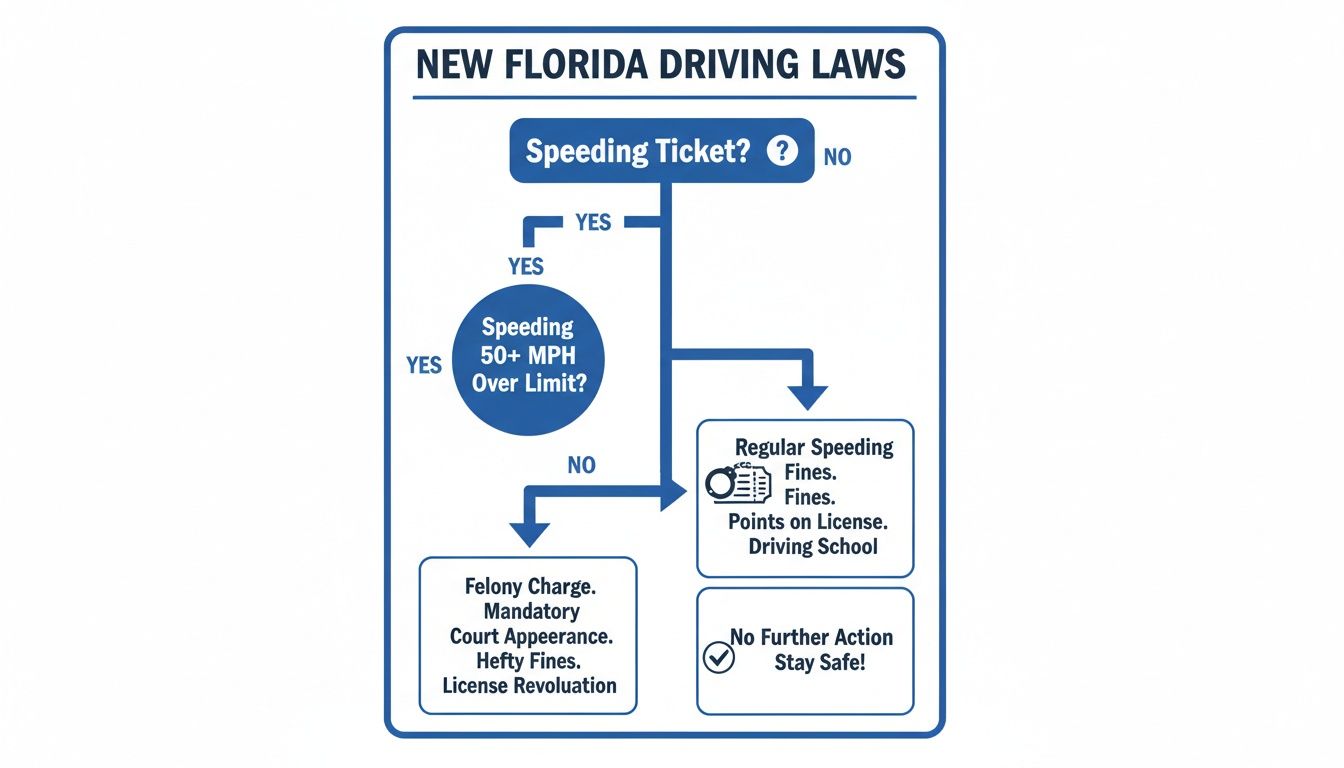
As you can see, crossing that 50+ mph threshold is the game-changer. It's what turns a simple ticket into a criminal offense that demands a court appearance.
The Shift From Civil Infraction to Criminal Charge
The most critical thing to understand here is the legal reclassification. A standard speeding ticket is a civil traffic infraction—a non-criminal violation. A criminal charge, on the other hand, comes with the risk of a permanent criminal record, which can create lifelong obstacles for jobs, housing, and even professional licenses.
This legal shift means a "dangerous excessive speeding" violation is no longer something you can just pay online. It now requires a mandatory court appearance, where you'll have to face a judge who determines the penalties.
This change didn't happen in a vacuum. It's a direct response to the alarming number of high-speed crashes on Florida’s increasingly crowded roads. This new law mandates criminal penalties and a court hearing for a reason—it’s aimed squarely at the kind of reckless speeds that lead to catastrophic accidents. For drivers who get these tickets, the stakes are now dramatically higher.
The Severe Consequences You Now Face
The penalties for a dangerous excessive speeding conviction are designed to be a powerful deterrent. They are miles beyond what you'd expect from a typical speeding ticket and get even worse for repeat offenses.
Potential Penalties Include:
Significant Fines: A first-time offense can result in a fine up to $500. A second offense within five years can double that to $1,000.
Potential Jail Time: Even a first offense carries the possibility of up to 30 days in jail. A second offense can mean up to 90 days.
Driver's License Points: A conviction will add points to your license, pushing you much closer to a suspension.
A Permanent Criminal Record: A conviction means you will carry a criminal record that can follow you for life.
These penalties show that the state has adopted a new, zero-tolerance stance on extreme speeding. To learn more, check out our guide on how the new super speeder law in Florida impacts drivers. Our goal is to protect your license and record when you're facing these serious new charges. Past results do not guarantee future outcomes.
How These Laws Affect Different Florida Drivers
Florida's new driving laws cast a wide net, but they don't affect everyone the same way. The real-world consequences of a ticket can be vastly different depending on your license type, your age, and whether you live in Florida. For some, a violation is a costly headache; for others, it's a direct threat to their career.
A single ticket under these tougher rules can set off a chain reaction, creating unique problems for commercial drivers, young motorists, and out-of-state visitors. The stakes are simply higher for certain groups trying to navigate Florida’s roads.
Commercial Driver's License (CDL) Holders
For anyone who drives for a living, a traffic ticket isn't just a personal problem—it's a professional crisis. The new driving laws in Florida put an even heavier weight on the shoulders of CDL holders, whose careers depend on keeping their driving record clean.
A conviction for a serious offense like "dangerous excessive speeding" can trigger a whole separate set of penalties from the Federal Motor Carrier Safety Administration (FMCSA), on top of any state penalties. These can have a serious impact on a career.
Disqualification: Certain violations can lead to a temporary or even permanent CDL disqualification. A second serious traffic violation within three years can lead to a 60-day disqualification, effectively putting you out of work.
Job Loss: Many transportation companies have strict policies regarding serious moving violations. A single conviction could be grounds for termination.
Increased Insurance: The insurance premiums for commercial fleets are already high. A driver with a serious violation becomes a high-risk liability, which can increase costs for their employer.
For a CDL holder, addressing a ticket isn’t just about a fine. It’s about protecting their livelihood. You can learn more about the specific challenges commercial drivers face in our article on defending against CDL speeding tickets. Our practice focuses on traffic and DUI defense, and we are dedicated to helping these professionals stay on the road.
Younger Drivers in Hillsborough County
Young drivers, especially those under 25, already face some of the highest insurance rates in the state. For teens and young adults navigating the busy roads of Hillsborough County, the new laws can increase that financial pressure. A serious traffic conviction can hit this group disproportionately hard.
Insurers often view a young driver as a higher risk due to their lack of experience. Adding a serious violation to their record can lead to a few predictable outcomes.
Skyrocketing Premiums: A conviction for a high-speed offense could cause their already high rates to increase substantially, making it a real struggle to afford coverage.
Policy Cancellation: In some cases, an insurer might decide to non-renew the young driver's policy entirely. This forces them to shop for coverage in the high-risk market, where costs are often much higher.
Future Financial Hurdles: A poor driving record at a young age can follow them for years, making it difficult to get affordable insurance well into their adult lives.
These new laws make it more critical than ever for young drivers and their parents to address citations. Our goal is to protect your license and record. Past results do not guarantee future outcomes.
Out-of-State Visitors
As a top tourist destination, Florida's roads are packed with out-of-state drivers. What many visitors don't realize is that a ticket you get here doesn't stay here—it often follows you home. Florida is a member of the Driver License Compact, an agreement between states to share driver information.
This means that if you get a ticket in Florida, the details of that violation will almost certainly be sent back to your home state's DMV. Your home state will then usually apply its own penalties, including points on your license, just as if the violation happened there.
For an out-of-state driver, dealing with a Florida ticket comes with its own set of challenges. A serious offense might require a mandatory court appearance, which can create a logistical problem involving travel, hotels, and time off work. Ignoring it is not an option; the court can issue a warrant and suspend your driving privileges in Florida, which can then affect your license back home.
Consulting with an attorney who handles criminal traffic matters across Florida can help you manage these issues, often without you ever having to set foot back in the state.
The Lasting Impact on Your Insurance and Driving Record
Getting a ticket under Florida’s new driving laws is more than just a one-time fine or a temporary headache. It can start a domino effect that can impact your life for years, affecting everything from your driving privileges to your finances. The fallout goes far beyond the courtroom, leaving a lasting mark on both your driving record and your insurance premiums.
Ignoring the long-term consequences can be a costly mistake. A single conviction for one of these serious new violations can kick off a chain reaction, making it much harder and more expensive to legally drive in Florida.
How New Violations Affect Your Driving Record
Florida uses a point system to track traffic violations. Accumulate too many points in a certain amount of time, and you're looking at an automatic license suspension. A conviction for "dangerous excessive speeding" adds a heavy load of points to your record, pushing you dangerously close to that threshold.
Here’s how quickly it can happen:
12 points within 12 months results in a 30-day suspension.
18 points within 18 months results in a 3-month suspension.
24 points within 36 months means a 1-year suspension.
This system is designed to sideline high-risk drivers. With these new laws adding more severe violations to the mix, it's easier to accumulate points and lose your license. Keeping your record clean is essential to staying on the road.
The Financial Fallout with Your Insurance Carrier
Perhaps the most immediate and painful impact from a serious traffic conviction is the financial one. Insurance companies set their rates based on risk, and a violation for something like extreme speeding signals "high-risk driver" to them. That perception almost always leads to a sharp, significant hike in your premiums.
For the average Florida driver, even a standard ticket can make insurance rates jump by 20-50%. With these new criminal-level offenses, that percentage can climb even higher. If you want to see the numbers, you can check out our guide that breaks down how a speeding ticket can affect your insurance rates.
Beyond just your own policy, understanding your insurance responsibilities is key. For instance, knowing if you can rent a car without insurance in Miami is fundamental knowledge for any driver in the state.
A serious conviction under the new laws doesn't just mean higher rates. Insurers may decide you're too risky to cover at all, leading them to not renew your policy. This can force you into the world of high-risk insurance, which is notoriously expensive and often provides less coverage.
This financial pain isn't temporary. Those higher premiums can follow you for three to five years, costing you thousands of extra dollars over time. For many drivers, especially in places like Broward County, the long-term insurance costs can far exceed the initial court fine. The only way to shield yourself from these lasting financial penalties is to address the citation head-on. Our goal is to protect your license and record. Past results do not guarantee future outcomes.
Navigating a Citation Under the New Laws
The sight of flashing lights in the rearview mirror is enough to make anyone’s heart sink. But when you’re handed a ticket under Florida’s tough new driving laws, that feeling of dread can quickly turn into panic. What happens next, both on the side of the road and in the days that follow, can have a massive impact on the outcome.
First, stay calm. It's easier said than done, but being respectful during the stop is always the right move. After the officer leaves, take a minute to read the citation. You need to know the exact violation, what the officer wrote down, and most importantly, the deadline for you to respond.
Missing that deadline isn't an option. It can trigger an automatic driver's license suspension and a stack of new penalties. That ticket isn't just a bill for a fine; it's a legal document that kicks off a formal process.
Immediate Dos and Don'ts After a Traffic Stop
Your defense starts the second that ticket is in your hand. Knowing what to do—and what not to do—can either protect your rights or inadvertently complicate your situation.
What You Should Do:
Document Everything: As soon as you’re safely parked, write down everything you remember. The location, time of day, weather, traffic conditions, and the conversation with the officer. These details fade fast but can be critical later on.
Preserve Evidence: If it's safe, take pictures or video of the scene, especially if the citation was for something like an unsafe lane change.
Read the Citation Carefully: Look up the specific statute you're accused of violating. You need to understand exactly what the state has to prove to make the charge stick.
What You Should Not Do:
Do Not Admit Guilt: Avoid saying things like, "I know I was speeding." Any admission you make to the officer can be used against you.
Do Not Argue: Getting into a debate on the roadside won’t make the officer change their mind. It may, however, result in unflattering notes being added to the report that can hurt your case.
Do Not Ignore the Citation: This is the single worst mistake you can make. The problem won't disappear; it will only get bigger, leading to a license suspension and possibly even a warrant.
Recognizing When You Need Professional Legal Assistance
Not every traffic ticket requires a lawyer. But under the new driving laws in Florida, the stakes are so much higher. A citation for something like "dangerous excessive speeding" is no longer just a pricey infraction—it can be a criminal charge. That distinction changes everything.
A civil infraction might result in fines and points. A criminal traffic violation, on the other hand, can lead to jail time, a permanent criminal record, and thousands of dollars in fines and increased insurance costs. This is the moment when getting professional help becomes a serious consideration.
A consultation with a law firm that focuses on traffic and DUI defense can provide clarity during a stressful time. It allows you to understand the charges against you, the potential penalties, and the strategic options available for your defense.
If an incident leads to a citation, having solid legal guidance on what to do when accidents happen is indispensable. A skilled attorney can scrutinize every detail of your case, from the legality of the traffic stop itself to the calibration records of the officer's equipment.
Our goal is to protect your license and your record. We handle criminal traffic matters across Florida and offer a Free Consultation to go over your case. Remember, this information is for educational purposes and isn't a substitute for legal advice tailored to your unique situation. Past results do not guarantee future outcomes.
Your Questions About Florida's New Driving Laws, Answered
When major traffic laws change, it’s natural to have questions. We’ve been getting a lot of calls about these updates, so we’ve put together answers to some of the most common things drivers are asking. Think of this as your quick-reference guide to staying on the right side of the law.
Please note: this is for general information. Every traffic stop has its own unique details, so this isn’t a substitute for legal advice on your specific case.
When Does the New Dangerous Excessive Speeding Law Take Effect?
Mark your calendars. The significant one, House Bill 351, which makes "dangerous excessive speeding" a criminal offense, officially takes effect on July 1, 2025. This gives every driver in Florida some time to get familiar with the new reality: driving 50 mph or more over the limit, or hitting any speed over 100 mph, now comes with criminal consequences.
This isn't just a minor tweak. It’s a direct response to the kind of high-risk driving that causes serious accidents on our highways. It’s a modern approach to a timeless problem—making roads safer by targeting the behavior that puts everyone in danger.
What Is the Difference Between a Civil and a Criminal Traffic Violation?
Understanding this difference is absolutely essential now. A civil traffic infraction is what most people think of as a typical ticket—like for speeding 15 mph over the limit. The penalties are usually fines, points on your license, and maybe traffic school. In many cases, you don’t even have to go to court.
A criminal traffic violation is a whole different matter. It’s a misdemeanor or felony charge that can lead to:
A permanent criminal record.
The possibility of jail time and probation.
Significant fines that dwarf a normal ticket.
A mandatory court appearance.
The new "dangerous excessive speeding" law pulls what used to be a civil issue deep into criminal territory, and the stakes have never been higher.
I Have a Clean Driving Record. Will That Help Me?
A clean record is always a positive factor, but it’s not a "get out of jail free" card, especially when you're facing a criminal charge. A prosecutor or judge in a place like Orange County might look at your clean history favorably when it comes to sentencing, but it doesn't just make the charge disappear.
For a basic civil ticket, a good record might help you get a "withhold of adjudication" to avoid points. But for a criminal charge under the new driving laws in Florida, the law's focus is squarely on the severity of the offense itself. The mandatory court appearance means every single case gets reviewed by a judge, no matter how clean your record was before.
Is a Court Appearance Mandatory for Dangerous Excessive Speeding?
Yes, it is 100% mandatory. This is one of the most important parts of the new law. You can't just hop online to pay the fine or mail a check and be done with it. This isn't that kind of ticket anymore.
You or your attorney must physically appear in court to answer the charge. If you don't show up, a warrant will be issued for your arrest and your driver's license will be suspended automatically.
This requirement makes it crystal clear how seriously the state is taking this offense. It forces you to confront the charge head-on in a courtroom. If you have more questions like this, you can find a lot more answers on our extensive FAQ page on Florida traffic defense.
Should I Contact an Attorney for This Type of Ticket?
When you’re facing a criminal charge that could mean jail time, a permanent record, and a massive financial hit, getting a professional legal opinion is a prudent step. A lawyer who focuses on traffic and DUI defense understands the system. They know how to analyze every detail of your case, from the moment the officer pulled you over to the evidence they plan to use against you.
Their job is to spot weaknesses in the state’s case and build a defense strategy designed to seek a favorable outcome. While no specific result can be promised, an attorney can navigate the system for you. Our goal is to protect your license and your record.
If you've been ticketed under Florida's new driving laws, the consequences are more serious than ever. At Ticket Shield, PLLC, our practice is built around defending drivers in all 67 counties, from simple speeding tickets to criminal traffic charges. Don't wait—protect your record and your future. Call us 24/7 for a free, no-obligation consultation to talk about your options. Learn how we can help at https://www.ticketshield.com.
Attorney Advertisement. Office in Broward. Prospective clients may not obtain the same or similar results.