Do Police Have a Ticket Quota in Florida
Do police have a ticket quota? Uncover the truth about performance metrics, how they impact Florida drivers, and what it means for your traffic citation.
When flashing lights pop up in your rearview mirror, one question almost always comes to mind: Do police really have a ticket quota?
It’s one of the most common beliefs among drivers, and the answer isn't a simple yes or no. While official, mandatory ticket quotas are illegal in Florida, the reality on the ground is far more complicated. Many law enforcement agencies use performance metrics that can feel an awful lot like a quota to the driver getting the ticket.
Understanding Ticket Quotas in Florida
The idea that every officer has to write a specific number of tickets per month is a myth that just won't die. State law is clear: agencies cannot require an officer to issue a fixed number of citations. But the line between an illegal "quota" and a legal "performance goal" can get pretty blurry from the driver's seat.
Think of it less like a direct order and more like a sales team's monthly target. An officer probably won't be told, "You must write 50 tickets this month, or else." However, their performance reviews, chances for promotion, and even their shift assignments could be heavily influenced by their "productivity" on the road.
That pressure is real, and it can absolutely shape an officer's discretion when deciding whether to write a ticket or give a warning.
Quotas vs. Performance Goals
So, what's the actual difference? It's subtle but important.
An Illegal Quota is a rigid policy—written or unwritten—that demands an officer issue a specific number of tickets in a set timeframe. Falling short would lead to some form of punishment.
A Performance Goal is a much broader way to measure an officer's overall activity. It might include the number of traffic stops, warnings issued, arrests made, and even positive community interactions. Citations are just one piece of a much larger puzzle.
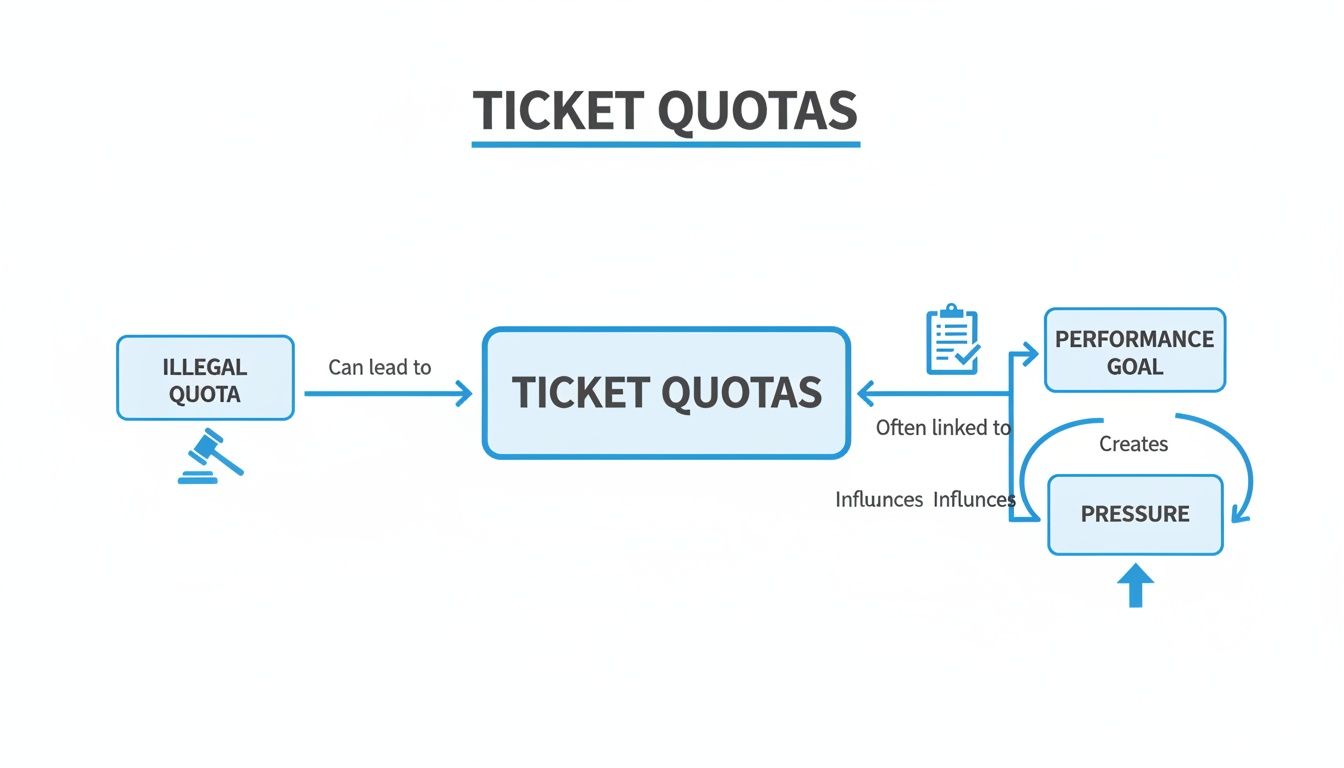
This flowchart helps visualize how both systems—one illegal, one common practice—can lead to the same result: pressure on officers to write tickets.
This table breaks down the key distinctions between what's explicitly illegal and what's common practice in many departments.
Official Quotas vs Unofficial Performance Goals
Characteristic | Official Ticket Quota (Illegal in FL) | Unofficial Performance Goal (Common Practice) |
|---|---|---|
Definition | A specific, mandatory number of tickets to be written in a set period. | A broader measure of an officer's total law enforcement activity. |
Consequences | Failure to meet the number can lead to disciplinary action. | Performance is evaluated on multiple factors, not just ticket counts. |
Focus | Purely on citation numbers. | Overall officer productivity, including arrests, warnings, and stops. |
Driver's View | Feels like an officer is just "out to get someone" to meet a number. | Feels exactly the same—like an officer is under pressure to write a ticket. |
Ultimately, whether an officer is trying to hit a "quota" or a "goal," the outcome for the driver is identical: a costly ticket that can impact your license and insurance for years.
As the chart and table show, both systems can create pressure to generate enforcement activity. For a driver on the receiving end of a traffic stop, the internal politics of the police department don't matter much. What matters is that some stops feel less about public safety and more about hitting a number.
Understanding this dynamic is crucial. It provides important context for why you might get a ticket for a minor infraction, especially near the end of the month. To get a better handle on the rules officers are enforcing, you can learn more about Florida state traffic laws in our detailed guide. This background helps you see the bigger picture of how and why tickets are issued.
A History of Quota-Like Systems in Florida
The question "do police have a ticket quota?" isn't just a modern-day gripe; it has a long and complicated history right here in Florida. While state law officially forbids ticket quotas, the pressure on officers to meet certain numbers has a way of bubbling to the surface, pulling back the curtain on how these systems can operate just below the surface of official policy.
A perfect example of this blew up in North Florida back in July 2006. A leaked internal memo from a lieutenant to his patrol officers laid out some very specific "minimum activity" expectations. The memo didn't dance around the issue—it explicitly told each officer they were expected to issue a certain number of citations every month. The controversy sent shockwaves across the state and became a textbook case of unofficial quotas in action.
That single incident did a great job of highlighting the built-in conflict between genuine public safety and internal performance pressure. It also exposed a common tactic departments use to get around the laws that ban quotas.
The Language of Quotas
To stay on the right side of the law, police agencies often swap out the word "quota" for more neutral-sounding corporate jargon. But these terms serve the exact same purpose, creating an environment where officers feel they have to write tickets to prove they're being productive, even when a simple warning might be the more appropriate choice.
You'll hear a lot of phrases like these:
"Performance Standards": This is a catch-all term that measures an officer's activity level, and ticket counts are often a key metric.
"Station Averages": This tactic can pit officers against each other by comparing their citation numbers, creating a competitive pressure.
"Productivity Goals": It's all about setting targets for enforcement actions, which almost always includes the number of traffic stops and tickets issued.
This shift in language allows departments to keep the pressure on without technically breaking the law. For the driver getting that ticket, the difference is meaningless—the stop feels like it's about hitting a number, not about safety.
This kind of system can lead to an officer's value being measured by their stats, which can impact everything from their shift assignments to their chances for promotion. It’s a big reason so many drivers swear that enforcement ramps up toward the end of the month.
This enforcement pressure isn't just about traditional traffic stops, either. Automated systems play a huge role, too. To get a better sense of how it all works, check out our guide on red light cameras in Florida. Understanding all the different ways tickets are generated gives you a much clearer picture of the challenges drivers are up against.
How Quota Pressure Affects You on the Road
That internal pressure on officers to hit performance goals has a direct impact on your experience as a driver. This is especially true in crowded places like Broward County, where the sheer volume of traffic creates endless opportunities for enforcement. When an officer’s focus shifts from genuine public safety to just meeting a monthly target, the whole dynamic of a traffic stop changes.

What does that shift look like in the real world? It often means more aggressive enforcement and a lot less discretion. An officer who might have given you a friendly warning for rolling through a stop sign in an empty intersection suddenly feels compelled to write a citation to keep their numbers up. As the end of the month or quarter gets closer, that pressure intensifies.
The Real-World Consequences for Drivers
This focus on numbers can lead to a few tangible effects that might feel familiar. It’s what validates that nagging feeling you sometimes get that a ticket was more about the officer's needs than any real danger you posed.
Here are the consequences you’ll see on the street:
Less Leniency: Officers may become less willing to exercise their discretion or issue a warning, even for borderline violations where no one was in any real danger.
Focus on Minor Infractions: You might see more tickets for purely technical violations, like a partially obscured license plate or driving one to five miles per hour over the limit. These are easy, quick citations that help bolster activity reports.
Increased Enforcement in "Hot Spots": Instead of patrolling areas with a history of serious accidents, officers might camp out in locations known for generating easy tickets, like confusing intersections or well-known speed traps.
This kind of enforcement can seriously erode the trust between the public and law enforcement. When drivers feel like they’re being treated as a statistic just to help an officer meet a goal, it completely undermines the idea that traffic laws are being enforced fairly to keep our roads safe.
This is exactly why understanding the mechanics of traffic enforcement is so critical. A single ticket can lead to points on your license, which is a significant issue for every Florida driver. You can learn more about how this works by reading our detailed guide on the Florida traffic ticket point system.
Knowing what’s at stake helps you make smart decisions when you get a citation. Our goal is to protect your license and your record from a system that sometimes prioritizes numbers over common sense.
Recognizing Signs of a Quota-Driven Ticket
Let's be clear: proving a specific ticket was written just to hit a performance goal is next to impossible. But you can absolutely learn to spot the red flags. Understanding the whole context of your traffic stop is the first real step toward figuring out your options and maybe even building a defense.
Certain patterns and behaviors can hint that an officer's decision was influenced more by internal pressure than an actual threat to public safety. This isn't about questioning an officer's integrity; it’s about understanding the system they operate in. When the pressure is on, especially near the end of the month or quarter, the line between getting a friendly warning and a costly citation can get awfully thin.
Common Indicators of Performance Pressure
Think back to your traffic stop. Did anything feel a little off? Maybe a bit rushed? While no single sign is a smoking gun, a few of them together can paint a pretty telling picture. Keep an eye out for these clues that suggest your ticket might have been part of a numbers game.
Key signs often include:
End-of-Month Timing: A sudden surge in traffic stops and ticketing during the last week of the month or quarter is a classic sign. It often means officers are hustling to meet their performance metrics.
Location Choice: Was the officer set up in a high-volume, low-risk spot? Think of a long, straight road where drivers naturally drift a few miles over the limit, not a dangerous school zone. This kind of setup prioritizes ticket quantity over genuine safety.
Unwillingness to Issue a Warning: For a minor, borderline infraction where nobody was in any danger, an officer's flat-out refusal to even think about a warning can be a red flag. It might suggest they feel they need to document the stop as a formal citation.
"Stacking" Minor Violations: Did you get cited for multiple trivial offenses at once? Something like a burnt-out license plate light and going two miles over the speed limit? This can be a tactic to pump up enforcement stats from a single stop.
The real question isn't just "do police have ticket quotas?" but rather "how does the pressure for performance affect my traffic stop?" Recognizing these signs empowers you to look at your citation with a more critical eye.
By learning to spot these indicators, you can get a much better feel for the circumstances surrounding your ticket. This knowledge is priceless when you're trying to decide your next steps.
The table below gives you a clear checklist to help you break down your own experience and spot the common signs that your ticket may have been influenced by performance pressures.
Potential Red Flags of a Quota-Driven Ticket
Use this checklist to identify common signs that your traffic ticket may have been influenced by performance pressures rather than a significant safety concern.
Red Flag | Description | What It Could Mean |
|---|---|---|
Aggressive Ticketing for Minor Offenses | Getting a citation for a very minor violation, like not signaling for the full 100 feet before a turn on an empty street. | The officer might be focusing on easy-to-prove, low-level infractions to boost their citation count with minimal effort. |
Sudden Enforcement "Blitzes" | A sudden, heavy police presence shows up in an area that isn't typically a high-priority enforcement zone. | This could point to a department-wide push to crank up the statistics for a specific period, often driven by management. |
Impersonal and Rushed Interaction | The officer seems completely uninterested in your explanation, just quickly writing the ticket with almost no conversation. | An officer focused on hitting a number might treat the stop like a transaction, aiming for speed and efficiency to get to the next one. |
Seeing one or more of these signs doesn't automatically mean your ticket is invalid, but it does give you a powerful reason to question it. It suggests the stop may have been less about safety and more about fulfilling a performance metric, which is valuable information to have when you're deciding on your next move.
Challenging a Citation in a Quota-Driven System
So, you understand that performance pressures on officers exist. That’s one thing. Knowing what to do about it is the crucial next step.
While it might be tempting to march into court and argue that your ticket was just to help an officer hit their numbers, that approach is rarely effective. Proving an individual officer’s motivation is nearly impossible, and it isn't a recognized legal defense against a traffic violation.
Instead, the most effective way to challenge a citation is to focus on the technical and legal merits of the ticket itself. This strategy sidesteps the unprovable "why" and zeroes in on the "how" and "what" of the traffic stop. Our goal is to protect your license and record by carefully examining the evidence presented against you.
Focusing on a Stronger Defense
A sound defense is built on facts, procedures, and evidence—not on speculating about an officer's motives. An attorney with a practice focused on traffic defense knows exactly where to look for weaknesses in the citation.
This means asking critical questions like:
Was the equipment calibrated correctly? The radar and lidar guns used to measure speed require regular, documented calibration to be considered accurate in court.
Did the officer have a clear line of sight? Obstructions like other cars, trees, or even hills can interfere with an officer’s ability to accurately single out one specific vehicle.
Were there any procedural mistakes? The law requires officers to follow specific procedures when they write a ticket. Any misstep could be grounds for a challenge.
Knowing a quota-like system might be in place is a powerful motivator to fight back. However, the fight itself has to be grounded in the specific, verifiable details of your case, not the broader system. Past results do not guarantee future outcomes.
Interestingly, research suggests that just banning quotas doesn't always stop aggressive ticketing. One comprehensive study actually found that laws prohibiting police ticket quotas sometimes led to a slight increase in citations. This suggests that other factors, like departmental culture, keep driving enforcement. Learn more about these nationwide findings.
This is exactly why having professional representation is so important. An attorney who handles traffic cases across Florida knows how to navigate the local court system and identify the strongest arguments for your specific situation. For more detailed strategies, check out our guide on how to beat a traffic ticket in Florida.
How an Attorney Can Protect Your Driving Record
Trying to make sense of a traffic ticket on your own can be a frustrating, isolating experience. When you're standing alone against the legal system—especially if you have a nagging feeling your ticket was just about meeting a quota—you’re already at a disadvantage. This is exactly where having professional representation becomes a critical tool for protecting your rights and your driving record.
Our firm, with its office in Broward, handles traffic and DUI defense matters across all 67 counties in Florida. We're dialed into the local court procedures and know about the pressures that can drive traffic enforcement. Our entire focus is on protecting your license and record by working to get fines reduced, avoid points, and keep your insurance rates from increasing.
A Strategic Approach to Your Defense
Our team includes former prosecutors, which gives us an invaluable look at how the other side thinks and builds its case. That experience allows us to dissect every detail of your citation, from the moment the blue lights flashed to the evidence presented in the report. We're looking for procedural mistakes, technical errors, and any other weakness we can challenge.
We provide dedicated legal support so you can feel confident in your defense. Our goal is to pursue the best possible outcome for your specific situation. This includes:
Challenging the Evidence: We go over every piece of the citation with a fine-tooth comb, including the officer’s report and any tech-based evidence like radar or lidar readings.
Negotiating on Your Behalf: We can take over all communication with the court. Our job is to negotiate for a reduction in charges or penalties whenever possible.
Representing You in Court: In the vast majority of cases, our clients never have to set foot in a courtroom. We handle all the proceedings for you, saving you time and stress.
Attorney Advertisement: Submitting information through our website does not create an attorney-client relationship. Our goal is to protect your license and record. Past results do not guarantee future outcomes. Office in Broward.
If you're on the fence about what to do next, you can learn more about whether you need a lawyer for a traffic ticket in our detailed guide.
Don’t let one ticket put your driving privileges or your finances at risk. Contact us for a free consultation to talk about your case.
Frequently Asked Questions About Ticket Quotas
When you're dealing with a traffic ticket, a lot of questions pop into your head. Here are some of the most common ones we hear about ticket quotas. These are straightforward answers to give you a clearer picture, but they are not a substitute for legal advice tailored to your specific case.
Are Police Ticket Quotas Illegal in Florida?
Yes, they are. Florida Statute 316.640(6) is very clear: state and local agencies are explicitly banned from creating formal ticket quotas.
However, there's a huge gray area. The law doesn't stop agencies from using "performance metrics" or "productivity standards." This creates a backdoor pressure system where officers may feel they need to issue a certain number of citations to show they're doing their job.
Can I Get My Ticket Dismissed by Mentioning a Quota?
It's almost never that simple. Trying to argue in court that your ticket was just part of a quota is usually an ineffective strategy because proving an individual officer's motivation is incredibly difficult.
A much stronger defense is built on the facts and legal merits of your specific case. This means challenging the evidence, pointing out procedural mistakes, or questioning the officer's observations. An attorney's job is to find an effective defense for you. Past results do not guarantee future outcomes.
Does Time of Month Affect My Chances of Getting a Ticket?
While there's no hard-and-fast rule, there's a mountain of anecdotal evidence suggesting that ticket enforcement ramps up near the end of the month or quarter. It's a common belief that this is when officers are trying to hit those "performance goals."
If you got pulled over for a minor, borderline infraction during the last week of the month, it could be a contributing factor. Still, the core issue in court will always be whether the ticket itself is valid.
The pressure on officers is real. In fact, national surveys show that about 40% of U.S. police officers feel pressured by informal ticket quotas disguised as "productivity goals." It's a system that can damage both officer morale and public trust. Learn more about these nationwide findings.
At Ticket Shield, PLLC, our practice focuses on protecting your license and your record. If you've received a traffic ticket anywhere in Florida and are worried about what comes next, let our team work for you. Contact us today for a free consultation to go over the details of your case. https://www.ticketshield.com