A Driver's Guide To Red Light Cameras In Florida
Struggling with red light cameras in Florida? This guide explains how they work, the laws in Miami-Dade, how to fight a ticket, and your legal options.
That envelope in your mail from a local police department can definitely make your stomach drop. When it’s for a red light camera violation in Florida, the first thing you need to understand is that the document you're holding is a Notice of Violation. It comes with a standard $158 fine, but it does not immediately add points to your license.
The key is to act quickly, because ignoring this notice is where the real trouble begins.
Your First Steps After A Red Light Camera Notice
That piece of mail puts you at a critical crossroads. Your next move—whether you pay that initial fine or decide to contest it—sets everything else in motion. What you have isn’t a formal traffic ticket yet; think of it as an administrative warning shot. You typically have about 30 days to respond before the situation gets more serious.
This whole system is run under a state law called the Mark Wandall Traffic Safety Act. Since it was put in place, these automated cameras have become a fixture at many Florida intersections, generating a ton of revenue while also sparking a heated debate over whether they’re truly fair or effective.
The Two Paths A Violation Can Take
Once you get that Notice of Violation (NOV), you really only have two choices. The first path is to just pay the $158 fine. Doing so closes the case. No points go on your license, and your insurance company never even hears about it. It’s handled a lot like a simple parking ticket.
But if you ignore the notice or miss the payment deadline, the violation gets upgraded to a Uniform Traffic Citation (UTC). This is a real-deal traffic ticket with much bigger consequences. The fine jumps up, and a conviction means points get added to your driving record, which almost always leads to higher insurance premiums.
A Notice of Violation is an administrative fine that doesn't touch your driving record. A Uniform Traffic Citation is a legal citation that can lead to points, higher fines, and jacked-up insurance costs. Knowing the difference is everything.
To give you a better sense of how these two documents stack up, here’s a quick comparison.
Notice Of Violation Vs Uniform Traffic Citation At A Glance
Attribute | Notice of Violation (NOV) | Uniform Traffic Citation (UTC) |
|---|---|---|
Initial Fine | $158 (standard state fine) | $262+ (fine plus court costs) |
Points on License | None. Does not affect your record. | Yes. A conviction adds points. |
Insurance Impact | None. Not reported to insurers. | Likely. Convictions often lead to premium hikes. |
Response Time | Typically 30 days to pay or contest. | Deadline set by the court. |
Legal Status | Administrative notice (like a parking ticket). | Formal legal citation (a real traffic ticket). |
Understanding this table makes it clear just how important it is to deal with the initial notice properly.
Florida’s red light camera program kicked off back in July 2010 and has since churned out over eight million violations, raking in nearly $1.3 billion in fines split between the state and local governments. While the program was once massive, its footprint has actually shrunk by over 50% from its peak as many cities have shut their programs down.
Making the right call early on is essential. Contesting the notice is always an option, but navigating the legal process means you need to understand court procedures and what defenses might actually work. If you're not sure what to do next, you can learn more about what to expect in traffic court. Our goal is to protect your license and your record. Past results do not guarantee future outcomes. Submitting information through our website does not create an attorney-client relationship.
This is an attorney advertisement. Office in Broward.
How Florida's Automated Cameras Actually Work
That bright flash you see at an intersection is just the start of a process that’s part high-tech automation, part old-fashioned police work. Red light cameras in Florida aren’t just taking random pictures; they’re part of a system designed to capture very specific evidence of a potential traffic violation. It’s a blend of sophisticated technology and mandatory human oversight.
The whole thing kicks into gear the moment a vehicle rolls over the white stop line after the traffic light has already turned red. Sensors embedded in the pavement or advanced radar systems detect the car’s movement, triggering the camera to start documenting the event.
And it’s not just a single snapshot. The camera is programmed to record the entire sequence to build a clear, undeniable picture of what happened.
Capturing The Violation: A Step-by-Step Process
When a potential violation is flagged, the system automatically pulls together a precise evidence package. This isn’t random; it’s a standardized process designed to meet strict legal requirements, leaving very little room for doubt about the vehicle’s actions.
The evidence package almost always includes:
Two High-Resolution Photographs: The first photo catches your vehicle right at the stop line with the light clearly red. The second one snaps your car in the middle of the intersection, proving you actually went through it.
A Close-Up of Your License Plate: A clean, readable shot of your plate is essential to identify the vehicle’s registered owner.
A 12-Second Video Clip: This is the key piece of context. It records six seconds before your car entered the intersection and the six seconds after.
Essential Data Points: The system also logs the date, time, and location, and even notes how long the yellow and red lights were active before the violation.
This collection of data is the foundation for the Notice of Violation that eventually shows up in your mailbox.
The Human Element: A Required Review
Despite all this advanced automation, a computer can’t legally issue a traffic ticket in Florida. State law requires a crucial human review to ensure the system is accurate and fair, creating a unique partnership between private companies and local police.
Typically, a third-party vendor owns and maintains the camera equipment. They’re responsible for making sure it’s all working correctly and for collecting the initial data when the system flags a potential violation. But that’s where their job ends.
The vendor's system flags a potential violation, but a sworn law enforcement officer must personally review the entire evidence package—the photos, the video, and all logged data. Only after this human verification can a Notice of Violation be officially issued.
This review is a fundamental legal safeguard. The officer is trained to analyze the evidence and determine if a violation of Florida law actually happened. For instance, knowing whether you can you turn right on a red light in Florida is critical. An officer would check if a driver came to a complete stop before making a legal turn—something an automated system might easily misinterpret.
Why Signage Is A Legal Requirement
Long before you even see an intersection with a red light camera, the law says you have to be warned. Florida statutes mandate clear and visible signs that alert drivers to automated enforcement. This isn't just a courtesy; it's a legal must-have for the system to be valid.
The idea is that the program's primary goal should be to deter bad driving, not just to mail out tickets. These signs are meant to encourage drivers to be more cautious. If an intersection is missing the required signage, any tickets issued from that camera could potentially be challenged and dismissed.
You can learn more about how this and other factors play into a potential case in our complete guide to Florida red light camera tickets. This requirement underscores a key principle: the entire process has to be transparent from start to finish.
Navigating Red Light Tickets In Miami-Dade County
Dealing with a red light camera ticket isn't a one-size-fits-all problem across Florida. Every major metro area has its own story and its own way of doing things, and Miami-Dade County is a perfect example of this complicated local scene. As a major hub for traffic enforcement, you have to understand the specifics of how these systems work locally if you get a violation notice in the mail.
The history of red light cameras in Miami-Dade is a turbulent one, filled with public arguments and changing policies. Big cities like Miami and Hialeah used to run massive camera programs, but both eventually pulled the plug after facing accusations that the cameras were more about making money than making streets safer. Still, other towns within the county have kept their programs going, creating a patchwork of enforcement that can easily trip up drivers.
This local background matters. A lot. The arguments that may be effective in traffic court, the exact steps you need to follow, and even the deadlines can be different here than in other parts of the state. Knowing these local quirks is the first step to handling a citation the right way.
The Miami-Dade Process From Flash To Fine
When a camera at an intersection in Miami-Dade flags a potential violation, it kicks off a very specific, standardized process to gather evidence. The whole system is built to create a clear record of what happened, which then gets reviewed by a human before a notice is ever sent to the vehicle's owner.
Here’s a look at the typical journey a violation takes from the street to your mailbox.
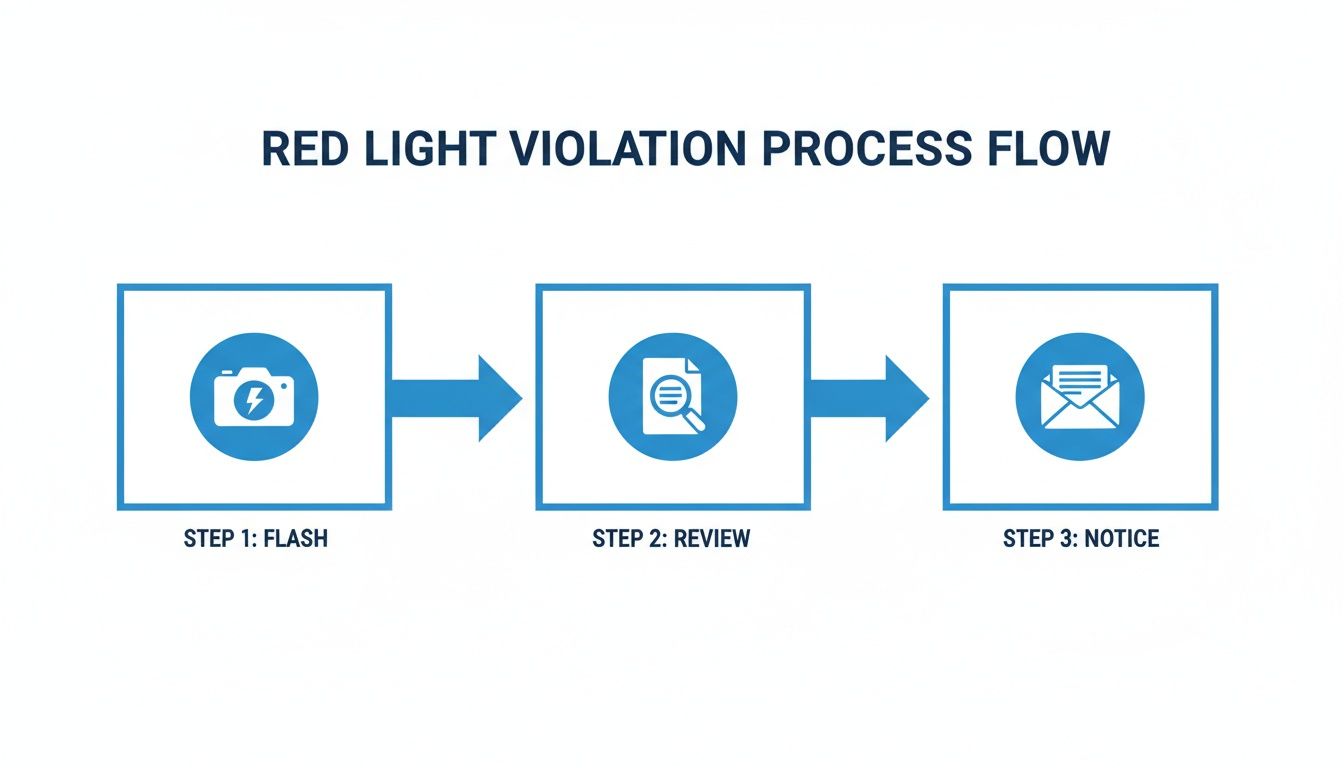
This flowchart breaks it down into three key stages: the automated camera flash captures the event, a trained officer reviews the evidence, and only then is an official notice mailed out.
Key Considerations For Miami-Dade Drivers
If you get a Notice of Violation from a city within Miami-Dade County, the clock starts ticking immediately. You typically have a 30-day window to either pay the $158 fine or formally request a hearing to fight it. Missing this deadline is a huge mistake—it automatically escalates the notice to a more serious Uniform Traffic Citation.
When you decide to contest a ticket here, a few key factors come into play:
Evidence Review: The first thing to do is carefully review the video and photos they provide. Is the picture of the driver or the license plate even clear? Did you actually come to a complete stop before making a legal right on red?
Procedural Accuracy: Was the notice issued correctly and within the legally required time? Any slip-ups in their administrative process could be grounds for a dismissal.
Affidavit of Non-Responsibility: If you weren't the one driving your car, you have to file a sworn affidavit naming the actual driver. This is a formal legal document with its own strict deadlines.
Navigating the local court system in Miami-Dade requires an understanding of its specific procedures. Each courthouse may have its own way of scheduling hearings and processing paperwork, and familiarity with these local rules can be a significant advantage.
Ultimately, whether you pay or fight the ticket is your call. But just paying the initial fine isn't always the smartest move, especially if you think there are reasons to challenge the violation.
Our practice focuses on traffic and DUI defense, and our goal is to protect your license and record. We handle criminal traffic matters across Florida, including in Miami-Dade, and are familiar with the local legal environment. Past results do not guarantee future outcomes, but a professional review of your case can help you understand your options and make an informed decision. Remember, submitting information through our website does not create an attorney-client relationship.
This is an attorney advertisement. Office in Broward.
Are Red Light Cameras About Safety or Money?
Nothing sparks a debate among Florida drivers quite like red light cameras. On one side, you have officials who see them as a crucial public safety tool. On the other, you have a whole lot of drivers who are convinced they're just automated cash registers for cities.
This argument—safety versus revenue—is really at the heart of the entire controversy.
The official pitch is pretty simple: the threat of getting a ticket in the mail makes people think twice before blowing through a red light. In theory, this should cut down on the most dangerous kinds of intersection crashes, especially the brutal T-bone collisions that often have tragic outcomes. Supporters will tell you it's all about changing driver behavior to make the roads safer for everyone.
But there’s another side to this story, and it’s one that a lot of drivers and even some safety experts find more convincing. Many argue these cameras are creating a whole new set of problems, sometimes making intersections even more dangerous than they were before.
The Law of Unintended Consequences
One of the biggest knocks against red light cameras is the documented spike in rear-end collisions at intersections where they're installed. The data is pretty clear on this. Drivers see the camera, realize the light is about to change, and slam on their brakes to avoid a $158 ticket.
That sudden stop easily catches the driver behind them off guard, leading to a chain reaction of fender-benders. While these accidents are usually less severe than a T-bone crash, the fact that they happen more often raises a huge question: are the cameras actually improving safety, or are they just trading one type of accident for another?
While proponents argue that cameras prevent severe side-impact collisions, state-level data has repeatedly shown that the same intersections often experience a spike in rear-end crashes. This trade-off is at the very heart of the safety debate.
This tricky reality has fueled a major public backlash all across Florida.
A Statewide Backlash Against Perceived Money Grabs
This isn't just a hypothetical debate; it has played out in city halls and on ballots across the state for years. Many cities that jumped on the red light camera bandwagon have since shut down their programs after facing intense public pressure and some pretty damning data.
Red light cameras were sold as a fix for safer streets, but what they really ignited was a fierce debate over their true purpose. A revealing 2022 state study found that at many intersections, crashes actually went up after the cameras were installed, mostly due to rear-end collisions from drivers hitting the brakes. As you can learn more about these findings, the number of active programs statewide has nose-dived from 82 in 2014 to just 39 today.
This isn't just a statistic; it’s a trend driven by real-world examples:
Miami and Hialeah: Two of the biggest cities in Miami-Dade County pulled the plug on their camera programs after years of residents insisting they were just a "money grab."
Sweetwater: Back in 2019, voters in this city overwhelmingly chose to ban the cameras, with a staggering 81% approving the measure after the program started raking in millions in annual revenue.
Unincorporated Miami-Dade: The county itself also shut down its program, pointing to the growing controversy and negative public opinion.
These high-profile reversals tell a clear story. When residents feel like a program is more about generating cash than preventing accidents, public support dries up fast. The debate isn’t over, but the growing number of cities ditching red light cameras suggests that for many Floridians, the argument that they're a revenue tool is winning.
Common Defense Strategies For A Camera Ticket

Getting that Notice of Violation in the mail doesn't mean you're automatically on the hook to pay it. The evidence might look damning at first glance, but there are often several ways to challenge the ticket. Understanding these common defense strategies can help you figure out the best move for your situation.
Think of it like a referee reviewing a controversial play in a football game. The call on the field was a penalty, but a closer look at the replay might reveal a detail that overturns the whole thing. A traffic ticket works the same way—the government has to prove its case, and sometimes the evidence just isn't as solid as it seems.
A strong defense almost always comes down to finding weaknesses in the evidence or mistakes made during the ticketing process.
Challenging The Provided Evidence
The heart of the state's case against you is the photo and video captured by that automated camera. If that evidence is flawed, their entire argument can fall apart.
One of the most direct ways to fight back is to scrutinize the quality of the images themselves. Is the license plate number crystal clear? Can you definitively say that's your car? Sometimes glare, bad weather, or an obstructed camera view can make the photos completely inconclusive. If the evidence isn't clear, you can argue it fails to meet the burden of proof.
The video footage is another critical area. It has to show your vehicle clearly failing to stop at the stop line while the light was red. This is especially true for those tricky right-turn violations.
The Right-On-Red Defense: Florida law lets you turn right on red after coming to a complete stop, unless a sign says otherwise. A very common defense is proving you did, in fact, stop completely before making your turn. The camera's angle might not have caught that brief but totally legal stop.
The Obstructed View Argument: Was a tree branch or a big truck blocking the traffic light or a required warning sign? If you can show your view was blocked, you can argue you couldn't have known you were about to commit a violation.
Identifying Procedural And Identity Issues
Beyond the photos and video, the way the ticket was issued has to follow strict legal rules. Any misstep by the city or its camera vendor could make the notice invalid.
A major defense is proving you weren't the one driving your car when the violation happened. The notice is sent to the registered owner, but that person isn't always behind the wheel.
In Florida, you have the right to submit a sworn Affidavit of Non-Responsibility. This is a legal document where you declare under oath that you were not driving the vehicle and, if you know, identify who was. This has to be filed within a strict deadline, usually 30 days from when the notice was mailed.
Even the timing of the notice is mandated by law. The city must mail the Notice of Violation within 30 days of the date the infraction occurred. If it shows up in your mailbox later than that, the ticket may be legally unenforceable. You'll want to check the postmark date on the envelope and compare it to the violation date on the notice itself.
When you start looking at these options, you realize there are many factors to consider. You can learn more about how to fight a red light ticket in our detailed guide. Our practice focuses on traffic defense, and our goal is to protect your license and record. Please remember that past results do not guarantee future outcomes and submitting information does not create an attorney-client relationship.
Attorney Advertisement. Office in Broward.
Why You Should Consider Professional Legal Help
Trying to fight a traffic ticket on your own can feel like stepping into a different world. The legal system has its own language, its own deadlines, and its own rules that can easily trip up anyone without experience. This is where a law firm that handles traffic defense can make a significant difference.
The number one goal is always to protect your driving record. Points on your license aren't just a minor hassle; they can lead to skyrocketing insurance premiums for years to come. In some cases, they can even put your driver's license at risk of suspension. Bringing in professional help shifts that entire burden from your shoulders to an experienced team.
Saving You Time And Serious Stress
One of the most immediate benefits of hiring a traffic ticket attorney is sheer convenience. A legal professional can manage every single part of your case, from filing the right paperwork to appearing in court on your behalf.
That means you likely won't have to take time off work, drive down to the courthouse, or sit around for hours waiting for your name to be called. For most people, that peace of mind is invaluable. Instead of stressing about what to say to a judge, you can trust your case is being handled appropriately.
A Notice of Violation from a red light camera might seem minor, but ignoring it or handling it the wrong way can spiral into much bigger problems. An experienced attorney can spot procedural errors or weak evidence you'd never see, protecting your driving record from the very beginning.
When The Stakes Are Even Higher
While any ticket is a pain, the consequences can be far more severe for certain drivers. Having an attorney in your corner becomes absolutely critical in these situations:
Commercial Driver's License (CDL) Holders: For professional drivers, even a minor violation can put their entire livelihood on the line. Points on a CDL can easily lead to suspension or even termination.
Out-of-State Residents: Trying to deal with a Florida ticket from another state is a logistical nightmare. A local attorney can handle everything without you ever having to come back.
Parents of Teen Drivers: A ticket on a young driver’s record can make the family's insurance rates go through the roof. Protecting their early driving history is just a smart financial decision.
The world of red light cameras in Florida is always changing. The number of cities using them dropped from 67 in 2016 to just 42 by 2023, a clear trend of programs shutting down due to public pushback. Even so, cameras still issued over a million notices last year, and of those that were contested, thousands were dismissed.
When you're facing an automated fine, you need a firm that understands this environment. Our practice is dedicated to traffic defense, offering a clear, upfront process with a single focus: keeping your record clean. To learn more, see what a dedicated Florida red light ticket lawyer can do for you.
Attorney Advertisement. Office in Broward.
Common Questions About Florida Red Light Camera Tickets
Getting a ticket in the mail from one of Florida’s many red light cameras leaves most drivers with the same handful of questions. Here are some clear, straightforward answers to the things we hear most often.
Will I Get Points On My License If I Just Pay The Ticket?
No, not if you pay the initial $158 Notice of Violation before the deadline. Think of that first notice like a parking ticket—it doesn’t add points to your license or get reported to your insurance company.
But if you ignore it, the situation changes fast. The notice escalates to a formal Uniform Traffic Citation, and a conviction at that stage will put points on your license.
What Happens If I Ignore The First Notice?
Ignoring that first notice is an expensive mistake. The violation gets upgraded to an official Uniform Traffic Citation, and the fine jumps to over $260. Worse, a conviction will add points to your record.
If you continue to ignore the citation, you're risking a suspension of your driver's license. It’s a problem that only gets bigger and more costly the longer you wait.
Can I Get A Ticket For A Right Turn On Red?
Absolutely, and it’s one of the most common reasons for a camera ticket. Florida law is very specific: you must come to a complete and full stop behind the solid white line before you begin your right turn on red (unless a sign says no turn on red).
Many drivers get ticketed for making a "rolling stop," where the car’s wheels never actually stop moving. The cameras are programmed to catch that lack of a full stop, triggering a violation.
I Wasn't The One Driving My Car, What Can I Do?
You are not responsible for a ticket if you weren't behind the wheel. To clear your name, you must file a sworn Affidavit of Non-Responsibility with the agency that issued the ticket.
This is a legal document where you declare under oath that you were not driving the car when the violation occurred. Pay close attention to the deadline on your notice, as you typically only have 30 days to submit this affidavit.
Trying to figure out a red light camera ticket can feel confusing, but you don't have to handle it alone. At Ticket Shield, PLLC, our practice focuses on traffic defense and is here to help protect your driving record. For a free, no-obligation consultation to go over your options, visit us at https://www.ticketshield.com. This is an attorney advertisement. Office in Broward. Submitting information via our website does not create an attorney-client relationship. Past results do not guarantee future outcomes.