Can I Fight a Red Light Ticket in Florida? A Guide to Your Defense Options
Can I fight a red light ticket? This Florida guide explains defenses, court steps, and tips for drivers statewide (can i fight a red light ticket).
Yes, you can fight a red light ticket in Florida. In many situations, it's a wise decision.
Whether an officer handed you a citation on the roadside or you received a notice in the mail from a red light camera in a place like Broward County, simply paying the fine is the same as pleading guilty. That decision can lead to points on your license and an unpleasant surprise when your insurance bill arrives.
Your Right to Contest a Florida Red Light Ticket
Getting a red light ticket, especially in a busy area like Broward, can feel like you've already been found guilty. But it’s critical to remember that a ticket is just an accusation, not a conviction.
You have a legal right to challenge it, and doing so is often a sound financial move. The first step is to identify the exact type of ticket you're holding, because the strategy to fight it changes depending on its source.
Notice of Violation (Camera Ticket): This is the first letter that arrives in the mail, sent to the registered owner of a vehicle photographed running a red light. This is not a formal citation yet and does not automatically add points to your license. It's an offer to pay a fine and close the matter before an official ticket is issued.
Uniform Traffic Citation (UTC): This is the official ticket. It’s either handed to you directly by a police officer or mailed to you after a camera’s Notice of Violation is ignored. A UTC is a formal charge that carries the risk of points, higher fines, and other penalties if you’re convicted.
To help you figure out what you're dealing with, let's break down the key differences.
Red Light Ticket Initial Assessment
This quick summary can help you understand your situation and what's at stake.
Ticket Type | Initial Document | Points on License? | Key Defense Areas |
|---|---|---|---|
Camera Ticket | Notice of Violation (by mail) | Not initially, but yes if it becomes a UTC. | Photo clarity, vehicle identification, signage, timing of the light. |
Officer-Issued Ticket | Uniform Traffic Citation (on the spot) | Yes, if convicted. | Officer's view, road conditions, conflicting testimony, emergency situations. |
Understanding which path you're on is the first step toward building a sound defense.
Why Contesting a Ticket is a Prudent Choice
Every citation has potential weaknesses. An officer's view might have been blocked. A camera’s photo evidence could be blurry or fail to clearly identify the driver. In Florida, the burden is on the state to prove you’re guilty—not on you to prove your innocence.
Contesting the ticket forces the state to meet its standard of proof, which often opens the door for a dismissal or a reduced penalty. Our practice focuses on finding these weaknesses. You can read more about how this works in our guide on getting a red light ticket dismissed in Miami-Dade County.
While camera programs are often presented to the public as a safety measure, it's worth examining the financial incentives. Research has shown that private companies running these camera systems often retain a significant portion of the revenue, with cities sometimes receiving less than 20% of the fine money. Knowing there's a profit motive behind these tickets makes exercising your right to a fair hearing even more important.
Understanding Red Light Laws in Broward County

Florida has a statewide red light law, § 316.075, that serves as the legal foundation for every ticket. However, its day-to-day application can feel more intense in a sprawling, populated area like Broward County, where heavy traffic and automated enforcement are part of daily life. Knowing the specific rules is the first step toward building a defense against a red light ticket.
A violation isn't as simple as driving through an intersection when the light is red. The law is nuanced and covers several common driving scenarios that affect Broward drivers.
What Constitutes a Violation in Broward
Many drivers are caught by surprise when they learn what can trigger a ticket. It's not always as obvious as it seems. Beyond blatant offenses, the state has to prove you committed a specific infraction, such as:
Entering After Red: This means your vehicle’s front tires crossed the solid white stop line after the traffic light turned red.
Improper Right on Red: You failed to come to a complete stop behind the white line before making a legal right turn on red. These "rolling stops" are a frequent violation caught by red light cameras.
Blocking the Intersection: You legally entered an intersection on a green or yellow light but were unable to clear it before it turned red, obstructing cross-traffic.
These details are crucial. For example, if you were already in the intersection when the light changed from yellow to red, you may not have violated the law. That’s a key detail that can be argued in court.
The Camera Ticket Process Explained
Red light cameras are a common sight on Broward's busiest roads. When a camera flags a potential violation, it initiates a specific, multi-step legal process that begins with a letter arriving in the mailbox of the vehicle's registered owner.
The initial "Notice of Violation" you receive in the mail is not an official ticket. Consider it an offer to pay a lower fine to resolve the matter before it escalates to a Uniform Traffic Citation (UTC)—the kind that carries points and higher penalties.
Ignoring this notice can lead to more serious issues. If you do not pay the fine by the deadline, the county will issue an official UTC. This formal citation gives you the right to request a hearing in traffic court, where you can present a defense. You can explore the complexities and potential defense angles in our detailed guide on Florida red light camera laws.
The growing use of this technology is a global trend. The market for these cameras is projected to exceed $700 million by 2033, driven by advances in AI and automated enforcement. For Broward drivers, this means the technology issuing tickets is becoming more sophisticated, making a skilled legal analysis more critical than ever. You can read more in these insights on the automated camera market.
When you decide to contest a red light ticket, the outcome often depends on the right defense. Florida law provides several angles to challenge citations from both cameras and police officers, but each requires a different approach. Understanding these common defenses is your first step to building a case.
If a red light camera sent you a notice, your challenge is about the technology. The evidence is technical, which means your defense is often found in procedural details and potential errors.
Was the Evidence Clear? The photo or video must clearly show your vehicle running the red light. If the image is blurry, captures the wrong license plate, or doesn't definitively prove it was your car, you can argue the evidence is insufficient.
"It Wasn't Me": Camera tickets are mailed to the car's registered owner, but that doesn't mean the owner was driving. You can submit an affidavit naming the person who was driving, which is a valid defense for the owner.
Did the Notice Arrive Too Late? The clock starts at the moment of the violation. Florida law requires the initial "Notice of Violation" for a camera ticket to be mailed within 30 days. If it arrives after that deadline, the ticket may be invalid.
A successful outcome here requires a careful review of the notice and the evidence.
Challenging an Officer-Issued Citation
When a police officer personally hands you a ticket, the dynamic changes. Now, it's their observation versus other evidence, and your defense needs to question what the officer claims to have seen.
A few common ways to do that include:
Obstructed View: Was the officer’s view blocked by a large truck, a building, or heavy rain? If they could not get a clear, unobstructed look at your car crossing the stop line after the light turned red, their testimony may be challengeable.
Mistaken Identity: In the chaos of a busy intersection, it's possible for an officer to identify the wrong car. They might have seen a violation but mistakenly pulled over your vehicle instead of the actual violator.
Necessary Action to Avoid an Accident: This is a significant defense. Did you have to accelerate into the intersection to avoid being rear-ended by a driver who was not stopping? This "necessity" defense argues that running the light was the lesser of two evils.
Justifying Your Actions in Court
Sometimes, the most effective defense isn’t to deny you ran the light, but to explain why it was a reasonable action under the circumstances. In legal terms, these are called affirmative defenses—you admit to the act but argue it was legally justified.
A classic example is making way for an emergency vehicle. If you had to carefully and safely move your car through a red light to let an ambulance or fire truck pass, that’s a powerful defense that judges and hearing officers take very seriously.
Small details can also make a significant difference. Studies show a high percentage of violations occur within the first second after a light turns red. This split-second timing is critical, and you can discover more insights about red light camera timing and effectiveness to see how grace periods are sometimes used. Demonstrating you were caught in that brief, transitional moment can sometimes be enough. Our goal is to protect your license and your record by exploring every one of these angles.
Navigating the Broward County Traffic Court Process
So, you’ve decided to fight your red light ticket. That means you'll be interacting with the Florida traffic court system. The thought of court can be intimidating, but understanding what to expect can reduce uncertainty and put you in a more confident position.
Whether you're in a busy courthouse in Broward County or a smaller county courthouse, the basic steps are similar across the state.
The process begins the moment you officially plead "not guilty" to your Uniform Traffic Citation (UTC). This is a critical first step, and you must do it within the deadline on your ticket—usually 30 days. Most counties allow you to submit your plea online or by mail, which prompts the court to set a hearing date.
Preparing for Your Hearing
Once you have a hearing date, preparation begins. This is where you or your attorney start gathering the evidence needed to build your defense. A crucial part of this is a formal process called discovery, which is the legal term for requesting all the evidence the state has against you.
What kind of evidence are we talking about? It could include:
The officer’s notes from the traffic stop.
Any available dash-cam or body-cam footage.
Maintenance and calibration records for the red light camera or the officer's radar equipment.
Clear, high-resolution copies of any photos or videos.
Obtaining this information is how you find weaknesses in their case. Perhaps the camera hadn't been properly serviced, or the officer’s view of the intersection was partially blocked. Such details can become the cornerstone of a defense.
The overall game plan boils down to a few key areas.
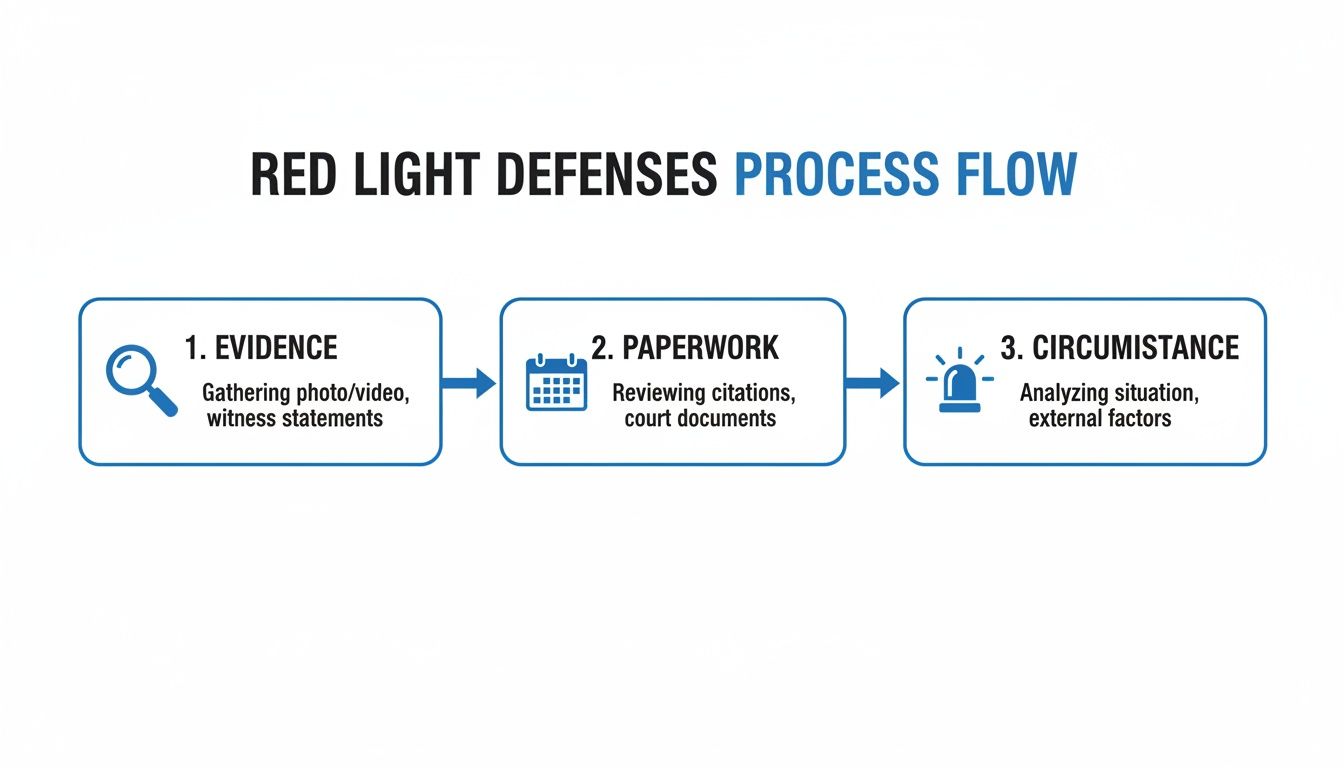
As you can see, a sound defense is built on three pillars: the evidence you can gather, managing the paperwork and deadlines, and carefully analyzing the unique circumstances of your ticket.
Who You'll Encounter in Court
Walking into a courtroom feels less mysterious when you know the roles of the people involved. In a typical traffic hearing, you'll encounter a few key individuals:
The Judge or Hearing Officer: This is the person who presides over the hearing, listens to both sides, and makes the final decision.
The Citing Officer: If a police officer wrote your ticket, they will be present to explain to the judge why they issued it.
The State's Attorney (sometimes): While less common for a simple traffic ticket, a prosecutor may be there to argue the case for the state.
Knowing their roles helps you understand the flow of the hearing. For a more detailed walkthrough of the experience, check out our guide on what to expect in traffic court.
Whether you handle it yourself or seek legal assistance, being prepared is your best path toward a favorable result. Our goal is always to protect your license and your record.
The True Cost of a Red Light Ticket Conviction
Simply paying the fine for a red light ticket might seem like the easiest path, but it can be a costly mistake in the long run. The initial fine is just the beginning; a conviction can set off a chain reaction of hidden costs that impact your finances for years.

The financial ripple effect extends far beyond that one-time payment. Once you’re convicted of a moving violation, the consequences can add up quickly.
Points on Your Florida Driver's License
Florida uses a point system to track driving history, and a conviction for running a red light will add three to four points to your record, depending on the circumstances. These aren't just abstract numbers; they are a direct measure of risk that both the state and your insurance company monitor closely.
When these points accumulate, the consequences become serious:
12 points in a 12-month period leads to a 30-day suspension.
18 points in an 18-month period triggers a 3-month suspension.
24 points in a 36-month period results in a 1-year suspension.
A single ticket might not seem like a major issue, but it moves you closer to a suspension, especially if you already have points on your license.
The Spike in Your Car Insurance Premiums
This is often the most significant and lasting financial impact. After a red light conviction, your insurance provider will likely reclassify you as a higher-risk driver, which means your premiums will increase. This isn't a one-time fee—the rate hike can last for three to five years, potentially costing you hundreds, if not thousands, of extra dollars over time.
Let's look at how quickly the costs can escalate beyond the initial fine.
Cost of a Red Light Ticket Conviction Beyond the Fine
Expense | Initial Fine (Approx.) | 3-Year Insurance Increase (Est.) | Total Potential Cost |
|---|---|---|---|
Red Light Ticket | $158 - $262 | $600 - $1,500+ | $758 - $1,762+ |
As you can see, the long-term insurance penalty often dwarfs the original fine. It’s a primary reason why simply paying the ticket can be a significant financial misstep.
The total cost of increased insurance premiums can easily exceed the original fine, making the decision to simply pay the ticket a costly one. Exploring the full financial picture is essential, and you can learn more by reading about the real cost of running a red light.
Career Consequences for CDL Holders
If you drive for a living, the stakes are even higher. Commercial Driver's License (CDL) holders are held to stricter federal standards. A conviction for a serious moving violation like running a red light isn't just a fine—it can lead directly to a CDL suspension, putting your ability to earn an income at risk.
Fighting a red light ticket is about more than avoiding a fine. It's a strategic move to protect your license, your insurance rates, and for some, your livelihood.
How an Experienced Traffic Attorney Can Help
You have the right to represent yourself, but deciding if you can fight a red light ticket on your own involves a serious cost-benefit analysis. The legal system can be complex, and a misstep could lead to a conviction. Partnering with an attorney whose practice focuses on traffic defense provides you with a professional advocate whose job is to protect your interests.
This is not about finding a secret loophole. It's about applying professional knowledge to your situation. An experienced attorney understands the specific procedures of local courts, like those in Broward County, and is familiar with the hearing officers and what they expect. They can spot technical errors in a citation or procedural mistakes that a non-lawyer would likely miss.
Strategic Advantages of Legal Representation
When you hire a firm that handles traffic tickets across Florida, you get a team to manage the entire process for you. They will file the necessary paperwork, formally request the evidence from the state, and build a defense based on experience. For many people, that peace of mind is a significant benefit.
Here are some of the key advantages:
Court Appearances: In most cases, your lawyer can appear in court on your behalf. This means you may not have to take time off work, experience the stress of the courthouse, or face a hearing officer alone.
Evidence Review: They know precisely what to look for in camera maintenance logs, officer notes, and video evidence to identify weaknesses in the state's case against you.
Negotiation: A knowledgeable attorney can often negotiate with the court or state to seek reduced charges or penalties, aiming for an outcome that keeps points off your license.
Attorney Advertisement: Choosing to hire legal representation is an important decision. Our goal is to protect your license and record by providing a defense grounded in legal knowledge and experience. Office in Broward. Past results do not guarantee future outcomes.
Ultimately, the decision to hire a red light ticket lawyer is an investment in protecting your driving record and avoiding the long-term costs that follow a conviction, such as increased insurance premiums. A no-obligation consultation can help you understand all your options.
Got Questions About Florida Red Light Tickets? We Have Answers.
Still weighing your options after getting a red light ticket in Florida? It’s normal to have questions. Here are some of the most common ones we hear from drivers, along with straightforward answers.
What’s the Difference Between a “Notice of Violation” and a Real Ticket?
The first letter you get in the mail from a red light camera is a Notice of Violation. It is a preliminary warning, not an official ticket. It does not put points on your license and is essentially an offer to pay a fine to resolve the matter.
The actual ticket is called a Uniform Traffic Citation (UTC). This is the official document filed with the court, which carries points and requires a formal legal response.
Should I Just Pay That Initial Fine and Get It Over With?
It might seem like the easiest path, but paying the initial notice is an admission of guilt. Doing so closes the door on your right to contest the ticket in court.
In many situations, the more prudent approach is to wait for the official Uniform Traffic Citation (UTC) to be issued. This keeps all your legal options and defenses available.
Can I Actually Fight a Red Light Ticket in Broward County?
Yes, you can fight a red light ticket in Broward County, or any other county in Florida. The laws and your rights are consistent across the state.
An attorney whose practice focuses on traffic tickets will be familiar with the local court procedures, which can be beneficial in building a defense.
Remember, a ticket is just an accusation, not a conviction. You have the right to make the state prove its case against you in court.
Will a Red Light Ticket Put Points on My License?
It can. If you are convicted of an officer-issued citation or you let a camera ticket become a Uniform Traffic Citation (UTC) and are found guilty, you could receive three to four points on your Florida driver's license.
Facing a red light ticket can be stressful, but you don’t have to handle it alone. At Ticket Shield, PLLC, our practice focuses on protecting your driving record and helping you avoid costly penalties. For a free consultation to discuss your case, visit us at https://www.ticketshield.com. Submitting information via our forms does not create an attorney-client relationship.