
Florida Expunging Driving Record Guide 2026
Learn about expunging driving record eligibility, costs, and the process in Florida for 2026. Our lawyer-led firm offers a free consultation.
A past traffic mistake can haunt you. In Florida, you can only expunge certain criminal traffic offenses, not civil tickets. The process is slow, document-heavy, and unforgiving. If you guess wrong, you waste time and may waste your one shot.
You found something on your record and now it’s costing you. Maybe a job application stalled. Maybe a landlord got quiet. Maybe your insurer treated an old case like it happened yesterday. For gig drivers, one entry can mean account trouble. For military members and professionals, one unresolved record can create a much bigger problem than the original stop on the roadside.
That’s why expunging driving record issues in Florida has to be approached the right way. Not emotionally. Not by clicking through an automated app. Not by trusting a chatbot that can’t tell the difference between a civil infraction and a criminal traffic offense. You need a legal strategy.
Florida traffic law is full of traps for drivers who assume every “ticket” is treated the same. It isn’t. A speeding citation under Chapter 316 is not the same thing as a reckless driving charge under Florida Statute § 316.192. One usually stays where it is. The other might open the door to sealing or expungement if the case ended the right way.
At Ticket Shield, PLLC, the point is direct attorney guidance. You speak to your lawyer by phone or text. No middlemen. No ticket mill intake loop. No automated service pretending to practice law. If your record affects your license, work, insurance, or future, you need a lawyer-led review before you file anything.
Table of Contents
Introduction A Clean Record is Your Shield
A clean record protects more than your pride. It protects your income, your mobility, and your advantage when someone runs your background. If a past traffic case is still following you, you need to know whether Florida law gives you a real path to remove it or whether you’re chasing something the law does not allow.
That distinction matters because many drivers use the phrase “expunging driving record” loosely. They mean insurance history, court history, DMV history, or all three at once. Florida does not treat those records as identical. If you don’t separate them at the beginning, you can spend months collecting paperwork for a case that was never eligible in the first place.
Why drivers get this wrong
Drivers often make one of three mistakes:
They assume every traffic case can be erased. It can’t.
They confuse a withheld outcome with expungement. Those are not the same thing.
They file before getting the right legal analysis. That’s dangerous in a state that treats record clearing conservatively.
Practical rule: If your case was a normal speeding ticket, a red-light citation, or another civil infraction, stop and verify eligibility before spending another hour on paperwork.
This issue shows up across Florida, from the Richard E. Gerstein Justice Building in Miami to county courthouses handling criminal traffic petitions elsewhere in the state. The courthouse won’t fix a bad strategy for you. The judge reviews what’s filed. If the filing is wrong, you’ve created delay and expense for yourself.
Why a lawyer matters before the paperwork starts
Real legal help matters at the front end, not after a denial. A lawyer can look at the charge, the final disposition, and your broader criminal history, then tell you whether expungement, sealing, withhold of adjudication, or a different path makes sense.
That’s the difference between legal counsel and automation. An app can ask what county your ticket came from. It can’t protect you from filing the wrong petition on the wrong case for the wrong record.
What Does Expunging a Record in Florida Really Mean
Expungement is not a magic delete button for everything tied to your driving history. In Florida, the first question is simple. Was this a civil traffic infraction or a criminal traffic offense? If you don’t answer that correctly, you’re already off course.

Why your driving record is not one thing
Florida law separates ordinary traffic violations from criminal traffic charges. That’s the line most generic guides blur, and it’s the line that decides whether you have any chance at relief.
According to this Florida driving record expungement explanation, civil violations like speeding or running red lights are permanently ineligible for expungement, while criminal traffic offenses like DUI, reckless driving, and DWLS-Knowingly may qualify if dismissed or withheld. That’s the rule you need to start with.
Here is the practical difference:
Type of case | Common example | Expungement outlook |
|---|---|---|
Civil traffic infraction | Speeding, red light, many routine Chapter 316 citations | Generally not eligible |
Criminal traffic offense | Reckless driving under § 316.192, some DWLS-related cases, DUI-related criminal proceedings | May be eligible only if the outcome and history fit Florida rules |
Civil tickets and criminal traffic charges do not live in the same legal category. Treating them the same is how drivers waste money.
If you aren’t sure what your case was, start by reviewing the case record and your history through a proper Florida driving record check guide. Don’t rely on memory. Many people say “ticket” when the case was filed as a crime.
Which Chapter 316 offenses matter
Chapter 316 covers a wide range of driving behavior, but not every violation under that chapter creates the same long-term problem or the same remedy. That matters for expunging driving record questions.
A speeding ticket usually leads to a civil result. A reckless driving allegation under § 316.192 is different because it can be charged as a criminal traffic offense. The legal path changes because the case category changes.
Use this filter:
If you paid a routine citation, you likely closed out a civil matter.
If you were arrested, booked, or required to appear in criminal court, the case may fall into the criminal category.
If the final result was dismissal, dropped charges, or acquittal, you may have an opening worth reviewing.
If you were adjudicated guilty of a criminal offense, your path gets much narrower.
This isn’t semantics. It decides whether you should pursue record clearing at all.
Are You Eligible to Clear Your Florida Criminal Record
Florida gives very little room for error here. Eligibility is strict, and the law does not reward assumptions. The first major issue is the one drivers usually learn too late. Florida treats expungement as a limited opportunity, not an unlimited cleanup tool.

Ask yourself these questions first
According to this Florida expungement limits overview, Florida allows only one criminal record expungement in your lifetime through the standard court-ordered process. That one-time rule shapes every serious strategy decision.
Use this checklist before you do anything else:
Have you already sealed or expunged a record through the standard court process? If yes, that may block another standard court-ordered expungement.
Were you found guilty or adjudicated guilty of the offense you want cleared? If yes, eligibility may fail.
Do you have any criminal convictions in Florida or another jurisdiction? That can create a major problem for eligibility.
Do you have a pending criminal case right now? Pending charges can stop the application.
Was the traffic matter criminal, not civil? If it was civil, you’re likely chasing relief the law doesn’t offer.
One more issue gets overlooked. A lot of drivers would be better served by understanding withheld adjudication in Florida traffic cases before they become fixated on expungement. In some situations, the right goal is preventing a conviction from entering in the first place, not trying to clean up the file later.
Why uncertainty is a warning sign
If you answered “maybe” to any item above, you need a case review before filing. “Maybe” usually means one of three things. The clerk record is unclear. The final disposition is being misread. Or the driver is mixing up the court file with the license history.
Those mistakes are common. They’re also dangerous.
Your one chance should not be spent on guesswork.
Florida’s approach is narrow for a reason. The state is not offering broad amnesty for every old driving problem. It’s offering limited relief for people who fit specific legal criteria. If your background includes more than one event, more than one county, or any out-of-state history, the risk of self-diagnosis goes up fast.
A strong attorney review focuses on documents, not stories. The charge document matters. The disposition matters. The existence of any past conviction matters. If you’re missing any of those pieces, stop and get them before you file.
What Is the Step-by-Step Expungement Process
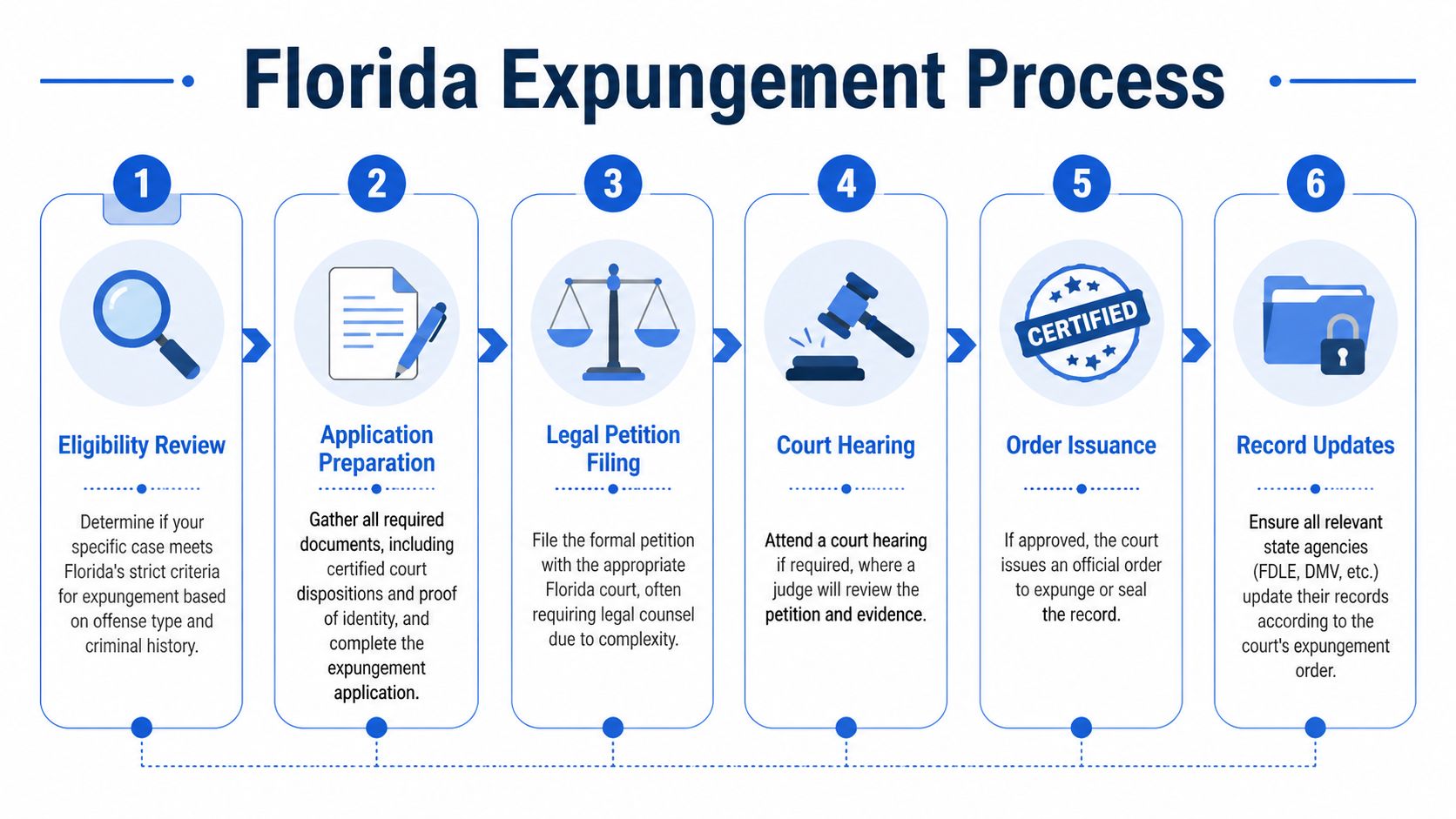
A driver gets a case dismissed, assumes the record can be wiped, downloads a few forms, and files alone. Then the application stalls because the case was misclassified, the disposition was incomplete, or the wrong agency got the packet first. That mistake can cost months. In Florida, record clearing is a narrow criminal-law process. It does not rescue ordinary civil traffic tickets.
What happens before you ever file in court
Start with the right question. Was this a criminal traffic offense or a civil infraction? If you skip that step, the rest of the process can be a waste of time. Florida expungement applies to qualifying criminal cases. It does not erase the usual paid ticket, school-zone citation, red-light ticket, or other standard civil traffic matter from your driving history.
The process usually starts with the Florida Department of Law Enforcement, not the judge. Before any petition reaches the courthouse, you need the paperwork to match the case history. That means gathering the record, confirming the final disposition, and making sure the application lines up with what happened in court.
You will usually need:
Certified court dispositions showing how the case ended
Fingerprint materials required for the application
Identity documents and related application items
Driving-history-related documents when they matter to the filing
Then the application must be completed accurately, notarized, and sent through the proper channel before the court phase even begins.
Drivers get tripped up here because it looks clerical. It is legal work disguised as paperwork. A wrong disposition, a missing certification, or a bad read of the charge type can stop the process before a judge ever sees it.
If you need a focused explanation of how criminal traffic record clearing works, read this guide on Florida traffic ticket expungement for criminal driving cases.
What happens at the courthouse
Once FDLE issues the certificate of eligibility, the case moves to court. The petition is filed in the county tied to the arrest or prosecution. The State Attorney must be served correctly. In some cases, the judge may rule on the papers. In others, a hearing may be set.
That is the point where self-filed cases often start falling apart.
The court is not checking your forms for you. The judge expects the petition, supporting documents, proposed order, and service to be correct. If your filing mixes up a civil ticket with a criminal case, leaves out a required document, or asks for relief the law does not allow, you have handed the court a reason to deny it.
This video gives a general overview of the topic before you start sorting your own documents:
If the judge signs the order, agencies then update their records. That last phase can move faster than the front end, but drivers make a serious mistake when they treat the order as the hard part. The hard part is building a legally correct file before the petition is submitted.
Immediate Steps to Take
If you believe your case might qualify, do this now:
Get the certified disposition. Do not rely on memory, a payment receipt, or an online docket note.
Verify the charge category under Florida law. Criminal and civil traffic matters do not lead to the same result.
Check your prior history for disqualifiers. Past convictions or prior record-clearing use can change the analysis fast.
Find every open case. A pending criminal matter can block the application.
Have a lawyer review the full file before filing. One filing can be your one shot. Do not spend it guessing.
A lawyer-led firm like Ticket Shield, PLLC can review the charge, the disposition, and the filing posture before you commit to a petition. That kind of review matters most when a driver is stuck on the question Florida generic guides usually blur. Is this a criminal traffic case that might be cleared, or a civil driving record problem that cannot be expunged at all?
How Do DUIs and Minor Tickets Affect Expungement
Drivers need blunt answers. A dropped criminal traffic case and a stack of paid routine tickets do not lead to the same result. If you mix those together, you’ll misunderstand your options.

Scenario one dropped criminal traffic charge
Take a driver arrested on a DUI-related charge. The person completes the required process, the prosecutor drops the case, and there is no adjudication of guilt. That is the kind of fact pattern that at least deserves a careful legal review.
The important point is not false optimism. The important point is classification and outcome. If the case was criminal and ended favorably, analysis starts. If the case was criminal and ended with a disqualifying result, analysis usually ends.
For a more focused discussion of that issue, review this Florida DUI expungement article. DUI cases are highly specific, and drivers shouldn’t assume that every dismissed DUI-style case leads to the same form of relief.
Scenario two a record full of standard tickets
Now take a commercial driver with several years of speeding citations and maybe a red-light violation. The driver paid them, moved on, and now wants them erased because a background screen or employer review keeps surfacing the history.
That is where many people get bad advice online.
Those are usually civil traffic infractions. They were not criminal cases. Paying them usually closed them out as adjudicated matters. For expunging driving record purposes, that’s a dead end in most situations.
A record full of routine paid tickets is frustrating. It is not the same as an eligible criminal case.
This is why legal judgment matters more than convenience. An automated service may let both drivers start the same intake flow. A real attorney will tell the first driver there may be a path and tell the second driver not to waste time pursuing an unavailable remedy.
What Are the Costs and Common Pitfalls to Avoid
Drivers often ask about cost first. That’s understandable, but it’s the wrong starting point. The core question is whether you’re spending money on a viable strategy or on a filing that never had a chance.
Where the real expense comes from
The expense in a Florida expungement matter usually comes from several places working together, not from one single line item. You may face:
Government application fees
Clerk filing costs
Fingerprinting costs
Certified record retrieval costs
Attorney time for review, drafting, filing, and court handling
No serious lawyer should pretend the process is free of friction. It isn’t. But the more important financial issue is failed effort. A driver who files on an ineligible case, misunderstands the disposition, or serves the wrong office can lose time and money while getting no meaningful progress.
The value-driven choice is the one that identifies eligibility early and avoids wasted filings.
Common pitfalls that will derail your expungement
These are the mistakes that hurt drivers most often:
Filing for a civil infraction: Speeding and similar tickets are the wrong target for expungement in Florida.
Misreading the final outcome: “Withhold,” dismissal, dropped charges, and adjudication each mean different things.
Using incomplete records: If the disposition isn’t certified or the paperwork doesn’t match the case file, problems follow.
Ignoring service requirements: The State Attorney’s Office has to be handled correctly.
Confusing sealing with expungement: Those are different legal outcomes with different practical effects.
Trying to DIY a one-shot process: When the law limits standard relief, casual filing is a bad gamble.
A protective strategy is simple. Confirm eligibility first. Build the filing second.
What Does a Clearer Record Mean for Your Future
A successful expungement can change the way your future applications are read. That matters if you drive for a living, hold a professional license, apply for housing, or work in a field that screens hard for any criminal history.
Why employment and licensing change after relief
According to this Harvard Law Review discussion of expungement outcomes, people who obtain expungement experience sharp wage and employment improvements, and that matters in particular for gig economy drivers and security-clearance-related work. For Florida drivers, that benefit is practical, not theoretical.
A cleaner record can help when:
An employer runs a background check
A rideshare or delivery platform reviews eligibility
A licensing board looks at prior criminal history
A federal or security-sensitive role examines your background
When relief is granted, the result isn’t just emotional closure. It can improve the way gatekeepers evaluate your reliability and risk.
Why your record and your online footprint both matter
Court relief is one piece of reputation protection. The other piece is what still appears when someone searches your name online. If you’re dealing with employment or housing concerns, this online reputation management guide gives practical steps for reducing collateral damage after a legal issue.
If you’re still dealing with the front-end problem of keeping future entries off your history, this guide on getting a Florida ticket off your record is worth reading closely. Prevention is often easier than cleanup.
A clear point matters here. Expungement is not just about removing a reminder of the past. It’s about restoring options.
Frequently Asked Questions About Florida Expungement
Can I expunge a speeding ticket in Florida
Usually no. A standard speeding citation is generally a civil traffic infraction, and those are not the cases drivers should target for expungement.
Does expungement erase my entire driving history
No. Drivers often use “driving record” broadly, but different systems keep different records. A court-file result and a license-history entry are not always the same thing.
Is sealing the same as expungement
No. They are different legal remedies. The practical consequences differ, which is why the right strategy depends on the exact charge and outcome.
Can I do this myself
You can try. It’s risky. If you misclassify the case, submit the wrong records, or misunderstand your eligibility, you create delay and expense without solving the problem.
When should I call a lawyer
Immediately, if the case was criminal, if the outcome involved a dismissal or withhold, if you’ve ever had another record issue, or if your job depends on a clean background.
If you want the right goal from the start, No Points, no wasted motions, and no guessing about whether your case can be cleared, visit TicketShield.com for a free consultation.
