
Can You Expunge a DUI in Florida? A 2026 Legal Guide
Can you expunge a DUI in Florida? Our attorneys explain the hard truth about DUI convictions and the critical steps to protect your record before it's too late.

No. If you're convicted of DUI in Florida, you can't expunge or seal it. Your only real chance to clear the record is to stop the conviction before it happens through dismissal, acquittal, or a strategic reduction.
It's common to ask the expungement question too late.
That’s the mistake.
In Florida, the legal fight that matters most happens before a DUI conviction. Once a judge adjudicates you guilty under Fla. Stat. § 316.193, the cleanup options disappear. The record stays. The damage keeps showing up in places that matter, including employment screens, housing applications, licensing reviews, and insurance underwriting.
If you're searching “can you expunge a dui in florida,” you need the hard answer now, not comforting nonsense. A DUI conviction is the outcome you must avoid. Everything in your defense should be built around that reality.
Table of Contents
What Is the Difference Between Sealing and Expunging a Record
Can You Expunge a DUI Arrest That Did Not Lead to a Conviction
What Is the Step-by-Step Process to Petition for Expungement
How Does a DUI Record Permanently Affect Your Life in Florida
The Hard Truth About DUI Convictions in Florida
Florida is unusually unforgiving on this issue. If you are convicted of DUI, Florida law blocks both sealing and expungement.
Under Florida Statute § 943.0585, a DUI conviction can't be expunged or sealed, and the conviction remains visible for 75 years on your driving record, with insurance premium hikes averaging 80% to 100% for 3 to 5 years post-conviction, as discussed in this Florida DUI expungement analysis. The underlying offense is governed by Fla. Stat. § 316.193, which defines DUI in Florida, including impairment and a 0.08% or higher BAC.
Why the answer is no for convictions
People often get trapped by assuming a first offense can be cleaned up later. In Florida, that assumption can wreck your strategy.
A DUI conviction is treated as a permanent mark. It stays on the criminal side and the driving side. That means your background doesn't naturally heal with time. It keeps resurfacing.
Practical rule: If you're asking about expungement after a conviction, you're asking the wrong legal question. The right question is how to avoid the conviction now.
That’s why I tell drivers to stop thinking like this is a ticket problem. It isn’t. It’s a record problem, a licensing problem, an insurance problem, and often a career problem.
If you want a fuller look at the practical fallout, review these Florida DUI consequences.
Why the pre-conviction window matters
The case is still alive before adjudication. That’s your opportunity window.
Your lawyer can challenge the stop. Your lawyer can attack field sobriety evidence. Your lawyer can examine breath or blood issues. Your lawyer can push for dismissal, no-file, acquittal, or a reduction to an offense that doesn't carry the same permanent block.
Once guilt is formally entered, those options narrow fast.
Here’s the blunt truth in courthouse terms. Whether your case is at the Richard E. Gerstein Justice Building in Miami, the Broward County Judicial Complex in Fort Lauderdale, the Edgecomb Courthouse in Tampa, or the Orange County Courthouse in Orlando, the law doesn’t care that you learned your lesson. It cares whether you were convicted.
That’s why delay is dangerous. Waiting for “the court date to see what happens” is not a defense strategy. It’s surrender by drift.
What Is the Difference Between Sealing and Expunging a Record
People mix these up constantly. That confusion leads to bad decisions.
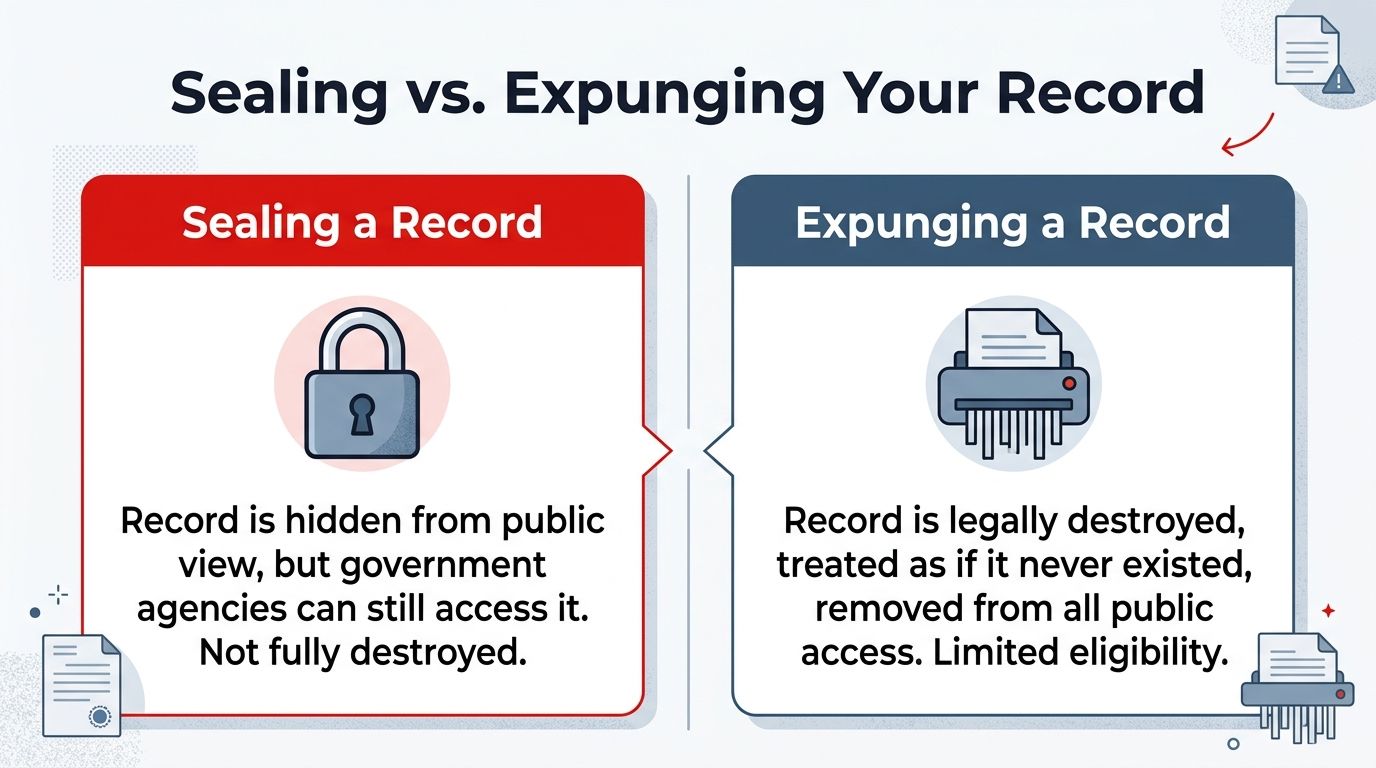
Sealing and expunging are not the same tool. If you don’t understand the difference, you can’t evaluate what outcome your attorney should fight for.
What sealing actually does
Think of sealing like putting a file in a locked vault.
The record still exists. Government agencies and certain authorized entities may still access it. But the general public usually cannot. For many drivers, that can mean the difference between a public background check exposing the case or not.
That matters when a DUI charge gets reduced to a non-DUI offense and adjudication is withheld. In the right situation, sealing can become the defensive objective because it takes the record out of ordinary public view.
What expungement actually does
Think of expungement like legal destruction of the record.
It is the stronger remedy. The point is to treat the matter as removed from public access to the fullest extent allowed by law. For someone who was arrested but never convicted, that is often the cleanest result available.
Here’s a quick comparison:
Remedy | Public visibility | Government access | Best use case |
|---|---|---|---|
Sealing | Hidden from most public checks | Still accessible to certain agencies | Reduced eligible charge with withhold |
Expungement | Removed from public access | Very limited residual access under law | Arrest or case that ended without conviction |
Sealing hides. Expungement destroys. If your lawyer isn't aiming for the correct outcome based on your facts, you're wasting precious time.
If you need a broader overview of Florida record-clearing rules beyond DUI-specific cases, review this guide to traffic ticket expungement.
The practical takeaway is simple. A DUI conviction gets neither. A non-conviction outcome may open the door to expungement. A reduction to an eligible offense may open the door to sealing.
Those are very different futures.
Can You Expunge a DUI Arrest That Did Not Lead to a Conviction
Yes. This is the narrow path that gives drivers real hope.
If your DUI case ends without a conviction, you may be able to expunge the arrest record. That usually means one of a few outcomes happened. The charge was dropped. The prosecution declined to proceed. The case was dismissed. Or you were found not guilty.
Which case outcomes can open the door
The key is the outcome, not the arrest itself.
A DUI arrest alone does not automatically doom you to a permanent public record. In Florida, if the case ends favorably enough, the arrest can become eligible for record clearing through the formal expungement process.
These are the results that usually matter most:
Dismissal: The court dismisses the charge.
Nolle prosequi or no-file: The prosecution stops pursuing the case. If you’re not familiar with that term, this explanation of what nolle pros means in court is worth reading.
Not guilty verdict: You fight the case and win.
Florida processed 9,555 criminal record expungements from September 2018 to February 2025, but that total excludes all DUI convictions, and Florida’s one-time rule limits lifetime expungement opportunities to a single record per person, according to Florida expungement totals.
That number matters because it proves two things at once. Florida does allow expungement in some criminal cases. Florida does not allow it for DUI convictions. So if you want a clean record path, the defense objective must be a non-conviction result.
Why your one chance matters
The one-time rule changes how you should think about your case.
You don’t have unlimited tries. You don’t get to casually accept a bad result now and “fix it later.” If your case is eligible for relief, you need to protect that opportunity carefully and use it correctly.
A dropped DUI charge is not just a win in court. It may be your only opening to erase the arrest from public view.
That’s why your defense must be designed backward from the record consequence. A lawyer should evaluate every pressure point in the state’s case with one question in mind. Can this weakness produce a dismissal, no-file, or acquittal?
If yes, that path matters far more than a quick plea that feels convenient today and haunts you later.
The phrase “can you expunge a dui in florida” has one honest answer. You can’t expunge a DUI conviction. You may be able to expunge a DUI arrest if the case ends without a conviction. That difference is everything.
What Is the Step-by-Step Process to Petition for Expungement
If your DUI case ended without a conviction, the legal work is not over. You still have to clear the record correctly.
Florida uses a dual FDLE-court system. That means one agency process and one court process. If you mishandle either one, your petition can stall or fail.
The process begins with the Florida Department of Law Enforcement. It does not begin with a casual request to the clerk, and it definitely does not begin with assumptions.
What you file first with FDLE
You must first seek a Certificate of Eligibility from FDLE.
The process includes fingerprints, the required application materials, and a $75 FDLE application fee, and attorney-reported benchmarks note that technical mistakes, including incomplete criminal history disclosure, can contribute to denial rates exceeding 40%, as described in this overview of Florida DUI expungement procedure.
That is exactly why DIY filings are risky. The problem usually isn’t dramatic courtroom lawyering. It’s paperwork precision. One missing document, one inaccurate history disclosure, one filing in the wrong posture, and you’ve created a problem that didn’t need to exist.
What happens in court after FDLE approval
Once FDLE issues the certificate, the case moves to court.
You file a petition in the court with jurisdiction over the arrest. If the arrest happened in Miami-Dade, that may place you at the Richard E. Gerstein Justice Building. In Broward, you may be dealing with the Broward County Judicial Complex. The right courthouse matters because the petition belongs where the case originated.
The court reviews the submission. The prosecutor can object. If that happens, the judge may set a hearing. At this stage, people who relied on automated apps or ticket mills hit a wall. They expected a form service. What they needed was a lawyer who could respond to an objection, fix defects, and argue the petition.
For a visual overview of the process, this video is a useful starting point:
Immediate Steps to Take
If you think your non-conviction DUI arrest may qualify, do these things immediately:
Get the final disposition
Secure certified case paperwork showing the exact result. Dismissal, acquittal, or nolle prosequi language matters.Check your full criminal history
Do not guess. Expungement eligibility can be affected by prior history and by whether you already used your one shot.Preserve all case identifiers
Keep the arrest date, case number, agency name, and charging documents together. FDLE filings punish sloppy records.Do not trust app-based shortcuts
If a service puts you with a chatbot, case manager, or middleman instead of a lawyer, that’s a red flag.Move before life gets busier
People delay this because the case feels “over.” The public record doesn’t disappear on its own.
Use caution: Expungement is administrative, legal, and procedural at the same time. That combination is where self-filed cases break down.
An expungement petition is not glamorous work. It is exacting work. That’s why direct lawyer access matters. If a prosecutor objects or a filing issue appears, you need an attorney, not a support queue.
What Are Your Alternatives if a DUI Cannot Be Expunged
If your case won’t end in a dismissal or acquittal, the strategy shifts. It does not disappear.
The strongest alternative is often a reduction to reckless driving under Chapter 316, paired with withheld adjudication if the facts and negotiation posture support it. That outcome is not the same as beating the case outright, but it can preserve options a DUI conviction destroys.
Why a reduction can change everything
A DUI conviction shuts the record-clearing door. A properly structured reduction may reopen part of it.
When a DUI is reduced to reckless driving and adjudication is withheld, the case may become eligible for sealing. That doesn’t give you immediate expungement of a DUI conviction because there is no DUI conviction to expunge. It gives you a different offense with a different legal future.
This distinction is not academic. It is often the difference between a public criminal record that follows you and a sealed case that ordinary employers don’t see.
Here’s the practical comparison:
DUI conviction under Fla. Stat. § 316.193
Permanent problem. No sealing. No expungement.Reduced reckless driving result with withhold
Not ideal, but potentially sealable. That can protect background visibility later.Dismissal or acquittal
Best position for expungement of the arrest record.
If you want to understand how that negotiation path can matter, review this discussion of a DUI reduced to reckless driving.
The wrong plea ends the conversation. The right negotiated result can preserve a future remedy.
Other alternatives exist, but they are narrower and highly fact-dependent. Some cases justify aggressive motion practice to force better offers. Some call for trial posture. Some involve treatment-driven mitigation if alcohol use is part of the larger picture.
What to do if alcohol is part of the bigger problem
A DUI case can be a legal emergency and a personal warning at the same time.
If alcohol use is starting to control your decision-making, get help early. A resource on facing life on life's terms can be useful for drivers who need a more honest reset beyond the courtroom.
That isn’t a substitute for legal defense. It’s a separate form of protection. Judges, prosecutors, families, employers, and licensing boards all notice whether you took the issue seriously.
The point is simple. If expungement is off the table, your lawyer should still be fighting for the next-best legal landing spot, not sleepwalking you into the worst one.
How Does a DUI Record Permanently Affect Your Life in Florida
At this point, a lot of drivers finally understand the stakes.
A DUI conviction doesn’t just punish you at sentencing. It keeps punishing you after the case is over. You carry it into job interviews, insurance renewals, housing searches, license applications, and professional reviews.

A first-time Florida DUI conviction can bring up to 6 months in jail, $500 to $1,000 in fines, a license suspension, and community service, and the conviction remains on your driving record for 75 years, affecting employment, housing, and professional licensing, according to this summary of Florida DUI expungement limits and penalties.
What happens after the courtroom
Start with insurance. Carriers price risk aggressively after a DUI. Even when you keep driving, you may be treated as high-risk for years.
Then employment. A background check doesn’t care that your case was years ago if the record is still there. The record appears. The employer asks questions. You explain. Sometimes that ends the opportunity without anyone ever saying it out loud.
Housing can work the same way. A landlord sees a criminal history entry involving impaired driving and decides to move on to someone else.
Here’s how that often plays out in real life:
Situation | What the DUI record can trigger |
|---|---|
Job application | Extra review, rejection, or loss of trust |
Apartment search | Denial after screening |
Professional licensing | Disclosure obligations and board scrutiny |
Insurance renewal | Higher premiums and stricter underwriting |
Who gets hit especially hard
Some drivers are more exposed than others.
If you drive for work, even part-time, a DUI can become an income interruption. Gig drivers often face platform problems fast. If you hold a professional license, you may need to report the charge or conviction. If you serve in the military or need a clearance-sensitive position, a criminal record can create a chain reaction.
The same goes for busy professionals who cross county lines every day and assume a first offense can be handled without significant fuss. It often can’t.
A DUI record doesn’t stay in the courthouse. It follows you into the parts of life you were trying to protect.
And there’s a deeper problem. Once the record is permanent, you lose control over your own narrative. Every future employer, landlord, board, or insurer gets to define you by a single event unless your lawyer prevents that result now.
That’s why drivers in Tampa at the Edgecomb Courthouse, Orlando at the Orange County Courthouse, Fort Lauderdale at the Broward County Judicial Complex, and Miami at the Richard E. Gerstein Justice Building need to treat the first court date as the beginning of a defense campaign, not a routine appearance.
Your Next Step Is Your Most Important One
If you’re charged with DUI in Florida, stop looking for a future shortcut and start protecting the present case. That’s where your record is won or lost. The only real path to expungement is avoiding the conviction through dismissal, no-file, or acquittal. If alcohol use is becoming part of a larger problem, get support alongside your legal defense. This guide on how to overcome alcoholism may help you take that part seriously too. If you need legal help, speak with an attorney, not an automated app, a chatbot, or a ticket mill. For Florida-specific defense options, review these DUI attorneys in Florida.
If your goal is to protect your license, your record, and your future, act now. Visit Ticket Shield, PLLC for a free consultation and a lawyer-led defense focused on the No Points goal.
