Florida DUI Reduced to Reckless Driving: A Strategic Guide
Discover how a DUI reduced to reckless driving can protect your future in Florida. Learn about the legal process, key defense factors, and potential penalties.
If you’re facing a DUI charge in Florida, your mind is probably racing with worst-case scenarios. But it's important to know that a conviction isn't a foregone conclusion. One of the most common and critical goals in any DUI defense is to have the charge reduced to reckless driving.
While no outcome can be guaranteed, achieving this reduction is a very real possibility, especially when a defense attorney finds weaknesses in the prosecutor’s case. Our goal is to protect your license and record.
Why a DUI Reduction to Reckless Driving Is a Critical Goal
When you’re charged with a DUI, the potential consequences are severe and can follow you for the rest of your life. A DUI conviction stays on your Florida record permanently—it can never be sealed or expunged. This fact alone creates a huge incentive to fight for a lesser charge.
The most sought-after alternative is almost always a reduction to reckless driving.
While still a serious traffic offense, a reckless driving charge carries penalties that are substantially lighter and comes with far less social stigma than a DUI. To get a better feel for the specifics, you can learn more about what is reckless driving in Florida criminal charges in our guide.
This reduction isn’t something that just happens. It’s the direct result of strategic legal negotiation. A prosecutor might agree to the lesser charge if they have legitimate doubts about proving the DUI "beyond a reasonable doubt" in front of a jury.
Comparing DUI and Reckless Driving Penalties
The difference in penalties is stark. A DUI conviction triggers mandatory minimum sentences, incredibly expensive insurance requirements, and a permanent criminal record that can haunt you during background checks for jobs and housing.
Reckless driving, on the other hand, is treated more like a serious traffic violation. The penalties are far more manageable. Court records and legal statistics show that a significant number of DUI cases are plea-bargained down to this lesser charge.
The table below gives you a clear, side-by-side look at the typical penalties for a first-time offense. It perfectly illustrates why pursuing a DUI reduced to reckless driving is the primary goal in most cases.
Important Disclaimer: The penalties listed are for a standard first offense without any aggravating factors. Every case is unique, and actual outcomes will vary based on the specific circumstances. Past results do not guarantee future outcomes.
DUI vs Reckless Driving Penalties in Florida at a Glance
Penalty Type | Standard First DUI Conviction | Reckless Driving Conviction |
|---|---|---|
Criminal Record | Permanent, cannot be sealed | Can often be sealed with a withhold |
License Suspension | 6-12 months (mandatory) | 0-30 days (discretionary) |
Fines & Fees | $500 - $1,000 (plus costs) | $25 - $500 (plus costs) |
Probation | Up to 12 months | Up to 6 months |
Jail Time | Up to 6 months | Up to 90 days |
Insurance Impact | Requires expensive FR-44 insurance | Standard insurance rate increase |
Points on License | 5 points | 4 points |
As you can see, the differences are significant across the board, from your freedom to your finances.
Our goal is to protect your license and your record by carefully examining every detail of your case. We look for any and every opportunity to negotiate a favorable resolution like this.
Understanding the Legal Divide Between DUI and Reckless Driving
To see how a DUI can be pleaded down to reckless driving, you first have to understand that in the eyes of Florida law, they are two completely different animals. Even though both involve a car, one is about your condition, while the other is about your actions. This legal gap is where a defense attorney can find the leverage for a plea bargain.
A DUI charge is laser-focused on impairment. The prosecutor’s entire case is built on proving that your “normal faculties” were compromised by alcohol or a controlled substance. Think of it like a science experiment—the state has to show up with hard, measurable evidence to win.
Their go-to tools are things like a Blood Alcohol Concentration (BAC) number from a breath or blood test, or the results from a roadside Field Sobriety Test. The question isn't just how you were driving, but why you were driving that way—and the state’s answer has to be impairment.
Shifting Focus From Impairment to Action
Reckless driving, on the other hand, is all about action. Under Florida law, this charge requires the state to prove you drove with a “willful or wanton disregard for the safety of persons or property.” This is less of a science lab and more about telling a story based on what people actually saw.
Here, the prosecutor doesn't need to prove you were drunk or high. They just need to prove your driving itself was wildly dangerous. Their evidence often comes from:
Witness testimony: Other drivers who saw what you were doing.
Officer observations: The arresting officer’s description of your driving pattern.
Physical evidence: Skid marks on the road or other signs of aggressive maneuvering.
This difference is everything. Proving impairment can be a lot harder for the state than it sounds, especially if there are holes in their evidence, like a mistake made during a breath test. It’s often much easier to prove that someone was driving like a menace than to prove the specific reason why. To get a better feel for this standard, you can explore the key difference between careless and reckless driving in our detailed guide.
The Strategic Opening for Negotiation
This legal divide creates the perfect opening for a plea deal. The moment a defense attorney finds a serious weakness in the state's ability to prove impairment beyond a reasonable doubt, the DUI case starts to look shaky for trial.
For example, what if the breathalyzer machine used in your case had a sloppy maintenance history? Its BAC reading could be challenged and maybe even thrown out of court. Without that key piece of scientific evidence, the prosecutor’s DUI case just got a lot harder to win.
In that situation, the prosecutor is left with evidence of how you were driving—maybe you were swerving or going way too fast. While that might not be enough to get a DUI conviction anymore, it could absolutely support a reckless driving charge.
This is where the negotiation happens. Rather than risk losing the entire case at trial, a prosecutor is often willing to offer a plea to reckless driving. It allows them to get a conviction for a serious traffic offense, while you get to avoid the life-changing disaster of a DUI on your permanent record. The goal is to successfully shift the legal argument from what was in your system to how you were handling your car.
Key Factors That Strengthen Your Case for a DUI Reduction
Getting a DUI charge knocked down to reckless driving almost always comes down to one thing: finding the cracks in the prosecutor’s case and prying them wide open. A prosecutor almost never offers a plea deal out of the kindness of their heart. It’s a calculated business decision based on their risk of losing the case if it goes to trial.
That’s where an experienced defense attorney comes in. We meticulously pick apart every shred of evidence—from the police report to the dashcam video—hunting for procedural mistakes, constitutional violations, or simple inconsistencies that create that risk.
The goal is to dismantle the state's story, piece by piece, until there’s enough reasonable doubt to make a reckless driving plea their best and safest option.
Issues with the Initial Traffic Stop
The entire case against you is built on the legality of that first traffic stop. If the officer didn't have a legitimate, legal reason—what the law calls reasonable suspicion—to flash those lights and pull you over, then any evidence they found after that moment could be thrown right out of court. This is a massive weak point.
An officer can't just stop you based on a hunch or a gut feeling. They need to be able to point to a specific traffic violation they saw or a clear pattern of driving that suggested you were impaired.
Common ways an attorney can challenge the stop include:
No clear traffic violation: The officer said you were "weaving," but was it really just a normal correction inside your lane? If the video shows you weren't breaking any laws, the stop might be invalid.
Vague or anonymous tips: A 911 call about a "drunk driver" in a blue sedan, without more, is often not enough to justify a stop unless the officer personally sees you driving erratically.
Pretextual stops: The officer might claim you had a busted taillight, but if the dashcam or bodycam footage shows it was working perfectly fine, the stop was illegal.
If a motion to suppress evidence based on a bad stop is successful, the prosecution's case often crumbles. That makes a dui reduced to reckless driving or even a full dismissal a very real possibility.
Flaws in Field Sobriety Tests
Those roadside "tests"—the walking in a line, the standing on one foot—are not the scientific proof many people think they are. They're just divided-attention exercises that are notoriously subjective and tricky to perform perfectly, even for someone who is completely sober. A sharp attorney will scrutinize how these tests were given for any and all mistakes.
The National Highway Traffic Safety Administration (NHTSA) has a very strict playbook for how these tests must be administered. If the officer deviates from that script, the results become unreliable.
For example, an officer must give precise instructions, demonstrate the test properly, and have you perform it on a flat, dry, well-lit surface. If they make you do the walk-and-turn on the sloped, gravelly shoulder of a busy highway, that’s a major flaw we can use to attack the results.
Other factors that can throw FST results into question include:
Medical Conditions: Do you have bad knees, back problems, or an inner ear issue that affects your balance? These conditions can make passing the tests impossible.
Improper Instructions: If the officer’s directions were confusing, mumbled, or just plain wrong, you can’t be faulted for not following them correctly.
Environmental Factors: Trying to balance on one foot in the dark, with rain pouring down and headlights flashing in your eyes, is a recipe for failure.
By showing the FSTs were flawed, a defense attorney can argue that the officer never even had the probable cause required to make an arrest in the first place, further weakening the state's position.
Inaccuracies in Breath or Blood Testing
The breathalyzer or blood test result can feel like the final, unbeatable piece of evidence in a DUI case. But it's far from it. These machines need constant, strict calibration and maintenance, and the legal procedures for collecting samples have to be followed to the absolute letter.
Florida has a mountain of rules governing chemical tests. If law enforcement fails to comply with any of them, the test results can be ruled inadmissible in court.
Here are some of the most common ways to challenge the chemical test evidence:
Improper Observation Period: Before a breath test, the officer must watch you continuously for 20 minutes to make sure you don't burp, vomit, or put anything in your mouth. If they get distracted and look away for even a minute, the test is invalid.
Machine Malfunctions or Errors: Breathalyzer maintenance logs are public records. We pull these logs to look for any history of breakdowns, calibration errors, or repair issues that cast doubt on your specific result.
Unqualified Technicians: The person running the breath test or drawing your blood has to be properly certified. If their certification is expired, the evidence they collected may be suppressed.
Chain of Custody Issues: For a blood test, the prosecutor has to prove that your blood sample was properly sealed, labeled, and tracked from the moment it left your arm until it was analyzed at the lab. Any gap in that chain can compromise the integrity of the sample.
When a BAC reading is successfully challenged and ruled inadmissible, the prosecutor loses their silver bullet. This drastically improves the odds of negotiating a DUI reduced to reckless driving.
The Long-Term Impact on Your Record, Insurance, and Career
The difference between a DUI conviction and a successful plea to reckless driving echoes for years, rippling through your wallet, your career, and your personal life. While the immediate court penalties are scary enough, it's often the secondary consequences of a DUI conviction that cause the most lasting damage. Fighting for a reduction isn't just about dodging jail time; it's about protecting your financial stability and future opportunities.
Here's the hard truth: a DUI conviction in Florida creates a permanent criminal record that can never be sealed or expunged. That single fact can become a massive barrier, popping up on background checks for employment, housing, and even professional licenses for the rest of your life. A reckless driving charge, while still serious, might be eligible for sealing if you get a "withhold of adjudication," which effectively hides it from public view.
The Financial Fallout of a DUI Conviction
The most immediate and painful long-term hit is almost always financial, and it starts with your car insurance. Insurers see a DUI as a giant red flag for high-risk behavior, and they hammer your premiums accordingly. A reckless driving charge, on the other hand, leads to a far more manageable rate increase.
Florida insurance data paints a stark picture of this financial gap. A DUI conviction can send your premiums soaring by an average of 92%. That can turn a typical $2,500 annual policy into a staggering $4,800 bill that you’ll be paying for years. In contrast, a reckless driving charge typically increases rates by only about 23%, or an extra $575 per year. Over a few years, that difference alone can save you tens of thousands of dollars.
This financial burden is one of the most compelling reasons to fight for a DUI reduced to reckless driving. The goal is to shut down these long-term costs that go far beyond the initial court fines.
Professional and Career Consequences
For many professionals, a DUI conviction isn't just an embarrassment—it can be a career-ending event. Certain professions, especially those requiring state licenses or involving company vehicles, have zero-tolerance policies for alcohol-related driving offenses.
Commercial Drivers (CDL): A first-time DUI conviction means an automatic one-year disqualification of a Commercial Driver's License.
Licensed Professionals: Fields like nursing, real estate, and aviation can trigger disciplinary proceedings that may lead to license suspension or even revocation.
Job Seekers: Many employers are understandably hesitant to hire applicants with a DUI on their record due to liability concerns. Understanding how employers conduct a Criminal Record Check For Employers is crucial when you think about the long-term career damage.
A reckless driving conviction is far less likely to set off these severe professional alarms. While you might still need to disclose it on some applications, it just doesn't carry the same automatic disqualifiers or heavy stigma as a DUI.
The permanent nature of a DUI conviction creates a domino effect, closing doors to opportunities that a lesser traffic offense simply doesn't. While a reckless driving charge is still a mark on your record, its impact is far less severe. If you're concerned about your permanent record, you can learn more about whether you can get a DUI off your record in our detailed guide. Our practice focuses on criminal traffic matters across Florida, and our goal is to protect your license and record. Past results do not guarantee future outcomes.
What Happens Right After a DUI Arrest in Florida?
Getting arrested for a DUI in Florida immediately throws you into two legal battles at the same time. You’re not just dealing with one case; you're fighting a war on two fronts, each with its own rules, deadlines, and devastating consequences.
One fight is the criminal case that slowly makes its way through the court system. The other is a fast-moving administrative process with the Florida Department of Highway Safety and Motor Vehicles (DMV) that is laser-focused on taking away your driver's license.
Winning this two-front war demands immediate and smart action. The deadlines are iron-clad, and one wrong move in the DMV process can completely sabotage your chances in court, and vice-versa.
The Critical 10-Day DMV Deadline You Cannot Miss
The clock starts ticking the second you’re arrested. From that moment, you have only 10 calendar days to request a Formal Review Hearing with the DMV. That’s it. If you blow past this deadline, your license is automatically suspended.
This hearing is your one and only shot to challenge the administrative suspension. It’s a battle completely separate from your criminal DUI charge. Even if your lawyer eventually gets the criminal DUI charge knocked down to reckless driving, failing to act within those 10 days means that DMV suspension sticks.
Key Takeaway: The 10-day rule is non-negotiable. Protecting your ability to drive starts with meeting this urgent deadline. An experienced attorney can file the request for you, making sure every piece of paper is filled out correctly and submitted before it’s too late.
Write Down Everything, Right Now
While the memory is still fresh, you have to write down every single detail you can remember about the arrest. Don’t wait. Details that feel small or pointless right now could become the key piece of evidence that cracks your case open later.
Your notes need to cover the entire timeline, from what you were doing before you even got in the car to what happened after you were released. Think about these points:
Before the Stop: Where were you coming from? What did you eat or drink, how much, and over what period?
The Traffic Stop: What reason did the officer give for pulling you over? What questions did they ask you? What were the road and weather conditions like?
Field Sobriety Tests: What specific instructions did the officer give? Did you have any physical injuries or limitations that made the tests hard to do?
Arrest and Testing: Were you read your rights? How long after your last drink did you take the breath test? Were you watched for the required 20-minute period before the test?
This information becomes the foundation of your defense. It helps your attorney spot inconsistencies in the police report and find procedural mistakes that can weaken the prosecutor’s case. For a detailed breakdown of what to expect, check out our guide on what happens after a DUI arrest.
Juggling the Court and DMV Cases
It is absolutely essential to understand that winning your DMV hearing doesn’t mean you’ll win in court, and vice versa. Your attorney's job is to manage both of these processes at the same time, defending your rights and your license from every possible angle.
While your lawyer is fighting the administrative suspension at the DMV hearing, they are also gearing up to fight the criminal charge in court. This dual-track strategy is critical to landing the best possible outcome, like getting a DUI reduced to reckless driving. The flowchart below shows just how different the long-term impact of these outcomes can be on your record, insurance, and career.
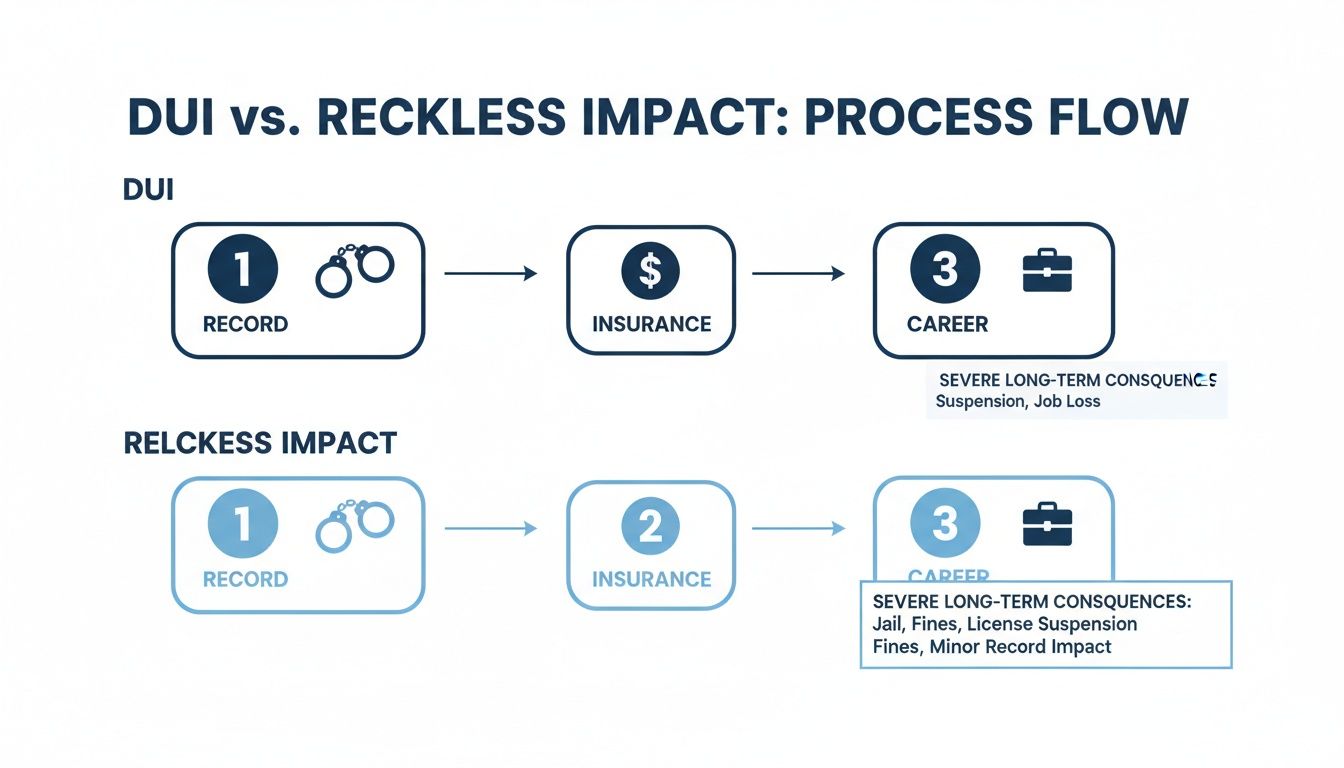
As you can see, a reduction to reckless driving can dramatically lessen the severe, life-altering consequences that come with a permanent DUI conviction.
This strategic approach has become more vital as arrest numbers stay high. Even though drunk-driving fatalities in the US have plummeted by over 50% since 1982, DUI arrests have consistently stayed around one million per year. Plea policies that allow for reductions play a big role, with Department of Justice statistics showing success rates between 20-25%. In 2022, Florida saw over 67,000 DUI arrests, and judicial data reveals that more than 12,000 (about 18%) were successfully downgraded to reckless driving.
How a Focused DUI Defense Attorney Can Make a Difference
Walking into court alone for a DUI charge means you’re up against a prosecutor whose only job is to get a conviction. It’s an incredibly unbalanced fight. But hiring a Florida DUI defense attorney completely changes that dynamic. Suddenly, you have a professional in your corner whose job is to challenge every piece of the state's case and build leverage.
Our practice focuses on traffic and DUI defense, and we handle criminal traffic matters across Florida. Our goal is simple: protect your license and your record. We do that by digging into every single detail, starting with the police report, body camera footage, and even the dispatch logs. We’re hunting for procedural errors, inconsistencies, or any violation of your constitutional rights.
Strategic Case Analysis and Negotiation
Finding the weak spots in the prosecution's evidence is how you create the opportunity to negotiate a DUI reduced to reckless driving. A skilled defense attorney works methodically to build reasonable doubt, which can convince a prosecutor that offering a better plea deal is their smartest move.
We zero in on the most common areas for a successful challenge:
Challenging the Traffic Stop: Did the officer even have a legitimate, legal reason to pull you over in the first place? If not, the entire case could fall apart.
Scrutinizing Sobriety Tests: Were the field sobriety exercises administered correctly? Were the conditions appropriate, or were you on an uneven surface or in bad weather?
Analyzing Breathalyzer Results: We don't just take the number at face value. We demand the machine’s maintenance logs and calibration records to see if its readings were even accurate and reliable.
By finding these flaws, an attorney can file motions to suppress evidence. If a judge agrees to throw out a key piece of evidence—like the breath test—the prosecutor is left with a much weaker case. That’s when a reduction to reckless driving starts looking like a very attractive option for them.
Attorney Advertisement: This content is for informational purposes only and does not constitute legal advice. Submitting information via our forms does not create an attorney-client relationship. Past results do not guarantee future outcomes. Our office is in Broward.
Handling the Legal Burden for You
Beyond legal strategy, a good attorney takes the entire complex process off your shoulders. We handle all the legal filings, show up to court appearances for you whenever possible, and manage the separate administrative hearing with the DMV to fight for your license.
This lets you get back to your job and your life while we do the heavy lifting to secure the best possible outcome.
If you’re facing a DUI charge, you don't have to go through it alone. Contact Ticket Shield for a free, confidential consultation to talk about the specifics of your case. Our office is in Broward, and we serve clients throughout all 67 Florida counties.
Frequently Asked Questions About DUI Reductions
Navigating the legal system after a DUI arrest is confusing. You're hit with information from all sides, and it's hard to know what's true. Here are some straightforward answers to the questions we hear most often from clients trying to get a DUI reduced to reckless driving in Florida.
Remember, every case has its own unique facts. This information is a great starting point, but it's no substitute for advice tailored to your specific situation.
Is a Wet Reckless the Same as a Reckless Driving Charge?
Yes, for all practical purposes. In Florida, "wet reckless" is the informal term lawyers and judges use for a reckless driving charge that started out as a DUI. Even though the arrest was for an alcohol-related offense, the final conviction on your record is for reckless driving.
This is a huge distinction. It helps you dodge the mandatory penalties and heavy stigma that come with a formal DUI conviction. Keep in mind, however, that the courts and prosecutors will still see the original DUI filing, which could play a role if you ever find yourself in legal trouble again.
If My DUI Is Reduced Do I Still Have to Deal with the DMV?
Absolutely. This is a critical point that trips a lot of people up. The criminal court case and the DMV's administrative license suspension are two separate battles fought on two different timelines. Winning in court doesn't automatically mean you win with the DMV.
Even if we successfully get your criminal charge knocked down, the DMV can still suspend your license based on the arrest alone—especially if you refused the breath test or blew over the legal limit of .08. A key part of our job is to fight for you in both arenas: challenging the criminal charge while also defending your driving privileges at the DMV hearing.
Can I Get a DUI Reduced If My BAC Was High?
A high Blood Alcohol Concentration (BAC), particularly one at .15 or above, definitely makes things harder, but it doesn't make a reduction impossible. The prosecutor will see that high number as their strongest piece of evidence, but an experienced DUI attorney knows that the number itself is only part of the story.
For example, were there major flaws in how the breath test was given? Are the machine's maintenance and calibration records a mess? Did the officer violate your constitutional rights during the traffic stop? Any of these issues can create the leverage needed to negotiate a better deal. The final outcome is always based on the specific facts of your case. Past results do not guarantee future outcomes.
How Long Does a Reckless Driving Charge Stay on My Record?
A reckless driving conviction will stay on your Florida driving record for life. However, unlike a DUI, you might be able to get the court record sealed if the judge grants a "withhold of adjudication." This means you are not formally convicted of the crime, even though you resolved the case.
Sealing the record is a game-changer, as it keeps it out of public view for things like routine background checks by employers. Pushing for a withhold of adjudication so you can later pursue sealing is a core part of the legal strategy we build for our clients.
Facing a DUI charge is a serious situation, but it's one you don't have to go through alone. The legal team at Ticket Shield, PLLC focuses on traffic and DUI defense in all 67 counties across Florida. Our goal is to protect your license, your record, and your future. For a free, confidential consultation about your case, visit https://www.ticketshield.com.