Understanding the Consequences for DUI in Florida
Explore the consequences for DUI in Florida, from license suspension and fines to long-term career impacts. Get clarity on what happens after a DUI arrest.
A DUI charge in Florida is a serious matter. The consequences come from two different directions: the DMV imposes administrative penalties, and the courts bring criminal charges. Even for a first offense, you could face possible jail time, steep fines, a suspended license, and a permanent criminal record that can never be sealed or expunged.
What Really Happens After a Florida DUI Arrest
Getting arrested for a DUI in a place like Miami-Dade County can be a disorienting experience. From the moment of the arrest, you are placed into two separate legal battles at the same time. Understanding this dual-track system is the first step toward protecting yourself.
One battle is with the Florida Department of Highway Safety and Motor Vehicles (DHSMV). Their focus is solely on your driver's license. The other is the criminal case, which proceeds through the court system and determines penalties such as fines, probation, and potential jail time.
A Two-Front Battle
Think of it as fighting a war on two fronts. Winning one doesn't guarantee you've won the other. You could succeed in your DMV hearing and keep your license, but still be convicted on the criminal DUI charge. Conversely, your criminal charge could be reduced, but you might still have to serve a full license suspension from the DMV.
This complexity highlights the seriousness of the situation. Florida has a reputation for being tough on impaired driving. In 2021 alone, 874 people were killed in Florida in crashes attributed to alcohol-impaired driving, which is over 23% of all traffic deaths in the state. Official numbers can be found in reports from the Florida Office of Program Policy Analysis and Government Accountability.
A DUI arrest can trigger a domino effect of consequences impacting your freedom, finances, and future. This is not just a traffic ticket; it's a criminal offense with repercussions that can last for years and demands an immediate, strategic response.
At-a-Glance First Offense Penalties
To provide a clear starting point, the table below outlines the typical consequences for a standard, first-offense DUI in Florida. These penalties can become much more severe if there are aggravating factors, such as a high Blood Alcohol Concentration (BAC) or an accident that caused property damage or injury. The timeline after an arrest moves very quickly; we explain what to expect in our guide on what happens after a DUI arrest.
Here is a quick summary of what a first-time DUI conviction in Florida typically involves.
Quick Summary of First-Time Florida DUI Penalties
Penalty Type | Description of Consequence |
|---|---|
Fines | Minimum of $500 up to $1,000. |
Jail Time | Up to six months in county jail. |
Probation | Typically up to one year of supervised probation. |
License Suspension | Administrative suspension of 180 days to one year. |
DUI School | Mandatory completion of Level I DUI School (12 hours). |
Community Service | Minimum of 50 hours of mandatory community service. |
Vehicle Impoundment | Your vehicle will be impounded for 10 days. |
This table shows the standard penalties, but every case is unique. The specifics of your stop, your BAC level, and whether anyone was injured can all drastically change the outcome.
Navigating the Two Fronts: Administrative and Criminal Penalties
A DUI arrest in Florida can be very disorienting. You are immediately thrown into two separate legal battles, which is one of the most confusing parts of the process. Understanding how each one works is essential for building a solid defense from day one.
The first fight is the administrative case with the Florida Department of Highway Safety and Motor Vehicles (DHSMV). This case is all about your driver's license, and it moves quickly. The moment you're arrested, an automatic suspension process begins, leaving you a very short window to take action.
The second is the criminal case, which unfolds in the county court system, such as in Miami-Dade County. This is where a state prosecutor formally charges you with Driving Under the Influence. The criminal court determines penalties like fines, probation, and potential jail time.
The Administrative Battle: Your License on the Line
The administrative action against your license is immediate and is not concerned with what happens in your criminal case. When the officer arrests you for DUI, they will take your physical driver's license and issue a citation. That citation is more than just a ticket—it serves as a temporary driving permit that is only valid for 10 days.
After those ten days, your license is suspended unless you take action. You have that brief, 10-day window to formally request a hearing with the DMV to challenge the suspension. If you miss this deadline, you automatically lose your right to challenge it. It's a critical first step that cannot be overlooked. You can learn more about what this involves by reading about the administrative license suspension hearing.
The chart below illustrates how an arrest splits into two parallel legal tracks that you must address simultaneously.
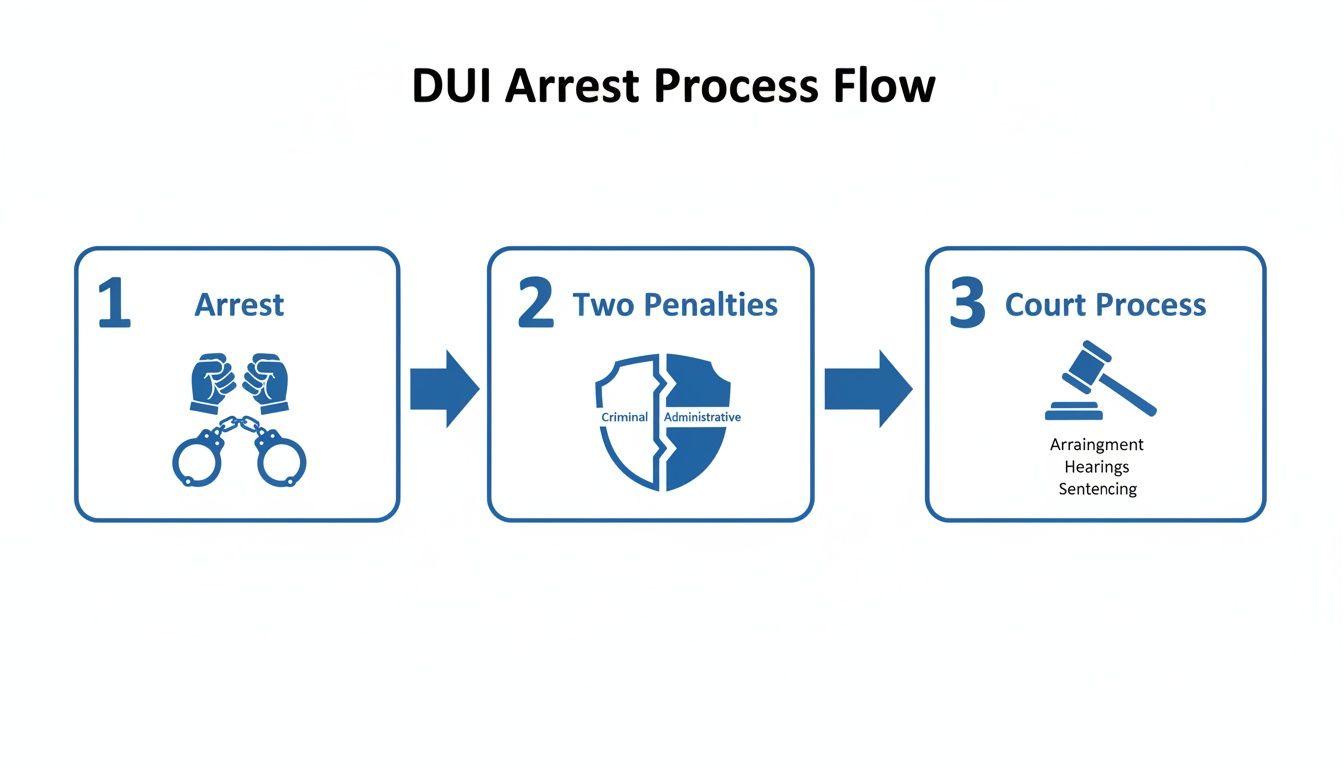
As you can see, the arrest is just the beginning. It immediately branches into administrative and criminal proceedings, both requiring your full attention.
The Criminal Battle: Defending Your Record
While the DMV moves quickly on your license, the state prosecutor is methodically building a criminal case against you. This process takes much longer and involves formal stages like an arraignment, pre-trial hearings, and possibly a full trial.
The consequences for a DUI in Florida handed down by the criminal court are severe and designed to punish and deter. They include:
Substantial Fines: Mandatory minimum fines start at $500 for a first offense.
Probation: A period of court-ordered supervision, often lasting up to a year.
Jail Time: Even a first-time conviction can carry a sentence of up to six months.
DUI School: You will have to attend and complete a state-approved substance abuse course.
Vehicle Impoundment: Your car can be impounded for 10 days or more.
It’s crucial to understand these two proceedings are independent of each other.
A common misconception is that winning your DMV hearing and saving your license means the criminal case will be dropped. That is not true. The outcome of your administrative hearing has no legal impact on the criminal charges you face, and vice versa.
Because you are fighting two different battles in two different venues with different rules, you need a strategy for both. One requires swift action to keep you on the road, while the other demands a careful defense to protect your freedom and your permanent record. An experienced legal team can manage both fronts, working to protect your rights at every turn. Our goal is to protect your license and record. Past results do not guarantee future outcomes.
When you are arrested for a DUI in Florida, you are suddenly fighting a battle on two separate fronts. While the DMV is focused on one thing—your driver's license—the criminal court system has a much broader and often tougher set of penalties in mind.
These are not minor penalties. The criminal consequences are designed to punish and deter, and they become significantly more severe with each offense. It doesn't matter if you're in a major metro area like Miami-Dade County or a quieter part of the state; the system is built to handle these cases, and it handles many of them.
In 2018 alone, there were 32,177 DUI arrests across Florida. That number shows how seriously law enforcement and prosecutors take these charges. It's a high-volume, high-stakes environment where the specific details of your case can make a significant difference.
First DUI Offense Penalties
For a standard, first-time DUI conviction, Florida law sets a clear range of penalties. A judge has some discretion, but they cannot go below the mandatory minimums established by the state.
Here’s the baseline of what you can expect:
Fines: The base fine will be between $500 and $1,000.
Jail Time: You could be sentenced to up to six months in jail. While it’s not guaranteed for a first offense, it is always a possibility.
Probation: A probation period of up to one year is standard, which includes any jail time you might serve.
Community Service: You will be required to complete a mandatory minimum of 50 hours of community service.
Vehicle Impoundment: Your car will be impounded for 10 days. This is a separate penalty that cannot be served concurrently with any jail sentence.
These are the starting points. Certain aggravating factors can trigger "enhanced penalties," making the consequences far more serious.
Second and Subsequent DUI Offenses
If you have a prior DUI, the penalties increase dramatically. The law looks closely at the time between your convictions to determine the severity of the punishment.
For a second offense, the fines jump to between $1,000 and $2,000. If that second DUI occurs within five years of your first one, you face a mandatory minimum of 10 days in jail.
A third offense can be life-altering. If your third DUI occurs within 10 years of a prior conviction, it is automatically charged as a third-degree felony. This is no longer a misdemeanor. A felony conviction carries up to five years in prison and a fine of up to $5,000.
Factors That Enhance DUI Penalties
Beyond the number of prior offenses, the specific circumstances of your arrest can elevate a standard DUI into a much more severe charge with tougher mandatory minimums.
High Blood Alcohol Concentration (BAC)
If your BAC was 0.15 or higher—nearly double the legal limit—the penalties are automatically enhanced, even for a first-time offense.
Fines (First Offense): Increased to $1,000 - $2,000.
Jail Time (First Offense): The maximum possible sentence increases to nine months.
Ignition Interlock Device (IID): Mandatory installation on your vehicle for at least six continuous months.
Minor in the Vehicle
Driving under the influence with a passenger under the age of 18 is another serious aggravating factor that triggers the same enhancements.
Fines (First Offense): Increased to $1,000 - $2,000.
Jail Time (First Offense): The maximum sentence increases to nine months.
DUI with Property Damage or Injury
If your DUI involved an accident, the charges are elevated based on the level of harm caused.
Property Damage: This is a first-degree misdemeanor, punishable by up to one year in jail and a $1,000 fine.
Non-Serious Bodily Injury: This is also a first-degree misdemeanor.
Serious Bodily Injury: This is a critical situation. A DUI causing serious injury is a third-degree felony, which carries a potential prison sentence of up to five years.
It is a critical mistake to assume that a first-time DUI is "just a misdemeanor." The presence of aggravating factors can quickly turn a standard charge into a felony, bringing life-altering consequences that include prison time and the permanent loss of certain civil rights.
This tiered system of penalties clearly indicates how seriously Florida treats these offenses. It also underscores the importance of a strong, strategic defense from the very beginning.
To help you see the full picture, here’s a side-by-side comparison of how the criminal penalties escalate.
Florida DUI Penalties by Offense Number
Penalty | First Offense | Second Offense | Third Offense (Felony) |
|---|---|---|---|
Fines | $500 - $1,000 | $1,000 - $2,000 | Up to $5,000 |
Jail Time | Up to 6 months | Up to 9 months (10 days mandatory if within 5 years) | Up to 5 years in prison |
Probation | Up to 1 year | Up to 1 year | Up to 5 years |
Vehicle Impoundment | 10 days | 30 days | 90 days |
Ignition Interlock | Possible, mandatory if BAC >0.15 | Mandatory for at least 1 year | Mandatory for at least 2 years |
As you can see, the consequences grow exponentially with each subsequent offense, making a proactive defense absolutely essential from day one.
Our practice focuses on DUI defense, and we are committed to exploring every legal option available. You can learn more about the specifics by reviewing our detailed guide on DUI penalties in Florida. Our goal is to protect your license and record. Past results do not guarantee future outcomes.
When a DUI Involves More Than Just Alcohol
When people hear "DUI" in Florida, they almost always think of alcohol. But that’s a common and costly misconception. The law is concerned with whether your "normal faculties" are impaired, not just by alcohol.
This means you can face the exact same life-altering criminal penalties and license suspensions for driving while impaired by illegal drugs, prescription pills, or even some over-the-counter medications. It’s often called a DUID, or Driving Under the Influence of Drugs, but the consequences are identical to an alcohol-based charge.
How DUID Cases Are Different
While the penalties are the same, how the state attempts to prove a DUID case is completely different. An officer cannot use a breathalyzer to measure the amount of a prescription medication in your system. Instead, they must build their case on a different foundation of evidence.
Officer Observations: This is the starting point. The officer’s testimony about your driving pattern, physical appearance, and behavior during the stop is the initial evidence.
Chemical Tests: Instead of a breath test, they will request a urine or blood test. These are designed to detect the presence of controlled substances in your system.
Drug Recognition Expert (DRE) Testimony: Many DUID cases rely on the evaluation of a DRE—a specially trained officer who conducts a 12-step process to determine if you're impaired and, if so, by what specific category of drug.
A surprising fact for many is that a DUID charge can result from a legally prescribed medication. If your doctor prescribed you a medication and you took it as directed, you can still be arrested and convicted if it impaired your ability to drive safely. The fact that the drug is legal is not a defense.
The Growing Concern of Drug-Impaired Driving
Drug-impaired driving is a significant and growing safety issue on Florida's roads. The data is sobering. In 2021, driving under the influence of drugs was a factor in a staggering 22.3% of all traffic fatalities in the state. That figure is alarmingly close to the percentage for alcohol-related deaths and includes impairment from both illegal and legal medications. You can explore the data for yourself on the Drive Sober Florida data portal.
A prescription from a doctor is not a free pass to drive. If your medication, even an over-the-counter one, impairs your judgment, coordination, or reaction time, you are at risk of being charged with DUI in Florida.
The danger escalates exponentially when substances are mixed. Combining alcohol with prescription drugs, for example, can create a level of impairment far greater than either substance alone, creating an extremely volatile situation behind the wheel. If that impairment leads to a crash with serious injury or a fatality, the consequences can become catastrophic, potentially leading to felony charges like DUI Manslaughter. You can get a sense of the gravity by reading about a DUI Manslaughter sentence in Florida.
Ultimately, the law focuses on one thing: impairment. It doesn't matter if it came from a bottle, a joint, or a pill bottle. If it affects your ability to operate a vehicle safely, you could be facing the full range of DUI consequences in Florida.
The Hidden Costs and Long-Term Impact of a DUI
A DUI conviction casts a long shadow, creating obstacles that linger for years, long after court fines are paid and probation is completed. The upfront criminal penalties are just the beginning. The true consequences of a DUI in Florida are often the hidden, long-term damages that affect your finances, career, and personal freedom.

These lasting effects are often far more disruptive than the initial court case. Understanding them from the start shows why a strong, immediate defense is so vital.
The Financial Fallout Beyond Court Fines
One of the most significant financial impacts of a DUI conviction is its effect on your car insurance. After a conviction, insurance companies label you a “high-risk driver,” and your premiums will skyrocket—often by hundreds of dollars a month for several years.
But it's more than just a rate hike. Florida requires drivers convicted of a DUI to obtain a special type of high-risk insurance certification known as an FR-44. This policy requires you to carry liability coverage limits that are substantially higher than what a standard driver needs.
Let’s put that in perspective:
Standard Florida Minimums: 10/20/10 coverage ($10,000/$20,000/$10,000).
FR-44 Mandatory Minimums: 100/300/50 coverage ($100,000/$300,000/$50,000).
That’s a huge increase. This dramatic jump in required coverage, combined with your new high-risk status, creates a heavy and sustained financial burden. You must maintain this FR-44 coverage for three consecutive years without any lapse, or the DMV will suspend your license again.
Professional and Career Ramifications
A DUI conviction is a permanent part of your criminal record. In Florida, it's one of the few criminal offenses that can never be sealed or expunged. This means it will appear on background checks for the rest of your life, creating major hurdles for your career.
In a sprawling metro area like Miami-Dade County, where reliable transportation is essential for most jobs, the professional consequences can be devastating.
A DUI conviction on your permanent record isn’t just a personal matter; it becomes a professional liability. It can close doors to job opportunities, professional licenses, and career advancement long after you've served your sentence.
Many employers have strict policies against hiring individuals with a DUI, especially for jobs that involve:
Driving a company vehicle
Operating heavy machinery
Working with children or other vulnerable populations
Positions in healthcare, finance, or government
Additionally, professionals with state-issued licenses—such as nurses, pilots, real estate agents, or commercial drivers—can face disciplinary action from their licensing boards. This could lead to a license suspension or even full revocation, potentially ending a career you’ve worked hard to build.
Personal Freedom and Other Lasting Impacts
The consequences extend far beyond your finances and job prospects. A permanent DUI record can affect your personal freedom and limit your opportunities in unexpected ways.
For instance, applying for an apartment or a mortgage can become more difficult. Landlords and lenders might view a DUI conviction as a sign of irresponsibility. Even your ability to travel internationally can be affected; countries like Canada have strict policies that may bar entry if you have a DUI conviction on your record.
Because a DUI conviction is permanent in Florida, these challenges do not simply fade over time. The shadow of that one mistake can follow you for decades, impacting your ability to find work, secure housing, and travel freely. Recognizing the full scope of these long-term consequences for a DUI in Florida underscores the importance of addressing the charge head-on from the moment of arrest. Our goal is to protect your license and record. Past results do not guarantee future outcomes.
How Experienced DUI Defense Can Help Mitigate Consequences
Facing the aftermath of a DUI in Florida can feel overwhelming. The consequences are severe, and it’s easy to feel as though the outcome is predetermined. But an arrest is not a conviction.
The days immediately following a DUI charge are the most critical. This is the window where a strong defense can be built to protect your rights, your license, and your future. An experienced legal team knows how to challenge the state's case from every possible angle, working to mitigate the penalties at both the DMV and in criminal court.

It all starts with a thorough review of the details of your arrest. The goal is to identify weaknesses in the prosecution's case and use them to your advantage. A proactive defense explores every legal avenue to secure a better outcome.
Scrutinizing the Traffic Stop and Arrest
Every DUI case begins with a traffic stop. For that stop to be lawful, the officer needed a valid reason, known as reasonable suspicion, to pull you over. If they cannot justify the initial stop, any evidence collected afterward—observations, sobriety exercises, and chemical tests—could be suppressed.
A solid defense strategy often involves asking critical questions:
Challenging the Traffic Stop: Was there a valid traffic violation, or was the officer acting on a hunch?
Questioning Probable Cause: Did the officer have sufficient credible evidence to make an arrest? A mere suspicion of drinking is not enough.
Reviewing Body Camera Footage: This footage is an unbiased witness and can often tell a different story than the officer's written report.
A successful challenge to the legality of the stop can lead to evidence being suppressed. When that happens, the state’s entire case can be compromised. Our practice focuses on defending drivers against traffic and DUI charges all across Florida.
Contesting Sobriety Exercises and Chemical Tests
Field Sobriety Exercises (FSEs) are notoriously subjective. Even a sober person might struggle to perform them perfectly under the pressure of a traffic stop. Performance can be affected by nerves, medical conditions, or even uneven pavement.
Breath, blood, or urine tests are not foolproof either.
An experienced defense attorney understands the science and the strict procedures behind chemical testing. This knowledge is crucial for finding errors in how tests were administered, how the machines were calibrated, or how samples were stored—any of which can make the results unreliable and inadmissible in court.
Potential challenges we investigate include:
Improper Administration of FSEs: Officers must follow a strict, standardized protocol when conducting these exercises. Many do not.
Breathalyzer Inaccuracies: Was the machine properly calibrated and maintained? We can request those records.
Issues with Blood or Urine Samples: Were the samples collected, stored, and transported according to rigid legal and scientific standards? Any break in the chain of custody can taint the evidence.
Our mission is to protect your license and your record by meticulously examining every piece of evidence. Understanding the full range of defense strategies is key. That’s why we encourage you to learn more about what a Florida DUI defense attorney can do for you. By exploring every option, we work toward achieving the most favorable result possible for your specific situation. Attorney Advertisement. Past results do not guarantee future outcomes. Office in Broward.
Common Questions About Florida DUI Consequences
When you're dealing with the fallout of a DUI arrest, you likely have many urgent questions. This section is designed to provide direct answers to some of the most common concerns. Please note, this is for general information and is not a substitute for legal advice tailored to your specific case.
Is Jail Time Guaranteed for a First DUI in Florida?
While jail is a possibility for any DUI conviction, it is not always mandatory for a first offense. Florida law allows for up to six months, but a judge often has the discretion to impose alternatives like extended probation, higher fines, or additional community service hours.
However, certain factors can make jail time more likely. If your BAC was 0.15 or higher, or if there was an accident with property damage or injuries, the probability of a jail sentence increases significantly. The final outcome always depends on the specific facts of your case, the court, and the prosecutor.
How Long Does a DUI Stay on Your Record in Florida?
A DUI conviction in Florida is permanent. Unlike many other criminal offenses, a DUI is specifically excluded by law from being sealed or expunged.
This means that conviction will remain on your record for the rest of your life. It will appear on background checks for employment, housing applications, and professional licenses, indefinitely. The permanent nature of this consequence is a primary reason why a robust defense to avoid a conviction is so important.
What Happens If I Refuse a Breathalyzer Test in Miami?
Under Florida's "implied consent" law, you have the right to refuse a breath test, but this choice comes with immediate penalties. In Miami-Dade County, as in the rest of the state, a first-time refusal triggers an automatic one-year driver's license suspension.
A second refusal has even more serious consequences: an 18-month license suspension, and you will also be charged with a separate first-degree misdemeanor just for the refusal. So, while declining the breathalyzer might limit the evidence for the criminal DUI charge, it guarantees a lengthy license suspension and can result in a new criminal charge.
The decision to refuse a chemical test has significant and immediate consequences for your driving privileges. It is a choice that trades one set of problems for another, highlighting the difficult position a driver is in during a DUI stop.
What Is the Critical 10-Day Rule in a Florida DUI Case?
The "10-day rule" is the most urgent deadline you will face immediately after a DUI arrest. From the moment of your arrest, you have exactly ten calendar days to formally request a review hearing with the DHSMV to challenge the administrative suspension of your driver's license.
If you miss that 10-day window, you forfeit your right to fight the suspension, and it will automatically go into effect. This administrative process is completely separate from your criminal court case and requires your immediate attention if you wish to have any chance of protecting your ability to drive.
A DUI charge can jeopardize your license, your finances, and your future. Don't face it alone. The team at Ticket Shield, PLLC is dedicated to defending drivers across Florida. We handle everything from challenging the initial stop to negotiating with prosecutors, all with the goal of protecting your record. For a free, confidential consultation to discuss your case, visit us at https://www.ticketshield.com or call us 24/7. Attorney Advertisement. Submitting information via forms does not create an attorney-client relationship. Past results do not guarantee future outcomes. Office in Broward.