Are Radar Detectors Legal in Florida? the Complete 2026
Are radar detectors legal in Florida? Learn the statutes, exceptions for commercial vehicles, penalties, and how Ticket Shield can protect your license.

Yes. Radar detectors are legal in Florida for private passenger vehicles under state law, but federal law bans them in commercial motor vehicles. The answer changes the moment your vehicle is being operated as a commercial motor vehicle, so identifying your vehicle correctly matters before you rely on a detector.
You're driving down I-95 when the detector chirps. A trooper appears ahead, and your first thought is whether the device itself has put you in legal trouble. In most Florida passenger cars, SUVs, and privately operated trucks, it hasn't. The bigger concern is what happens next: your speed, your statements, the officer's observations, and whether you receive a citation that could add points to your license.
A detector is not a defense to speeding. It's also not permission to drive aggressively. If you've been stopped, focus on protecting your record, not arguing about equipment on the dashboard. Drivers who want broader background on the business side of legal services can also find legal marketing resources, but your immediate priority after a stop is understanding the law and responding carefully.
Table of Contents
Florida Statutes and Federal Rules That Govern Radar Detectors
Radar Detectors Versus Radar Jammers and Signal Interference
The Short Answer on Radar Detector Legality
Florida law generally allows a private motorist to possess and use a radar detector in a personal vehicle. The state's speed-enforcement statutes regulate how officers measure and prove speed. They don't create a statewide prohibition against ordinary drivers owning or using passive detector devices in private passenger vehicles.
That distinction answers the question, “Are radar detectors legal in Florida?” For a person driving a personal sedan, SUV, or truck, the answer is generally yes under Florida law. The important exception is commercial driving, where a federal rule controls and prohibits radar detectors in commercial motor vehicles.
Practical rule: A legal detector doesn't make an otherwise questionable traffic stop disappear. Treat it as an alert device, not a license to test the limits of enforcement.
Why does this matter after a stop? Because many drivers focus on whether the detector is legal and overlook the actual citation. An officer may still issue a speeding citation based on the officer's observations and speed-measurement evidence. If you argue about the detector at the roadside, you may distract yourself from the facts that later matter in court or during a legal review.
Keep your interaction controlled. Pull over safely, provide the required documents, and avoid volunteering explanations about how fast you were traveling or why the detector alerted. Don't reach toward the device, make sudden movements, or turn the stop into a debate about radar technology.
The detector question becomes more complicated when the vehicle is used for work, when the device has signal-interference features, or when the citation alleges speeding rather than possession of equipment. Those are separate legal questions. A Florida driver who wants to avoid points should have the citation reviewed promptly instead of assuming that a lawful detector means every related allegation will fail.
Florida Statutes and Federal Rules That Govern Radar Detectors
Florida Statute §316.1906 is the central state authority for radar-based speed enforcement. The statute addresses law-enforcement requirements, including officer radar training, an independent visual speed check, compliant equipment, and periodic calibration testing. The calibration requirement calls for speed-detection systems to undergo testing at least once every 12 months, as stated in the Florida radar-enforcement statute.
The statute's structure matters. It tells officers and agencies how speed-detection evidence must be supported, but it doesn't ban a private Florida driver from possessing a passive radar detector. In plain English, Florida regulates the government's proof of speed rather than treating a driver-owned listening device as prohibited equipment.
Florida Statute §316.0776 also governs speed-detection systems and traffic-infraction detectors. It addresses where those systems may be used on state roads, including Department of Transportation permission and installation requirements. That framework concerns official detection and traffic-enforcement equipment, not a blanket prohibition on passive devices used by private motorists. You can review related provisions through Florida Chapter 316 traffic laws.

How the rules apply to your vehicle
The legal analysis starts with the vehicle, not the brand of detector.
Private passenger vehicle: Florida law generally permits a passive radar detector.
Commercial motor vehicle: Federal law prohibits use and prohibits operating a commercial motor vehicle equipped with or containing a detector.
Official speed-detection system: Florida statutes regulate government equipment, placement, training, and testing.
Signal-interference device: A jammer raises a different legal issue because it transmits interference rather than merely receiving signals.
Under 49 CFR §392.71, federal law states that a driver may not use a radar detector in a commercial motor vehicle. It also prohibits operating a commercial motor vehicle that is equipped with or contains one, and it bars a motor carrier from requiring or permitting that violation. The federal commercial-vehicle regulation applies even when the vehicle is operating in Florida.
That federal rule is the boundary private drivers must not miss. Florida permission for passenger vehicles doesn't override a federal restriction tied to commercial operation.
Radar Detectors Versus Radar Jammers and Signal Interference
A passive radar detector receives signals and alerts the driver. It doesn't attempt to disable, confuse, block, or overpower an officer's radar equipment. A radar jammer is different because it actively transmits interference designed to disrupt speed-measurement signals.
That distinction is central to the evolving traffic-technology rules. Recent Florida legislative materials include updates addressing speed-detection systems and traffic-infraction detectors, including a 2026 bill that would take effect July 1, 2026, according to the Florida Senate bill text. A separate 2026 law review discussion describes Florida's focus on signal-jamming devices while explaining that passive radar detectors generally remain outside that ban.
Don't assume a product is lawful because its packaging calls it a detector. Some devices combine detection, GPS alerts, laser-related functions, or interference features. Read the technical description and ask what the device transmits.
Feature | Radar Detector | Radar Jammer |
|---|---|---|
Primary function | Receives radar signals and alerts the driver | Transmits interference intended to disrupt radar |
Operation | Passive listening | Active signal interference |
Legal concern in Florida | Generally lawful for private passenger vehicles | Separate and substantially more serious legal concern |
Commercial-vehicle treatment | Prohibited in a commercial motor vehicle | Prohibited conduct remains unlawful and can create additional exposure |
Driver's practical step | Verify the vehicle classification and device features | Don't use or install a device designed to interfere |
You can learn more about the underlying equipment through Ticket Shield's explanation of how radar speed guns work. The key point is simple: receiving a signal and interfering with a signal are not the same act.
If an officer claims your device is a jammer, don't try to resolve the technical dispute on the shoulder of the road. Don't admit that the device was intended to defeat enforcement. Preserve the product information, installation details, and purchase documentation, then obtain legal advice before making statements beyond the documents required during the stop.
Commercial Vehicle Exceptions and Federal Restrictions
The commercial-vehicle rule is the trap that catches drivers who rely only on Florida law. A detector may be lawful in your personal vehicle, yet prohibited when you operate a commercial motor vehicle. The federal rule applies to use, and it also covers operating a commercial motor vehicle that is equipped with or contains a radar detector.

The regulation at 49 CFR §392.71 says that no driver may use a radar detector in a commercial motor vehicle, and no motor carrier may require or permit that violation, regardless of whether the vehicle is operating in Florida. The rule also reaches a vehicle that contains the detector, so leaving the unit in the cab can create a problem under the regulation. Review the federal commercial motor vehicle detector restriction directly.
Why classification matters
Drivers often think about ownership. The law focuses on operation and vehicle status. A delivery driver, truck operator, or employee using a work vehicle must determine whether the vehicle falls within the commercial motor vehicle category before relying on a detector.
That issue can arise with a company truck, delivery van, or another work vehicle. A personal vehicle used casually for work may require a different analysis from a vehicle operated as part of a commercial fleet. Don't guess based on the vehicle's appearance or your job title. Confirm the applicable classification and remove the device whenever federal commercial-vehicle rules govern.
A commercial-vehicle citation can create consequences beyond the device itself. It may affect your employment, driving record, and professional obligations, while a separate speeding citation can create additional exposure. If you received a citation while driving for work, review CDL traffic ticket defense options promptly.
Do not rely on the passenger-car answer while driving a work vehicle. The federal restriction is the controlling problem.
If you're unsure, take the conservative step before driving: remove the detector from the commercial motor vehicle and preserve the citation if you've already been stopped. A lawyer can evaluate the charge, the vehicle's status, the officer's observations, and the documents involved.
Practical Tips for Florida Drivers Using Radar Detectors
A lawful device still requires disciplined driving. Keep the detector from becoming the focus of the stop, and never treat an alert as proof that you can safely exceed the posted speed limit.
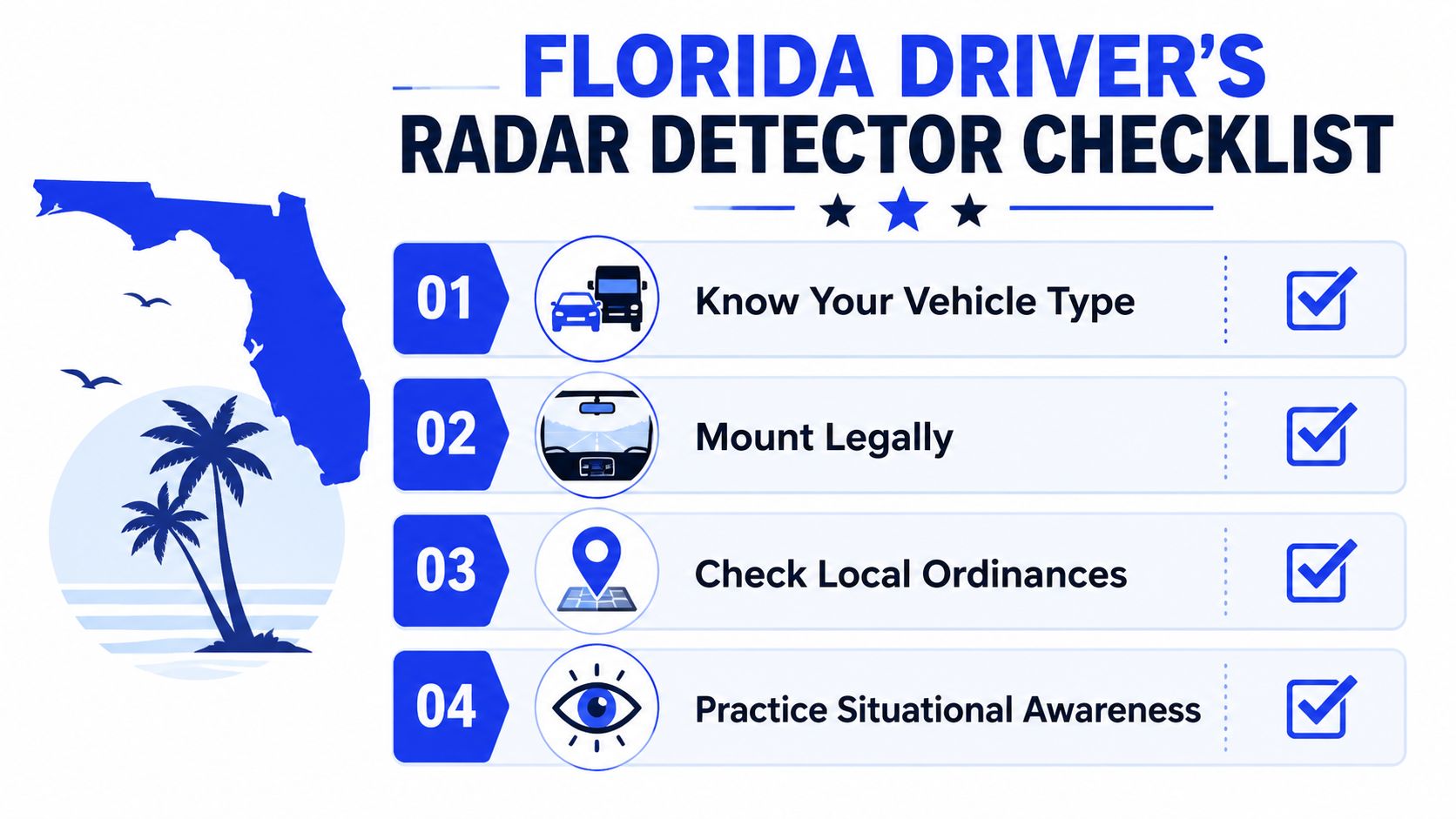
Use a four-part safety check
Know your vehicle type. Before using the device, decide whether you're driving a private passenger vehicle or operating a commercial motor vehicle. That classification determines whether the federal restriction applies.
Mount responsibly. Keep the device from obstructing your view or interfering with safe control of the vehicle. A dashboard placement may reduce unnecessary attention, but the most important consideration is that the installation doesn't create a separate visibility or equipment issue.
Check the device's function. Confirm that it's a passive detector. Don't use a product that claims to block, scramble, jam, or interfere with radar signals.
Practice situational awareness. An alert can be false, late, or unrelated to the speed measurement being used. Continue driving lawfully, maintain control, and don't make abrupt maneuvers because the device sounds.
A rental car creates a practical complication. Before driving, inspect the vehicle and identify any installed electronics. If you find a detector, don't assume the rental company's installation makes its use lawful. Ask whether the vehicle is a private passenger vehicle, avoid activating a device with interference features, and document the equipment if a later citation raises questions.
Handle the traffic stop carefully
When an officer approaches, keep your hands visible and wait for instructions. Provide your license, registration, and proof of insurance as required, but don't volunteer a narrative about the detector or your speed.
You can answer direct questions respectfully without arguing roadside. Don't say that the detector warned you, that you slowed down because of it, or that you knew you were traveling too fast. If you receive a citation, don't ignore it. Preserve every page and seek advice about the response options and potential license consequences through Florida driver license points guidance.
Protect Your License With Direct Attorney Access
A detector question often appears alongside a speeding citation, an equipment allegation, or a commercial-vehicle issue. The device may be lawful, but the citation can still threaten your driving record. That's why you need a lawyer to examine the actual charge, the officer's evidence, the vehicle classification, and the available defenses.
The service model matters. A lawyer-led firm should let you communicate directly with your attorney by phone or text. Automated apps, ticket mills, corporate answering services, middlemen, and chatbots can leave you repeating the same facts to people who aren't handling the legal analysis. You deserve a direct answer about what was filed and what strategy protects your license.
Ticket Shield, PLLC provides direct attorney communication and handles Florida traffic matters statewide. You can review its Florida speeding-ticket legal services and ask a lawyer to evaluate the citation before you make an avoidable decision.
Act before the citation controls the outcome
Don't wait until a points problem appears on your record. Early review allows counsel to identify the charge, examine the enforcement evidence, assess whether the device allegation is legally relevant, and choose a response designed to protect your driving privilege.
The goal is not to win an argument about a dashboard device. The goal is No Points on your license whenever the facts and law support that result. Contact a firm that gives you direct attorney access instead of routing you through an automated system.
Visit Ticket Shield, PLLC for a free consultation with a lawyer-led Florida traffic defense firm. Get direct communication by phone or text and take immediate action toward achieving “No Points” on your license.