CDL Traffic Tickets: A Florida Driver's Defense Guide
Your Florida CDL is your livelihood. Learn how CDL traffic tickets lead to disqualification and how a dedicated attorney can protect your career.
A single CDL traffic ticket is not a fine. It’s a threat to your career. Federal rules can disqualify you for violations that regular drivers survive. If you want to protect your livelihood, you need a strategic defense now.
You saw the lights. You pulled over. The officer walked up, took your documents, and came back with a citation that looks routine.
It isn’t routine for you.
If you hold a CDL in Florida, that ticket can hit your license, your job, your insurance profile, and your ability to stay on the road. Paying it may feel like the fast way out. It’s usually the wrong move. For a CDL holder, paying the ticket is often the moment a traffic problem turns into a career problem.
Florida law matters here. So do federal rules. Under Florida Statute § 316.187, speed is judged not only by the posted limit but by whether it was lawful under the actual conditions. That matters in defense. Under Florida Statute § 316.192, reckless driving allegations can quickly become much more serious. And in courtrooms like the Richard E. Gerstein Justice Building in Miami, these cases are handled by people who know exactly how much is at stake for a professional driver.
One more point. A professional license system isn’t unique to Florida or even the U.S. If you want a simple example of how other countries also tie vehicle classes to strict licensing consequences, review Flex Electric's UK licence info. Different country. Same basic truth. Higher-license drivers live under tighter rules.
If you’re dealing with cdl traffic tickets in Florida, start with a focused legal strategy, not guesswork. Our more detailed guidance for professional defense for Florida CDL drivers breaks down that approach.
Table of Contents
Your CDL is Your Career. A Ticket is a Direct Threat.
A CDL isn’t just a license. It’s your earning power.
When a regular driver gets a ticket, the conversation is usually about money and inconvenience. When you get one, the conversation is about disqualification, employer scrutiny, and whether your record will still support your job next month. That’s why cdl traffic tickets have to be treated differently from the first hour.
Why this ticket is different for you
Speeding tickets are the most prevalent traffic violation affecting CDLs, with about 41 million drivers receiving at least one speeding ticket annually in the U.S., and excessive speeding means 15 mph or more over the posted limit, which triggers mandatory CDL disqualification consequences under the federal framework described in these traffic ticket statistics.
That’s the first hard truth. Your CDL is tied to a federal regulatory system that watches certain violations far more aggressively than most drivers realize.
The second hard truth is that these rules can follow you even when you’re not in the truck. For serious categories of conduct, the risk doesn’t disappear because you were driving your personal vehicle. Your livelihood is still exposed.
Practical rule: If you have a CDL, never treat a ticket like a minor errand. Treat it like an employment emergency.
What Florida drivers usually get wrong
Most CDL holders who call after a citation make the same mistake first. They focus on the fine listed on the ticket. That number is not the primary problem.
The actual problem is the downstream record impact. A conviction can trigger licensing consequences, employment issues, insurer concerns, and internal company discipline. In many situations, the ticket itself is only the opening event.
That is why your first response matters. You need to preserve the facts, protect your timeline, and decide quickly whether the charge can be challenged on proof, procedure, officer observations, equipment issues, or legal classification.
What Are FMCSA Serious and Major Violations?
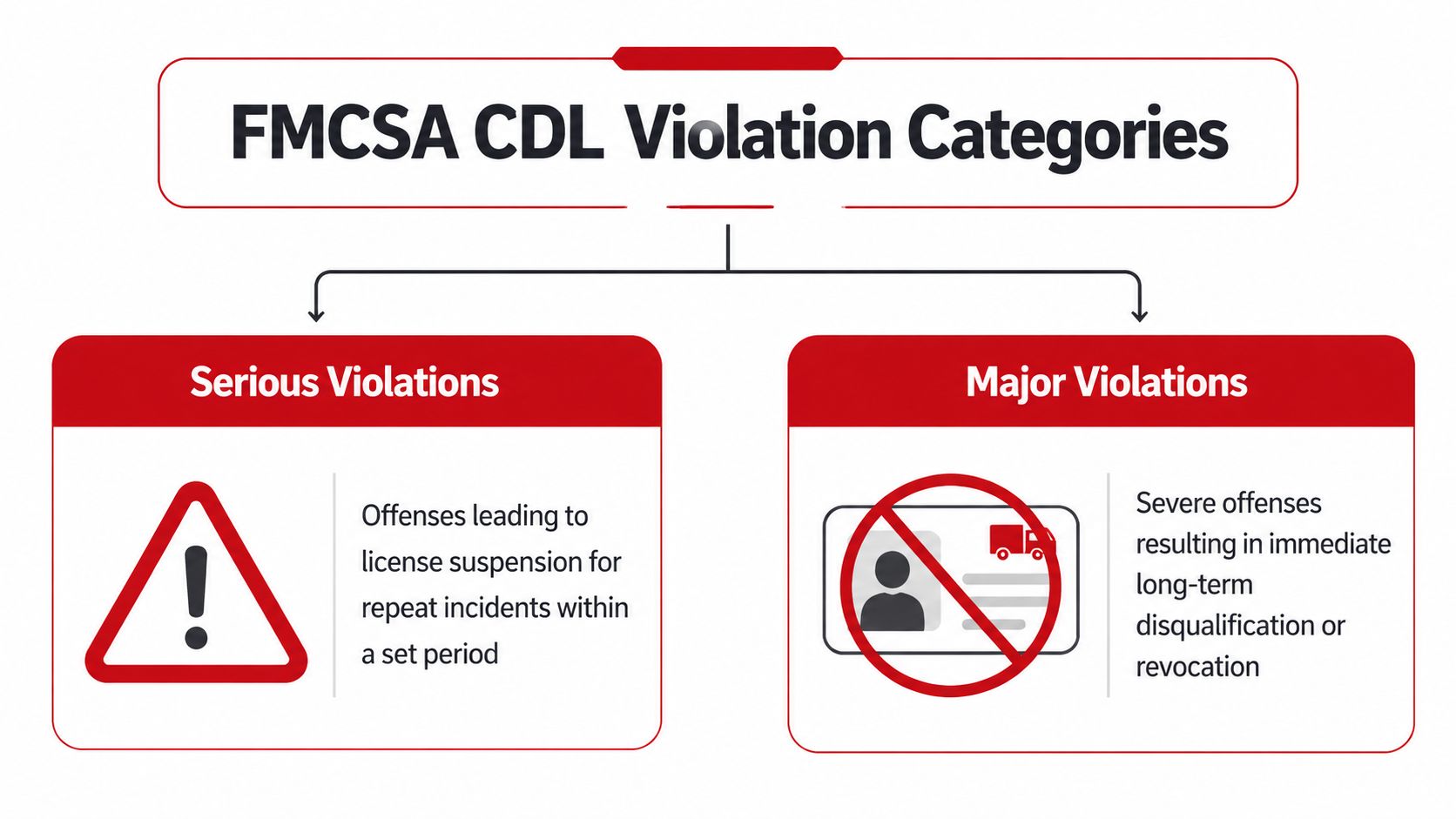
Federal rules divide CDL-threatening conduct into two groups that every professional driver should know. Serious violations and major violations.
If you don’t know the difference, you can’t make a smart decision about whether to fight, negotiate, or build a record-correction strategy.
Why federal categories matter more than the fine
The Federal Motor Carrier Safety Administration classifies CDL violations into serious and major categories. Two serious violations within 3 years require a 60-day CDL disqualification, a third serious violation within 3 years requires 120 days, one major violation triggers a 1-year revocation, and two majors can result in a lifetime ban, as outlined in this explanation of traffic ticket defense options for commercial drivers.
Those timelines are what matter. Not the officer’s tone. Not the base fine. Not whether the stop felt unfair.
Common examples of serious violations include:
Excessive speeding: Driving 15 mph or more over the limit.
Reckless driving: In Florida, this often raises issues under § 316.192.
Following too closely: A common allegation after lane compression or sudden braking.
Improper lane changes: Often written when an officer believes your movement created risk.
Common examples of major violations include:
DUI-related conduct: This is career-threatening from the start.
Leaving the scene: A hit-and-run allegation changes the case immediately.
Using a CMV in a felony: This reaches far beyond a routine citation.
If alcohol is part of your situation, review Florida-specific BAC context at this BAC limit resource for Florida.
Federal classification is what turns an ordinary-looking citation into a CDL crisis.
What the disqualification table looks like
Violation Type | Examples | 1st Offense | 2nd Offense within 3 years | 3rd Offense within 3 years |
|---|---|---|---|---|
Serious violation | 15+ mph over, reckless driving, tailgating | No automatic disqualification listed in the verified benchmark for a single serious violation | 60-day disqualification | 120-day disqualification |
Major violation | DUI, hit-and-run, felony use of CMV | 1-year revocation | Lifetime ban | Lifetime ban |
Why CDL drivers lose ground by waiting
A lot of drivers waste time because they think one serious citation won’t end the case. That misses the point. Even when a first serious violation doesn’t create an immediate federal disqualification, it plants the flag that sets up the next one.
That’s why the defense objective is not “get through court somehow.” The objective is to stop the event from becoming a conviction that follows you into the next stop, the next roadside inspection, or the next employer review.
Which Common Offenses Put Your CDL at Most Risk?
Some charges are dangerous because they happen often. Others are dangerous because prosecutors and employers read them as evidence that you’re unsafe. CDL drivers need to know both.
Speeding is the citation that hits CDL drivers hardest
Speeding is the offense that comes up again and again in cdl traffic tickets. And for CDL holders, the grading matters.
In the CDL point structure described in this breakdown of moving violations and CDL impact, 1 to 10 mph over brings 3 points, 11 to 20 mph over brings 4 points, 21 to 30 mph over brings 6 points, and 31 to 40 mph over brings 8 points. That same source notes that a single 25 mph over ticket carries 6 points.
That should get your attention immediately. One bad stop can push your record into a dangerous position fast.
Florida drivers also need to remember that speed cases are not always as simple as the number on the citation. Under § 316.187, the state still has to justify that the alleged speed was unlawful under the conditions. Radar use, pacing details, officer vantage point, traffic flow, and road conditions can all matter in a real defense.
Reckless driving and driving behavior citations
Reckless driving is especially toxic on a CDL record. In Florida, § 316.192 defines reckless driving around willful or wanton disregard for safety. That language gives the state room to argue broadly. It also gives the defense room to challenge whether the facts fit the charge.
Following too closely and improper lane changes are also dangerous because they’re highly subjective. A driver may be reacting to traffic compression, a merge conflict, poor roadway design, or another motorist’s sudden move. An officer may still write it as a behavior-based violation that reads badly on paper.
Here’s how I want clients to think about these cases:
Speeding cases often turn on measurement and conditions.
Reckless cases often turn on interpretation.
Lane and following-distance cases often turn on context and video.
If you operate a commercial vehicle, safe cargo practices also matter because roadside encounters often grow out of broader officer scrutiny. For practical safety context, review commercial vehicle load securing techniques from HGV Learning.
If your citation involves speed, start with focused Florida guidance on CDL speeding tickets.
A bad CDL case usually starts with a simple label on paper. The defense starts by challenging whether that label fits the actual facts.
What Are the Real-World Consequences for Your Job and License?
The legal case is only half the problem. The employment side can hit first.
A truck driver can lose work before a suspension ever starts
A traditional CDL driver usually feels the damage in stages. First comes the citation. Then comes internal employer review. Then the questions start. Are you still insurable. Do you have to be pulled from a route. Does the company want this on a safety file.
That’s why paying the ticket is often a costly mistake. You may think you’re closing the matter. In reality, you may be creating a conviction that your employer, insurer, or safety department now has to address.
For some drivers, the risk goes beyond trucking. Military personnel and veterans can face record scrutiny that reaches into clearance concerns. Professionals whose jobs depend on a clean driving history can also face discipline that has nothing to do with the courtroom.
Gig drivers get hit even faster
Gig and delivery drivers have it even worse in one respect. A single moving violation can trigger immediate platform problems. The verified research specifically notes the overlooked impact on Uber, Lyft, and DoorDash drivers in Florida, where a single moving violation can lead to immediate account deactivation, and that FMCSA masking laws prohibit deferred prosecution for CDL drivers, which means apps can still detect violations through MVR pulls, as discussed in this article on negotiating CDL traffic tickets and masking laws.
That means your income can stop before you ever get a fair chance to explain what happened.
If your case touches alcohol allegations, the employment fallout becomes even more severe. That issue is addressed more broadly in this discussion of DUI impact on employment.
Here’s a short explainer that helps drivers understand how fast a traffic record problem can affect work:
Your employer may see a conviction as a safety problem. A gig platform may see it as a deactivation trigger. You see the same result either way. Lost income.
How Can You Build a Defense for Your Florida CDL Ticket?
You need a plan immediately. Not after the hearing date gets close. Not after you’ve talked yourself into paying it.
A CDL defense in Florida is built on facts, timing, and record control. The court case matters. The reporting trail matters too.

Immediate steps to take
Take these steps as soon as possible:
Do not pay the ticket first: Payment is usually treated as a plea. For a CDL holder, that can trigger consequences far beyond the fine.
Preserve every document: Keep the citation, notice, inspection paperwork, log entries, and any dispatch records.
Pull your evidence early: Save dashcam footage, GPS data, ELD information, phone records, and vehicle maintenance records before anything gets overwritten.
Write your timeline now: Record weather, traffic, lane positions, officer statements, and what other vehicles were doing while the stop is still fresh in your mind.
Check the charge against the facts: Was this speeding, reckless driving, following too closely, or an officer’s rough interpretation of a fast-moving traffic event.
Get legal review quickly: An experienced Florida traffic attorney can assess technical and strategic defenses before the case hardens.
The legal issues often come down to specifics. Was the pacing reliable. Was radar properly supported. Did the officer have a clear observation angle. Did road conditions matter under § 316.187. Did the facts support a reckless allegation under § 316.192.
One practical option for Florida drivers who want attorney-led handling is a CDL ticket lawyer resource from Ticket Shield, which explains the type of support available in these cases.
Why DataQs matters after court
Most drivers never hear about DataQs until they’ve already absorbed the record damage. That’s a mistake.
The verified data notes that successful court resolutions can qualify for DataQs disputes to remove violations from FMCSA profiles, that 2025 FMCSA data referenced there notes a 25% error rate in violation logging, that removals occur in 40% of challenges, and that April 2026 FMCSA updates expedited DataQs for CDL masking cases, according to this discussion on DataQs challenges and FMCSA profile cleanup.
That matters because a strong defense doesn’t stop at the courtroom door. If the reporting is wrong, late, mismatched, or not updated after a proper result, your record can still stay damaged unless someone pushes the correction process.
Record strategy: Winning the hearing is critical. Making sure the federal record reflects the real outcome is just as important.
Why Is a Lawyer Your Shield, Not an Automated App?
A CDL defense is not a bulk commodity. It is a fact-specific legal problem with employment consequences attached.
That’s why I don’t recommend handling cdl traffic tickets through an automated app, a chatbot workflow, or a volume-based ticket mill. Those systems are built to process cases. Your case needs to be analyzed.
A CDL defense is not a bulk process
A real defense asks questions that software usually can’t ask well. Was the allegation written in a way that overstates the conduct. Is the officer’s narrative vulnerable. Does the charge create a federal classification problem even if the fine looks small. Is there a path to challenge proof, negotiate the charge, or protect the downstream record.
Those are legal judgment calls. They depend on the courthouse, the charge, the paperwork, and the facts. A driver with a reckless citation near the Broward County Judicial Complex does not need canned text. That driver needs strategy.
Direct attorney access changes the outcome
You should be able to ask your lawyer what the risk is, what the court options are, and what the record strategy looks like. Directly. By phone or text. Without a call center. Without a nonlawyer middle layer. Without a chatbot guessing.
That’s the practical difference with a lawyer-led model. You’re not buying automation. You’re getting legal judgment.
Here is my advice. If your CDL supports your household, hire counsel who treats the case like a license-protection matter, not a transaction. Ask who will review the citation. Ask who appears or handles negotiations. Ask how they deal with record issues after court. If you can’t get clear answers, keep looking.
Take Control and Protect Your CDL Now
The worst move in a CDL case is passive acceptance.
You can’t treat this ticket like a nuisance. You can’t assume the court will understand your job pressure. And you can’t assume paying the fine ends the problem cleanly. For many CDL holders, that payment is the decision that causes the damage.
Florida drivers need to move fast and move deliberately. Review the charge. Preserve the evidence. Get legal analysis before any plea is entered. If the case can be challenged, challenge it. If the charge can be negotiated into a safer outcome, push for that. If the record later needs correction, pursue that too.
Your objective is simple. No points if possible. No disqualifying record if possible. No unnecessary damage to your livelihood.
That is the right frame for every CDL case.
If you’re standing in this situation right now, act like your paycheck depends on it. Because it does.
Your career is on the line. Don’t plead guilty by paying the fine. Visit Ticket Shield, PLLC for a free consultation focused on one objective, protecting your Florida driving record and fighting for No Points.