
Understanding The BAC Limit Florida Drivers Must Know
A complete guide to the BAC limit Florida enforces, including the 0.08% rule for adults, zero-tolerance laws for under-21s, and stricter CDL limits.
In Florida, the magic number everyone knows is 0.08%. That’s the official Blood Alcohol Concentration (BAC) limit for most drivers over 21. If you’re at or above that number while behind the wheel, you can be charged with Driving Under the Influence (DUI)—no matter how sober you feel.
Understanding Florida's BAC Limits
Florida’s driving laws are all about keeping the roads safe, and the legal BAC limit is a cornerstone of that effort. Think of it as a hard line drawn in the sand. Cross it, and you've broken the law.
The key concept here is what’s known as a "per se" DUI. In plain English, this means the number itself is all the proof the state needs. If a chemical test shows your BAC is 0.08% or higher, you are legally considered impaired. They don't need evidence of you swerving or slurring your words; the test result is enough to press charges.
Different Limits For Different Drivers
It's a huge mistake to think the 0.08% rule is a one-size-fits-all standard. Florida law is much tougher on certain drivers, setting stricter limits based on age and the type of vehicle they’re operating. Young drivers and commercial drivers, for example, are held to a much higher standard.
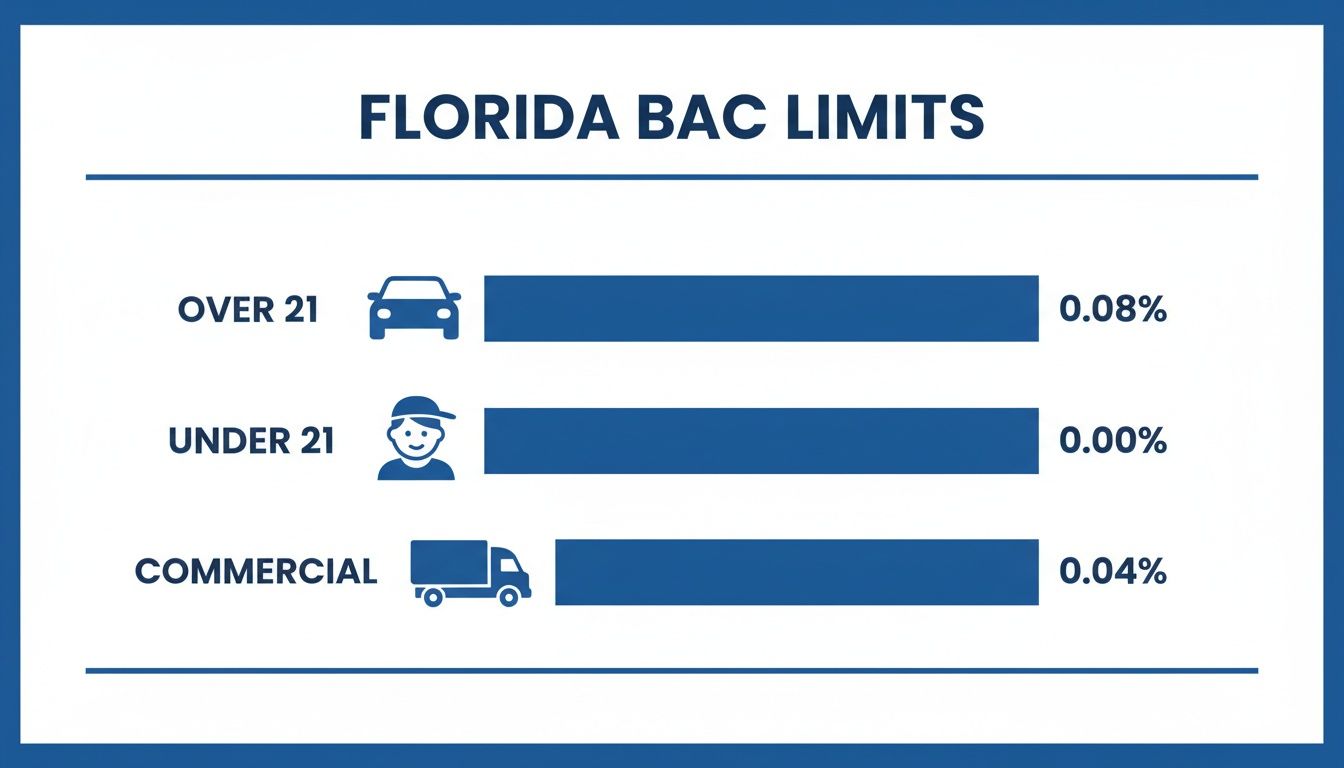
As the chart makes clear, there’s very little room for error if you’re under 21 or driving a commercial vehicle. The state has a zero-tolerance approach for young drivers and expects professional drivers to meet the highest safety standards.
Florida BAC Limits At A Glance
To make it simple, here’s a quick breakdown of the legal BAC limits for different drivers across Florida.
Driver Category | Legal BAC Limit | Primary Consequence For Exceeding Limit |
|---|---|---|
Drivers 21 Years and Older | 0.08% | DUI charges, fines, license suspension, possible jail. |
Drivers Under 21 Years | 0.02% | Automatic administrative license suspension. |
Commercial Drivers (CDL) | 0.04% | CDL disqualification, standard DUI penalties. |
This table neatly summarizes the different legal lines in the sand, showing just how little alcohol it takes to be over the limit for some drivers.
Impairment Begins Sooner Than You Think
While 0.08% is the legal threshold, it’s not some magic switch that suddenly flips you from sober to impaired. The truth is, critical driving skills like judgment, coordination, and reaction time start to fade after just one or two drinks.
The safest bet is always the same: if you drink, don't drive. Ever. Trying to guess if you're "okay to drive" is a losing game that can lead to dangerous situations and serious legal trouble.
Knowing the specific laws that apply to you is the first step toward responsible driving. To get a better handle on the rules of the road, you can learn more about general Florida state traffic laws in our detailed guide. Making smart decisions before you even start the car is the best way to protect yourself and everyone else on the road.
The 0.08 BAC Standard For Adult Drivers
For the overwhelming majority of drivers in Florida aged 21 and up, 0.08% is the magic number you never want to see. That figure isn't just a suggestion—it's the legal blood alcohol concentration (BAC) limit, a hard line drawn in the sand not just in the Sunshine State but across the entire country.
If you're behind the wheel with a BAC at or above this level, you are, by definition, driving under the influence (DUI). It’s that simple.
Setting a uniform standard was a huge step in making DUI laws clear and enforceable. It gives law enforcement a concrete, scientific metric for impairment, taking most of the guesswork out of the equation.
How The 0.08 BAC Law Is Enforced
Picture this: you're heading home after dinner and drinks in a busy area like Miami-Dade County. Police in high-traffic zones are always on the lookout for tell-tale signs of impairment—weaving, abrupt speeding or braking, or ignoring a traffic signal. A minor traffic violation can spiral into something much more serious if an officer smells alcohol.
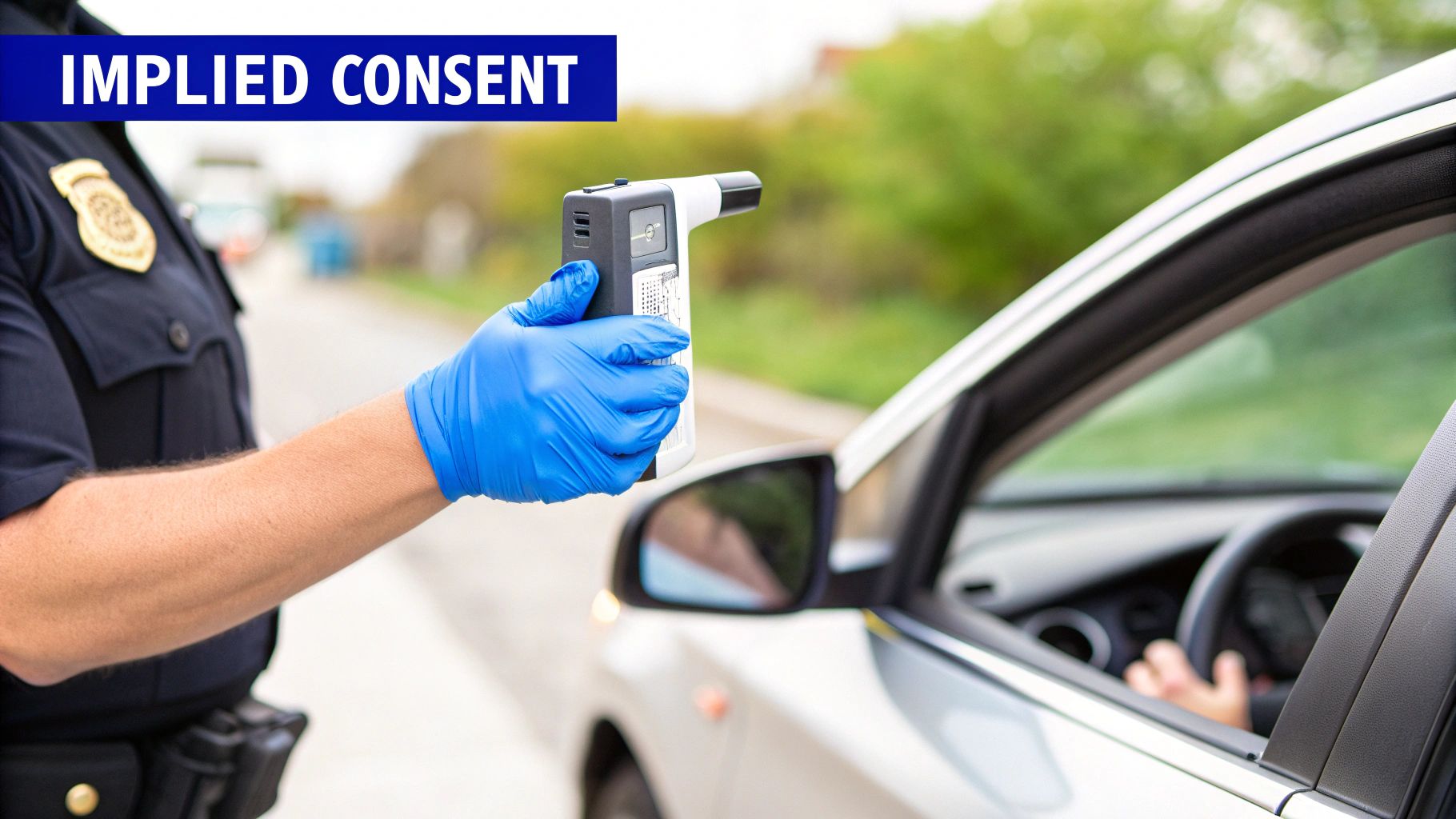
If the officer has a reasonable suspicion you've been drinking, they'll likely ask you to perform a few field sobriety exercises or take a chemical test, which is usually a breathalyzer. If that device shows a BAC of 0.08% or higher, you're considered "per se" intoxicated. It doesn't matter if you "feel fine" or think you're driving perfectly—the number itself is enough for an immediate DUI arrest.
Consequences Of A First-Time DUI Conviction
A DUI charge is a serious criminal offense, and the penalties can be significant. Even for a first offense, the consequences are designed to be a massive deterrent, impacting your freedom, your finances, and your ability to drive for a long time.
Here's what a standard first-time DUI conviction in Florida typically looks like:
Fines: The financial hit usually starts between $500 to $1,000.
Jail Time: You could be looking at up to six months behind bars.
License Suspension: Say goodbye to your driving privileges for 180 days to one year.
Probation: A year of supervised probation is common.
Community Service: You'll be required to complete a mandatory 50 hours of service.
And that’s just the start. Court costs, mandatory DUI school, and the fees to get your car out of impound can pile on, making the total financial burden much heavier. For a deeper dive, check out our guide on first-time DUI penalties in Florida.
The Higher Stakes Of An Enhanced DUI
Florida law gets even tougher on drivers who are found to be severely impaired. If your BAC comes back at 0.15% or higher—that's nearly double the legal limit—the penalties get a whole lot worse. The law recognizes the extreme danger posed by a highly intoxicated driver and punishes them accordingly.
A BAC of 0.15% or higher elevates a standard DUI into a much more severe category. This level of intoxication presents a far greater risk to public safety, and the penalties reflect that reality.
The penalties for an enhanced DUI are more severe across the board, with fines starting at $1,000 and the mandatory installation of an ignition interlock device in your vehicle. This tiered system is designed to make sure the punishment fits the level of risk the driver created. Facing a DUI is an intimidating experience, and the first step toward dealing with it is understanding exactly what the bac limit florida laws mean for your specific situation.
Florida's Zero Tolerance Law For Drivers Under 21
While most adults in Florida know the standard DUI limit is 0.08% BAC, the rules change dramatically for anyone under the age of 21. Florida draws a hard line with its Zero Tolerance policy, setting a legal limit so incredibly low that it leaves absolutely no room for error. This isn't just a friendly suggestion; it's a strict legal boundary designed to protect young drivers and everyone else on the road.
For drivers who haven't hit the legal drinking age, the legal blood alcohol limit is a tiny 0.02%. This isn't a typo. That microscopic number means even a trace of alcohol in your system can trigger serious, life-altering consequences.
Understanding The 0.02% BAC Limit
Putting the 0.02% limit into perspective is key. This isn't about being drunk, buzzed, or even feeling the slightest effect of alcohol. It's about having any detectable amount in your system. This level can be reached with far, far less than what anyone would consider "a drink."
Think of it this way: some over-the-counter medicines, certain mouthwashes, or even a dessert made with cooking wine could, in theory, push someone to that level. While it's not a common scenario, it perfectly illustrates the point—the law isn't targeting impairment, it's targeting the mere presence of alcohol. The message is crystal clear: if you are under 21, there is no safe amount of alcohol you can have before getting behind the wheel.
This strict policy exists for a reason. Statistics have shown time and again that young, inexperienced drivers are at a much higher risk of getting into an accident when alcohol is involved. That combination of inexperience and the impairing effects of alcohol is a notoriously dangerous cocktail, and Florida's law is built to prevent tragedies before they happen.
Administrative Penalties For Underage Drivers
One of the most important things to understand about the zero-tolerance law is how violations are handled. A typical DUI is a criminal offense, but a first-time violation for a driver under 21 with a BAC between 0.02% and 0.079% is handled administratively. Don't let that fool you—the consequences are still severe.
The penalties are swift and automatic. The goal is immediate intervention to correct dangerous behavior long before it can escalate into a more tragic event or a criminal DUI charge.
An underage driver who blows a 0.02% or higher will have their license suspended on the spot. This isn't something a judge decides weeks later in court. It happens right then and there.
Here’s a breakdown of the typical administrative penalties:
First Offense: A driver with a BAC of 0.02% or higher gets an automatic six-month license suspension.
Second or Subsequent Offense: The penalty doubles to a one-year license suspension.
Refusal to Test: If an underage driver refuses to take a breath test, the suspension is even longer—one year for a first refusal and a painful 18 months for any subsequent refusal.
To get their license back, the young driver must also complete a substance abuse education course. It's also crucial to remember these penalties are completely separate from any potential criminal charges that could be filed if the BAC is 0.08% or higher. At that point, it becomes a standard DUI case. The administrative suspension is a serious penalty on its own, and knowing how to navigate the process is vital. You can learn more about how to handle an administrative license suspension hearing in our detailed article.
Stricter BAC Limits For Commercial Drivers
While most drivers in Florida know the standard BAC limit is 0.08%, a completely different rulebook applies to the professionals who drive for a living. For anyone holding a Commercial Driver’s License (CDL), the legal threshold for impairment is slashed in half. This isn't an arbitrary rule; it reflects the immense responsibility that comes with operating a massive vehicle on public roads.

The legal BAC limit in Florida for a CDL holder behind the wheel of a commercial vehicle is just 0.04%. This isn’t some unique state quirk—it’s a federal standard that Florida, like all other states, strictly enforces. The logic is simple: a fully loaded semi-truck, a passenger bus, or a tanker carrying hazardous materials presents a far greater risk to public safety. As a result, their operators are held to a much higher standard of care.
The Port of Miami: A Real-World Example
Picture the non-stop action at the Port of Miami in Miami-Dade County. It's a massive hub of commerce where thousands of heavy commercial trucks navigate dense, often chaotic, urban traffic every single day. This high-stakes environment demands peak performance and razor-sharp judgment from every single driver.
A single lapse in concentration can lead to a catastrophic, multi-vehicle accident. This is precisely why the strict 0.04% BAC limit Florida enforces is so critical for safety in and around areas like this. Law enforcement knows the devastating consequences of an impaired commercial driver and actively patrols these vital corridors. The lower limit means that even a small amount of alcohol—an amount that might not even put a regular driver over the 0.08% mark—is enough to get a commercial operator taken off the road.
Severe, Career-Threatening Consequences
For a professional driver, a DUI isn’t just a legal headache; it's a direct threat to their entire livelihood. The penalties are intentionally severe and immediate, designed to remove unsafe drivers from the road and protect the integrity of the profession.
A first-time conviction for driving a commercial vehicle with a BAC of 0.04% or higher leads to an automatic one-year disqualification of their CDL. If that driver was transporting hazardous materials at the time, the disqualification jumps to a staggering three years. Get a second offense, and you're facing a lifetime ban from ever holding a CDL again.
These aren't just temporary suspensions; they are penalties that can end careers. Losing a CDL means losing your income, your professional standing, and your ability to work in the industry you've built a career in.
On top of the stricter BAC limits, commercial drivers must also navigate a different regulatory world, including specific commercial vehicle insurance requirements that add another layer of professional accountability.
To put the differences into perspective, let's compare the rules side-by-side.
BAC Limit Comparison: Personal Vs. Commercial Vehicle
This table highlights the stark differences in legal limits and immediate consequences for CDL holders versus standard drivers in Florida.
Violation Type | Personal Vehicle Driver (Non-CDL) | Commercial Vehicle Driver (CDL Holder) |
|---|---|---|
Legal BAC Limit | 0.08% | 0.04% (when operating a commercial vehicle) |
BAC for CDL Disqualification (Personal Vehicle) | 0.08% or higher | 0.08% or higher |
First Offense Consequence (CDL) | N/A | One-year CDL disqualification |
First Offense (Hazmat) Consequence (CDL) | N/A | Three-year CDL disqualification |
Second Offense Consequence (CDL) | N/A | Lifetime CDL disqualification |
The takeaway is clear: the law holds professional drivers to a much higher standard, with penalties that can end a career instantly.
When A Personal Vehicle DUI Affects Your CDL
Here’s one of the most misunderstood and dangerous assumptions in commercial driving law: many drivers believe their professional license is safe as long as they weren’t on the job when they got a DUI. That couldn't be more wrong.
If a CDL holder is convicted of a DUI in their personal car with a BAC of 0.08% or higher, they will still face a one-year CDL disqualification. The law doesn't care what you were driving; it follows the driver. This means a mistake made in your pickup truck on a Saturday night can prevent you from legally driving your semi-truck on Monday morning for an entire year, hammering home the high standards expected of CDL holders both on and off the clock.
Understanding Implied Consent And BAC Testing In Florida
When a police officer pulls you over on suspicion of drunk driving, the stop quickly shifts from a simple traffic issue to a full-blown DUI investigation. This is the moment where one of Florida’s most critical—and often misunderstood—driving laws takes center stage: Implied Consent. This legal concept is the backbone of how the BAC limit in Florida is actually enforced on our roads.
Put simply, the moment you accepted your Florida driver's license, you legally agreed to take a chemical test—like a breath, blood, or urine test—if an officer has probable cause to believe you're driving under the influence. It’s not a decision you make on the side of the road; it’s a condition you already accepted for the privilege of driving in the state.
The Foundation of Implied Consent
The whole idea behind implied consent is that driving is a privilege, not an absolute right. The state grants you that privilege with the understanding that you'll do your part to keep the roads safe. A key part of that deal is agreeing to a BAC test when you are lawfully asked to take one.
This law provides law enforcement with the essential tools they need to get impaired drivers off the road. Without it, officers would have a much tougher time gathering the scientific proof needed to show a driver was over the legal limit. Think of it as a pre-authorized agreement that ensures Florida's drunk driving laws can be enforced effectively.
Types Of Chemical Tests Used in Florida
When an officer invokes the implied consent law, they have a few different methods to choose from to measure your BAC or check for the presence of drugs. The test they pick depends on the specific situation.
Breath Test: This is the go-to test in most DUI stops. A breathalyzer device measures the alcohol concentration in your breath, which gives a direct reading of the alcohol level in your blood. It’s quick, non-invasive, and gives immediate results.
Urine Test: If an officer suspects you’re impaired by something other than alcohol, they might request a urine sample. This test can pick up a wide range of substances that a standard breathalyzer would miss.
Blood Test: This is the most accurate test, but it's also the most invasive. A blood draw is usually only required in very specific scenarios, like a crash involving serious injury or death, or if a driver is unconscious and can't perform any other test.
The type of test requested is all about the circumstances of the stop and what the officer believes is causing the impairment. For a deeper look into what happens during these encounters, you can learn more by reading our guide on the legality of DUI checkpoints in Florida.
The Serious Consequences Of Refusing A Test
While you can physically say "no" to a chemical test, the implied consent law makes sure that refusal comes with its own set of steep, automatic penalties. These aren't criminal charges; they are administrative penalties handed down by the Florida Department of Highway Safety and Motor Vehicles (DHSMV), and they happen completely separate from any criminal DUI case.
Refusing a lawful request for a chemical test triggers immediate and significant administrative penalties. These are not criminal punishments but civil sanctions that directly impact your driving privilege.
The penalties for refusing are designed to be harsh, and they get worse if you do it more than once:
First Refusal: If it's your first time refusing to submit to a test, your driver's license will be automatically suspended for one full year.
Second or Subsequent Refusal: A second refusal is not just a suspension—it’s a first-degree misdemeanor charge and comes with an automatic 18-month license suspension.
It's critical to understand this suspension happens whether you are ever convicted of the DUI or not. The penalty is for the act of refusing the test itself. This is why knowing the bac limit florida laws and the implied consent rule that backs them up is so important for every single driver.
How An Attorney Can Help Navigate A DUI Charge
Getting pulled over and facing a DUI charge is overwhelming. The consequences tied to the BAC limit Florida enforces are swift and serious, and in the confusing moments after an arrest, it's easy to feel lost.
The actions you take in the first few days are absolutely critical, especially when it comes to keeping your driver's license. This is a stressful, high-stakes situation where having professional guidance can make all the difference.
Our practice is built around DUI and traffic defense across Florida. Our goal is to protect your license and your record by digging into every last detail of your case. From our office in Broward, we handle criminal traffic matters in all 67 counties, making sure our clients can always reach their attorney directly by phone, text, or email.
The Critical 10-Day Window
After a DUI arrest in Florida, a clock starts ticking on your right to drive. You have just 10 calendar days from the arrest date to formally challenge the administrative suspension of your driver's license.
If you miss this deadline, you automatically lose your right to a hearing. The suspension goes into effect without question. This 10-day period is arguably the most crucial part of your entire case. Filing the right paperwork with the DHSMV is the only way to preserve your ability to drive while the criminal case moves forward. An experienced legal team can step in immediately to ensure you don't miss this vital deadline.
Our goal is to protect your license and record. Past results do not guarantee future outcomes, but a proactive approach is key.
A Focused Approach To DUI Defense
A DUI charge is about a lot more than just a BAC number. A strong defense means scrutinizing every single thing that happened, from the moment the blue lights came on to the final breath test.
This includes asking the tough questions:
Challenging the Traffic Stop: Did the officer have a legitimate, legal reason to pull you over in the first place? If the stop was bad, everything that followed could be thrown out.
Questioning Test Procedures: Were the field sobriety exercises administered correctly and according to training standards? Was the breathalyzer machine properly calibrated and maintained?
Protecting Your Rights: Did the officer properly inform you of your rights, including Florida’s Implied Consent law?
Each of these points is a potential opening for a powerful legal challenge. The details matter, and knowing the nuances of police procedure is vital. You can learn more about contesting a charge in our detailed article about how to beat a DUI in Florida.
If you're facing a charge, don't wait for that 10-day window to close. Contact us for a free, confidential consultation to talk about your case.
Attorney Advertisement. Office in Broward.
Frequently Asked Questions About Florida BAC Limits
When you're dealing with the complexities of Florida DUI law, a lot of questions come up. Let's get straight to the point and answer some of the most common ones we hear every day about the BAC limit Florida enforces.
Can I Still Get A DUI If My BAC Is Below 0.08?
Yes, absolutely. That 0.08% number is what’s known as the per se limit. It means that if your BAC is at or above that number, the number itself is all the proof needed to show you were impaired.
But Florida law is broader than just that one number. You can still be arrested and convicted of DUI if alcohol or any other substance has impaired your "normal faculties," no matter what the breathalyzer says. If an officer sees you swerving, slurring your speech, or failing field sobriety tests, they can still make an arrest—even with a BAC below the legal limit.
What Is The BAC Limit For Boating In Florida?
This one surprises a lot of people. Florida’s laws for Boating Under the Influence (BUI) are nearly identical to the DUI laws on the road. The legal BAC limit Florida sets for operating any vessel—from a tiny jet ski to a massive yacht—is 0.08% for anyone 21 or older.
And just like on the highway, the zero-tolerance policy of 0.02% applies to boat operators under the age of 21. Make no mistake, law enforcement agencies like the Coast Guard and FWC are actively patrolling our waterways to keep them safe.
Do Out-Of-State DUIs Affect My Florida License?
They sure do. Florida is part of the Driver License Compact, which is basically an agreement between member states to share driving records and information. This means that if you get a DUI conviction in another state, they will report it right back to the Florida DHSMV.
Once Florida gets that notification, they will typically impose penalties as if the DUI happened right here. This can include a full license suspension and other requirements. The lesson here is simple: DUI laws follow the driver, not just the state where the offense occurred.
I Was Visiting Orlando, Do The Same BAC Limits Apply?
Yes, the BAC limit Florida has on the books is a statewide law. It doesn't matter if you're a lifelong resident driving in your hometown or a tourist visiting the theme parks in Orlando—the same rules apply to everyone, everywhere.
The limits are consistent across all 67 counties:
0.08% for drivers 21 and over
0.02% for drivers under 21
0.04% for commercial drivers
Florida law makes no exceptions for visitors. Having an out-of-state license won't shield you from Florida’s strict DUI penalties, which can include arrest, jail time, and license suspension.
Can Factors Like Medication Affect A BAC Test?
While your prescription or over-the-counter meds don't contain alcohol that a breathalyzer would detect, they can have a massive impact on your impairment level. Mixing alcohol with certain medications can seriously amplify its effects, making you unsafe to drive even with a very low BAC.
Keep this in mind: if you are charged with a DUI, the prosecutor can argue that the combination of alcohol and your medication is what caused your impairment. It's illegal to drive while under the influence of any substance—or mix of substances—that impacts your normal faculties.
Understanding your rights and the details of Florida's DUI laws is the first and most critical step in protecting yourself. A conviction carries serious, long-lasting consequences, making it essential to take smart, informed action right away.
A DUI charge can jeopardize your license, finances, and freedom. At Ticket Shield, PLLC, our practice is focused on DUI and traffic defense. Our goal is to protect your record and driving privileges. Don't wait—contact us 24/7 for a free, confidential consultation to discuss your case. Learn more and get help now.

