Significado del orden de las señales de alto: Explicación de la ley de tránsito de Florida
¿Qué significa una señal de alto en Florida? Conozca la autoridad legal detrás de las señales de alto, cómo afectan su registro de conducir y sus opciones de defensa.

You're at a four-way intersection, you stop, and another driver rolls through without fully stopping. Or an officer pulls you over because you allegedly failed to stop, even though the sign was partly hidden by vegetation. In Florida, that encounter involves more than a red sign and a routine fine. A stop sign order can reflect municipal authority, a court directive, or a traffic-control requirement that affects your driving record and your ability to protect your license.
The practical question is not “Who stopped first?” It's whether the sign was legally placed, whether you complied with the required stopping point, whether another vehicle or pedestrian had priority, and whether the citation accurately records what happened. Those details can determine whether you accept the ticket, challenge it, or seek a result that avoids points.
Table of Contents
What Is a Stop Sign Order in Florida
You may first encounter the phrase stop sign order on a municipal notice, in an enforcement discussion, or while dealing with a citation. A local government may direct that a sign be installed or maintained at an intersection. Separately, a court may issue an order involving your conduct after a traffic case. Those documents serve different purposes, but both can carry consequences beyond the physical sign beside the road.
The sign itself is a regulatory instrument. The U.S. Manual on Uniform Traffic Control Devices provisions for STOP signs describe a fixed octagonal sign with a white legend and border on a red background. The sign must be installed on the right side of the approach it controls, and when it requires a full stop, the face can't contain secondary legends. The octagon is reserved for STOP signs, allowing drivers to identify the command even when distance, darkness, or partial obstruction makes the lettering harder to read.
Why the document matters
A municipal directive generally concerns traffic control at a location. It may affect residents, businesses, road users, or a property owner asked to comply with an installation requirement. A court order is different. It can impose an obligation on a person in a legal case, and ignoring it may create an issue separate from the original citation.
Before you respond, preserve the notice, citation, photographs, dashcam footage, and any correspondence. Compare the sign's location and visibility with the approach you were driving. Practical guidance on sign design and enforcement is also available in Florida traffic signs and their legal meaning.
The Florida Legal Authority Behind Stop Signs
Florida's stop-sign rules rest on Chapter 316, not merely on a city's decision to place a sign at a corner. Florida Statute 316.123 provides the core legal authority for intersection right-of-way rules. The statute states that right-of-way may be indicated by stop signs or yield signs under section 316.006, placing stop-sign control within Florida's uniform traffic-control framework. You can review the statutory text through the Florida Senate's publication of section 316.123.
That framework matters because a sign communicates a legal command. At a stop sign, you must stop as required, then proceed only when the movement is safe and you have yielded to traffic that has priority. A driver can't treat the intersection as an informal courtesy exchange where each person decides independently whether stopping feels necessary.
How to analyze a stop-sign encounter
Start with the approach, not the intersection as a whole. Ask where the sign controlled your lane, whether the stop line or crosswalk was visible, and whether you stopped before entering the intersection. A stop made after crossing the required stopping point may still create enforcement exposure, even if the vehicle eventually came to rest.
Next, separate the sign's authority from the officer's observation. A valid traffic-control scheme doesn't automatically prove that you violated it. The state still must establish the conduct alleged in the citation. The officer's position, lighting, traffic, obstructions, and the timing of your stop can all matter when evaluating the evidence.
Finally, identify whether this was a one-time citation or part of a court-directed obligation. A municipal sign affects everyone using the approach. A court order may impose personal consequences on the named driver. If you're unsure what document you received, don't assume it's just another payable ticket. A careful explanation of the stopping requirement is available in Florida guidance on what “stop” means at a stop sign.
Municipal and Court-Issued Stop Sign Orders
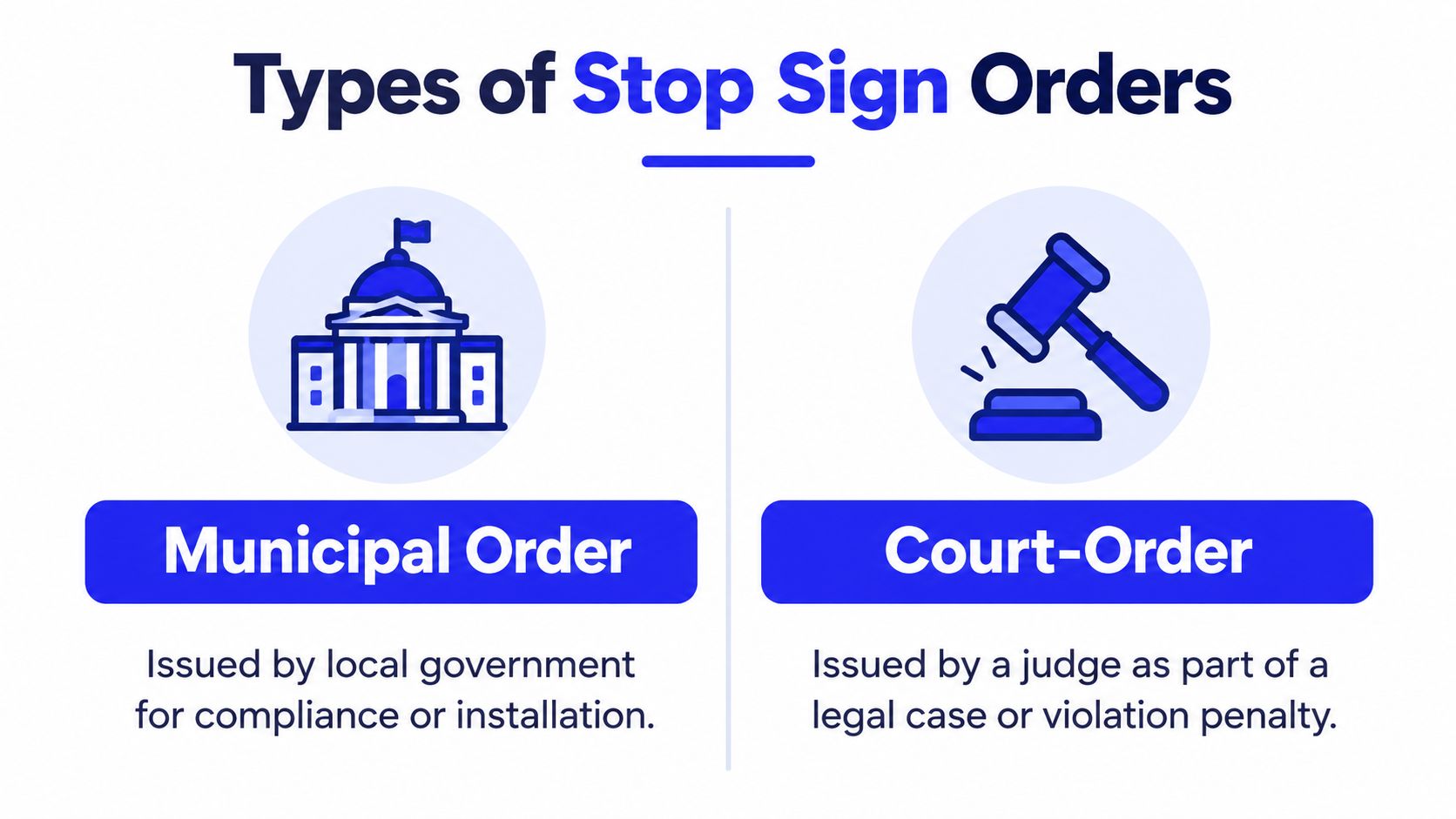
A municipal stop sign order and a court-issued order can appear similar to a driver who has just received paperwork, but their legal functions differ. A city or local transportation authority may issue a directive concerning installation, removal, placement, or maintenance at a particular intersection. That type of order addresses traffic control for a location. It doesn't normally target one driver's license.
A court-issued order operates on a different level. A judge may connect compliance with a stop-sign-related requirement to an existing legal matter. The exact consequence depends on the order and the underlying case. You should read the document carefully, identify the person bound by it, and note every deadline or condition.
Two practical examples
Suppose a business receives a municipal notice concerning a sign near its driveway. The question may involve installation authority, access, visibility, or compliance with a local directive. That dispute is not the same as a driver receiving a citation for failing to stop at the intersection.
Now consider a driver who receives a court document after a traffic case. That driver must comply with the court's language, not with an informal summary from a clerk, friend, or online post. Missing a requirement can produce consequences separate from the underlying stop-sign allegation.
Right-of-way disputes
All-way stops create a recurring problem when vehicles arrive close together. Stopping first doesn't automatically answer every right-of-way question. Drivers must yield to vehicles already in the intersection or close enough to present an immediate hazard, and pedestrians may have priority at crossings. The phrase “first to stop goes first” is therefore incomplete.
If two vehicles stop nearly together, don't force the issue. Confirm that the other vehicle has yielded, account for pedestrians and cyclists, and proceed only when the movement is safe. For a practical discussion of stopping order and intersection priority, see Florida stop-sign dimensions and related compliance issues.
How Stop Sign Orders Affect Traffic Enforcement
A stop sign order can change the enforcement context even when the underlying driving conduct looks ordinary. Municipal officials may focus attention on an intersection after installing or modifying control. Officers may also monitor a location where drivers repeatedly misunderstand the stopping requirement. That doesn't eliminate the need for proof, but it can make the intersection a place where small details receive close attention.
Compliance depends on conditions and driver behavior, not on the sign alone. Winnipeg public works reported that when all-way stop control was installed without being warranted, an average of 68% to 95% of approaching motorists didn't come to a complete stop, as documented in its public works discussion of stop-sign control. The same source describes a North Carolina transportation study reporting crash reductions of 68% overall, 77% for injury crashes, and 75% for frontal-impact crashes after all-way stops were installed at appropriate locations.
What officers typically document
An officer's report may address:
Vehicle movement: Whether your vehicle slowed, stopped, or continued through.
Stopping location: Whether you stopped before the stop line, crosswalk, or intersection.
Visibility: Whether the sign and roadway markings were visible from your approach.
Traffic conditions: Whether another vehicle or pedestrian affected the movement.
Driver statements: What you said during the roadside encounter.
The presence of a stop sign order doesn't turn every citation into a serious offense, and you shouldn't assume that enforcement attention proves guilt. At the same time, a court-related order can make compliance especially important because the issue may involve more than the civil citation itself. Review the potential record consequences before making a payment decision, including the discussion of points from a Florida stop-sign ticket.
Defending Against Stop Sign Citations
Paying a stop-sign ticket may feel like the fastest way to end the problem. It can also mean accepting the citation's consequences without examining whether the evidence supports it. Before you pay, determine what the ticket alleges, whether it affects your record, and whether the sign, markings, and officer observation support the charge.
A defense begins with facts gathered quickly. Photograph the approach from the driver's perspective, preserve dashcam footage, and identify the weather, lighting, traffic, and any obstruction. Don't move or alter anything at the intersection, and don't rely on memory alone when physical evidence may disappear.
Issues worth investigating
Sign visibility: Trees, construction equipment, darkness, glare, or another object may affect whether a reasonable driver could identify the sign in time.
Placement: The sign's position should be evaluated against the approach it controls and the driver's ability to see it.
Stopping point: A driver may have stopped, but the dispute may concern whether the stop occurred before the applicable line, crosswalk, or intersection.
Observation angle: An officer positioned behind another vehicle or around a curve may have had a limited view of the critical moment.
Citation accuracy: Incorrect vehicle information, location details, or a description that doesn't match the roadway can matter.
Why early review helps
A weak defense says only, “I stopped.” A stronger defense identifies precisely where the vehicle stopped, what the officer could see, whether the sign was visible, and whether the legal elements of the citation are established. The Florida stop-sign citation dismissal process can help you understand the issues that require attention before you choose a resolution.
Why Professional Legal Help Matters
Stop-sign cases often turn on details that aren't obvious from the ticket. A Florida traffic lawyer evaluates the citation, roadway layout, sign placement, officer's account, and your available evidence as one record. That review can reveal whether the practical dispute involves visibility, stopping position, right-of-way, or a separate court directive.
Local procedure also matters. A defense strategy may need to account for the court handling the citation and the county in which the alleged violation occurred. Ticket Shield, PLLC serves Florida motorists across all 67 counties, including jurisdictions in Miami-Dade, Broward, Palm Beach, Orange, Hillsborough, and Duval. The firm describes a lawyer-led model in which clients communicate directly with their attorney by phone or text, rather than relying on middlemen, corporate answering services, automated apps, or chatbots.
Direct communication changes the review
You should be able to explain the intersection in your own words and ask what the citation may do to your license. An automated system may collect basic information, but it can't replace a lawyer's assessment of conflicting facts or a court document with unusual conditions.
A lawyer can also help you avoid a common mistake, treating every stop-sign matter as interchangeable. A municipal sign dispute, a civil citation, and a court-issued compliance order may require different responses. The correct approach depends on the document and the evidence, not on a generic promise that every case will end the same way.
Protect Your License and Move Forward
A stop sign order or citation deserves prompt attention. Ignoring it can leave deadlines, court requirements, and record consequences unresolved. Paying immediately can also remove your opportunity to assess whether the sign was visible, properly positioned, and accurately described in the citation.
Gather the paperwork and evidence first. Keep the citation, photograph the approach safely, preserve any video, and write down what happened while the details remain clear. Then obtain legal guidance before choosing a resolution that could affect your driving record.
You don't need to argue with an officer at the roadside, and you shouldn't make assumptions based on a slogan about who stopped first. Protecting your license requires a fact-specific review of Florida law, the stop sign order, and the evidence supporting the allegation.
Visit Ticket Shield, PLLC for a free consultation about your Florida stop-sign citation or stop sign order. Speak directly with a lawyer by phone or text, and pursue a strategic resolution focused on the ultimate goal of achieving “No Points” on your license.