Nuevas leyes de exceso de velocidad en Florida: lo que los conductores deben saber
Las nuevas leyes de exceso de velocidad de Florida traen cargos penales y tiempo en la cárcel. Conozca cómo estos cambios afectan su licencia, su seguro y qué hacer si es multado.

Las nuevas leyes de exceso de velocidad de Florida cambiaron el panorama. Una multa ya no es solo una sanción económica que puedes pagar por correo y olvidar. En los peores casos, ahora puede significar exposición penal, tiempo en la cárcel y revocación de la licencia, razón por la cual pagar primero y hacer preguntas después es un error que no puedes permitirte cometer. Florida hizo ese cambio tras registrar 16,236 choques relacionados con el exceso de velocidad y 169 muertes en 2023, y la respuesta del estado ahora está escrita en la ley que regula cómo se castiga el exceso de velocidad peligroso (Descripción general de la ley de exceso de velocidad de Florida).
Si te acaban de detener, asume que la multa es el comienzo de una batalla legal, no el final. Una declaración de culpabilidad puede perseguirte durante años a través de puntos, daños en tu seguro y un historial que los empleadores y aseguradoras pueden ver. Si deseas un análisis más profundo sobre el problema de los súper infractores de velocidad en Florida, comienza con esta guía sobre la ley de súper infractores de velocidad en Florida.
Tabla de contenido
Por qué las multas por exceso de velocidad en Florida acaban de volverse mucho más peligrosas
Comprensión del Estatuto de Florida 316.1923 y el exceso de velocidad penal
Los costos ocultos de pagar tu multa por exceso de velocidad
Por qué las aplicaciones automatizadas y las procesadoras de multas ponen en riesgo tu licencia
Protege tu historial con una consulta gratuita de Ticket Shield
Por qué las multas por exceso de velocidad en Florida acaban de volverse mucho más peligrosas
Florida solía tratar la mayoría de los casos de exceso de velocidad como asuntos de tránsito rutinarios. Esa mentalidad es obsoleta. Bajo la nueva ley, el estado está dispuesto a convertir el exceso de velocidad extremo en conducta delictiva, lo que significa que ya no estás lidiando con una simple sanción de tipo civil. Estás lidiando con un cargo que puede poner en riesgo tu libertad, tu licencia y la tarifa de tu seguro.
El viejo error sigue siendo el más grande
Los conductores todavía piensan: “Simplemente la pagaré y seguiré adelante”. Eso es exactamente lo que perjudica a las personas. Pagar una multa de tránsito a menudo se trata como una declaración de culpabilidad, y una vez que eso sucede, el historial no desaparece solo porque la detención pareció menor. Si el cargo es lo suficientemente grave como para desencadenar consecuencias penales, debes tratarlo como un caso penal desde el principio.
La respuesta de Florida es contundente porque el peligro es real. En 2023, el estado registró 16,236 choques relacionados con el exceso de velocidad y 169 muertes (Descripción general de la ley de exceso de velocidad de Florida). Esas cifras explican por qué los legisladores pasaron de un modelo de “multa y listo” a uno que puede escalar hasta la cárcel y la revocación.
Regla práctica: Si el oficial dice que tu velocidad era extrema, no asumas que es solo una citación de tránsito. Verifica si la detención puede entrar dentro de la ley de exceso de velocidad penal de Florida antes de hacer cualquier otra cosa.
La medida más segura es una revisión legal inmediata. Si tu velocidad estuvo cerca del límite establecido, o si el oficial afirmó que estabas conduciendo de una manera que ponía en peligro a las personas o a la propiedad, no intentes adivinar tu exposición. Involucra a un asesor legal antes de tomar una decisión que asegure puntos o un historial penal. Para obtener un desglose directo de cómo se clasifican esos casos, consulta qué se considera exceso de velocidad penal en Florida.
Comprensión del Estatuto de Florida 316.1923 y el exceso de velocidad penal
La ley de velocidad extrema de Florida se encuentra en el Estatuto de Florida § 316.1923, promulgada a través del proyecto de ley HB 351 y con vigencia a partir del 1 de julio de 2025. Esta crea una nueva categoría de exceso de velocidad peligroso y excesivo. Eso importa porque los legisladores de Florida reemplazaron el antiguo modelo de multa y listo por uno que conlleva consecuencias de cárcel y revocación.
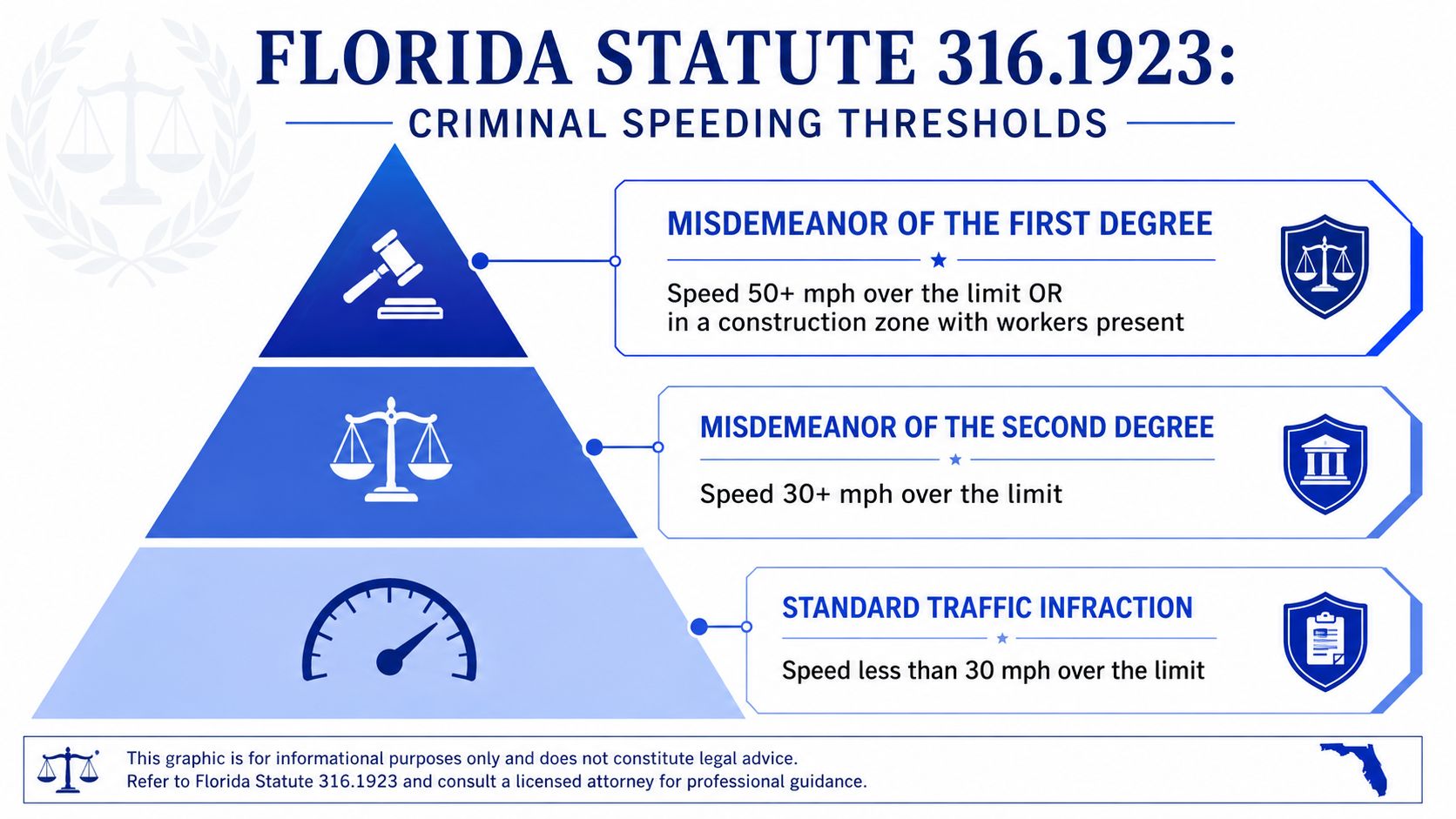
Los dos puntos desencadenantes que necesitas saber
El estatuto se aplica cuando un conductor va a 50 mph o más sobre el límite de velocidad publicado, o cuando un conductor va a 100 mph o más de una manera que amenaza la seguridad pública o interfiere con el tráfico. El segundo desencadenante importa porque la velocidad por sí sola no siempre es toda la historia. La forma en que se operaba el vehículo aún puede colocarte en territorio penal.
Las sanciones son graves. Una primera infracción puede conllevar hasta 30 días de cárcel y una multa de $500. Una reincidencia dentro de un plazo de cinco años puede ascender a 90 días de cárcel, una multa de $1,000 y de 6 a 12 meses de revocación de la licencia según el resumen del estatuto. Ese es un cambio importante con respecto a la multa por exceso de velocidad común que la mayoría de los conductores esperan.
Lo que esto significa para ti después de una detención
Si el oficial anotó una velocidad que parece estar muy por encima del límite, no te concentres únicamente en la cantidad en dólares impresa en la multa. Concéntrate en si el cargo podría ser tratado como un delito penal. Ese único detalle cambia la estrategia de declaración, el riesgo de comparecencia ante el tribunal y si tu historial se verá afectado con algo más que una multa.
Algunos conductores enfrentan arresto o detención después de una parada por velocidad extrema, y las preguntas sobre la fianza surgen rápidamente. Si eso sucede en el condado de Hillsborough, un recurso como costos de fianza en las cárceles de Hillsborough puede ayudarte a comprender la presión financiera inmediata mientras se construye tu defensa.
Para obtener un desglose directo de cómo se clasifican estos casos, consulta qué se considera exceso de velocidad penal en Florida.
Los costos ocultos de pagar tu multa por exceso de velocidad
Pagar una multa por exceso de velocidad no es una salida limpia. Generalmente es una declaración de culpabilidad, y esa declaración puede costar mucho más que la cantidad que figura en la multa. El daño aparece más tarde, cuando la compañía de seguros recalcula tu tarifa, los puntos golpean tu historial y la condena se convierte en parte del rastro de papel que te sigue.
Conveniencia a corto plazo frente a daños a largo plazo
Un pago rápido pone fin a la detención hoy, pero también sella el resultado. Una vez que se presenta la declaración, pierdes poder de negociación y es posible que nunca tengas la oportunidad de impugnar los hechos, la lectura de velocidad o la forma en que se manejó la detención. Si el caso involucra acusaciones de velocidad penal, pagar a ciegas puede ser mucho más perjudicial que defenderse.
Para una comparación práctica de tarifas, el desglose de Ticket Shield sobre cuánto cuestan las multas por exceso de velocidad en Florida es un lugar útil para comenzar. El problema mayor no es la multa base. Es el efecto dominó de una condena en tu historial y perfil de seguro.
Factor | Pagar la multa, Declaración de culpabilidad | Defenderse con Ticket Shield |
|---|---|---|
Resultado inmediato | El caso se cierra rápido | El caso permanece abierto mientras se construye la defensa |
Impacto en el historial | El riesgo de condena sigue sobre la mesa | La defensa se enfoca en reducir o evitar ese resultado |
Seguro | Mayor riesgo de daños en la prima | Mejor oportunidad de proteger tu historial asegurable |
Licencia | Persiste el riesgo de puntos y suspensión | La estrategia apunta a un resultado más limpio |
Estrés | Fácil ahora, costoso después | Más esfuerzo ahora, menos daño después |
Por qué las matemáticas suelen favorecer una defensa activa
Si conduces por trabajo, viajas diariamente o ya tienes multas anteriores, una declaración de culpabilidad puede ser un error costoso. Incluso una sola condena puede convertirse en la razón por la que tu aseguradora te trate de manera diferente en la renovación. Tu objetivo es más amplio que evitar una multa, estás tratando de proteger tu historial, tus tarifas y los próximos años de tu vida al volante.
Si la multa podría afectar tu trabajo, tus tarifas o tu licencia, no te apresures a pagarla. Haz que el estado demuestre su caso.
Qué hacer en el momento en que te detienen
Los primeros minutos de una detención de tráfico importan. La mayoría de los conductores empeoran la situación al hablar demasiado, admitir demasiado o entregar más de lo que exige la ley. Mantén la calma, sé cortés y no ofrezcas voluntariamente datos que puedan usarse en tu contra más adelante.
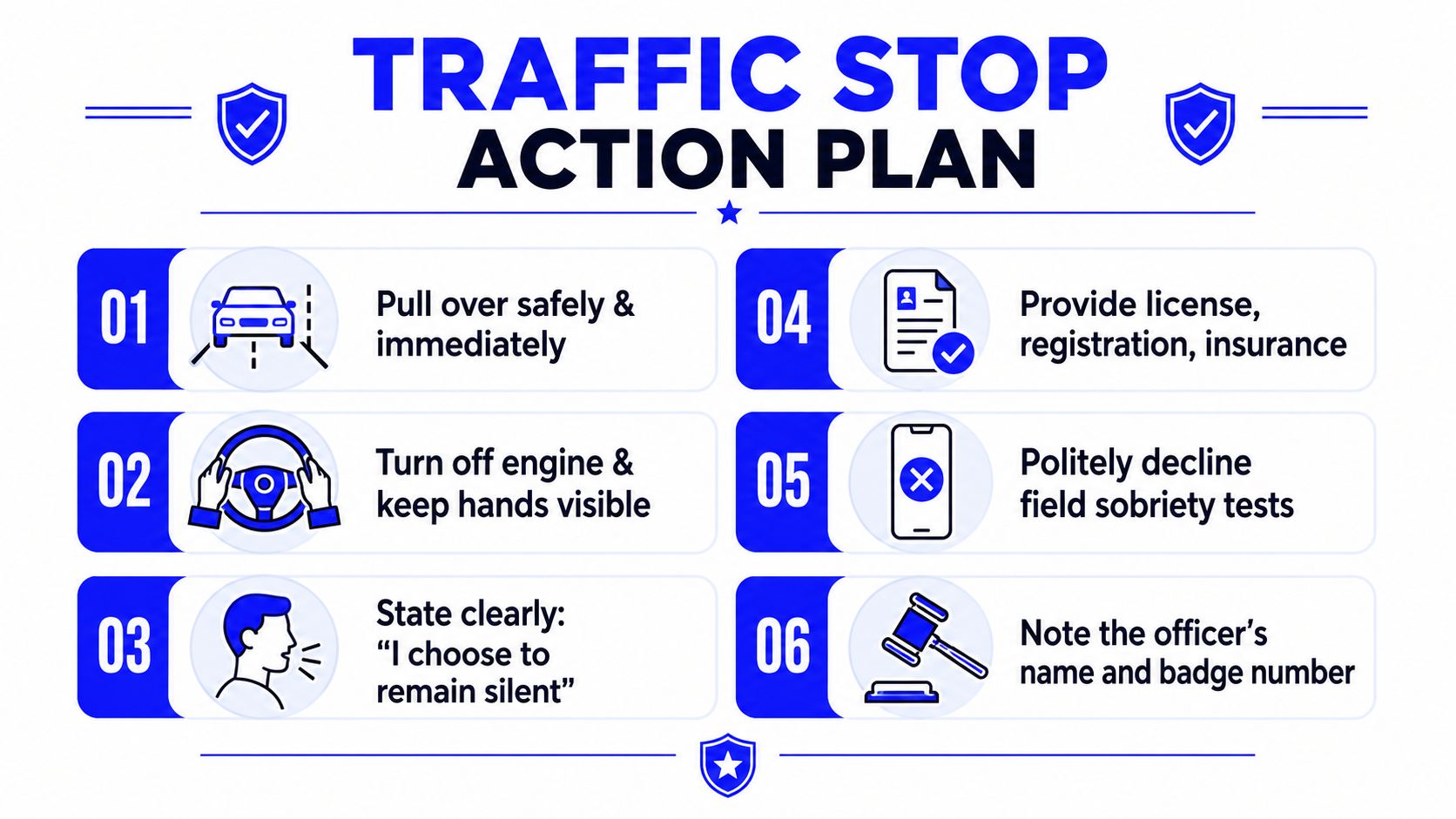
Tu detención comienza con control, no con conversación
Estaciónate de manera segura. Apaga el motor. Mantén tus manos visibles. Esos pasos disminuyen la tensión y mantienen el encuentro enfocado en el cumplimiento, no en el debate. Luego proporciona los documentos requeridos y deja de hablar a menos que el oficial te pida algo que estés legalmente obligado a proporcionar. Si deseas una guía en lenguaje sencillo para manejar la detención en sí, revisa derechos y estrategia en una detención de tráfico en Florida.
No conviertas el borde de la carretera en una sesión de confesión. No necesitas explicar hacia dónde ibas, qué tan tarde se te hizo o por qué crees que la velocidad estaba “probablemente cerca”. Ese tipo de charla solo le da al estado más material para usar más adelante.
Regla práctica: Sé respetuoso, no hablador. Tu objetivo es llegar a casa y proteger tu historial, no convencer al oficial en la berma de la carretera.
Documenta lo que puedas, luego llama a un abogado
Tan pronto como puedas, escribe el nombre del oficial, número de placa, ubicación, hora, condiciones del tráfico y cualquier cosa inusual sobre la detención. Si había varios autos, obras viales, problemas climáticos o problemas de visibilidad, anótalo también. Esos detalles importan porque los recuerdos se desvanecen rápidamente.
Vale la pena ver el siguiente video si deseas una referencia visual rápida sobre cómo debe manejarse una detención.
Una vez terminada la detención, tu primera llamada debe ser a un abogado de defensa de tránsito real, no a una aplicación, no a un chatbot y no a una línea de atención corporativa. La multa no es la línea de meta. Es el punto donde comienza la defensa.
Por qué las aplicaciones automatizadas y las procesadoras de multas ponen en riesgo tu licencia
Las aplicaciones automatizadas suenan convenientes porque prometen velocidad y simplicidad. Esa conveniencia es exactamente lo que perjudica a los conductores en casos de exceso de velocidad graves. Como se describió anteriormente bajo el § 316.1923, los límites son 50 mph por encima o 100 mph absolutos. Una vez que una multa puede generar exposición penal, tu defensa no puede reducirse a un formulario de registro rápido.
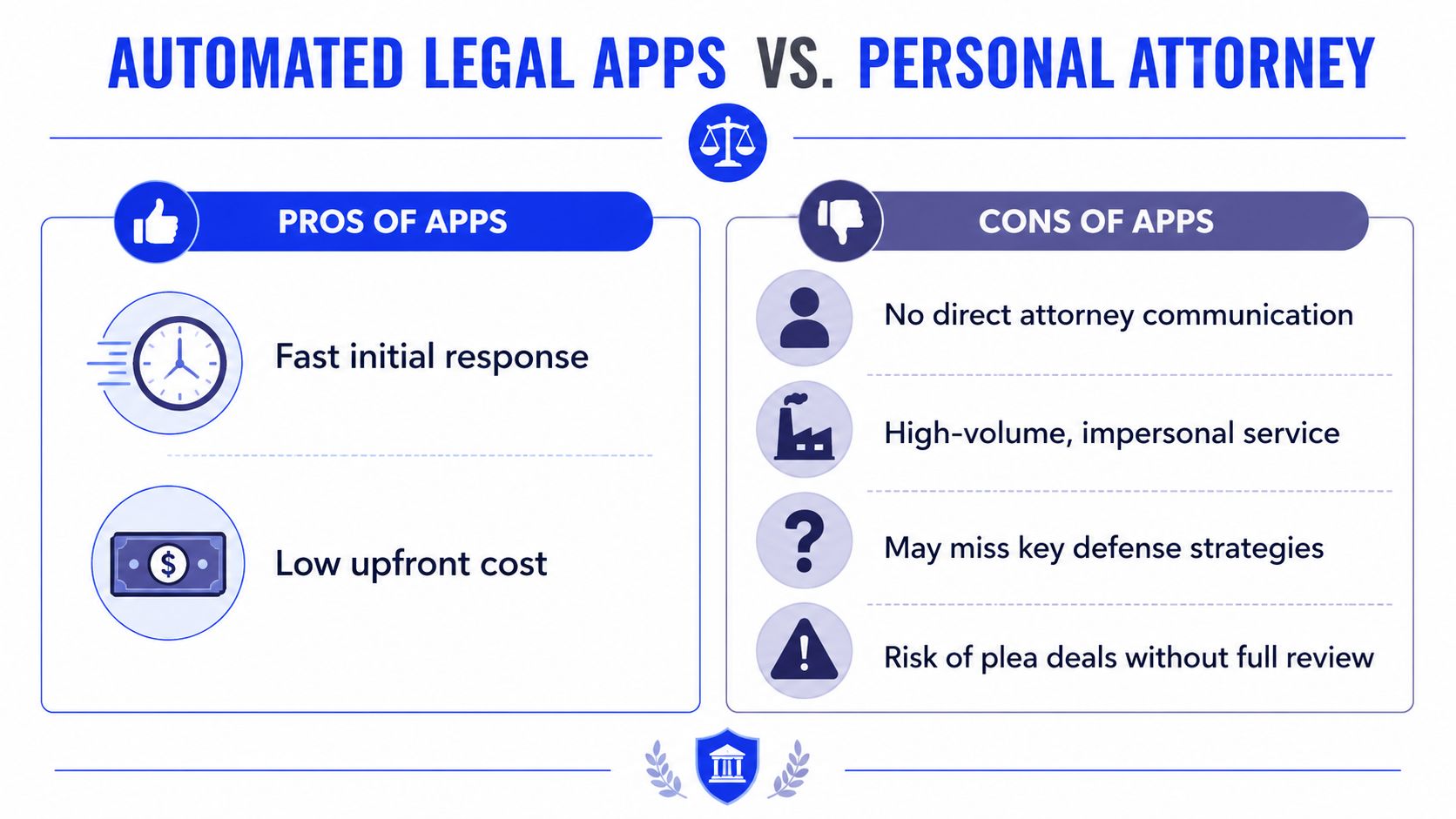
Los sistemas de volumen no conocen tu caso
Las operaciones de alto volumen están diseñadas para el procesamiento masivo. Te canalizan a través de intermediarios, sistemas de contestador corporativos o interfaces de chat que no pueden leer los detalles de tu detención. Un dato omitido, una mala suposición, y tu mejor defensa nunca llegará a plantearse.
Por eso importa una firma dirigida por abogados. Ticket Shield, PLLC está estructurada para que los clientes hablen directamente con su abogado por teléfono o mensaje de texto, lo cual es un modelo muy diferente al de una procesadora de multas que mueve expedientes mediante automatización. En un asunto grave de exceso de velocidad, la revisión directa de un abogado supera a una cola de devolución de llamadas en todo momento.
La conveniencia no es una estrategia
Las aplicaciones pueden parecer eficientes al principio. A menudo omiten la parte más importante: una defensa específica para el caso construida en torno a la multa, la detención y las opciones judiciales. Si tu velocidad estuvo cerca del límite penal, o si la detención ocurrió en una zona con problemas especiales de control policial, un flujo de trabajo genérico puede errar el blanco por completo.
Los conductores que deseen examinar más de cerca esa diferencia pueden revisar la comparación de defensa por exceso de velocidad basada en aplicaciones de Ticket Shield. Si tu historial importa, quieres un abogado que pueda revisar la multa, el estatuto y las opciones judiciales antes de presentar cualquier documento.
En resumen: El proceso que parece más barato suele ser el error más costoso.
Protege tu historial con una consulta gratuita de Ticket Shield
Las nuevas leyes de exceso de velocidad de Florida no son un cambio menor que puedas ignorar. El estado está tratando el exceso de velocidad extremo como un problema mucho mayor ahora, y tu respuesta tiene que estar a la altura de esa realidad. Si recibiste una multa, tu primer paso debe ser claro: protege tu licencia, protege tu seguro y mantén los puntos fuera de tu historial.
Ticket Shield, PLLC es una firma de defensa de tránsito en Florida dirigida por abogados. Los clientes hablan directamente con un abogado por teléfono o mensaje de texto, sin intermediarios. Eso importa cuando necesitas una defensa construida en torno a tu detención, tu multa y las opciones judiciales que tienes por delante.
No permitas que una detención por exceso de velocidad se convierta en un problema a largo plazo. Visita Ticket Shield, PLLC para obtener una consulta gratuita y trabaja para mantener los puntos fuera de tu licencia antes de que el daño sea definitivo.