Comparecencia ante el tribunal por multa de exceso de velocidad en Florida: Qué hacer después
Comparecencia en corte por multa de exceso de velocidad en Florida explicada. Conozca cuándo debe presentarse, cómo prepararse, sus opciones de declaración y cómo evitar puntos en su licencia.

Una multa por exceso de velocidad en Florida requiere una comparecencia ante el tribunal solo en situaciones específicas, la más común de las cuales es cuando se le multa por conducir a 30 mph o más sobre el límite establecido. Para otras infracciones, generalmente tiene 30 días para responder sin tener que pisar un tribunal.
Las luces azules se han ido, pero la citación doblada sigue en el asiento del pasajero. Está buscando una fecha de corte, preguntándose si pagar en línea hará que el problema desaparezca. Puede resolver la citación inmediata, pero también puede generar puntos, un registro de seguro y consecuencias que no tenía la intención de aceptar.
Florida se toma en serio la fecha límite de respuesta. El incumplimiento de una fecha límite o una citación sin responder pueden llevar a una suspensión indefinida de la licencia hasta que se comunique con el tribunal de tránsito y cumpla con sus requisitos, según el Departamento de Seguridad de Carreteras y Vehículos Motorizados de Florida (DHSMV). La decisión inteligente es identificar la categoría procesal de la citación antes de pagar, declararse culpable, solicitar una audiencia o contratar un abogado.
Tabla de contenido
La escala de sanciones estatutarias y lo que cada nivel significa para usted
Cómo prepararse antes de la fecha de corte de su multa por exceso de velocidad en Florida
Sus opciones de declaración y defensa en un caso de exceso de velocidad en Florida
Por qué la representación dirigida por un abogado cambia el resultado
Conductores de fuera del estado y la trampa de los tribunales de Florida
Qué hacer si no asistió al tribunal o ya tiene una retención de licencia
Cuándo una multa por exceso de velocidad en Florida realmente requiere una comparecencia ante el tribunal
La mayoría de las multas civiles por exceso de velocidad en Florida no requieren una comparecencia física obligatoria. La excepción importante es una citación por conducir a 30 mph o más sobre el límite establecido, lo que la ley de Florida trata como una infracción de comparecencia obligatoria según el Estatuto de Florida 318.19. Florida también requiere una audiencia para circunstancias graves, incluido un choque que resulte en muerte o lesiones corporales graves, ciertas infracciones de autobuses escolares y ciertas infracciones de carga descubierta.
Los secretarios judiciales de Florida identifican ejemplos de comparecencia obligatoria, incluido el exceso de velocidad de 30 mph o más sobre el límite, en su guía de multas de tránsito. La citación en sí misma es importante. Si el formulario dice “debe comparecer”, trate esa instrucción como vinculante. No es lo mismo que una promesa rutinaria por escrito de resolver una infracción civil.
Lea la citación antes de elegir una respuesta
Para una infracción civil estándar por exceso de velocidad, puede tener opciones para pagar, elegir un curso de mejoramiento del conductor si es elegible, presentar una declaración por escrito o solicitar una audiencia. Las preguntas frecuentes de un tribunal de tránsito de Florida explican que una Declaración condicional de no impugnación junto con una Declaración jurada de defensa o admisión y renuncia de comparecencia pueden permitir la revisión para una retención de adjudicación y sin puntos sin tener que asistir al tribunal, según el caso y el procedimiento del condado. La misma guía identifica un período general de elección o solicitud de audiencia de 30 días.
Ese plazo comienza en la fecha en que se emite la citación. No asuma que una solicitud de reprogramación pendiente justifica la inasistencia. A menos que un tribunal otorgue formalmente la reprogramación, la fecha de audiencia original sigue vigente.
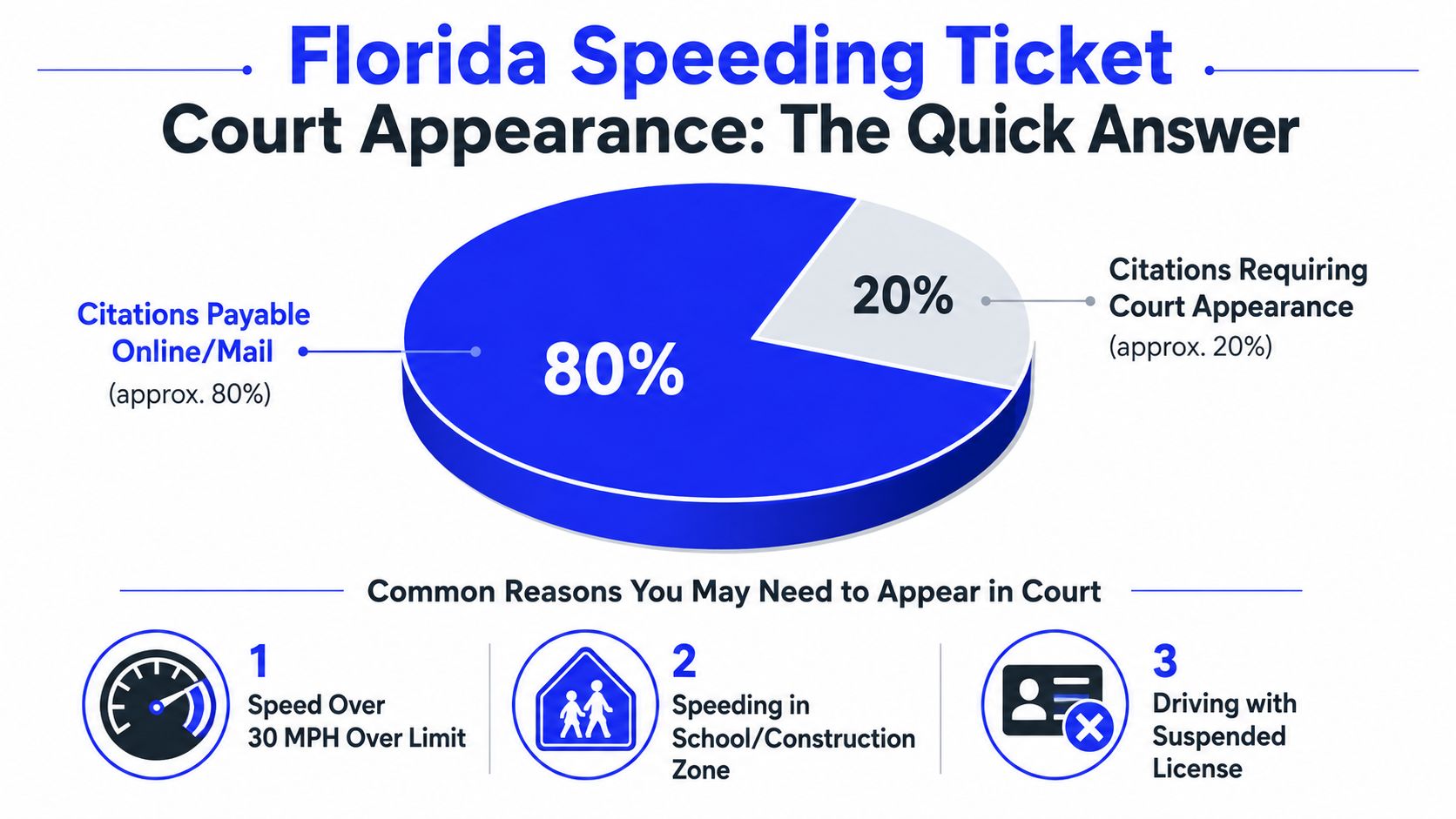
El gráfico proporcionado presenta una división de 80% pagadero y 20% de comparecencia ante el tribunal, pero ese porcentaje no está incluido en los datos legales verificados de Florida disponibles para este artículo. Use la imagen como una ayuda visual, no como una regla legal. La regla confiable es más simple: verifique la citación, identifique si la infracción es de comparecencia obligatoria y responda dentro del plazo aplicable.
Para obtener un contexto procesal adicional, revise esta guía sobre los requisitos de comparecencia ante el tribunal de tránsito de Florida. Ignorar la multa nunca es una estrategia válida. El DHSMV de Florida establece que el incumplimiento o la falta de comparecencia ante una citación de tránsito puede suspender su licencia indefinidamente hasta que el tribunal de tránsito del condado emisor confirme que ha cumplido con sus requisitos.
La escala de sanciones estatutarias y lo que cada nivel significa para usted
Las sanciones por exceso de velocidad en Florida crean una escala, y esa escala le da estructura a su estrategia de defensa. Según el Estatuto de Florida 318.18, de 1 a 5 mph sobre el límite es una advertencia, mientras que las sanciones civiles enumeradas aumentan de $25 para un exceso de 6 a 9 mph a $250 para 30 mph o más. Las infracciones en zonas escolares de hasta 5 mph de exceso pueden conllevar una sanción duplicada de $50.
Exceso de velocidad sobre el límite | Rango de multa base | Puntos en la licencia | ¿Requiere tribunal? | Intereses estratégicos |
|---|---|---|---|---|
De 1 a 5 mph | Advertencia | Depende de la disposición final | Por lo general, no | Confirme si la citación se trata como una advertencia u otra infracción |
De 6 a 9 mph | $25 | Depende de la disposición final | Por lo general, no | Resuelva rápidamente, pero no pague sin considerar el impacto en su registro |
De 10 a 14 mph | $100 | Depende de la disposición final | Por lo general, no | Compare el pago con las opciones de curso, declaración por escrito o audiencia |
De 15 a 19 mph | $150 | Depende de la disposición final | Por lo general, no | Una penalización más alta hace que una estrategia sin puntos sea más valiosa |
De 20 a 29 mph | $175 | Depende de la disposición final | Por lo general, no | Revise las pruebas y la elegibilidad antes de admitir la responsabilidad |
30 mph o más | $250 | Depende de la disposición final | Sí, sujeto a la citación y al estatuto | Comparecencia obligatoria y mayor riesgo procesal |
Esta tabla refleja la escala de penalización base verificada, no todas las evaluaciones posibles, recargos o cargos del condado. Tampoco garantiza un resultado fijo de puntos. Los puntos dependen de la disposición y de las normas que rigen el historial, por lo que la pregunta no es "¿De cuánto es la multa?", sino "¿Qué efecto tendrá esta resolución en mi licencia y en mi historial de seguros?".
Por qué la escala crea una ventaja
Una comparecencia ante el tribunal no es simplemente un castigo. Puede ser un punto estratégico. La diferencia entre un nivel de exceso de velocidad más alto y una disposición más baja por una infracción sin movimiento o sin puntos puede importar más que la multa original, especialmente si la citación afecta su trabajo que depende de la conducción o su seguro.
Para casos peligrosos de exceso de velocidad excesivo, el Estatuto de Florida 316.1922 establece un delito penal separado cuando un conductor viaja a 50 mph o más sobre el límite de velocidad, o conduce a 100 mph o más mientras también excede el límite establecido por 50 mph o más. Eso ya no es un procesamiento rutinario de multas civiles. Si su citación llega a ese territorio, necesita un análisis de defensa penal, no una decisión de pago en línea.
No asuma que el número del oficial pone fin a la discusión. Un abogado puede examinar la citación, el estatuto aplicable y la evidencia disponible, para luego buscar una resolución legal respaldada por los hechos. Para obtener una explicación enfocada sobre los puntos por multas de tránsito en Florida, revise las consecuencias en el registro antes de seleccionar una declaración.
Cómo prepararse antes de la fecha de corte de su multa por exceso de velocidad en Florida
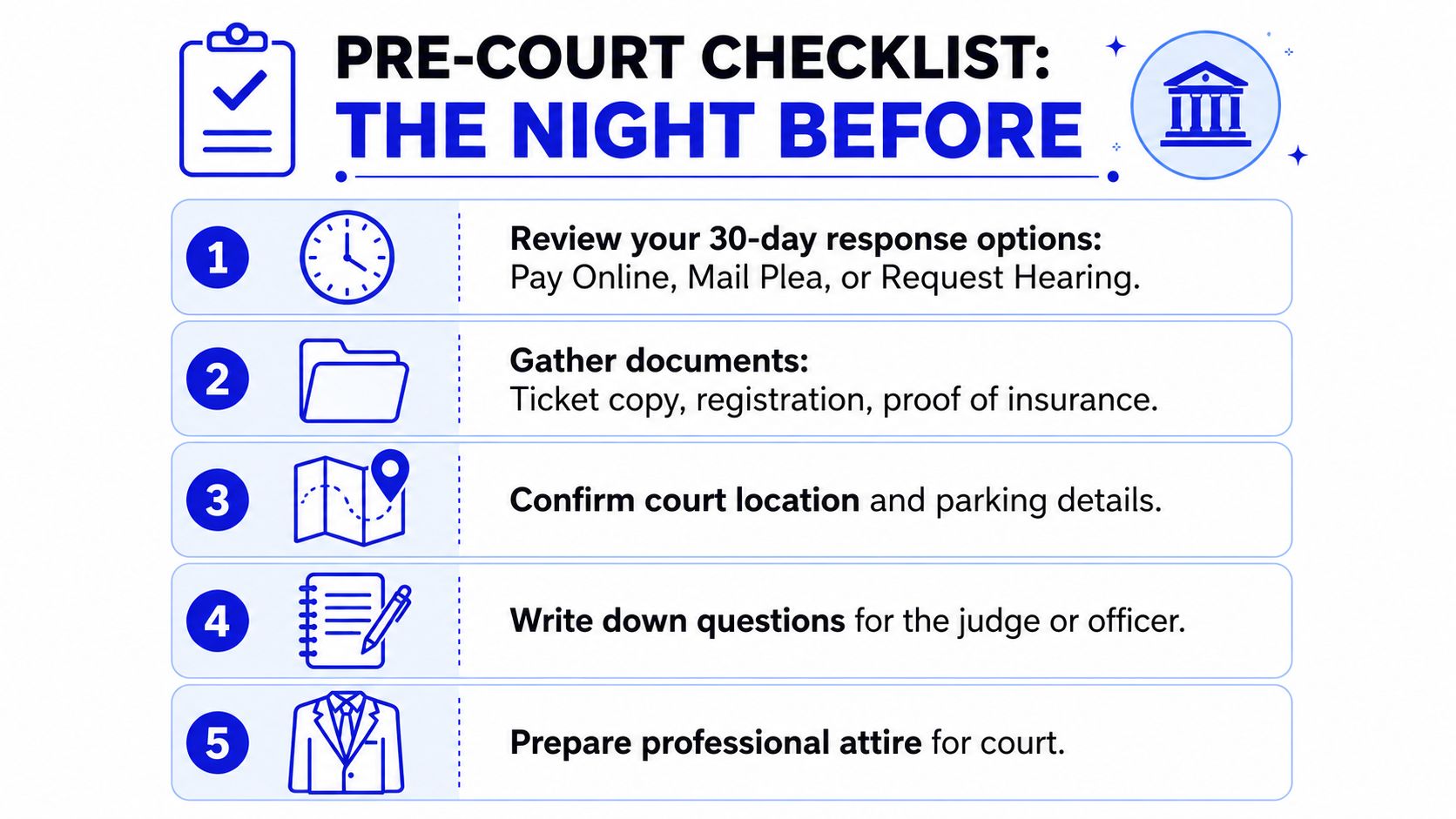
La preparación comienza con la citación, no la noche antes de la corte. Confirme el condado, el número de citación, el código de infracción, las instrucciones de comparecencia y la fecha. Si la multa es una infracción civil de rutina, determine si puede pagar, elegir un curso básico de mejoramiento del conductor, presentar una declaración por escrito o solicitar una audiencia a través del secretario del condado. Si la multa requiere una comparecencia, no trate las instrucciones de pago en línea como un permiso para faltar a la corte.
El marco estatutario de Florida permite que algunos conductores calificados elijan un curso básico de mejoramiento del conductor en lugar de una comparecencia física. El estatuto dice que esa opción puede reducir la multa civil en un 18%, retener la adjudicación y evitar puntos en casos calificados, pero la elegibilidad y el procesamiento del condado siguen siendo importantes. La guía del secretario de Miami-Dade también dice que se debe recibir un certificado de finalización del curso dentro de los 120 días posteriores al pago o de la comparecencia ante el tribunal para la resolución correspondiente de la escuela de tránsito.
Organice un expediente limpio
Traiga u organice lo siguiente:
Copia de la citación: Guarde el frente y el reverso, incluidas todas las instrucciones de la corte.
Identificación: Tenga disponible su identificación con foto para cualquier interacción con la corte o el secretario.
Registros del vehículo y del seguro: Reúna el registro y la prueba de seguro si son relevantes para su defensa o mitigación.
Evidencia: Conserve fotografías, imágenes de la cámara del tablero, detalles de ubicación y cualquier documento que aborde directamente la velocidad o las circunstancias alegadas.
Comunicaciones de la corte: Guarde números de confirmación, correos electrónicos, declaraciones enviadas por correo y cualquier solicitud de reprogramación. Una solicitud no es suficiente a menos que la corte la conceda.
No invente atenuantes. Un detector de radar que funcione, por ejemplo, no demuestra que la medición de velocidad del oficial estuviera equivocada, y puede distraer de cuestiones fácticas más sólidas. Concéntrese en la evidencia que aborde la citación directamente.
Controle la logística
Confirme la dirección del tribunal y la sala de audiencias que figuran en la citación. Deje suficiente tiempo para el estacionamiento, la seguridad y la localización de la sala correcta. Vístase de manera profesional, ponga en silencio su teléfono y diríjase al juez o al funcionario de audiencias de manera respetuosa.
Los calendarios judiciales avanzan rápidamente. El oficial puede presentar testimonios o pruebas, y usted puede tener la oportunidad de responder, según el tipo de audiencia y el procedimiento local. No interrumpa. Tome notas, responda solo a lo que se le pregunte y evite ofrecer una explicación larga antes de comprender el asunto que se está decidiendo.
Regla de la noche anterior: Verifique la fecha de la corte directamente a través del sistema oficial de tránsito del condado y no confíe en un mensaje telefónico sin responder o en una solicitud de reprogramación no aprobada.
Use esta lista de verificación de preparación para el tribunal de tránsito de Florida para organizar los documentos y las confirmaciones que necesitará. Si la citación dice que debe comparecer, planee comparecer u organizar una representación legal antes de la fecha.
Sus opciones de declaración y defensa en un caso de exceso de velocidad en Florida
Tiene cuatro caminos prácticos, pero no producen el mismo registro. Pagar es rápido, pero generalmente funciona como una admisión que resuelve la citación en términos que pueden incluir puntos y un registro de infracción de tránsito. Un curso de mejoramiento del conductor puede protegerlo contra los puntos cuando la ley de Florida y los hechos lo hagan elegible, pero debe completar el curso y cumplir con los requisitos del secretario.
Una resolución por escrito de no impugnación puede estar disponible para infracciones civiles que califiquen cuando el condado acepte los documentos requeridos. La guía de los tribunales de tránsito de Florida describe un proceso por escrito que involucra una declaración condicional de no impugnación y una declaración jurada o renuncia que puede permitir la revisión para una retención de adjudicación y sin puntos sin asistencia personal. Una audiencia formal le brinda la oportunidad de impugnar la acusación y exigir que el gobierno presente su caso, pero requiere una preparación cuidadosa.
Opción de declaración | Puntos en la licencia | Impacto en el seguro | ¿Requiere comparecencia ante el tribunal? | Ideal para |
|---|---|---|---|---|
Pagar la multa | Puede resultar de la resolución | El registro de infracción de tránsito puede afectar la evaluación de riesgos del seguro | Por lo general, no para multas civiles elegibles | Conductores que han revisado y aceptado las consecuencias en su registro |
Curso básico de mejoramiento del conductor | Puede evitar puntos en casos que califiquen | Puede proteger contra la consecuencia habitual de los puntos | A menudo no requiere comparecencia física | Conductores elegibles que puedan cumplir con los requisitos del curso y los plazos |
Declaración por escrito de no impugnación | Puede permitir una retención de adjudicación y sin puntos en casos que califiquen | Depende de la disposición final y del trato de la aseguradora | A menudo no, si el procedimiento del condado lo permite | Conductores que buscan una resolución por escrito sin tener que asistir al tribunal |
Audiencia formal | Depende del resultado | Depende de la disposición final | Sí, a menos que se permita la comparecencia de un abogado | Conductores que impugnan la acusación o buscan un resultado negociado |
El secretario de la corte puede indicarle qué documentación acepta el condado, pero no puede aconsejarle qué opción protege su historial de manejo. Haga exactamente esta pregunta antes de elegir: “Si selecciono esta opción, ¿qué disposición aparecerá en mi historial de manejo de Florida, se retendrá la adjudicación y se evaluarán puntos?”
No elija la escuela de tránsito automáticamente. La elegibilidad, el uso previo de cursos, la presunta infracción y el estado de comparecencia de la citación pueden cambiar el análisis. Si enfrenta un caso judicial obligatorio, trate la audiencia como una oportunidad de defensa, no como una transacción de pago rutinaria.
Por qué la representación dirigida por un abogado cambia el resultado
Una aplicación de tránsito puede ayudarlo a enviar información. Sin embargo, no puede reemplazar a un abogado de Florida que revise la citación real, comprenda el procedimiento local y tome decisiones de juicio sobre la evidencia y la negociación. Esa diferencia importa cuando el objetivo es obtener Cero Puntos, una retención de adjudicación, la desestimación del caso u otra disposición que proteja su historial de manejo.
Las agencias masivas de multas y los servicios automatizados a menudo colocan a un intermediario entre usted y la persona que maneja el caso. Es posible que se comunique con un servicio de contestador corporativo o un chatbot en lugar del abogado responsable de su defensa. Si su preocupación es la calidad de la comunicación, los recursos sobre servicios de contestador para bufetes de abogados pueden ayudar a explicar por qué una recepcionista o un centro de llamadas no es lo mismo que el acceso legal directo.
Qué debe incluir la representación directa
Una revisión dirigida por un abogado debe abordar la citación y los hechos detrás de ella. Eso puede incluir:
Análisis de la citación: Revisar el estatuto, la velocidad alegada, la ubicación, la fecha, la información del oficial y las instrucciones procesales.
Revisión de evidencia: Examinar los problemas de radar, láser, seguimiento de velocidad o testimonios disponibles cuando esos materiales sean obtenibles y relevantes.
Estrategia judicial: Decidir si se busca una resolución por escrito, comparecer en una audiencia, negociar o impugnar la acusación.
Comunicación con el cliente: Permitirle hablar directamente con su abogado por teléfono o mensaje de texto en lugar de forzar cada pregunta a través de una fila de soporte.
Ticket Shield, PLLC describe su servicio como dirigido por abogados, con comunicación directa con el abogado por teléfono o mensaje de texto y representación para asuntos de tránsito en Florida. Su servicio de abogados para multas por exceso de velocidad en Florida es un ejemplo del tipo de representación que debe evaluar. Pregunte en cualquier bufete quién manejará su caso, si un abogado comparece cuando está permitido, qué disposición buscan y cómo comunican las actualizaciones.
La información proporcionada por el editor indica que más del 99% de los clientes de Ticket Shield no comparecen ante el tribunal, pero esa cifra no forma parte de los datos legales verificados provistos para este artículo, por lo que no debe tratarse como un punto de referencia verificado de forma independiente. El punto más amplio sigue siendo válido: cuando el procedimiento de Florida permite la comparecencia de un abogado, la representación puede ahorrarle una visita al tribunal mientras conserva una defensa estructurada.
Vea el recurso integrado para obtener un contexto adicional sobre cómo manejar un caso de tránsito:
Conductores de fuera del estado y la trampa de los tribunales de Florida
Una multa por exceso de velocidad en Florida sigue el procedimiento de Florida, incluso cuando su licencia proviene de otro estado o país. La fecha límite de la citación, la instrucción de comparecencia y el proceso del condado emisor siguen teniendo el control. Trate la fecha de la corte como un punto de negociación, no simplemente como un castigo. La velocidad alegada, el nivel de penalización estatutaria y si la citación requiere una comparecencia pueden determinar qué resolución puede buscar antes de aceptar puntos u otras consecuencias.
Un visitante canadiense de temporada puede irse de Florida creyendo que la multa puede esperar, para luego descubrir una retención de la licencia al renovar la licencia de su provincia de origen o al realizar un trámite de agencia. Un conductor de un automóvil de alquiler también puede asumir que la compañía de alquiler resolverá la citación. Esto no reemplazará su deber de confirmar el estado del caso y cumplir con los requisitos del tribunal.
Los visitantes necesitan un plan específico para Florida
Si la citación permite el manejo por escrito, es posible que pueda enviar la declaración o renuncia requerida sin regresar a Florida. Una comparecencia obligatoria requiere la asistencia según las instrucciones, a menos que el tribunal permita otro acuerdo o un abogado de Florida pueda comparecer legalmente. No envíe una carta informal por correo y asuma que el secretario la aceptó. Utilice el formulario requerido, envíelo a través del canal aprobado y confirme la recepción con el secretario del condado emisor.
La guía de suspensión de tránsito del DHSMV de Florida explica que el incumplimiento o la falta de comparecencia ante una citación de tránsito puede provocar una suspensión indefinida hasta que el conductor se comunique con el tribunal de tránsito del condado emisor y cumpla con sus requisitos. Esa consecuencia puede extenderse más allá de Florida, dependiendo de cómo las autoridades de licencias compartan los registros de los conductores.
Para visitantes: Resuelva la citación de Florida antes de irse si es posible. La distancia es un problema de logística, no una defensa.
Consulte primero la citación y el portal oficial de tránsito del condado emisor. Luego, elija entre un abogado local, una declaración por escrito permitida o un acuerdo de comparecencia autorizado. Si tiene una licencia comercial o conduce por motivos de trabajo, obtenga asesoramiento legal antes de seleccionar una disposición. Una resolución de Florida aparentemente menor puede afectar su registro profesional y la licencia de la que depende fuera de Florida.
Qué hacer si no asistió al tribunal o ya tiene una retención de licencia
Una fecha de corte perdida requiere acción inmediata. No espere a que un aviso de renovación, una parada en la carretera o una consulta del empleador revelen el problema. El DHSMV de Florida dice que una licencia de conducir puede ser suspendida indefinidamente después de no cumplir o no comparecer ante una citación de tránsito, y la suspensión se cancela solo después de que el conductor se comunique con el tribunal de tránsito en el condado donde se emitió la citación y cumpla con los requisitos del tribunal.
Siga la secuencia de recuperación
Confirme el estado. Comuníquese con el secretario del condado emisor o con el tribunal de tránsito y pregunte si el caso muestra una comparecencia perdida, un saldo impago, un incumplimiento o una remisión por suspensión de licencia.
Obtenga los requisitos por escrito. Solicite el pago exacto, la declaración, la audiencia, la moción o el requisito de finalización del curso. No confíe en una respuesta general de un centro de llamadas.
Aborde el evento judicial. Si se perdió una fecha de audiencia, pregunte cómo solicitar una nueva fecha o solicitar una exención por la comparecencia perdida. Una reprogramación no es efectiva a menos que el tribunal la conceda.
Resuelva la retención del DHSMV. Después de cumplir con el tribunal, confirme qué paso de transmisión o despacho se requiere antes de asumir que su licencia es válida.
No conduzca hasta que se confirme el estado. Una autorización pendiente no es lo mismo que una licencia activa.
Los datos legales proporcionados no verifican una multa universal de $50 por no comparecer, un período de subsanación universal de 15 días, la presentación obligatoria del formulario SR-22, los procedimientos de orden judicial o un cronograma fijo de tarifas de reinstalación para cada caso de exceso de velocidad en Florida. Esos detalles pueden variar según el caso y el condado, así que no confíe en una lista de verificación genérica que prometa el mismo resultado en todas partes.
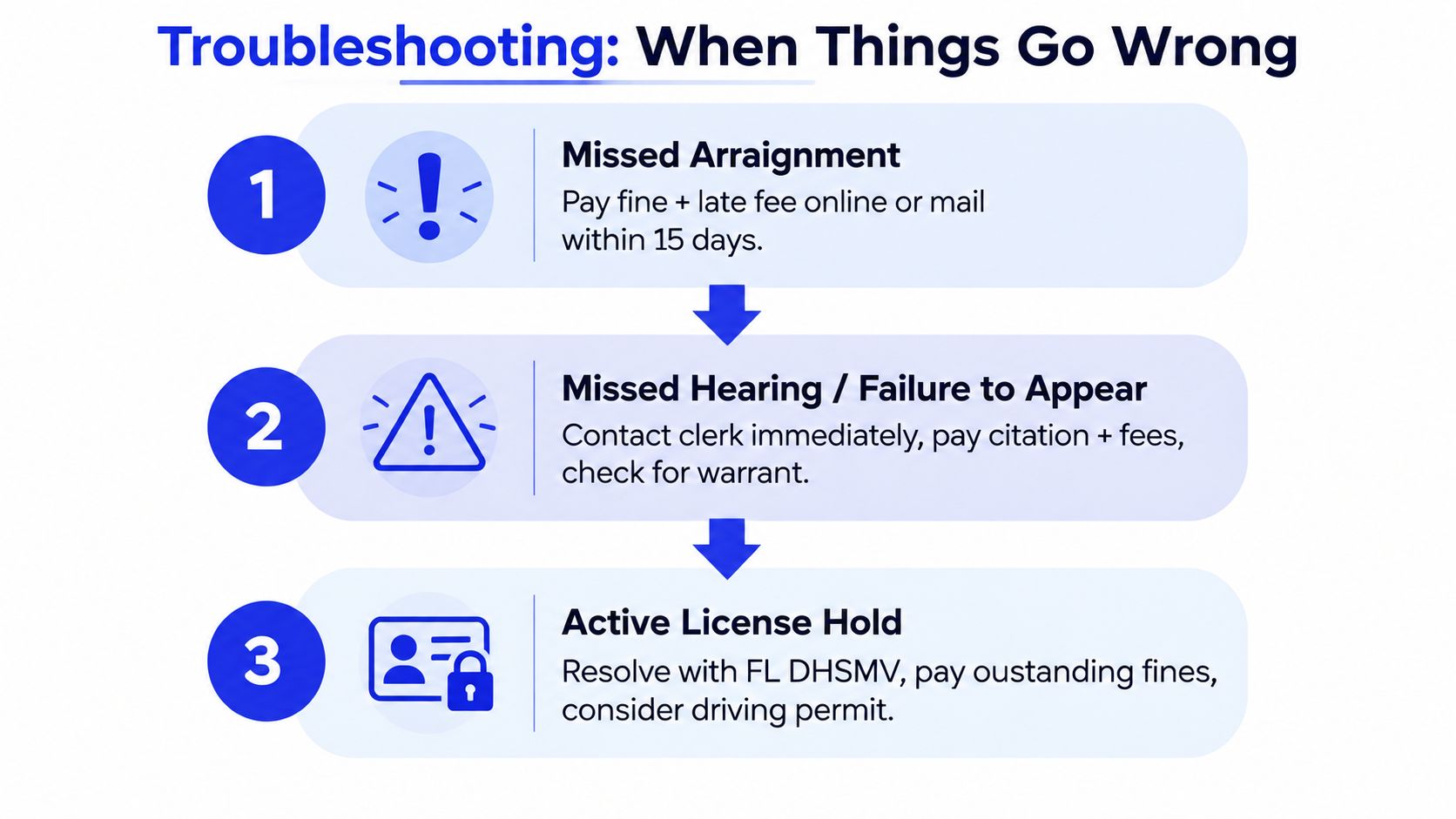
Para obtener una descripción práctica del proceso de recuperación, consulte qué hacer después de faltar a una fecha de tribunal de tránsito en Florida. La clave es la verificación. Pregúntele al secretario qué queda abierto, cumpla con la orden judicial real y confirme con el DHSMV que la retención se ha levantado antes de conducir.
Ticket Shield, PLLC ofrece consultas para multas de tránsito en Florida, comunicación dirigida por abogados por teléfono o mensaje de texto, y representación diseñada para abordar las presentaciones judiciales, las comparecencias y la protección del historial de manejo. Visite Ticket Shield, PLLC para obtener una consulta gratuita antes de pagar o faltar a su fecha de corte, y deje en claro el objetivo desde el principio: lograr "Cero Puntos" en su licencia.