Defensa contra multas de velocidad por radar: Estrategias de Florida que
Domine la defensa contra multas por exceso de velocidad con radar en Florida. Conozca tácticas de evidencia, desafíos de calibración y estrategias judiciales para proteger su licencia y evitar sanciones.

Usted está sentado en su casa con una multa de exceso de velocidad de Florida en la mano, preguntándose si el número del radar decide automáticamente su caso. No es así. La lectura de un radar es una prueba, no un sustituto de una capacitación adecuada, pruebas, identificación de su vehículo y cumplimiento de la ley de Florida.
No pague la multa antes de comprender las consecuencias y la evidencia detrás de ella. Una defensa enfocada en multas por exceso de velocidad con pistola de radar examina el dispositivo exacto, el oficial exacto, las condiciones de tráfico exactas y los registros exactos vinculados a su detención.
Índice de contenido
Por qué vale la pena luchar contra las multas de radar en Florida
Evidencia crítica que debe obtener después de una detención por radar
Debilidades técnicas y de procedimiento en las lecturas de radar
Preguntas de contrainterrogatorio y tácticas en la sala de audiencias
Opciones de negociación y resultados probables por jurisdicción
Proteja su licencia con representación directa de un abogado
Por qué vale la pena luchar contra las multas de radar en Florida
Una multa por exceso de velocidad en Florida puede afectar más que la cantidad impresa en la infracción. La multa puede acumular puntos en su historial de manejo, influir en las decisiones de seguros y crear complicaciones si ya tiene otras infracciones de tránsito. Pagar sin revisar sus opciones generalmente significa aceptar el fundamento fáctico y legal de la multa sin ponerlo a prueba.
El Estatuto de Florida 316.183 establece que es ilegal conducir a una velocidad mayor de lo razonable y prudente bajo las condiciones existentes. El estatuto también establece velocidades máximas predeterminadas, que incluyen 30 mph en distritos comerciales o residenciales y 55 mph en otros lugares, sujeto a los términos del estatuto y a los límites debidamente señalizados. Las violaciones se clasifican como infracciones de tránsito no penales sancionables como infracciones de movimiento bajo el capítulo 318. Lea el texto completo del Estatuto de Florida 316.183 antes de asumir que el número del oficial pone fin a la discusión.
El número no es todo el caso
La aplicación de la ley mediante radar se utiliza ampliamente porque las investigaciones de campo han encontrado repetidamente cambios medibles en el comportamiento de exceso de velocidad cuando los conductores están expuestos a controles de radar. Una evaluación de cinco años en carreteras rurales de Frisia, Países Bajos, reportó una disminución significativa en la velocidad media y en el porcentaje de conductores que superaban el límite a lo largo del tiempo. En Dubuque, Iowa, un estudio separado encontró que la proporción de vehículos que viajaban al menos a 5 mph sobre el límite y al menos a 10 mph sobre el límite disminuyó aproximadamente un 20%, mientras que la velocidad media ajustada disminuyó de 36.9 mph a 35.8 mph durante la fase de prueba. Un estudio clásico de flujo de tráfico encontró que los vehículos que viajaban a más de 10 mph sobre el límite disminuyeron del 42% al 28% inmediatamente después de la exposición al radar policial, para luego recuperarse al 38% dentro de una milla, como se resume en el registro de PubMed sobre los efectos del control por radar.
Esos resultados explican por qué las agencias utilizan el radar. No prueban que la lectura particular en su caso sea precisa o admisible. El tribunal aún necesita un fundamento confiable que conecte el dispositivo, el operador, el procedimiento de prueba y su vehículo.
Pagar puede ser la opción menos estratégica
Los conductores de Florida a menudo se concentran en la multa inmediata y pasan por alto las consecuencias en su historial. Un abogado defensor puede evaluar si el estado puede probar la velocidad imputada, si el oficial cumplió con los requisitos estatutarios y si una resolución negociada puede proteger su licencia.
Comience con una revisión práctica de las multas por exceso de velocidad en Florida y sus consecuencias relacionadas, pero no trate un programa de sanciones generales como una respuesta específica para su caso. Su resultado depende de la multa, su historial de manejo, el condado, las pruebas y la capacidad de la fiscalía para establecer el fundamento del radar.
Ticket Shield, PLLC utiliza un modelo dirigido por abogados en lugar de canalizar a los clientes a través de aplicaciones automatizadas, servicios de contestador corporativos o intermediarios. Usted debería poder comunicarse con su abogado por teléfono o mensaje de texto, preguntar qué pruebas son importantes y recibir una estrategia diseñada en torno a su multa real.
Regla práctica: Nunca asuma que pagar una multa de radar es inofensivo simplemente porque la infracción parece rutinaria.
Evidencia crítica que debe obtener después de una detención por radar
La defensa más sólida suele comenzar con los registros, no con el argumento de que "las pistolas de radar son inexactas". Los tribunales generalmente quieren saber si la fiscalía puede demostrar que el equipo específico era preciso, estaba debidamente probado, autorizado para su uso y era operado por un oficial calificado en el momento de la detención.
El Estatuto de Florida 316.1906 impone condiciones específicas sobre la evidencia de radar. El oficial debe haber completado el curso de capacitación en radar requerido bajo la sección 943.17(1)(b), haber realizado una determinación visual independiente de que el vehículo excedía la velocidad y haber redactado la multa únicamente cuando las condiciones permitían asignar la velocidad a un solo vehículo. Según el estatuto, la evidencia de radar es inadmisible a menos que se cumplan esos requisitos. Revise el Estatuto de Florida 316.1906 y sus requisitos de admisibilidad de radar.
Solicite los registros que identifican el dispositivo
Su abogado debe buscar el certificado de calibración vigente de la unidad de radar utilizada durante la detención. La solicitud debe identificar el dispositivo por número de serie u otro identificador de la agencia, no simplemente pedir "registros de radar".
La solicitud de pruebas también debe abordar:
Certificado de calibración: Confirme la identidad de la unidad, el estado de calibración, la fecha de la prueba y la precisión declarada.
Registros diarios de verificación de campo: Obtenga los registros de turno que muestran si el oficial probó la unidad antes de usarla y si el resultado registrado fue documentado.
Certificación del diapasón: Solicite certificados para los diapasones (tuning forks) utilizados para probar la unidad, junto con los registros que muestran qué diapasones se asignaron al dispositivo.
Historial de mantenimiento: Busque reparaciones, entradas de servicio, informes de daños, cambios de software y períodos en los que la unidad fue retirada de servicio.
Registros de capacitación del operador: Confirme que el oficial completó la capacitación de radar requerida en Florida y que fue capacitado en el equipo correspondiente.
Procedimientos de la agencia: Obtenga la política escrita de operación de radar del departamento y compárela con la conducta del oficial.
Notas del oficial y video: Revise las imágenes de la cámara corporal, las imágenes de la cámara del tablero, las notas de la multa y cualquier registro electrónico que muestre el patrón de tráfico.
Una solicitud genérica de registros de calibración puede pasar por alto el defecto decisivo. Un certificado para una unidad diferente no autentica el radar que produjo su lectura. Un registro general de capacitación puede no responder si el oficial siguió el procedimiento requerido durante su detención.
Busque eslabones perdidos en el fundamento legal
Los tribunales de Florida no necesitan un debate filosófico amplio sobre la ciencia del radar si la fiscalía no puede conectar el papeleo con su caso. El problema puede ser si la unidad estaba al día, si la prueba se realizó correctamente, si el diapasón estaba certificado y si el oficial pudo aislar su vehículo.
Una decisión de apelación de Washington declaró que las lecturas de radar requieren autenticación según las reglas de evidencia. Una decisión de Arkansas requirió prueba de la precisión del equipo de radar específico utilizado. Una decisión de la Corte Suprema de Hawái reconoció que la prueba del diapasón de un oficial podría respaldar una presunción prima facie sobre la precisión del diapasón, lo que hace que el rastro de certificación y prueba sea importante. Estas decisiones se analizan en el registro del caso que aborda la autenticación y precisión del radar, pero el abogado de Florida debe aplicar la ley de Florida a su caso.
Antes de ir al tribunal, revise qué llevar al tribunal de tránsito y entréguele a su abogado cada documento, fotografía, grabación y mensaje relacionado con la detención. No se comunique con el oficial por su cuenta para llenar vacíos. Deje que el abogado utilice el descubrimiento formal de pruebas y mociones específicas.
Una explicación visual puede ayudarle a comprender por qué los registros son importantes:
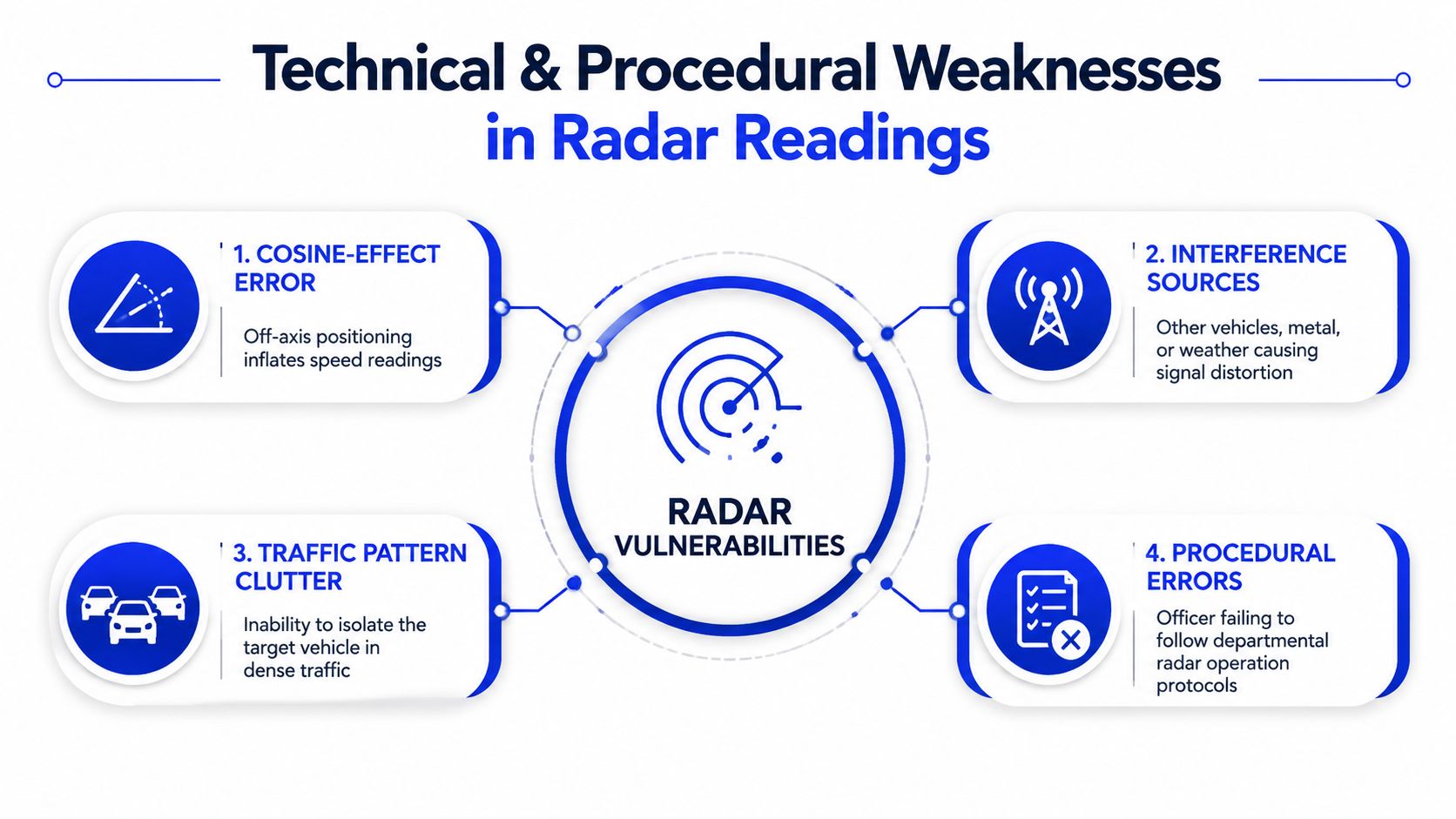
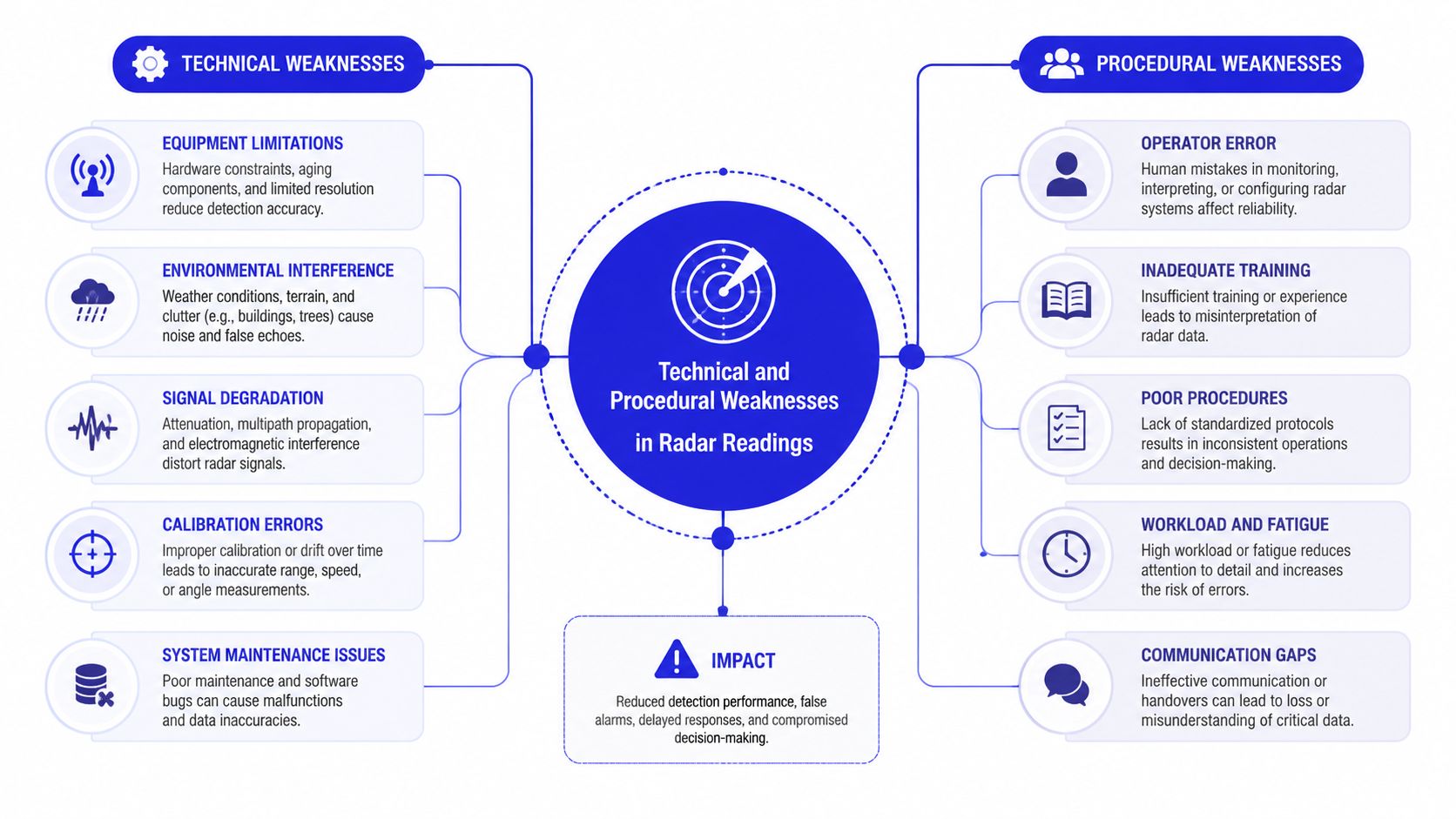
Debilidades técnicas y de procedimiento en las lecturas de radar
Una defensa de radar no debe afirmar que cada lectura de radar es errónea. Ese argumento es demasiado amplio y, por lo general, demasiado fácil de rechazar. El enfoque eficaz identifica una debilidad específica en la medición o en el fundamento legal, y luego combina esa debilidad con los registros y testimonios disponibles.
La geometría de la medición crea un problema real
El radar mide la velocidad en la línea de visión. Si el vehículo objetivo no está alineado con el haz, la velocidad mostrada puede diferir de la velocidad real del vehículo sobre el suelo. Una investigación controlada que involucró una pistola de radar y un saque de tenis abierto encontró que una ubicación en la línea central subestimaba la velocidad en aproximadamente un 3.4% en el momento del lanzamiento y en aproximadamente un 14.3% en el impacto en la cancha, lo que demuestra que la precisión depende de la posición tanto del dispositivo como del objeto en movimiento. La investigación se describe en el resumen de geometría de radar de Physics of Sports.
Para un caso de exceso de velocidad en Florida, haga preguntas prácticas:
¿Dónde estaba el vehículo de patrulla?
¿Qué carril estaba usando su vehículo?
¿El radar apuntaba directamente a lo largo del carril o a través de él?
¿Se estaba acercando o alejando del dispositivo?
¿Podría otro vehículo haber producido el retorno de señal más fuerte?
¿El oficial mantuvo un historial de seguimiento antes de detenerlo?
El llamado efecto coseno generalmente reduce una lectura de línea de visión correctamente interpretada cuando el ángulo está fuera de eje. Eso no anula automáticamente la multa. Expone una cuestión de medición, especialmente cuando la posición del oficial, el ángulo del carril y la identificación del objetivo no están claros.
La calibración establece límites, no la perfección
La guía de calibración de NIST para instrumentos de radar policial señala tolerancias del proveedor del orden de ±0.1 mph a 50 mph para algunos dispositivos. Esa cifra no es una tolerancia universal para cada unidad de radar. Muestra por qué el abogado debe identificar el modelo, revisar su especificación declarada y comparar la velocidad citada con las condiciones operativas documentadas. Consulte la guía de NIST sobre calibración de radares policial.
La defensa debe separar tres preguntas:
¿Estaba el instrumento funcionando dentro de su especificación declarada?
¿Se probó la unidad utilizando el procedimiento requerido?
¿El oficial seleccionó y rastreó su vehículo correctamente?
Esos son problemas diferentes. Una unidad puede tener un certificado de calibración vigente mientras el oficial identifica erróneamente el objetivo. Un oficial puede estar capacitado mientras falta la verificación de campo diaria. Un diapasón puede estar certificado mientras el registro de pruebas no establece cuándo o cómo se usó.
Construya el argumento a partir de defectos combinados
La investigación de radares deportivos ha reportado una sobreestimación sistemática en ángulos distintos de cero. Un estudio de cricket encontró un sesgo de +1.7 ± 0.8 m/s a 0° y diferentes velocidades residuales en desviaciones de 30° a 35°, como se analiza en el material técnico vinculado a NIST anterior. La relevancia no es que un dispositivo deportivo sea idéntico a una unidad policial. La relevancia es que el ángulo, la ubicación y la geometría del objetivo pueden afectar la velocidad mostrada.
Su abogado debe comparar el testimonio del oficial con la escena. El tráfico denso, las estructuras al costado de la carretera, las superficies reflectantes, el clima y los vehículos competidores pueden crear dudas sobre la selección del objetivo. La presentación más sólida combina una brecha de calibración, un problema de ángulo u objetivo y una falla de documentación. Evite confiar en la afirmación sin fundamento de que "el radar es inexacto". Los tribunales responden a un defecto concreto vinculado a su detención.
Utilice una explicación de cómo funcionan las pistolas de velocidad por radar para comprender la tecnología, y luego enfoque su defensa en lo que sucedió en la carretera y lo que prueban los registros.
Preguntas de contrainterrogatorio y tácticas en la sala de audiencias
La evidencia de radar se vuelve vulnerable cuando el oficial no puede proporcionar un fundamento claro y consistente. Su abogado no debe realizar el contrainterrogatorio para dramatizar. Las preguntas deben obligar al testigo a identificar el dispositivo, describir las pruebas, demostrar la capacitación y explicar cómo sabía el oficial que la velocidad mostrada pertenecía a su vehículo.
Comience con las calificaciones del oficial
Las primeras preguntas deben establecer si el oficial completó la capacitación de Florida requerida para la evidencia de radar bajo la sección 316.1906. El abogado debe solicitar el registro del curso, la fecha de finalización, el dispositivo o la tecnología cubiertos, y si la capacitación del oficial coincidía con la unidad utilizada durante la detención.
Luego pase a la operación:
¿Qué modelo y número de serie de radar utilizó?
¿Realizó una prueba antes del turno?
¿Qué prueba exacta realizó?
¿Registró el resultado en un registro diario de verificación de campo?
¿Qué diapasón utilizó?
¿Qué certificación demuestra que ese diapasón era preciso?
¿La unidad fue reparada, recibió servicio o fue retirada de uso antes de la detención?
¿Siguió el procedimiento operativo por escrito de la agencia?
Una respuesta segura no es suficiente si la fiscalía no puede presentar el registro de respaldo. Su abogado debe comparar el testimonio con el certificado, el registro de campo, el video y la política de la agencia.
Fuerce el problema de la identificación del objetivo
La ley de Florida exige una determinación visual independiente y condiciones que permitan asignar la velocidad a un solo vehículo. Pregunte cómo seleccionó el oficial su vehículo, qué otros vehículos estaban cerca, si el tráfico se movía en varios carriles y si el oficial observó su vehículo antes de activar el radar.
El abogado también puede examinar la estimación visual del oficial. Si el oficial afirma que el radar confirmó una velocidad observada, el testimonio debe explicar qué vio el oficial, durante cuánto tiempo y desde qué posición. Una mera afirmación de que el número apareció en la pantalla no responde a si el oficial rastreó el vehículo correcto.
Utilice mociones y objeciones de manera estratégica
Una moción para suprimir pruebas (motion to suppress) o una moción in limine pueden ser apropiadas cuando la evidencia carece del fundamento requerido. La moción precisa depende de la postura procesal y del defecto. Una objeción por fundamento inadecuado puede ser más efectiva que un ataque generalizado a la confiabilidad del radar cuando el estado no ha autenticado el dispositivo específico ni ha establecido las calificaciones del operador.
Cuestione las brechas en la cadena de custodia de la evidencia. Un certificado faltante, un cambio de dispositivo no explicado, una autorización vencida o una prueba de campo que nunca se documentó pueden ser importantes. Los razonamientos judiciales recientes se han centrado cada vez más en si la fiscalía demostró que el dispositivo en particular era preciso, estaba en buenas condiciones, debidamente autorizado y era operado por una persona calificada, como se refleja en la decisión de la Corte Suprema de Ohio de 2026 relacionada con el radar. El abogado de Florida aún debe confiar en la autoridad de Florida, pero el enfoque centrado en los registros es útil.
Para una preparación adicional, revise las estrategias de contrainterrogatorio para el tribunal de tránsito. No intente realizar este interrogatorio usted mismo sin comprender las reglas de evidencia y la práctica local del tribunal.
Opciones de negociación y resultados probables por jurisdicción
Los casos de tránsito de Florida no se resuelven mediante un único libreto estatal. Los condados de Miami-Dade, Broward, Palm Beach, Hillsborough, Orange y Duval tienen diferentes operaciones judiciales, fiscales, calendarios y prácticas locales de aplicación de la ley. Un abogado defensor debe evaluar la multa real y los registros disponibles antes de recomendar un litigio para desestimación, negociación u otra resolución.
Los riesgos legales aumentan drásticamente en un caso de alta velocidad. El Estatuto de Florida 316.1926 se aplica cuando un conductor supera el límite de velocidad por más de 50 mph en violación de las disposiciones de límite de velocidad especificadas, incluidas las secciones 316.183(2), 316.187 o 316.189. El estatuto trata esa conducta como una infracción de movimiento sancionable bajo el capítulo 318, lo que convierte la velocidad exacta medida en un hecho crítico. Revise el Estatuto de Florida 316.1926 con un abogado en lugar de confiar en una estrategia genérica para multas por exceso de velocidad.
Compare las vías prácticas
Jurisdicción | Resultado común | Factores de éxito de la defensa |
|---|---|---|
Miami-Dade | Resolución negociada o litigio basado en el registro | Autenticación del dispositivo, identificación del objetivo, disponibilidad del oficial y procedimiento del condado |
Broward | Negociación, solicitud de desestimación o disputa en audiencia | Documentos de calibración, verificaciones de campo, prueba de capacitación y precisión de la multa |
Palm Beach | Resolución específica del caso después de la revisión de pruebas | Fundamento del radar, condiciones de tráfico y testimonio del oficial |
Hillsborough | Disposición negociada o audiencia disputada | Registros completos del equipo y cumplimiento de la sección 316.1906 |
Orange | Resolución definida por la multa y el descubrimiento de pruebas | Aislamiento del vehículo, observación visual y documentación de pruebas |
Duval | Negociación o impugnación en audiencia | Identidad del dispositivo, calificaciones del operador y consistencia del procedimiento |
Esta tabla no garantiza un resultado. Ningún abogado responsable puede asegurar una tasa de éxito sin revisar sus hechos, y usted no debe contratar a nadie basándose en una garantía inventada. La pregunta relevante es si la evidencia disponible respalda una solicitud de desestimación, un resultado negociado diseñado para evitar puntos o una impugnación en una audiencia completa.
Elija el objetivo, no la etiqueta
La desestimación es el resultado preferido cuando el estado no puede probar el cargo o establecer evidencia de radar admisible. Si la desestimación no es realista, el abogado puede buscar una resolución que limite el impacto en el historial, dependiendo de la elegibilidad y de las opciones disponibles en el condado. La escuela de tránsito o la retención de la adjudicación (withholding adjudication) pueden ser relevantes en algunas circunstancias, pero no son automáticas y pueden tener límites de elegibilidad.
El límite de velocidad señalizado también importa. El Estatuto de Florida 316.187 autoriza el establecimiento oficial de límites de velocidad mediante investigaciones de ingeniería y de tránsito, establece un máximo de 70 mph en autopistas de acceso limitado y aborda otros límites viales, incluidos 65 mph en ciertas autopistas divididas fuera de áreas urbanas de 5,000 o más personas y la autoridad del DOT para establecer otros límites de hasta 60 mph. Revise el Estatuto de Florida 316.187 para confirmar qué regla se aplica a la carretera y a la multa.
Pídale a su abogado que compare el costo y el riesgo de una audiencia con las consecuencias de aceptar la multa. No deje que una aplicación automatizada elija esa estrategia a partir de una lista de verificación. Un abogado necesita revisar los registros reales del radar, el proceso del condado y su historial de licencia.
Proteja su licencia con representación directa de un abogado
Su prioridad es clara: proteger su historial de manejo y buscar Sin Puntos en su licencia. Una lectura de radar puede parecer decisiva, pero la ley de Florida aún exige que la fiscalía establezca el fundamento estatutario y probatorio. Los registros de calibración faltantes, las verificaciones de campo incompletas, las pruebas de capacitación insuficientes, los problemas de identificación del objetivo y las fallas de procedimiento pueden cambiar el análisis de la defensa.
Ticket Shield, PLLC es una firma de Florida dirigida por abogados que maneja la defensa de tránsito en todo el estado. La firma describe una comunicación directa con el abogado por teléfono o mensaje de texto, en lugar de un intermediario, un servicio de contestador corporativo o un chatbot automatizado. Revise los servicios de abogados para multas por exceso de velocidad en Florida de la firma y haga preguntas específicas sobre los registros que requiere su caso.
Usted merece una defensa construida en torno a su multa, no una respuesta producida en masa. No espere hasta la fecha de la audiencia para descubrir que el certificado del radar, el registro de verificación de campo o el registro de capacitación del oficial nunca fueron solicitados.
Visite Ticket Shield, PLLC para una consulta gratuita sobre su defensa de multas por exceso de velocidad con pistola de radar en Florida. Hable directamente con un equipo dirigido por abogados por teléfono o mensaje de texto, y tome medidas inmediatas hacia el objetivo final de lograr "Sin Puntos" en su licencia.