La sincronización de la luz amarilla en cámaras de semáforo en rojo y la ley de Florida
Aprenda cómo funciona la duración de la luz amarilla en las cámaras de semáforo en rojo en Florida, por qué los intervalos de amarillo son importantes legalmente y cómo proteger su historial.
You're probably here because a Florida intersection went sideways fast. You approached on green, the signal flipped to yellow, you made a split-second judgment, and then a camera flashed. Now you're staring at a notice and wondering whether the system is automatic, final, and not worth fighting.
That's the wrong mindset.
In Florida, the yellow phase isn't a throwaway warning. It's a legally required transition and an engineering setting that can decide whether camera evidence deserves trust. If the yellow felt too short, that instinct matters. Yellow timing isn't supposed to be arbitrary. It's supposed to be calculated.
A steady yellow also has a specific legal meaning under Florida Statute 316.075. It warns that the green phase is ending or that red will appear immediately afterward, and vehicles shall not enter the intersection under that signal, as stated in Florida Statute 316.075. That legal rule only makes sense if the signal timing itself is being handled correctly.
Real legal review separates itself from automated apps and ticket mills. A machine logs movement. A lawyer asks harder questions. Was the yellow interval engineered properly? Was the signal timing documented? Do the records match the camera event? In a red light camera yellow light case, those questions matter more than people think.
Table of Contents
Introduction Why Yellow Light Timing Controls Your Camera Case
What drivers miss first
What I'd tell you right now
How Red Light Camera Systems Actually Work
The five-part chain
Where reliability can break down
Safety data shows why setup matters
Yellow Light Timing Standards and Why Seconds Matter
Why one intersection can lawfully have a longer yellow
Longer yellow timing changes violations
Florida Law on Yellow Signals Under Chapter 316
Steady yellow has a statutory meaning
Chapter 316 ties legality to the signal device itself
Flashing yellow follows a different rule
Common Evidentiary Issues Tied to Yellow Light Evidence
The records that deserve scrutiny
Yellow Light Evidence Review Matrix
Why cross-examination matters here
How to Review and Contest a Camera Notice in Florida
Start with the notice itself
Build your review file
Don't hand this to a chatbot
Protect Your License and Driving Record With Ticket Shield
What direct attorney access changes
What protecting your record actually requires
Introduction Why Yellow Light Timing Controls Your Camera Case
You know the moment. You're driving through a familiar Florida corridor, traffic is tight, and the light changes right as you reach the decision zone. Brake hard and risk getting hit from behind, or continue through? You choose, the camera flashes, and the notice arrives later as if the event was simple.
It wasn't simple.
A red light camera yellow light case often turns on timing, not panic. The camera system records position against signal phase. It doesn't measure whether the yellow interval gave a real driver enough time to perceive, react, and either stop comfortably or clear the intersection. That gap between machine logic and real driving conditions is where many defenses begin.
Florida law gives yellow signals legal force, but engineering gives them practical meaning. If the yellow interval is too short for the approach speed, grade, and normal reaction time, the entire event becomes more questionable. That's why I tell drivers not to rush into paying before they understand how the intersection was timed.
What drivers miss first
They focus on the flash and the notice date. They should also focus on the intersection itself.
Signal timing matters: A yellow interval is part of the safety design, not decoration.
Records matter: Timing logs, maintenance history, and synchronization records can tell a very different story from a still image.
Florida law matters: Chapter 316 sets the legal baseline, but legal review has to test whether the equipment and signal operation match that baseline.
If you want a broader view of how these systems are used across the state, review Florida red light camera guidance.
The question isn't whether a camera flashed. The question is whether the yellow phase and the evidence package deserve confidence.
What I'd tell you right now
Don't treat this like a parking receipt. Treat it like a technical legal problem. In Florida, the yellow phase sits at the center of the issue because that's the point where engineering, statutory language, and camera proof all collide.
How Red Light Camera Systems Actually Work
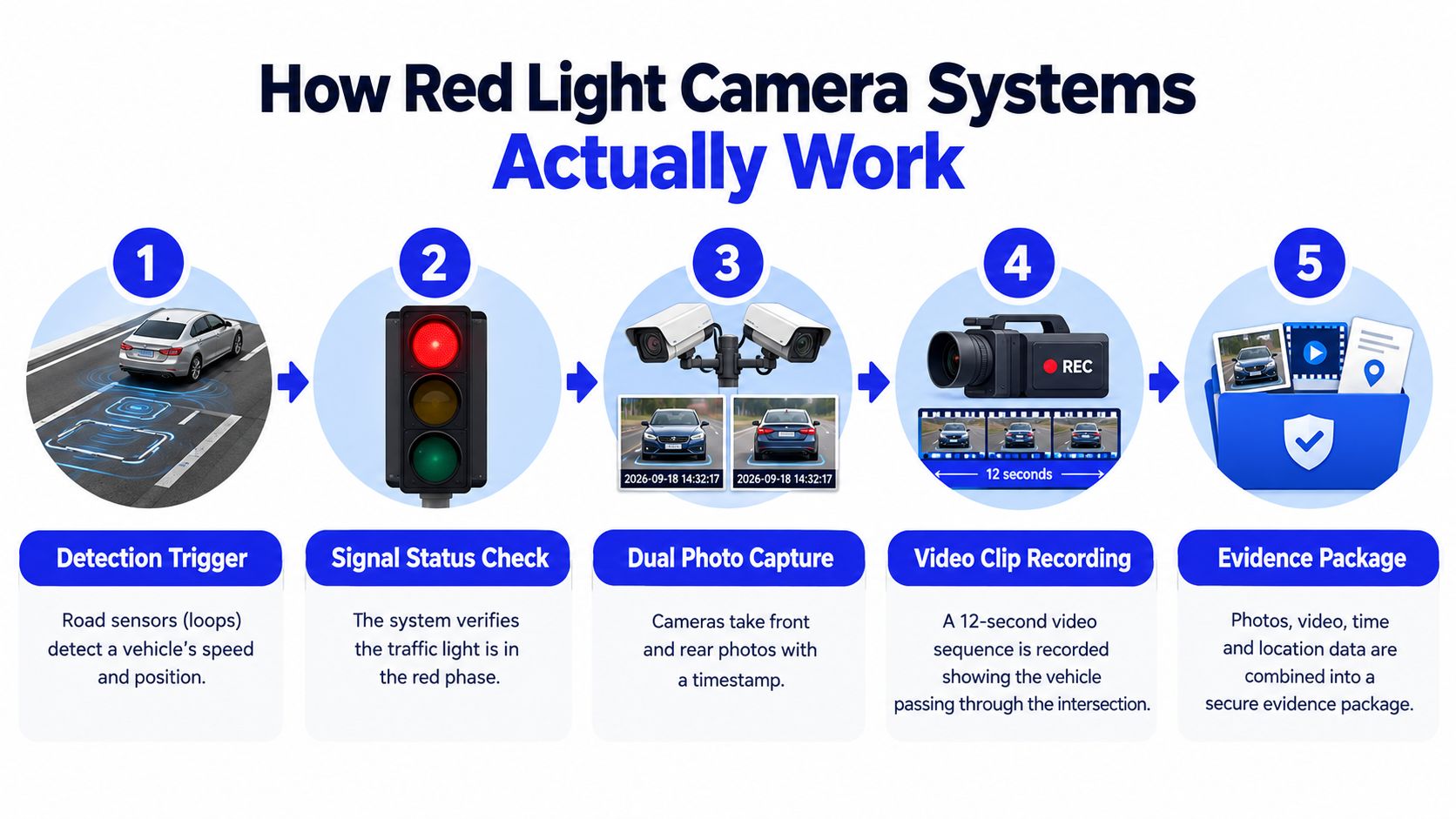
A red light camera system is only as reliable as the pieces feeding it. People assume the camera “saw what happened.” That's not how it works. The system depends on sensors, signal integration, timing data, image capture, and later review.
The five-part chain
Think of the system as a sequence, not a single camera snap.
Detection starts the event. Road sensors or video analytics identify a vehicle's position and movement near the stop line.
Signal status is checked. The system ties that movement to the traffic signal phase at that moment.
Images are captured. The evidence package usually includes timestamped images showing the vehicle's location as the event unfolds.
Video may be recorded. A clip can provide additional context that still photos can't.
A file is assembled for review. That package may include time, location, lane, images, and signal-phase information.
If you want to understand how traffic monitoring equipment is used more broadly, see Florida DOT traffic camera insights.
The camera does not judge intent. It records position against signal phase.
Where reliability can break down
The weak point isn't always the lens. It can be the timing relationship between the signal controller and the camera system. If those systems aren't aligned, the final package can look cleaner than the underlying process really was.
That's why calibration, maintenance, and synchronization matter. A technically polished image doesn't answer whether the yellow interval was appropriate or whether the event was matched to the signal correctly.
Safety data shows why setup matters
The public debate around camera systems has never been just about enforcement. It has always been about crash tradeoffs and intersection design. A 2020 systematic review found red-light cameras were associated with a 20% decrease in total injury crashes, a 24% decrease in right-angle crashes, and a 29% decrease in right-angle injury crashes, while also noting an increased rear-end crash risk, according to the systematic review on red-light camera safety effects.
That tradeoff is exactly why yellow timing can't be treated as an afterthought. If the setup changes how drivers react at the line, the yellow phase becomes central, not secondary.
Yellow Light Timing Standards and Why Seconds Matter
A yellow light that is too short can decide your case before the camera ever takes the photo. In Florida, that is not a minor setup issue. It is the pressure point where traffic engineering meets your legal defense.

Yellow timing must be calculated for the actual approach. The standard inputs are speed, grade, deceleration, and perception-reaction time. Federal operational guidance ties that timing to MUTCD and ITE methods, and explains that the interval should give a driver a fair chance either to stop comfortably before the line or clear the intersection at the prevailing speed, as stated in NHTSA's red light camera operational guidelines.
That is the legal angle drivers miss.
If the yellow interval does not match the road's real conditions, the camera may still produce a clean violation package. The problem is that a clean package can rest on bad timing. In a Florida camera case, that timing issue can support a defense under Chapter 316 because the notice depends on a lawful signal phase, not just a photograph stamped with red.
Why one intersection can lawfully have a longer yellow
Yellow time is not supposed to be uniform across a city. A downhill approach may need more time than a flat one. A faster corridor may need more time than a low-speed urban intersection. A signal engineer is supposed to account for that difference.
Human reaction time matters too. Drivers do not respond instantly, and signal timing standards reflect that reality. That is why a second, or even part of one, can change whether a driver had a fair stop-or-go choice when the light turned yellow.
Longer yellow timing changes violations
Research summarized by IIHS found that longer yellow signal timing reduced red-light violations by 36%, and cameras reduced violations even further after that timing change, according to the IIHS bibliography entry summarizing the field study.
That matters in court and in contested hearings. If longer, properly engineered yellow intervals reduce violations, then yellow timing is not a side issue. It is a central issue. It goes directly to whether the enforcement system is capturing dangerous conduct or trapping borderline entries created by timing that is too tight.
Here's a short visual explanation of why these seconds matter in practice.
Practical rule: Get the yellow timing records. If the interval was not engineered for the actual approach conditions, challenge the notice from that starting point.
Florida Law on Yellow Signals Under Chapter 316
You enter on yellow, the camera says you crossed on red, and the county acts like the case is over. It is not over. In Florida, the fight often starts with whether the yellow phase complied with Chapter 316 and whether the signal gave a real legal warning before red.
Steady yellow has a statutory meaning
Section 316.075 defines what a steady yellow signal means for drivers at an intersection. Florida uses yellow as the warning interval between green and red, and that legal meaning matters because a camera case depends on the sequence being lawful in the first place.
That is the pressure point. The statute sets the driver's duty, but it also assumes the traffic signal was operating as a valid traffic-control device with a proper yellow transition. If the yellow interval was too short for the approach speed and intersection conditions, the notice deserves scrutiny, not blind payment.
Chapter 316 ties legality to the signal device itself
Florida law also requires a traffic-control signal device to display yellow between green and red. That requirement appears in the current Florida Chapter 316 traffic-control signal provisions. A yellow phase is not window dressing. It is part of the legal architecture of the signal.
That is where engineering and legal defense meet. MUTCD and ITE timing standards address how long yellow should last. Chapter 316 supplies the rule the government is trying to enforce. Put those together and the question becomes simple. Was this driver judged under a lawful, properly timed warning interval, or under a setup that compressed the decision zone and manufactured the violation?
If your case also turns on whether the signal qualified as a lawful device, review this traffic control device violation guidance.
Flashing yellow follows a different rule
Florida treats flashing yellow differently from steady yellow. Under Florida's flashing yellow signal rule, a flashing yellow permits a driver to proceed with caution.
Do not let a hearing officer or vendor blur that line. A steady yellow warning before red is one legal condition. A flashing yellow caution signal is another. In a camera case, that distinction matters because the government must prove the exact signal phase and apply the right statute to it.
Common Evidentiary Issues Tied to Yellow Light Evidence
Most camera cases don't turn on dramatic courtroom moments. They turn on records. The important question is whether the yellow-phase evidence is complete, consistent, and technically reliable.
The records that deserve scrutiny
A clean photograph doesn't prove the whole event was captured correctly. You need to know whether the signal timing records, controller logs, and camera timestamps line up.
Maintenance history also matters. If the system was serviced, updated, or recalibrated near the event date, that can affect confidence in the evidence package. The same goes for synchronization between the signal controller and the camera platform.
Good evidence is connected evidence. The photo, the signal phase, and the timing records should tell the same story.
Yellow Light Evidence Review Matrix
Evidence Focus | What to Verify | Why It Matters for Yellow Light Review |
|---|---|---|
Signal timing records | Whether the yellow interval in place at that intersection was documented and current | The legal event depends on a valid yellow phase, not just a camera image |
Controller synchronization | Whether the camera event time matches the signal controller's phase timing | A mismatch can undermine confidence in the sequence shown |
Maintenance and calibration logs | Whether the system was tested, adjusted, or repaired near the event date | Technical changes can affect reliability or raise follow-up questions |
Photo sequence clarity | Whether the images clearly show vehicle position relative to the stop line and signal phase | Blurry or incomplete visuals can hide timing and location issues |
Video context | Whether the clip shows the approach and movement clearly enough to evaluate the yellow transition | Video can reveal hesitation, traffic flow, and approach conditions that still images miss |
Intersection-specific design records | Whether the approach speed, grade, and timing setup were consistent with engineering guidance | Yellow timing is supposed to be calculated for the actual roadway conditions |
Why cross-examination matters here
When a case turns on technical records, assumptions need pressure. A reviewer may treat the package as routine. A defense lawyer should treat it as something to test. Who maintained the system? What record shows the yellow interval in effect? How is synchronization confirmed?
Those aren't abstract questions. They're practical ones. If you want to understand how lawyers attack weak foundations in traffic cases, review these cross-examination strategies for traffic evidence.
How to Review and Contest a Camera Notice in Florida
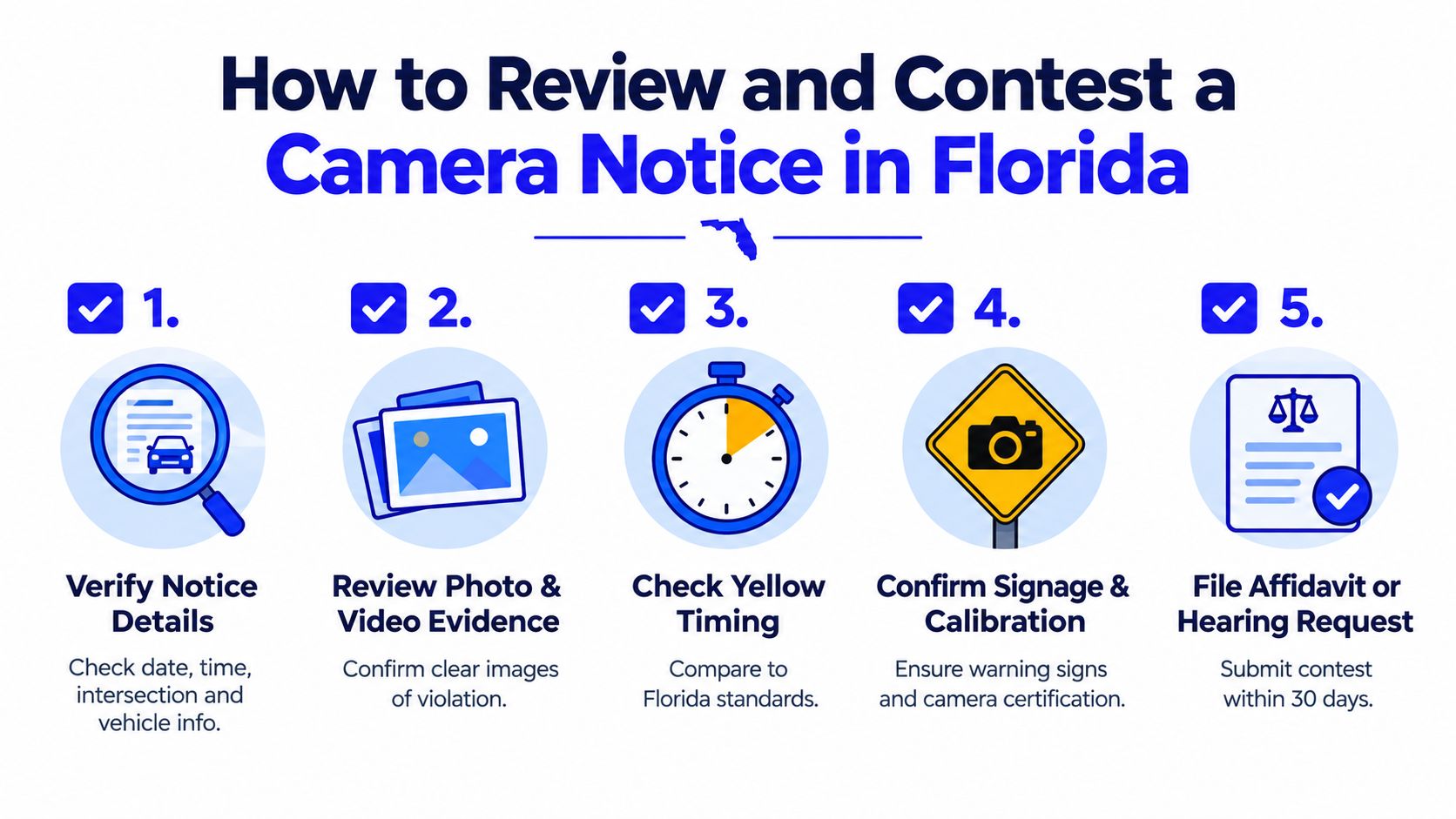
You need a process. Not outrage. Not guesses. A process.
Start with the notice itself
Read every line. Confirm the date, time, intersection, vehicle information, and image references. Save the envelope, the notice, and every available photo or video immediately.
Then focus on the yellow-light issue. If the location is familiar, write down what you remember about approach speed, traffic density, road grade, weather, and whether the yellow felt abrupt. Those details can fade fast.
Build your review file
Use a simple checklist:
Preserve the materials: Download or save the photo and video evidence as soon as you can.
Identify the intersection: Confirm the exact corner and direction of travel.
Request or examine timing-related records: Look for signal timing documentation, maintenance history, and anything showing how the yellow phase was set.
Check the visual evidence carefully: You want to know whether the vehicle's position and the signal sequence are clear.
Track the deadline: Don't let a filing date pass while you're still deciding what to do.
If you're trying to understand practical defense options in Florida, review how drivers challenge red light allegations.
Don't hand this to a chatbot
Many drivers make a bad choice. They use an automated app, a call-center intake system, or a ticket mill that treats every case the same. That model doesn't help much when the issue is intersection-specific timing, engineering records, and statutory language.
A lawyer-led review is different. You should be able to speak directly with your attorney by phone or text, ask what records matter, and get a strategy tied to your intersection, not a script. Ticket Shield, PLLC is one Florida option for that kind of lawyer-led traffic defense review.
If your defense depends on yellow timing, generic processing won't cut it. Someone needs to look at the actual intersection and the actual records.
Protect Your License and Driving Record With Ticket Shield
You open a camera notice, watch the clip, and assume the case turns on a single frame. That is a mistake. In a yellow-light camera case, the pressure point is often the timing behind the intersection and whether that timing lines up with Florida law and the records used against you.
That is why direct legal review matters. A lawyer needs to connect three things fast: the yellow interval set for that intersection, the engineering standards that should have guided it, and the Chapter 316 issues that can affect enforcement. If nobody makes that connection, a strong timing defense can get missed.
What direct attorney access changes
You need answers from the lawyer handling your case, not from intake staff, a chatbot, or a volume ticket operation. Questions about deadlines, records, and strategy come up quickly. Direct access by phone or text matters because camera cases are document cases, and document cases turn on details.
Ticket Shield, PLLC is one Florida option for that kind of lawyer-led review. The statewide practice matters because camera notices are issued all over Florida, often far from where you live. You should be able to get a case-specific review without being pushed into a generic process built for speed instead of defense.
What protecting your record actually requires
Protecting your record takes more than paying attention to the photo. It takes a lawyer who treats yellow timing as a legal and engineering issue, not as background noise. That is the difference between checking boxes and building a defense.
The same point applies to convenience. Many drivers want to avoid unnecessary court appearances, but convenience should come from strategy, not from a ticket mill that barely reviews the intersection file. Real attorney involvement gives you a better shot at protecting the outcome that matters most: your license, your record, and avoidable long-term consequences.

If you received a Florida camera notice tied to a yellow-light event, act now. Get a real legal review before you waive a timing issue that could have changed the case.
Visit Ticket Shield, PLLC for a free consultation if you're dealing with a Florida camera notice tied to a yellow-light intersection event. You'll get lawyer-led guidance, direct attorney access by phone or text, and a strategy focused on the result that matters most: No Points on your license.