How to Beat a Red Light Ticket in Florida: A 2026 Guide
Got a Florida red light ticket? Learn how to beat a red light ticket from an officer or camera with a lawyer's guide. Protect your record and avoid points.

Yes, you can beat a red light ticket in Florida, but only if you stop yourself from paying too fast, identify whether it came from an officer or a camera, and attack the right weakness. The fastest path is a no-points strategy built around evidence, timing, and procedure.
You open the envelope or look down at the citation in your hand, and your stomach drops. That reaction is normal. What matters next is whether you make the mistake that hurts drivers most. You pay it because you want it gone.
Don't.
If you're trying to figure out how to beat a red light ticket in Florida, start with this rule: paying first is usually the wrong move. Under Florida Statute 316.075, the issue is whether the state can prove you entered against a steady red signal. Under Florida Statute 316.0083, camera enforcement has its own procedural rules. Those are not technical side notes. They are often the entire fight.
A red light ticket is not one thing. In Florida, the defense depends on what issued it. An officer-issued citation is a witness case. A camera ticket is a records case. If you treat them the same, you can lose a ticket you could have beaten.
You also need to move fast. If your record has been clean for the past 3 years, meaning no moving violations, parking tickets, or accidents, your chances improve because that history can support prosecutor negotiations or court leniency, as explained by this driving record review.
Table of Contents
You Just Got a Red Light Ticket What Happens Now
You open your mail after work and see a red light ticket with a deadline printed on it. Your first instinct is to pay it and make it disappear. Stop. That decision can hand the government a clean win before you even know whether the case came from an officer's judgment or a camera system with paperwork problems.

Red light tickets in Florida split into two different fights. An officer-issued citation rises or falls on what the officer saw, remembered, and wrote down. A camera ticket rises or falls on whether the city and vendor followed the statute, mailed the notice properly, and can support the images and timing. Those are not the same case, and generic apps rarely treat them that way.
Start with the paper in your hand and preserve evidence before it disappears.
Immediate steps to take
Read every line of the document: Look for Uniform Traffic Citation or Notice of Violation.
Calendar the deadline today: Missing the response date limits your options fast.
Save the envelope, screenshots, and all pages: Mailing date, notice language, and image quality can become part of the defense.
Go back to the intersection and photograph it: Capture the stop bar, signal heads, turn-lane signs, lane markings, and anything that blocks visibility.
Write your account now: Note traffic conditions, weather, whether you entered on yellow, and whether another vehicle affected your view or stopping distance.
Pull your driving history if record protection matters: A clean history can affect how a lawyer evaluates strategy before court.
The first few hours matter more than drivers think.
If you want a quick checklist of early mistakes that hurt ticket defenses, read what to do when you get a ticket before you respond. Do not rely on a one-size-fits-all upload tool that treats every citation like the same form problem. A Florida red light case usually turns on facts, timing, and procedure.
Why your first response matters
Court clerks and hearing officers look for paperwork first because paperwork is easy to process. Your defense usually is not. In Hillsborough County, cases handled through the Edgecomb Courthouse often make early document preservation especially important because the ticket file and response paperwork can shape what gets reviewed first. In Miami-Dade, matters tied to the Richard E. Gerstein Justice Building can also turn on whether the notice, images, and filing history were preserved before the driver casually paid or missed a deadline.
That is why you should treat the ticket like a case file, not an annoyance.
Even road design and signal setup can matter in evaluating what happened at an intersection. Broader infrastructure issues are part of why cities invest in traffic management solutions, but that does not excuse a weak citation or a flawed camera notice in your case. Your job right now is simple. Do not admit the case by paying it before you identify which kind of red light ticket you received.
Is Your Ticket From an Officer or a Camera
This is the fork in the road. If you misread the ticket type, you prepare the wrong defense.
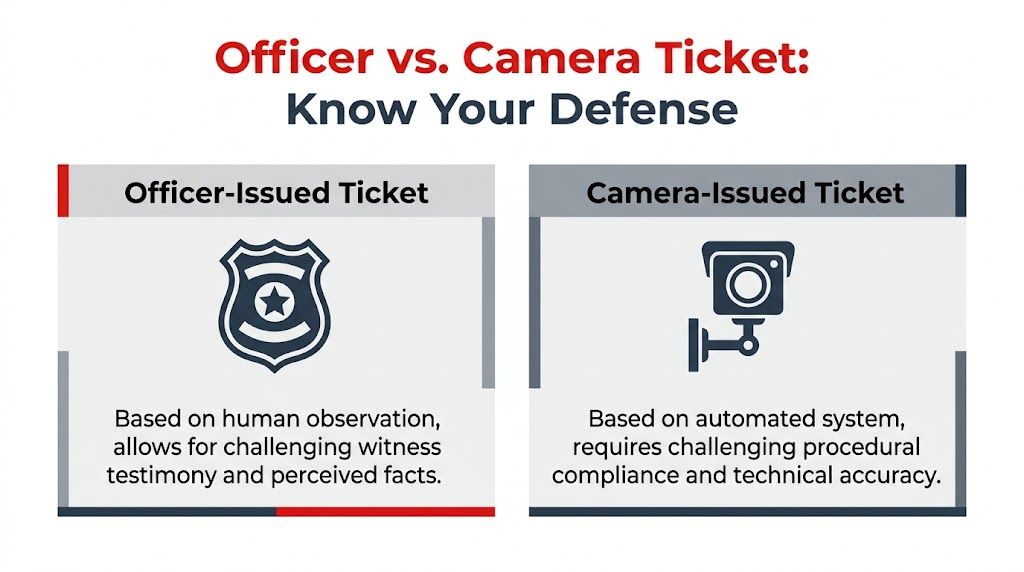
An officer-issued ticket is built on human observation. A camera ticket is built on automated enforcement and whether the city followed the law. In Florida, those are completely different fights.
What does the paper actually say
If the document says Notice of Violation, you're usually dealing with a camera case under Florida Statute 316.0083. If it's a Uniform Traffic Citation, you're dealing with a traffic case tied to an officer's observations under Florida Statute 316.075.
That difference controls almost everything that follows. It affects what evidence matters, what arguments work, and how much room you have to negotiate.
Florida camera systems use inductive loops placed before the stop bar, and a ticket can be invalidated if key procedural rules were broken, including if the notice was mailed more than 30 days after the violation or if the driver's face isn't clearly identifiable in the photo, according to this Florida red light camera defense discussion.
Officer Ticket vs. Camera Ticket Key Differences
Factor | Officer-Issued Ticket (Uniform Traffic Citation) | Camera Ticket (Notice of Violation) |
|---|---|---|
Basis of case | Officer says you crossed on red | Automated system recorded an event |
Main defense | Challenge perception, memory, angle, visibility | Challenge notice, images, timing, signage, system compliance |
Key statute | Florida Statute 316.075 | Florida Statute 316.0083 |
Important evidence | Officer location, sightline, diagrams, your testimony | Mailing date, photos, video, plate image, sign placement |
Typical pressure point | Credibility and reasonable doubt | Procedural defects and technical failure |
Which type is more dangerous to your record
An officer-issued case is usually more dangerous because it starts as a moving violation case. A camera notice often looks less threatening at first, which is why drivers ignore it or mishandle it.
That doesn't mean camera tickets are harmless. It means they require a different defense. Generic apps often flatten these differences into the same checklist. That's a mistake. If you're trying to understand the broader infrastructure behind automated enforcement, this overview of traffic management solutions helps explain why machine-based systems still depend on process and maintenance.
A red light case becomes easier to defend the moment you stop treating every ticket like the same ticket.
If you need a Florida-specific breakdown of how automated enforcement works, review red light cameras in Florida and compare it directly to the paper you received.
At courthouses like the Richard E. Gerstein Justice Building, lawyers win these cases by identifying the ticket type immediately and then forcing the state to prove the exact thing that kind of case requires. That's how you avoid wasting time on arguments that sound good but don't fit the evidence.
How to Build a Defense Against Officer-Issued Tickets
An officer-issued red light ticket is not a machine case. It's a witness case. That matters because witnesses can be mistaken, blocked, rushed, or uncertain.
When the state relies on an officer, you attack what the officer could see. The issue under Florida Statute 316.075 is not whether the stop felt abrupt or whether the officer seemed confident. The issue is whether the state can prove your vehicle crossed the limit line after the signal turned steady red.

Why officer testimony can be challenged
Most drivers lose these cases before they start because they assume the officer's word is final. It isn't. Good cross-examination creates doubt about distance, angle, timing, and obstruction.
According to Nolo's discussion of challenging officer testimony, success often turns on questions about the officer's exact distance and angle, any visual obstructions, and whether the officer is certain your front tires crossed the limit line before the light turned red. That same source states that former prosecutors report 75% of officers waver on exact timing under specific questioning.
What to ask in court
At the Edgecomb Courthouse in Tampa, I would want the officer pinned down on specifics, not conclusions.
Where exactly were you positioned: Ask for the officer's distance from the intersection and whether that location gave a direct view of both the signal and the limit line.
What blocked the view: Ask whether other vehicles, poles, signs, or turning traffic interfered with the line of sight.
What did you see first: Force the officer to explain whether they were watching the signal head, your front tires, cross traffic, or something else at the key moment.
How certain is the timing: If the answer shifts between "I think," "I believe," and "I saw," that's useful.
Did the vehicle enter on yellow: Entry on yellow can be a valid defense theme when the testimony cannot firmly place your front tires beyond the line after steady red.
Build your own record before court
You need more than denial. You need structure.
Start with photos from the officer's likely vantage point. Then diagram the intersection. Mark the stop line, crosswalk, lane position, and your path. If another car, truck, or left-turn queue blocked visibility, document that.
A short courtroom packet helps:
Intersection photos from the officer's possible location.
A simple diagram showing your lane and the limit line.
Your written timeline of when you approached, when the light changed, and whether you entered on yellow.
Any dashcam footage or witness statement you can obtain quickly.
If the officer can't clearly explain distance, angle, and timing, the case is no longer clean for the state.
You also need to stay disciplined in what you say. Don't volunteer that you "tried to make it through" or that you "were already committed." Those phrases often sound like admissions. The better position is precise and factual. You entered lawfully, visibility was limited, and the state cannot prove the crossing occurred after steady red.
If the hearing officer or judge is dealing with a crowded docket, your preparation matters even more. Organized evidence often lands harder than emotional argument. If your case also involves appearance issues by the officer, read can I fight a ticket if the officer didn't show up before the court date so you understand how that issue can affect strategy.
How to Dismantle a Red Light Camera Ticket
Camera tickets are won differently. You don't beat them by arguing with a machine. You beat them by showing the system or the city failed to follow the rules.
That means your attention shifts to mailing dates, image quality, stop bar position, signal timing, and equipment reliability under Florida Statute 316.0083.

What to inspect on the notice
A camera case is a paper trail. Read every page like you're auditing a contract.
Look for the date of the alleged violation and the mailing date. Compare the plate number, vehicle description, and photos. Check whether the images show what the city needs to prove. If the driver's face isn't clearly identifiable or the notice went out too late, those are not minor flaws. They can be defense points.
You should also inspect the intersection itself. Look for lane-specific signs, right-turn restrictions, stop bar clarity, and whether conditions at the location match the images in the notice. If the city wants to rely on a machine, the city has to get the process right.
How storm damage and bad timing create defenses
A serious emerging issue involves malfunctioning equipment after severe weather. According to this discussion of camera-ticket defenses and defective equipment issues, a projected 2026 defense angle in Florida involves post-hurricane camera malfunctions, with error rates as high as 15% in some intersections and yellow light durations falling below required standards, leading to dismissals in a high percentage of challenged cases.
That matters because yellow timing is not cosmetic. If the interval is too short, the enforcement record itself becomes suspect. In Florida, technical compliance is part of the fight.
Here is a practical explainer before you challenge the paperwork:
Camera cases reward document pressure
Unlike an officer-issued case, a camera case often turns on records most drivers never request. Maintenance logs. System review records. Image clarity. Trigger sequence. Compliance documents.
Use this checklist:
Mailing compliance: Was the notice sent within the required time?
Photo clarity: Can the city clearly connect the notice to your vehicle and the alleged event?
Intersection condition: Are the stop bar and signs visible and consistent?
Timing concerns: Does anything suggest a yellow interval problem or faulty triggering?
Post-storm issues: Did the intersection suffer weather-related damage that could affect reliability?
At the Broward County Judicial Complex, a strong camera defense often starts before the hearing with records review and pressure on procedural compliance. If you want a Florida-focused overview of these cases, read red light camera Florida defenses and compare each point to your notice.
What Are Your Options Before Trial
You open the notice, see a hearing date, and assume everything rides on one courtroom appearance. That is a mistake. A lot of red light cases in Florida are won, reduced, or redirected before trial, and the right pre-trial move depends first on what kind of ticket you have.
An officer-issued citation and a camera notice do not settle the same way. Officer cases often turn on witness problems, notes, training, and whether the officer can prove what they claim they saw. Camera cases usually turn on paperwork, notice deadlines, records, and whether the city followed the statute from start to finish. If you treat both tickets the same, you give away one of your best advantages.
Pre-trial strategy should do one of two things. Pressure a weak case toward dismissal, or protect your driving record through a negotiated outcome.
Florida courts allow red light camera enforcement, so the broad attack on the system is not the winning play. The better question is narrower and far more useful. Can the government prove this ticket, under the right procedure, with admissible evidence, against you?
That is where drivers get misled by apps and canned form services. Tools and intake systems can help organize information, and articles about AI legal assistants explain that trend well enough. They do not replace a county-specific defense plan. They do not sort out whether your case should be attacked on proof, challenged on procedure, or resolved through a record-protection negotiation.
A clean driving history matters here. It gives your lawyer room to push for a result that avoids points or keeps adjudication from hurting your record. But clean history alone is not enough. It has to be paired with a strategy that fits the ticket type and the local court.
Before trial, a lawyer should be doing work like this:
Review the file with the ticket type in mind: officer notes and witness issues for officer cases, mailing and compliance records for camera cases.
Look for procedural defects: late notice, bad identification, missing records, or gaps in the chain of proof.
Assess the realistic objective: dismissal, withheld adjudication, school, amendment, or another outcome aimed at no points.
Use local practice to your advantage: what works at the Orange County Courthouse may be handled differently in another county.
Sometimes the strongest result comes from forcing the other side to deal with a weak file before the hearing starts. Sometimes it comes from disciplined negotiation. Both happen before trial.
Ticket Shield, PLLC is one option drivers use for Florida traffic matters statewide, with direct attorney communication by phone or text. That matters in pre-trial work because deadlines shift, records come in late, and small facts can change the recommendation fast. If you are weighing whether representation makes sense, read this guide on whether you need a lawyer for a Florida traffic ticket.
Why You Should Never Fight a Red Light Ticket Alone
You walk into court thinking this is a simple traffic hearing. Ten minutes later, you have admitted a fact you did not need to admit, missed a deadline issue in the file, and walked out with a result that follows your license. That happens all the time.
Red light tickets look similar on paper. In Florida, they are not. An officer-issued citation and a camera ticket break apart in different ways, and they require different pressure points. If you do not know which kind of case you have and how that court handles it, you start the hearing behind.
Why apps and forms fall short
Apps can organize information. Templates can give you talking points. Generic services can file routine paperwork. None of that replaces a defense built for your ticket type, your county, and your risk level.
If you want context on the tech side, this overview of AI legal assistants is useful. Then stop there. Background technology does not cross-examine an officer, challenge the foundation for camera evidence, or spot the small defect that changes the outcome.
That is the core problem with app-based fixes. They treat red light tickets like one category. A Florida traffic lawyer does not.
What a lawyer changes
For an officer-issued ticket, the case often turns on observation, positioning, timing, and what the officer can say clearly under questioning. For a camera ticket, the fight is usually about notice, records, compliance, identity issues, and whether the government can prove each required step. Those are different cases. They should be handled differently from the start.
That difference matters in court and before court.
A lawyer changes the case in practical ways:
You stop making accidental admissions: drivers trying to explain themselves often fill gaps for the other side.
The defense matches the ticket: officer cases call for one approach, camera cases another.
Weak spots get used early: a bad notice, thin file, missing witness, or shaky foundation can create an advantage before the hearing starts.
The goal stays disciplined: protect the record, avoid points where possible, and do not chase a dramatic argument that hurts the primary objective.
Local practice gets used properly: judges, hearing officers, and prosecutors do not all handle these cases the same way.
If you drive for Uber, Lyft, or delivery apps, or you hold a job that depends on a clean record, do not treat this like a minor annoyance. A bad result can cost more than the fine. The same goes for military members, veterans, professionals with no time to sit in court, and Spanish-speaking drivers who need clear advice instead of a support queue.
You also need to be realistic about courtroom performance. Few drivers question an officer well under pressure. Many miss defects in a camera notice because they do not know what the file should contain. And few have the experience to push for the outcome that protects the record instead of just ending the hearing fast.
Fighting alone often costs more in the long run.
If you are still deciding, read whether you need a lawyer for a traffic ticket and compare that answer to what is at stake for your license, insurance, and work. Ticket Shield, PLLC is one Florida option drivers use when they want direct attorney handling instead of a generic system.