What Is the Difference Between a Citation and a Ticket in Florida
What is the difference between a citation and a ticket in Florida? None—the terms mean the same document, and you usually have 30 days to respond.
There is no difference between a traffic citation and a ticket in Florida. "Citation" is the formal legal term for the document. "Ticket" is the common name for the exact same thing. Both start a legal process that threatens your license with points and fines.
In Florida, a citation and a ticket are the same document. What matters is not the label. What matters is what the paper requires you to do next: respond on time, understand whether points are at stake, and decide whether paying, traffic school, or contesting the case makes the most sense.
Are You Facing a Citation or a Ticket?
When an officer hands you that document, a timer starts ticking. Whether you call it a citation or a ticket, it’s the official start of a legal problem. It will not go away on its own. You generally have 30 days to elect one of the available response options under Florida law and court procedure, including paying, electing school if eligible, or requesting a hearing through the clerk identified on the citation. The Florida Department of Highway Safety and Motor Vehicles outlines the point system and civil traffic options in its traffic citations overview, and Florida courts and clerks commonly enforce that same response window.
Legally, the document is a Uniform Traffic Citation, a formal notice that you have allegedly violated a traffic law. Florida’s traffic control chapter appears in Chapter 316 of the Florida Statutes. In everyday language, it is a ticket. The consequences are identical.
Attribute | Citation (Official Term) | Ticket (Common Term) |
|---|---|---|
Legal Status | The formal, legal name for the document. | The informal, widely used slang. |
Consequences | Begins a legal process, carries fines, points. | Carries the exact same fines and points. |
Your Response | Requires action within the deadline shown on the citation. | Requires the exact same action. |
What matters most | The charge, deadline, and outcome. | The charge, deadline, and outcome. |
The practical answer is simple: in Florida, citation and ticket mean the same thing. The real issue is whether this turns into a conviction, points, and higher insurance.
Confusion over these terms can lead drivers to underestimate the problem. A moving violation can cost far more than the fine itself because insurers often treat it as a risk signal. One industry estimate says a speeding ticket can raise premiums by about 25%, with roughly $588 or more in added annual cost for about three years, and insurers may review several years of driving history when setting rates, as discussed in this insurance-impact breakdown.
At Ticket Shield, we focus on the response and the outcome, not the jargon. If you want background on the underlying charge itself, you can learn more about what a traffic infraction is in our detailed guide.
What Are the Types of Florida Traffic Violations?
Let's get one thing straight: whether you call it a citation or a ticket, it’s the same piece of paper. The state of Florida does not care about the term you use. What matters—what your entire defense strategy depends on—is the specific violation written on that paper.
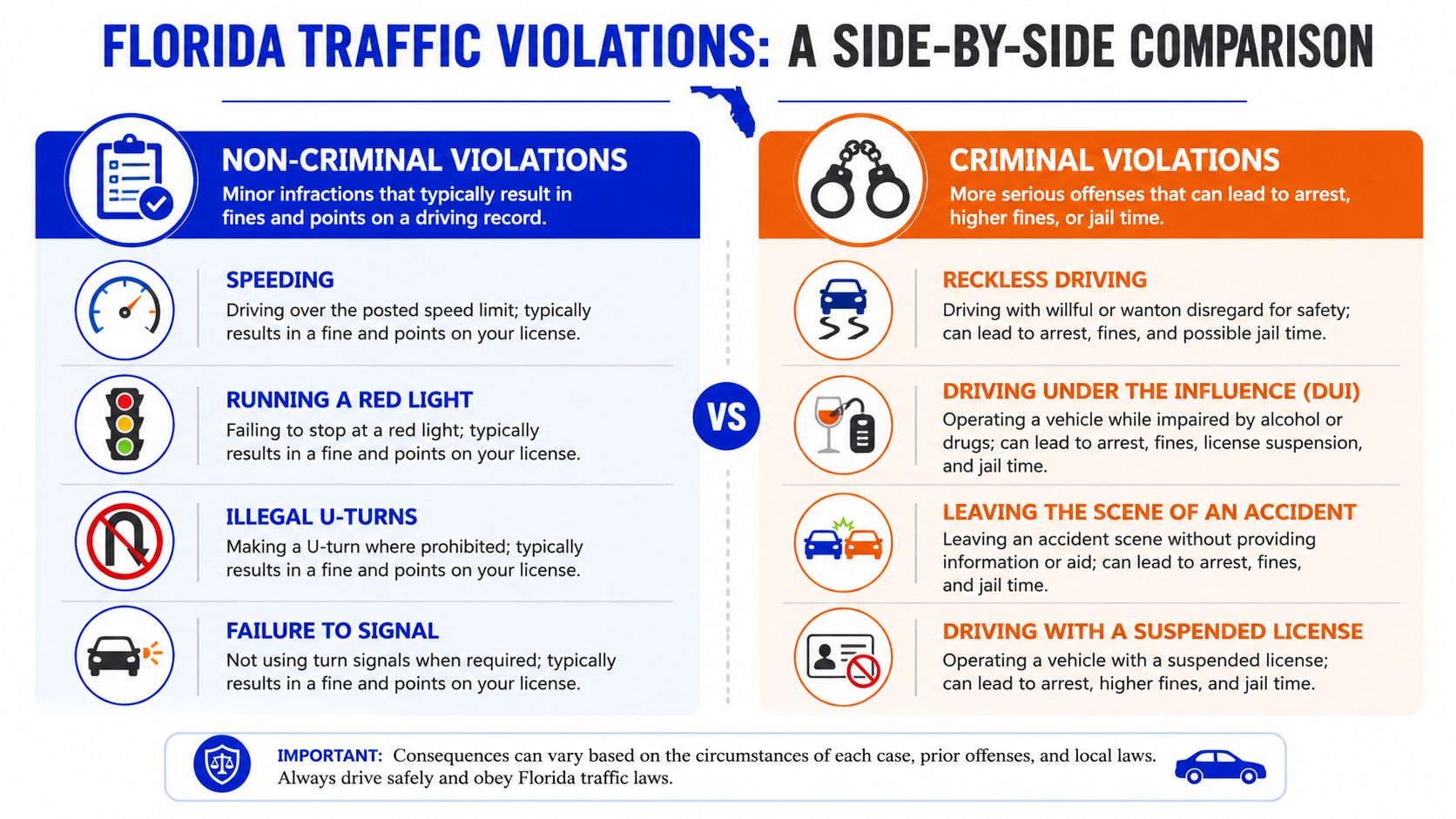
That charge determines the consequences for your license, your insurance, and your future. Not all violations are created equal.
As you can see, the name is irrelevant. Both terms point to the same legal event: a traffic violation that demands your immediate and careful attention.
What Is a Moving vs. Non-Moving Violation?
In Florida, most standard traffic infractions fall into two main buckets. Understanding which bucket your ticket belongs to is the first step in protecting your driving record.
Moving Violations: These cause the most harm. A moving violation means you were ticketed for an unsafe action while the car was in motion. This includes speeding, running a red light, or an illegal lane change. A conviction adds points to your license. This leads to higher insurance rates and the risk of suspension. For details, discover more about what qualifies as a moving violation.
Non-Moving Violations: These are generally less severe. They relate to the vehicle itself, not your driving. This includes an expired registration sticker, a broken taillight, or a parking violation. They still carry fines, but they typically do not add points to your license.
The difference here is everything. One moving violation can be the start of a serious downward spiral for your driving record. A non-moving violation is usually a manageable problem if you handle it correctly.
What Is a Criminal Traffic Violation?
Then there's the next level up. This is a much more serious category that goes far beyond a simple ticket. We're talking about criminal traffic violations. These are not just infractions. They are misdemeanor or even felony charges. They can lead to an arrest, jail time, and a permanent criminal record.
A criminal traffic charge is an attack on your freedom and your future. It requires an aggressive legal defense from an actual attorney, not a chatbot or an automated service.
Some of the most common examples we defend clients against include:
Driving Under the Influence (DUI)
Reckless Driving
Driving With a Suspended License (DWLS)
Leaving the Scene of an Accident
The consequences here are life-altering. The numbers alone show how serious this is for Florida drivers. In 2022, law enforcement issued 2.8 million traffic citations across the state. An estimated 25% of those resulted in points that jacked up insurance rates by an average of 21%. You can explore more data on these trends and their impact on drivers by reviewing these traffic citation statistics.
When the stakes are this high, you need a real lawyer in your corner. At Ticket Shield, you communicate directly with your attorney by phone or text. This is how we build the strongest possible defense against any of these violations.
How Does a Florida Ticket Immediately Affect You?
A Florida ticket does more than demand money. It starts a civil traffic case and forces you to choose a response path quickly. For most drivers, the immediate questions are: How long do I have, what happens if I pay, and is fighting it worth it?
In most ordinary traffic cases, the first hard deadline is 30 days. During that window, you typically must do one of four things: pay the citation, elect a basic driver improvement course if you qualify, request a hearing, or hire counsel to handle the process for you. Florida’s driver licensing statutes and DHSMV materials explain the consequences of convictions and the state’s point system in section 322.27 and the DHSMV points chart.
If you do nothing, the case usually gets worse, not better. A missed deadline can trigger extra fees, collections issues, license consequences, or a suspension depending on the court and the violation.
What happens after the officer writes the citation?
Here is the usual sequence in Florida:
The officer issues the citation. The document identifies the charge, location, statute, and court or clerk information.
The case enters the county court system. Even if you never step inside a courtroom, the ticket is now part of an official legal process.
You choose a response. That usually means paying, electing traffic school if permitted, requesting a hearing, or retaining an attorney to appear and negotiate or contest the charge.
The court records the outcome. That outcome determines whether points are assessed, whether court costs apply, and what appears on your driving record.
Insurance consequences may follow. The conviction itself often matters more than the original fine.
Quick comparison of your main response options
Option | What it usually means | Points risk | Cost reality | Record impact |
|---|---|---|---|---|
Pay the ticket | You close the case without contesting it. | Usually points if it is a moving violation. | Fine plus possible long-term insurance increase. | Treated as a conviction. |
Elect traffic school | Available only in eligible cases and subject to limits. | Can help avoid points in qualifying cases. | Fine/court costs plus course fee and time. | Does not erase every consequence, but may protect the point total. |
Request a hearing | You contest the violation before a judge or hearing officer. | Depends on the result. | Court costs may apply if you lose; may save more if you win. | A favorable result may avoid conviction or reduce impact. |
Hire counsel | An attorney handles filings, negotiation, and court appearance in most cases. | Goal is to avoid or reduce points. | Legal fee up front, but often weighed against insurance and record damage. | Best suited when the facts or stakes justify a defense. |
Is it better to pay or go to court?
There is no universal answer. Paying may be reasonable for a minor non-moving matter with no point consequences. It is much harder to justify when the citation is a moving violation, you already have points, you drive for work, or the facts suggest the charge can be challenged.
In our experience, the right question is not whether court is automatically better than payment. It is whether the long-term cost of a conviction is greater than the short-term cost of fighting it. For many moving violations, that answer is yes.
What Is the Financial Trap of Paying a Ticket?
Many drivers think the fine is the full price. It rarely is. Paying a moving ticket usually acts as an admission and can place points on your record if the offense carries them. Under Florida’s point system, too many points within a set period can lead to suspension, and the consequences escalate from there. DHSMV explains that accumulating 12 points in 12 months can lead to a 30-day suspension, with longer suspensions for additional point totals in later periods, as shown in the Florida point suspension rules.
The insurance side is often the bigger hit. Drivers tend to focus on a fine they can see and ignore years of premiums they cannot. That is why a fast payment can be the most expensive choice.
What Is the Difference Between a Citation and a Warning?
You must know exactly what kind of document you received. A warning and a citation are not the same.
Florida Citation vs Warning: What You Need to Know
Attribute | Official Traffic Citation | Verbal or Written Warning |
|---|---|---|
Legal Status | A formal traffic charge. | A notice or caution without a charge to resolve. |
Consequences | May carry fines, court costs, and points upon conviction. | No fine and no points by itself. |
Impact on Record | Can become part of your driving history if resolved as a conviction. | Typically does not create the same driving-record consequence. |
Your Response | Requires action by the deadline. | Usually no response required. |
A warning is a break. A citation requires a decision.
Attribute | Official Traffic Citation | Verbal or Written Warning |
|---|---|---|
Legal Status | A formal, legal charge of a traffic violation. | A notice of violation with no immediate penalty. |
Consequences | Carries fines, court costs, and mandatory license points upon conviction. | Carries no fines, no court appearance, and no points. |
Impact on Record | A conviction becomes part of your permanent driving record. | Does not appear on your official driving record. |
Your Response | Requires a formal legal response within 30 days. | Requires no further action from you. |
What Are Your Options After Receiving a Florida Citation?
Once you have the citation in hand, your job is to choose the response that matches the risk. The best path depends on three things: whether the charge is moving or non-moving, whether points matter to your license or job, and whether the facts of the stop give you something to contest.
Option 1: Pay the citation
This is the fastest path, but it is also the path that gives up your bargaining power. In many moving cases, payment closes the case as a conviction and allows points to be assessed if the offense carries points.
Option 2: Elect traffic school if you qualify
Florida allows some drivers to elect a basic driver improvement course in eligible non-criminal traffic cases. This option can help avoid points in qualifying situations, but it is not unlimited and it is not available for every charge. You still spend money and time, and you still need to follow the clerk’s instructions exactly.
Option 3: Request a court hearing
A hearing makes sense when the facts are disputed, the officer’s observations are weak, signage was defective, equipment may have been unreliable, or the ticket carries consequences that make a simple payment too costly. A hearing can also create room for amendment, dismissal, or a reduced resolution.
Option 4: Hire an attorney to handle it
Counsel is often most valuable when points would put you close to suspension, your livelihood depends on a clean record, or the citation has factual or procedural weaknesses. Representation can also spare you the burden of personally navigating filings and court appearances.
A practical rule: if the ticket is minor and carries no meaningful record consequences, a simple resolution may be fine. If the ticket can affect your license, insurance, or employment, the value of contesting it rises quickly.
Why Should You Avoid Automated Ticket Services?
The problem with automated ticket services is not just that they feel impersonal. It is that traffic cases often turn on small factual and procedural details that software cannot investigate on its own.
A useful defense is rarely built from slogans. It comes from asking targeted questions. Was the officer in a position to observe the lane change? Was the speed-measuring device current on calibration? Did the citation list the wrong statute, location, or vehicle? Was a stop sign hidden by overgrowth or defective placement? Did the officer cite the wrong person after a confusing multi-car stop?
Where representation can change the outcome
These are common examples of issues that may matter in a Florida traffic case:
Officer no-show: In some courts, if the officer does not appear when required, the state’s proof can collapse.
Clerical defects: Wrong tag number, incorrect statute, impossible time entries, or mismatched vehicle description may not automatically win a case, but they can expose sloppiness and support a broader challenge.
Radar or lidar issues: A speed case may depend on training records, testing, and calibration history.
Defective or obstructed signage: A stop sign hidden by branches or a speed-limit sign placed poorly can matter.
Mistaken identity: This comes up in fleet vehicles, borrowed cars, and chaotic roadside stops.
Negotiated no-point outcomes: Even when dismissal is not available, counsel may be able to seek an amendment or other resolution that avoids points.
Florida-specific examples
A driver on I-95 receives a speeding citation based on lidar. If calibration and testing records are missing or inconsistent, the state may have a proof problem.
A driver in Miami-Dade is cited for failing to obey a traffic control device at an intersection where the relevant sign is partially blocked by construction fencing. Photos taken the same day can become central evidence.
A driver in Broward pays a moving ticket without realizing he already has points from prior cases. The payment seems cheap until it pushes him closer to suspension and triggers higher insurance. That is exactly the kind of case where contesting or negotiating first may have been the smarter move.
Only a small share of drivers challenge tickets at all. One legal-industry source, citing National Motorists Association figures, says only about 5% formally contest them, which helps explain why routine payment is so common in busy courts, according to this ticket-contest analysis.
Ticket Shield’s position is straightforward: drivers are better served by direct lawyer access than by a form-based app when the record consequences are real. If you want a deeper comparison, see these key reasons why you should choose a local lawyer over an app.
What Should You Do Immediately After Getting a Ticket?

The first hour after a stop matters. Good cases are often built from details drivers forget by the next day.
Step 1: Stay calm at the roadside
Be polite. Provide the required documents. Do not argue on the shoulder of the road, and do not volunteer admissions such as guessing your speed or agreeing that you "must have missed the sign." Those statements can become evidence.
Step 2: Preserve the facts while they are fresh
As soon as you can do so safely, write down the location, lane position, weather, lighting, traffic conditions, and anything unusual about the stop. If another car was involved, note that too. If you use location tools in your vehicle, preserve trip history or dashcam footage. For general vehicle-monitoring tools, some drivers also rely on systems like CARLOCK to preserve movement data and alerts.
Step 3: Photograph the scene and the citation
Take clear photos of the ticket, the roadway, lane markings, signals, signs, and any obstruction that might matter. If the issue involves equipment or vehicle condition, photograph that immediately.
Step 4: Check the citation for errors
Review the date, time, location, tag, make/model, statute cited, and officer notes. A typo alone does not always defeat the charge, but errors can reveal a weak or rushed citation and may matter strategically.
Step 5: Calendar the deadline
Do not rely on memory. Put the response deadline on your phone calendar the same day. Missing the date can eliminate options that were available when the citation was first issued.
Step 6: Decide between school, payment, or a hearing
If the case is eligible for traffic school and preserving points is the main goal, that may be the simplest path. If the charge is questionable, or you already have points, a hearing or legal representation may be the better path.
What if you only received a warning?
If the officer gave you a warning, keep it for your records and move on carefully. A warning usually does not require payment, court action, or a school election. If you received an actual citation, do not treat it like a warning. A citation creates a deadline and can produce points, costs, and insurance consequences.
This checklist is the foundation of a strong response. Our complete guide on what to do when you get a ticket breaks it down even further.
Do not pay that ticket before you understand the consequences. Visit TicketShield.com for a free consultation.
How Can a Dedicated Attorney Defend Your Driving Record?
When you hire a traffic defense attorney, you are not just paying someone to show up in court. You are bringing in a professional to protect your driving record. The best way to do that is with a proven, strategic process. At Ticket Shield, we have built our entire approach around dismantling the state’s case against you, piece by piece.

Our defense kicks off the second you reach out to us. We immediately get to work. We conduct a deep dive into your citation and the details of the traffic stop. We hunt for legal errors and procedural mistakes that can get a case thrown out completely. This isn't an automated app—we are a law firm applying years of strategic legal experience to every single case.
A Strategic, Lawyer-Led Process
From day one, we take over. A dedicated attorney starts by using specialized legal intake services to gather all the critical information about your case efficiently. From that point on, we represent you in all communications with the court and law enforcement.
At Ticket Shield, over 99% of our clients never have to step foot in a courtroom. We handle everything so you can focus on your life, not a traffic violation.
Our primary goal never changes: get your case dismissed. It is the only way to guarantee no points hit your license and no conviction goes on your record. This is especially vital for gig drivers, military personnel, and other professionals. Their jobs depend on maintaining a clean driving history.
How Will You Fight for Me in Florida Courts?
We bring our strategic approach directly into Florida's courthouses. Whether your ticket is being heard at the busy Richard E. Gerstein Justice Building in Miami or a smaller county court, our presence makes it clear. You are taking this threat to your record seriously.
Our process is designed for one outcome—to protect you.
Evidence Review: We scrutinize every detail. This includes the officer’s written report and the calibration records for the speed detection device they used.
Legal Motions: We file motions to dismiss. These are based on anything from an improper stop to lack of sufficient evidence or violations of your rights.
Court Representation: We appear in court on your behalf. We are fully prepared to argue your case and negotiate for a dismissal or a reduced charge that carries no points.
This is a level of defense a "ticket mill" app just can't offer. Those services lack the direct attorney-client relationship that is essential for building a winning strategy. You can read more about what sets us apart and why clients choose experienced Florida traffic ticket lawyers to handle their cases. Your driving privileges are far too important to trust to an algorithm.
Don’t admit guilt by paying the fine. Visit TicketShield.com for a free consultation and let us fight for No Points on your record.
Frequently Asked Questions About Florida Tickets
Are citations the same as a ticket?
Yes. In Florida, a citation is the formal legal name for the same document most drivers call a ticket. The terms are interchangeable. The important issue is the charge listed on it and what deadline applies.
Do you get a ticket for a citation?
No separate second document exists. The citation is the ticket. If an officer says you are being issued a citation, that means you are receiving the traffic ticket itself.
What happens in a citation?
A citation starts a traffic case. You usually must respond within 30 days by paying, electing traffic school if eligible, requesting a hearing, or hiring counsel to handle the matter. The outcome determines whether points, court costs, and insurance consequences follow.
Is it better to pay a citation or go to court?
It depends on the violation and your record. Paying may be acceptable for some low-stakes non-moving matters. For moving violations, commercial drivers, repeat-point situations, or cases with factual defenses, going to court or having counsel contest the case is often the better option.
What is the difference between a citation and a warning?
A warning is not a formal charge that requires a response. A citation is. A warning usually carries no fine and no points. A citation can lead to fines, points, court action, and record consequences.
Will I have to go to court if I hire a lawyer?
Often, no. In many Florida civil traffic cases, an attorney can appear for you and handle the filings and court process. Whether personal appearance is required depends on the charge and the court.
Do not let a simple ticket damage your driving record and your finances for years to come. At Ticket Shield, PLLC, you speak directly with your attorney to build a powerful defense.
Visit TicketShield.com for a free and confidential consultation.