What does dismissal without prejudice mean
What does dismissal without prejudice mean - Discover what does dismissal without prejudice mean for your case. Learn if the State can refile charges in
TL;DR: A dismissal without prejudice means your Florida traffic or DUI case is closed for now, not forever. The State may file it again. Treat it like a pause, not a win. Your next moves can protect your license, record, and No Points goal.
You just left court, checked the docket, or got a message saying your case was dismissed without prejudice. You want to believe it’s over.
It might not be.
In Florida traffic and DUI court, those words can sound better than they are. If your case was at the Edgecomb Courthouse in Tampa, or any courthouse in Florida, the practical question is simple. Can the State come back? With a dismissal without prejudice, the answer is yes.
That matters if you’re fighting a speeding charge under Florida Statute 316.187, a DUI, reckless driving, or any case where your license, insurance, job, or rideshare account is on the line.
Table of Contents
What Does Dismissal Without Prejudice Really Mean
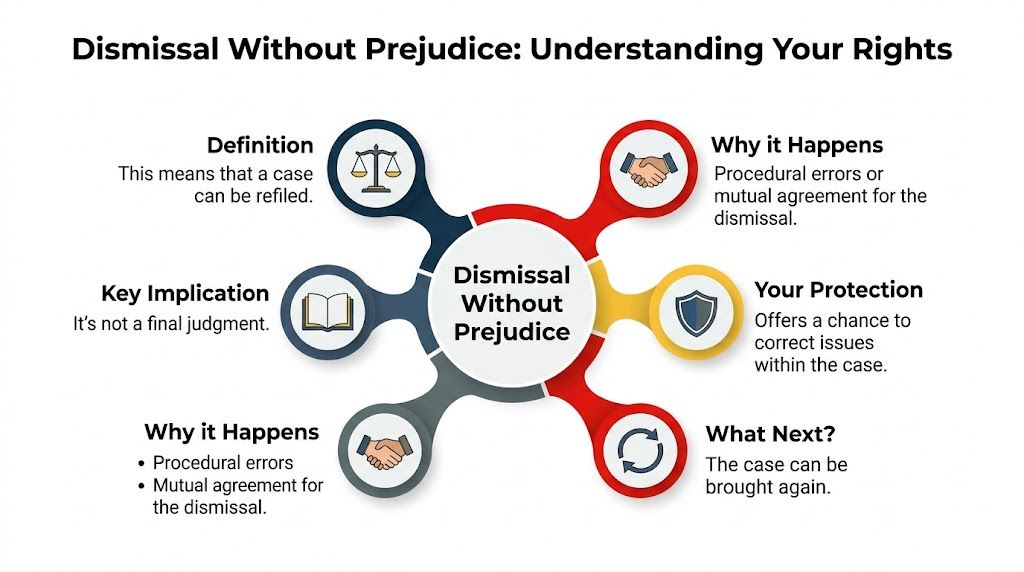
A dismissal without prejudice means the current case is over, but the State keeps the option to file it again.
That’s the clean answer to what does dismissal without prejudice mean.
For a driver, the best analogy is a rain check for the prosecution. They didn’t finish the game. They may try again later.
Why the word dismissed confuses people
Hearing ‘dismissed’ can lead to the impression of a victory.
That’s the mistake.
A dismissal without prejudice is not the same as an acquittal. It is not a finding that you were innocent. It is not a guarantee that the charge is gone for good. It means the current filing ended without finality.
Practical rule: If your case was dismissed without prejudice, act like it can come back tomorrow.
This comes up in traffic and DUI practice when the State isn’t ready, a witness is missing, paperwork has a problem, or a procedural issue blocks the case in its current form.
If you’ve also heard the term nolle pros, that’s related but not identical. If you want that distinction explained in plain English, review this guide on what does nolle pros mean in court.
Where this rule comes from
The broader legal idea has deep roots. Under Federal Rules of Civil Procedure Rule 41(b), the default for involuntary dismissal is generally with prejudice, but courts have discretion to dismiss without prejudice when fairness requires it, according to Cornell Law School’s explanation of dismissal without prejudice under Rule 41(b).
That matters for one reason. Courts treat dismissal language seriously. A judge chooses words that carry consequences.
Here is the practical translation:
Term | What it means for you |
|---|---|
Without prejudice | The State may bring the case again |
With prejudice | The State is barred from refiling the same case on the same grounds |
In Florida traffic court, you shouldn’t celebrate the first result as if you got the second.
The right mindset is defensive. Keep your paperwork. Watch the docket. Assume refiling is possible unless your lawyer confirms the matter is permanently closed.
How Is This Different From a Dismissal With Prejudice
The difference is finality.
A dismissal with prejudice ends the case permanently. A dismissal without prejudice leaves the door open.
One ends the case and one delays it
If your case is dismissed with prejudice, the State doesn’t get a do-over on the same charge based on the same underlying event.
If your case is dismissed without prejudice, you’re in a waiting period. The present case file is dead, but the problem may still be alive.
A quick comparison makes this easier:
Issue | Without prejudice | With prejudice |
|---|---|---|
Current case closed | Yes | Yes |
Can the State refile | Yes, if allowed and timely | No |
Real closure | No | Yes |
Good outcome | Temporary | Permanent |
This is why drivers get blindsided. They hear “dismissed” and stop paying attention. Then a new filing appears.
You want closure, not a postponement dressed up as a victory.
Which result should you want
You want with prejudice. Every time.
That’s the result that gives you real certainty. It’s also the result a strategic defense tries to force when the State has serious problems, repeated failures, or a weakness it can’t cure.
By contrast, a dismissal without prejudice often helps the prosecution more than it helps you. It lets them regroup.
That doesn’t mean it’s useless. Sometimes it creates time and advantage for the defense. Sometimes the State never comes back. Sometimes the weakness that caused the dismissal never gets fixed.
But don’t confuse a tactical opening with a final win.
If you’re deciding how seriously to treat the two outcomes, use this rule. With prejudice means done. Without prejudice means watch your back.
What Are the Dangers of a Dismissal Without Prejudice
The biggest danger is simple. The State gets time to repair a weak case.
That weak case may have had a missing witness, incomplete evidence, or a filing problem. A dismissal without prejudice can give prosecutors room to fix those issues and return stronger than before.

Why prosecutors ask for it
Prosecutors may seek this type of dismissal when they have strategic weaknesses, including witness unavailability or incomplete evidence, and they must still refile within Florida’s statute of limitations. Perlman Cohen explains that this can be 3 to 5 years for misdemeanors in Florida, and if they miss that deadline the case is permanently closed, as outlined in their discussion of what dismissed without prejudice actually means.
That’s good and bad news.
Bad news first. The State may have plenty of time left.
Good news next. Time limits matter. If the prosecution can’t get its act together before the deadline, the case can die for good.
Why legal limbo hurts you
Legal limbo punishes careful drivers and busy professionals alike.
You may still have to explain the situation to an employer. You may still worry about a pending refile. You may delay travel, job applications, or licensing decisions because you don’t know if the case is really over.
Automated apps and ticket mills commonly fail people. They often treat dismissal as an endpoint. A real defense treats it as a changing risk.
If your case involves records in another language, out-of-state witnesses, or documents that need precise legal handling, accuracy matters. When the issue is whether a case being dismissed could later be refiled, translated records and supporting documents need to be exact.
A smart defense uses this waiting period aggressively, not passively. That includes tracking dates, preserving evidence, and identifying whether the State can realistically fix the problem that caused the dismissal in the first place.
For Florida drivers, limitations analysis can be outcome-changing. This overview of the statute of limitations for traffic violations helps show why the calendar matters as much as the courtroom.
How Does This Affect My Florida Traffic or DUI Case
If your Florida traffic or DUI case was dismissed without prejudice, the two biggest mistakes are assuming your record is clear and assuming your license issues stop automatically.
They don’t.
Does it clear my record or stop license problems
In Florida, a dismissal without prejudice in a traffic or DUI case does not automatically clear your record or stop administrative license suspensions. A 2025 Florida Bar report also indicated that 15% of such traffic dismissals are refiled within 6 months, according to the summary discussed by Suhre Law in its article on dismissals with prejudice vs without prejudice.
That’s the part many drivers never hear until it hurts them.
If you were cited under Florida Statute 316.187 for speeding, or you’re facing a DUI-related suspension issue under Florida’s administrative process, the dismissal language in the criminal or traffic file doesn’t automatically fix every downstream problem. Separate agencies, separate records, and separate procedures may still be in play.
A dismissal without prejudice can close one courtroom file while leaving your driving problems very much alive.
Why this hits gig drivers and working professionals harder
If you drive for Uber, Lyft, delivery apps, or you depend on a clean record for a professional license or security-sensitive job, uncertainty is expensive even when no conviction exists.
A case that can be refiled creates a cloud over your livelihood. The case may be inactive, but the risk is active. For some drivers, that’s enough to disrupt work decisions, onboarding, and insurance handling.
This is one reason DUI dismissals need close review. If you’re dealing with that issue specifically, this breakdown of how to get DUI dismissed helps explain the kind of pressure points a defense should examine.
What Florida drivers need to watch next
Florida drivers need to watch more than the dismissal order.
Pay attention to:
Your docket status: Refiling often shows up there before anyone explains it to you.
Your license status: Administrative consequences can move on a different track.
Insurance questions: Uncertainty itself can create problems while the matter remains unresolved.
Speedy trial timing: In Florida misdemeanor practice, timing rules can become a major pressure point if the State tries to reset and proceed again.
This video gives a useful overview before you make assumptions about what your dismissal solved.
If your case was in Tampa at the Edgecomb Courthouse, or anywhere else in Florida, your next step should be practical. Verify what ended, what didn’t, and what deadline now controls.
What Are Common Scenarios for This Type of Dismissal
This issue makes more sense when you see how it happens in real courtrooms.

An officer is unavailable in a DUI case
A DUI hearing is set. The arresting officer doesn’t appear, or a required witness isn’t available.
The State may decide it can’t safely proceed that day. Instead of forcing a bad hearing and risking a stronger defense result, it drops the current case without prejudice and keeps the option to come back.
That is not generosity. It is damage control.
The charging paperwork has a fixable problem
A traffic or criminal filing can contain a defect that matters. Maybe the charging language is wrong. Maybe the paperwork doesn’t line up with the evidence the State wants to use.
If the problem is curable, a dismissal without prejudice lets the prosecution start over cleanly.
Suppression issues often become decisive at this stage. If the underlying weakness is not paperwork but unlawful evidence, the defense should be targeting the evidence itself. This explanation of what is a motion to suppress evidence shows why some defects can’t be solved by mere refiling.
The defense uses time to improve the position
Sometimes a dismissal without prejudice is the least bad option available.
Suppose the State has a witness problem today, but your defense also needs time to secure records, line up testimony, or investigate the stop. A temporary dismissal may create breathing room that later helps force a better outcome.
That doesn’t make the dismissal ideal. It makes it usable.
The right question isn’t “Was it dismissed?” The right question is “Who benefits from this timing?”
Here are three clues to read the situation correctly:
If the State’s problem is temporary, refiling risk is real.
If the weakness is structural, such as bad evidence or a serious constitutional issue, the defense may be in a stronger long-term position.
If the dismissal came after repeated State failures, the path toward a permanent dismissal may get stronger.
The facts behind the dismissal matter more than the label alone.
My Case Was Dismissed Without Prejudice What Should I Do Now
You need a plan immediately.
Not next month. Not when you “hear something.” Now.
Immediate steps to take
Keep every document: Save the dismissal order, hearing notices, citation, bond paperwork, discovery, and any messages from the court or clerk. Don’t rely on memory.
Preserve your evidence: Keep photos, dashcam video, GPS data, rideshare logs, receipts, and witness names. If the State refiles, you’ll want your evidence intact.
Check the court docket: Watch for new activity. Refiling often appears there first.
Confirm your license status: Don’t assume the court result fixed DMV or administrative issues.
Track deadlines: Refiling windows matter. So do hearing deadlines and any administrative timelines tied to your license.
Talk to a defense lawyer quickly: This is the window where strategy matters most. Waiting wastes your advantage.
What not to do
Don’t tell yourself the case is “basically over.”
Don’t toss paperwork. Don’t ignore notices. Don’t plead to a new filing without reviewing whether the State cured the problem that caused the dismissal.
And don’t hand this to an automated app or a middleman who treats your file like a data entry task. You need someone who can read the order, review the facts, and decide whether the State is vulnerable if it tries again.
If you need help evaluating next steps, this page on working with a traffic ticket dismissal lawyer is a good place to start.
A dismissal without prejudice creates opportunity, but only if you use it. Sometimes the right response is to prepare for refiling. Sometimes it’s to push for a better resolution while the State is off balance. Sometimes it’s to build the record for a permanent end.
Your job is not to celebrate early. Your job is to protect your license, your record, and your future.
If you want a lawyer-led Florida defense focused on the No Points goal, contact Ticket Shield, PLLC. You’ll speak directly with your attorney by phone or text, not a chatbot, not a call center, and not a ticket mill. Visit TicketShield.com now for a free consultation.