Super Speeder Law Florida: Florida Super Speeder Law:
Facing charges under the super speeder law florida? Our 2026 guide explains criminal penalties, court process, & how a lawyer can protect your record.

Florida's super speeder law turns extreme speeding into a criminal charge under Florida Statute §316.1922. That means mandatory court, possible jail, license consequences, and a lasting record. If you got cited or arrested, don't treat this like a normal ticket or just pay it.
You know that feeling when a traffic stop changes tone fast.
The officer isn't talking to you like this is a routine citation. You're not hearing the usual script about a fine and moving on. You're hearing words that sound bigger. Court. Criminal. Mandatory appearance. Maybe even arrest.
That panic is justified.
Florida changed the rules. What used to feel like a very bad speeding ticket can now put you into the criminal system. If you were stopped at a speed that falls under the super speeder law florida drivers are suddenly hearing about, you may be dealing with a charge that can affect your job, your license, your insurance, and your record all at once.

It's a common mistake made in the first few hours. They assume this is still something they can handle later, or that it works like every other ticket they've had before. It doesn't. If you need the basic first steps after any citation, review what to do when you get a ticket, then come back to this. A super speeder case needs a faster, more serious response.
Immediate reality: If the officer or paperwork made it clear you have to appear in court, you're not dealing with a simple payable speeding ticket.
The right move now is simple. Take the charge seriously. Protect your silence. Get the facts. Then get a lawyer involved before you make the case harder than it already is.
Table of Contents
What Exactly Is Florida's Super Speeder Law
You get stopped for speed and expect a bad ticket. Then the officer hands you paperwork that can put you in criminal court.
That is what changed in Florida on July 1, 2025, when House Bill 351 created the offense of dangerous excessive speeding under Florida Statute §316.1922. Before this law, extreme speeding was usually handled as a civil traffic infraction. Now, at certain speeds, the case can be filed as a criminal traffic charge.
That shift is the whole story. A civil ticket usually gives you options like paying the fine or contesting the citation through standard traffic procedures. A super speeder charge puts you in a different category from the start. You may have to appear in court. The judge can consider jail. A conviction can follow you as part of your record.
Why this law is different from the ticket you thought you got
Drivers panic because they recognize the word speeding and assume the case works like every other citation they have seen. It does not.
Under this law, the state is no longer treating the allegation as routine traffic business. It is treating it as criminal conduct serious enough to prosecute in court. That gives the prosecution an advantage and puts you at immediate risk if you handle the case like a payable ticket.
For broader context, review these new speeding laws in Florida. Then focus on the part that matters most to you. Super speeder is the point where a speeding stop can expose you to criminal penalties instead of a fine you pay and forget.
What that means for you right now
A charge under §316.1922 can force mandatory court appearances and open the door to jail time. It can also create a permanent record problem that an ordinary speeding citation usually does not create.
If you have received a citation under this law, stop thinking about points and online payment screens. Start thinking about protecting your record, your license, and your freedom. The right response is not delay. It is an immediate defense plan.
What Speeds Trigger a Super Speeder Charge
You get stopped expecting a bad ticket. Then you look closer and realize the alleged speed puts you into a criminal case.
That line is drawn by the charged speed itself. Under Florida Statute §316.1922, effective July 1, 2025, the state can pursue a super speeder charge if it alleges either 50 mph or more over the posted speed limit or 100 mph or more regardless of the posted limit.
The thresholds are simple. The consequences are not.
At this stage, two questions control everything:
Did the officer accuse you of driving 50 mph or more above the posted speed limit?
Did the officer accuse you of driving 100 mph or more?
If either allegation appears on the citation or charging paperwork, your case may be pushed out of the ordinary traffic system and into a criminal one.
That is why the exact number matters so much. A few miles per hour can decide whether you are dealing with a payable infraction or standing in court on a criminal traffic charge. The posted limit matters. The officer's method of measuring speed matters. The wording on the citation matters. If the state cannot prove the threshold speed, it has a real problem.
For background on how Florida speed limits are interpreted, this explanation of what a prima facie speed limit means gives useful context. In a super speeder case, though, the immediate fight is usually narrower. Can the state prove the specific speed that turns a routine stop into a criminal prosecution?
What changes once the alleged speed crosses the line
This is the part drivers miss. Before this law, a speeding stop usually meant a fine, points, and a decision about whether to pay or contest it. Once the alleged speed hits one of these thresholds, the case stops looking like ordinary ticket business.
Here is the practical difference:
Factor | Regular Speeding Ticket | Super Speeder Charge |
|---|---|---|
Offense type | Usually civil traffic infraction | Criminal traffic offense under §316.1922 |
Court appearance | Often handled without mandatory in-person court | Court appearance required |
Jail risk | Generally no jail exposure for ordinary speeding | Jail becomes possible |
Usual resolution path | Payment, traffic school, or standard traffic court procedures | Criminal case strategy and defense |
Record impact | Traffic record consequences | Risk of a permanent criminal record |
Early defense focus | Fine, points, mitigation | Attack the alleged threshold speed and the proof |
That comparison should drive your first decision. Do not treat this like a ticket you can clean up later. Treat it like a criminal charge from day one.
The first defense objective is usually straightforward. Get the allegation below the super speeder threshold, or expose a proof problem that keeps the state from establishing it. In many cases, that is the difference between ordinary traffic exposure and a charge that can follow you well beyond this stop.
What Are the Penalties for a Super Speeder Conviction
Only then do people finally understand how serious the charge is.
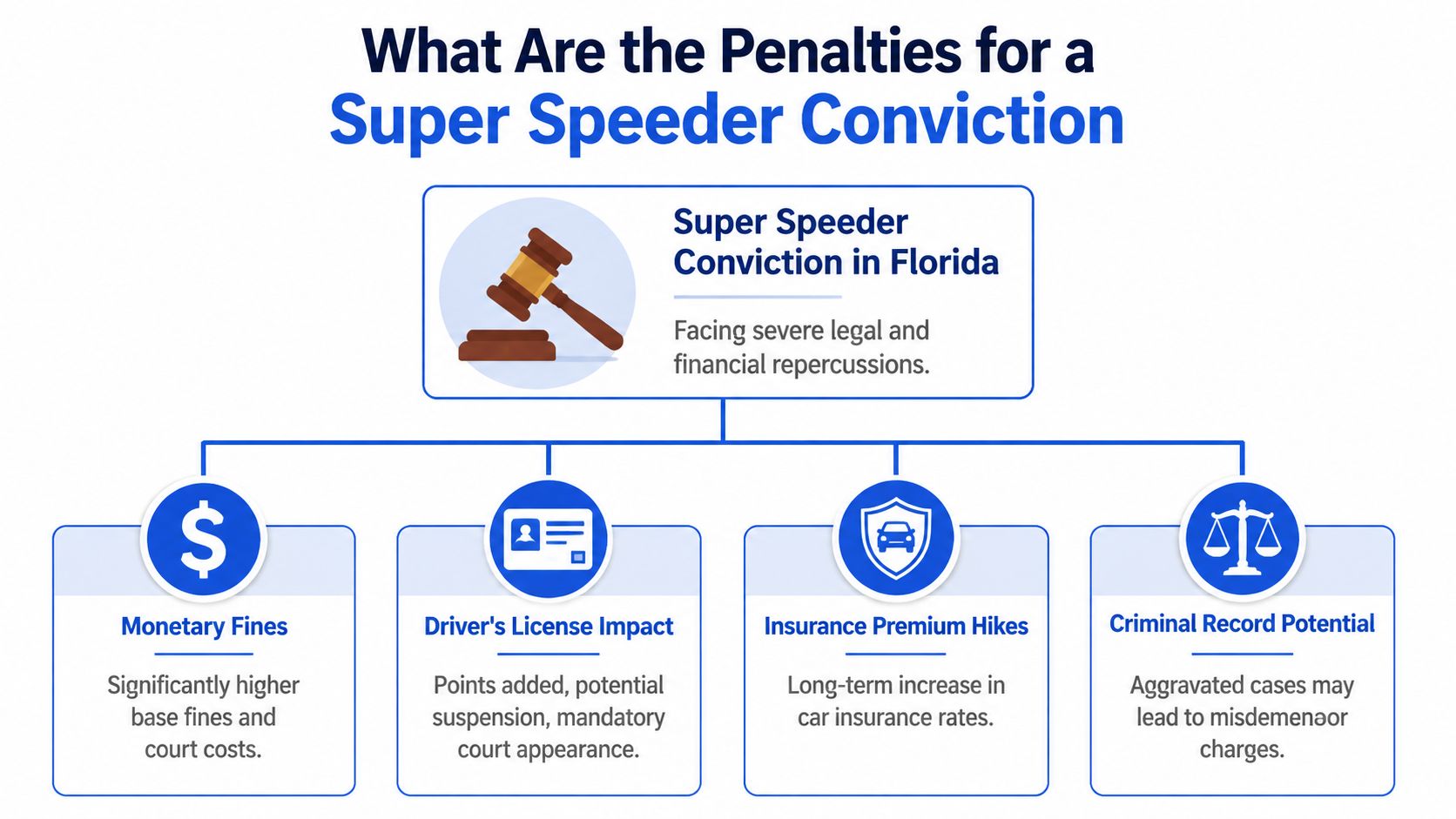
The penalty structure is highly non-linear. A first-offense conviction carries up to 30 days in jail and a $500 fine. A second or subsequent conviction within five years can rise to up to 90 days in jail, a $1,000 fine, and a driver's-license revocation period ranging from 180 days to one year, according to this summary of super speeder penalties in Florida.
The punishment jumps fast
This isn't a smooth progression where the consequences rise a little. They jump.
That matters if you drive for work, hold a professional license, need a clean background, or rely on your car every day. Commercial drivers and people with security-clearance concerns face compounding harm because the case doesn't stop at the courtroom door.
Here's the basic exposure:
First conviction: up to jail time and a financial penalty under the statute summary above
Repeat conviction within five years: significantly more jail exposure, a larger fine, and the risk of losing driving privileges for a substantial period
The state is not treating this like a fix-it ticket. It's treating it like conduct serious enough to justify criminal punishment.
For a quick visual explainer, watch this short overview:
The real damage happens outside the courtroom
The fine is often the smallest part of the problem.
A conviction can disrupt employment. It can threaten a rideshare or delivery account. It can create underwriting trouble with your insurer. If you drive a work vehicle or manage a fleet, it also helps to understand the basics of commercial auto insurance coverage types because employers and insurers often review driving-related risk differently when a criminal traffic case appears.
You should also understand how Florida handles driving records generally. This guide to the Florida license point system gives useful background, but a super speeder case is more serious than a points conversation alone.
Your goal should not be “get a lower fine.” Your goal should be “avoid a criminal conviction if at all possible.”
That's the right mindset. When clients focus only on today's court date, they miss tomorrow's insurance renewal, employer background check, and license problem.
What Happens After You Get a Super Speeder Ticket
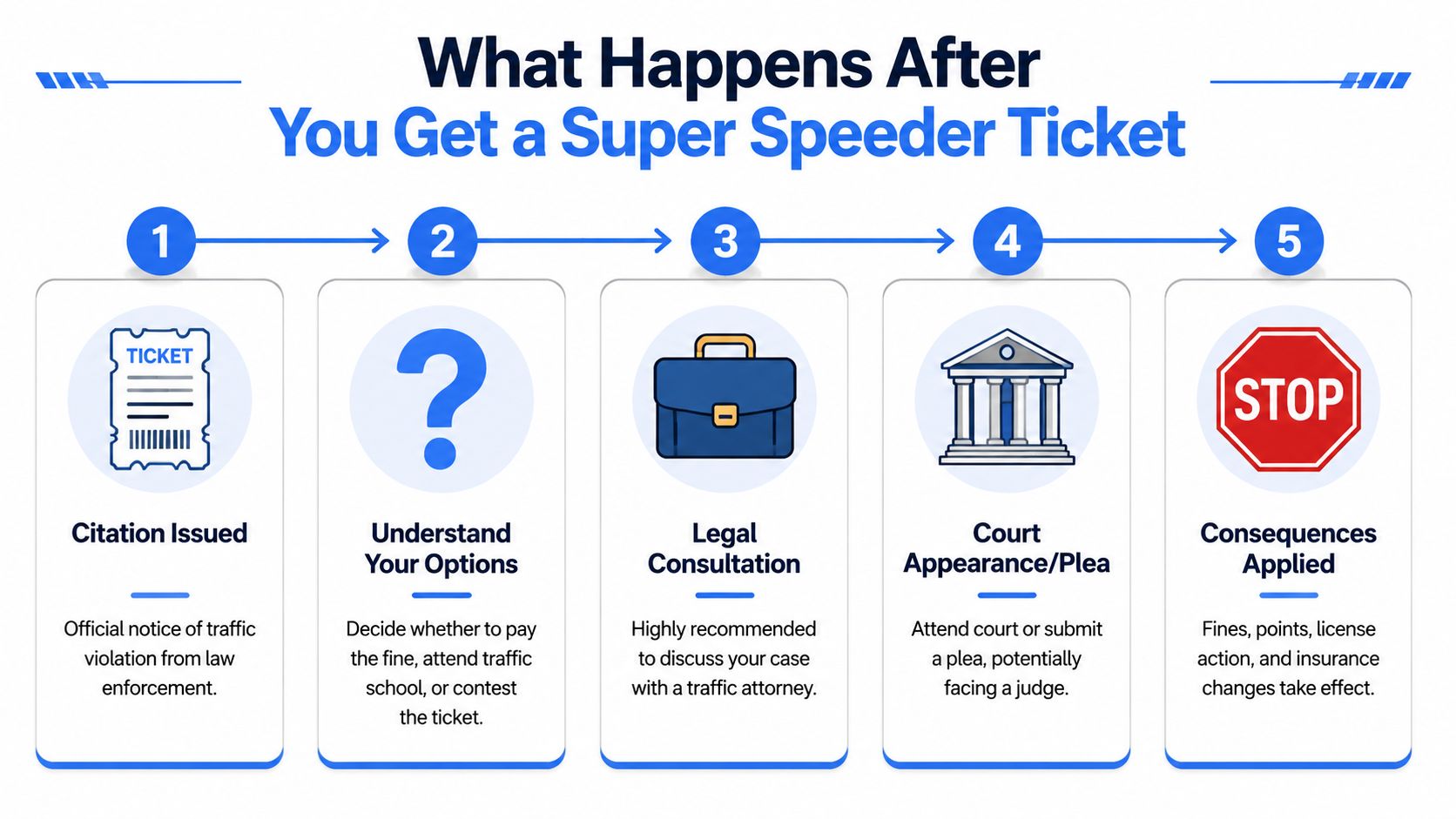
The paperwork you receive after the stop may look like a ticket, but the process doesn't behave like one.
Outcomes in these cases vary. One Florida news review found super speeder cases ending in jail time, fines, and at least one jury acquittal, according to this report on how super speeder cases are resolved after arrests. That matters because you should not assume your result is automatic. Good cases can be reduced. Weak state evidence can be challenged. Bad handling on your side can also make things worse.
What your paperwork usually means
In many cases, you're not holding a normal ticket with a simple payment option. You're dealing with notice of a criminal traffic court process.
That means you need to read every line. Look for the court date, location, and charge description. If your case is in Miami-Dade, for example, you may find yourself dealing with proceedings tied to the Richard E. Gerstein Justice Building. In Orlando, serious traffic matters may place you at the Orange County Courthouse. The location matters less than the rule behind it. Missing criminal court is dangerous.
A few immediate truths:
Your court date is not optional
Your words can be used against you later
The officer's measurement method may become a key issue
Early legal action gives your lawyer more room to work
Why the first court date matters so much
The first appearance sets the tone. It affects scheduling, negotiations, and how fast the defense can begin demanding evidence.
Some drivers hurt themselves before court even starts. They call around and explain too much. They post online. They tell the prosecutor or clerk they were “definitely speeding, just not that fast.” That kind of admission can close doors.
Go quiet. Save every document. Write down what happened while it's fresh. Then let your lawyer do the talking.
If you're from out of state, don't make the mistake of thinking a Florida criminal traffic charge disappears because you live elsewhere. It doesn't. The court still expects a response, and the consequences can follow you.
How to Defend Against a Super Speeder Charge
You defend this case by attacking proof, procedure, and classification. You do not defend it by hoping the judge sees you as a decent person and shrugs it off.
The best early defense question is blunt. Can the state really prove the speed that triggers §316.1922? If the answer gets shaky, the case gets more manageable.
Immediate steps to take
Do these now:
Stop talking about the facts of the stop. Don't explain yourself to police, friends, insurance, or social media.
Preserve every document. Citation, notice to appear, bond paperwork, towing records, screenshots, dashcam clips, and texts about where you were going.
Write down the stop from memory. Weather, traffic, lane position, what the officer said, whether pacing or radar was mentioned, and whether other cars were nearby.
Check the court date immediately. Put it in your phone, calendar, email, and paper planner.
Get legal review fast. These cases can turn on technical details that are easier to challenge early.
Where strong defenses usually start
A real defense is specific. It usually begins with the speed evidence itself.
Common issues include:
Radar, laser, or LIDAR proof
The defense may examine how the speed was measured, whether the device was properly maintained, and whether the reading can reliably be tied to your vehicle.Pacing evidence
If the officer used pacing, the details matter. Traffic conditions, distance, consistency, and identification can all matter.Driver identification
In a cluster of vehicles, the state still has to connect the alleged speed to the correct driver and car.Threshold reduction strategy
Sometimes the fastest route to protecting your record is not winning every argument. It's forcing the state off the super speeder threshold so the case no longer fits the criminal charge as filed.
If you want a broader overview of common speed-ticket defenses, review how to beat a speeding ticket in Florida. Then understand the difference here. A super speeder case is less forgiving and more technical.
This is also where lawyer access matters. A criminal traffic charge is not something you should hand to an automated app or a ticket mill built around intake staff and chatbots. Ticket Shield, PLLC is a lawyer-led Florida firm where clients communicate directly with their attorney by phone or text. That matters when the issue is not just points, but court strategy, exposure, and record protection.
Do Not Face a Criminal Charge Alone
A super speeder charge changes the stakes the moment it is filed. What used to be a traffic ticket you could pay and move on from now puts you into criminal court, with a judge, a court date, and a record that can follow you long after the stop itself.
That mindset shift matters. Panic leads people to make bad decisions. They pay what they can pay, miss what they cannot miss, and assume this will work like an ordinary speeding citation. It will not. A criminal traffic case demands a defense plan from the start, because early mistakes can box you into worse outcomes later.
Your job is simple. Treat the charge seriously, protect your record, and get a lawyer involved before the first court date. The goal is not just to argue about speed. The goal is to keep this from becoming the kind of case that affects your job, your license, your insurance, and every background check that comes after it.
That is the practical difference under Florida Statute §316.1922. You are no longer dealing with a routine civil infraction. You are dealing with criminal exposure.
If your goal is No Points, no criminal record if it can be avoided, and the strongest possible chance at a reduction or dismissal, visit Ticket Shield, PLLC now for a free consultation. You'll speak directly with a lawyer, not a middleman, and you can get clear guidance before this charge gets harder to fix.