Florida's New Speeding Laws: What You Need to Know Now
Confused by Florida's new speeding laws? Our expert guide explains the updated penalties, fines, and points to protect your license. Don't just pay that ticket.
You looked down for a second, saw the lights, and told yourself it's probably just a fine. That old mindset can cost you your license, your record, and a lot more money than the ticket itself.
Florida drivers need to treat speeding cases differently now. If you still think paying and moving on is the safe choice, you're already behind.
Table of Contents
Your Guide to Florida's New Speeding Laws
TL;DR: Florida's new speeding laws make a ticket more dangerous than most drivers realize. You're not just risking a fine. You may be risking points, suspension, mandatory court, and serious insurance damage. Treat every speeding charge like a license-protection issue from day one.
A lot of drivers are finding out about the new speeding laws the worst way possible. A stop on the way to work. A citation in a school zone. A court date they didn't expect. A notice that paying the ticket means accepting points.
That's the new reality. Speeding isn't a throwaway offense anymore, especially when the facts suggest aggressive driving, excessive speed, or a pattern the court doesn't like. If your case touches Florida Statute 316.187, 316.183, or related provisions in Chapter 316, you need to think strategically from the start.
The old rule was simple. Pay the fine and move on.
The new rule is different. Protect your record first. Then deal with the citation.
Practical rule: If a speeding ticket could affect your license, your insurance, your CDL, your rideshare account, or your clearance, it's not a minor problem.
Florida courts already took traffic cases seriously. What's changing is how much more exposure certain speeding allegations now create in practice. One bad decision at the roadside, one careless plea, or one missed deadline can make a manageable case much worse.
If you're trying to sort out how recent traffic changes fit into the bigger picture, review these new Florida driving laws. Then focus on your own case facts. That's what matters most.
Why you need to act fast
Drivers lose the advantage when they wait. Evidence gets harder to challenge. Deadlines close. Court options narrow. Insurance consequences become harder to avoid once points hit your record.
Take the ticket seriously the same day you get it. That isn't paranoia. It's how you protect your license.
What Exactly Has Changed in Florida Speeding Laws
Florida is moving away from treating every speeding case like a routine civil infraction. Under Chapter 316, including Florida Statute 316.187, speed violations still start with the officer's allegation. But newer enforcement and legislative changes mean some cases now carry much sharper consequences, especially at the high end.
That matters in real courtrooms. Judges at places like the Richard E. Gerstein Justice Building in Miami don't look at serious speed allegations as harmless paperwork. They look at the risk created by the driving.
Why the old approach no longer protects you
The biggest mistake drivers make is assuming all speeding charges are interchangeable. They aren't.
A lower-level speeding citation may stay in the ordinary traffic lane. A more serious excessive-speed allegation can push you into a mandatory court appearance, more aggressive prosecution, and much more pressure to plead quickly. That's where drivers hurt themselves.
Florida's speed laws already gave law enforcement broad authority to cite unsafe speed under Section 316.183, even when a driver thinks the posted limit is the whole story. Courts don't just ask, “How fast were you going?” They also ask whether your speed was reasonable under the circumstances.
If the officer writes the case in a way that sounds dangerous, the legal risk changes immediately.
That's why the label on the citation matters. So do the notes, the roadway conditions, and whether the officer described traffic, weather, or surrounding vehicles.
What Florida Statute Chapter 316 means for you
Florida drivers should pay close attention to three practical changes in the new speeding laws.
Higher exposure for extreme speed allegations: Some speeding conduct now gets treated as far more than a payable ticket. If the facts suggest very high speed or danger to others, you may be dealing with a criminal-style problem, not just a traffic problem.
Less room for casual fixes: Cases that once might have been handled by payment alone may now require a court appearance or a targeted legal response.
More downstream consequences: Even where the charge itself looks familiar, the damage to your record can ripple into work, insurance, and future stops.
If you want a closer look at how Florida is handling excessive speed allegations, read this breakdown of Florida's new super speeder law and HB 351.
Here's the practical bottom line. Florida hasn't “updated traffic fines” in a vacuum. It has changed the risk profile of speeding cases. For some drivers, a bad stop now threatens far more than money.
How Do The New Fines and Points Affect Your License
Most drivers obsess over the ticket amount. That's usually the wrong focus.
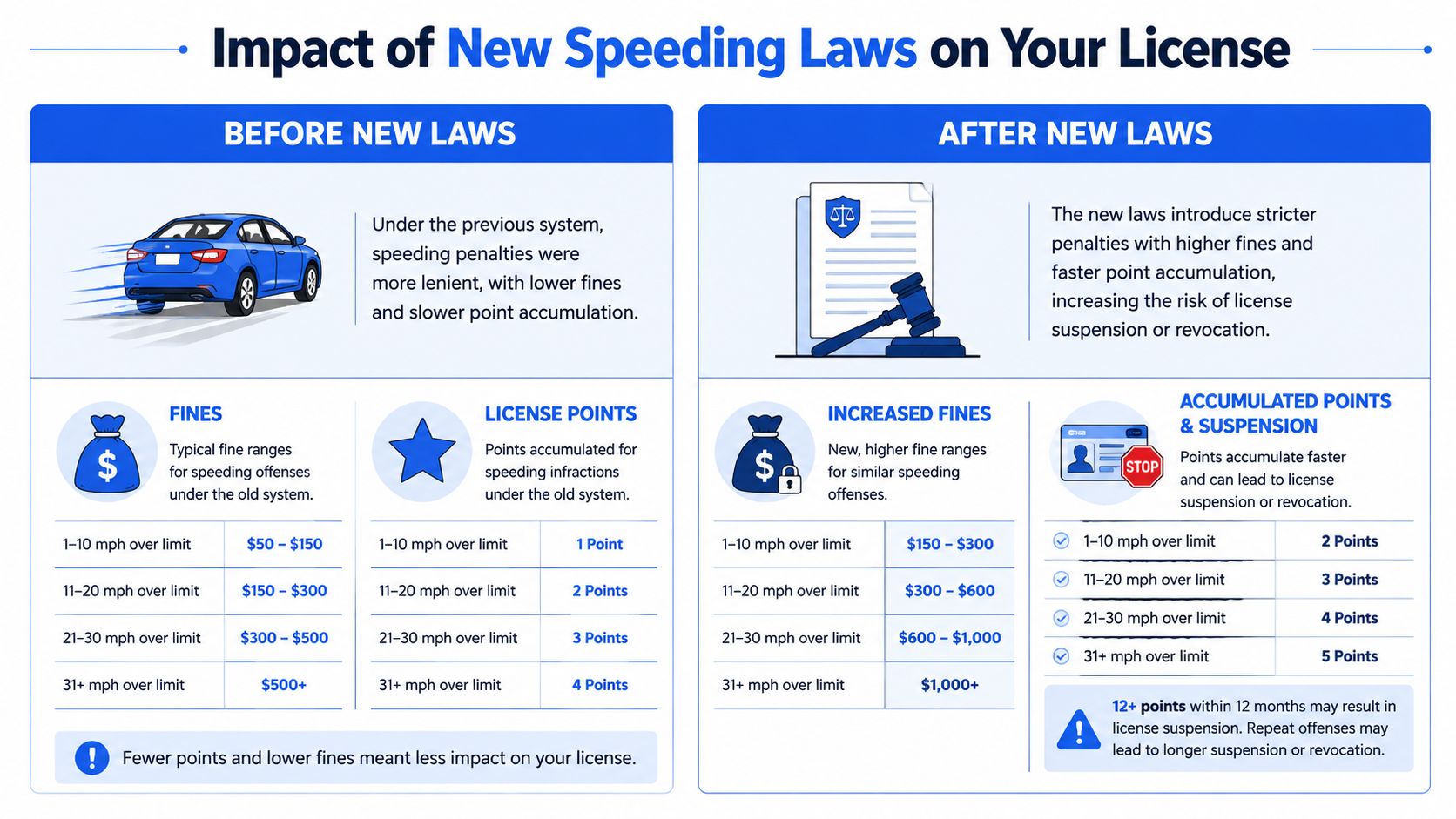
The primary threat is what the ticket does to your driving privilege. Points can trigger school requirements, put you closer to suspension, and signal to insurers that you're a higher-risk driver. Once that happens, the financial damage often outlasts the citation itself.
At the Broward County Judicial Complex in Fort Lauderdale, many drivers realize too late that “just paying it” was the expensive choice.
Why points matter more than the ticket itself
Florida's system punishes accumulation. One speeding case might seem manageable. Add another stop, a school-zone issue, or a more serious allegation, and you can find yourself dealing with a license problem instead of a simple citation problem.
That's why smart drivers ask different questions:
Will this put points on my record
Can I keep this off my driving history
Will this trigger a suspension path
Does this require court instead of payment
Those are the right questions. The posted fine is only part of the problem.
For a fuller explanation of how Florida tracks traffic consequences, review this guide to points on your Florida license.
Florida Speeding Penalties Old vs New
The comparison below stays qualitative where county-by-county fine schedules or court outcomes vary. That's the honest way to look at it.
Violation (MPH Over Limit) | Old Penalty (Approx. Fine/Points) | New Penalty (Approx. Fine/Points) |
|---|---|---|
Lower-level speeding | Usually treated as a standard traffic citation with possible points | Still may begin as a citation, but drivers face greater pressure to protect against points and record damage |
Moderate speeding | Fine-focused mindset, many drivers simply paid | More risk if the facts involve zones, surrounding traffic, or officer descriptions of unsafe driving |
High-speed allegation | Serious traffic case | Can move into much harsher territory, including mandatory court and more severe exposure |
Extreme speed allegation | Dangerous but often misunderstood by drivers | Far greater legal risk, possible criminal consequences, and stronger license threats |
Important: The “new” part isn't just money. It's that some speeding behavior now creates a different category of legal danger.
Immediate steps to take
Check the citation language: Look for wording tied to excessive speed, reckless behavior, mandatory appearance, or court date requirements.
Don't prepay blindly: Payment can amount to an admission and may lock in points.
Preserve your facts: Save dashcam footage, navigation history, and anything showing road, traffic, or visibility conditions.
Review your driving record: Existing points change your risk immediately.
Get legal advice early: The first decision often does the most damage.
Are Speed Cameras Now Enforcing Speed Limits
Florida drivers hear a lot of noise online about speed cameras. Most of it is sloppy, recycled, or flat-out wrong.
Right now, you should be very careful about assuming that every new enforcement trend from other places applies here. It doesn't. Florida traffic defense still turns on Florida statutes, the actual citation issued, the officer's basis for the stop, and whether the evidence holds up under challenge.
At the Edgecomb Courthouse in Tampa, no one wins a speed case by arguing with internet rumors.
What Florida drivers keep getting wrong
Drivers often mix up red-light camera enforcement with automated speed enforcement and assume they're the same. They're not the same issue. They don't raise the same legal questions. And they shouldn't be defended the same way.
Some states have moved into camera-based speed enforcement with structured pilot systems and posted warning rules. One example outside Florida involves cities using automated enforcement beginning at 11 mph over the posted limit, with a $50 baseline fine, warning periods, mandatory signage, and appeals procedures through January 1, 2032, as described by CalMatters' report on California's traffic law changes. That is useful as a warning about where traffic enforcement is heading generally.
It is not a substitute for reading Florida law.
If you're already dealing with a camera-based allegation of any kind, start with a defense-focused review of how to fight a speed camera ticket.
What evidence still matters in court
Even when technology plays a role, Florida cases still come down to proof. That includes:
Who observed the violation
What device was used
Whether the equipment was working properly
How the driver and vehicle were identified
Whether the stop and citation match the statute charged
A weak case can still produce a strong-looking ticket. Don't confuse the paper with the proof.
Courts care about admissible evidence, not gadgets. If the evidence chain is weak, the case may be weaker than it looks.
That's why speed cases need individual review. The right defense may involve the stop, the pacing method, the radar foundation, the officer's vantage point, or the mismatch between what was alleged and what can be proven.
Do Special Rules Apply to Your Driver Profile
Yes. The same ticket can hurt different drivers in very different ways.
A commuter may be worried about insurance. A CDL holder may be worried about employability. A rideshare driver may be worried about account status. A service member may be worried about command scrutiny or clearance headaches. A motorcyclist may be dealing with an officer narrative that paints lawful movement as aggressive.

Commercial and gig drivers face job risk fast
If you drive for a living, the new speeding laws hit harder.
A CDL driver doesn't have the luxury of treating a citation as background noise. Employers review records. Safety departments look for patterns. A single bad result can affect route assignments, internal discipline, or continued work.
Gig drivers face a different problem. App-based platforms may react to citations or driving-history changes in ways that leave the driver with fewer options and less income stability. You may beat the criminal risk and still suffer a work problem if you mishandle the traffic side.
Use a strict checklist after any stop:
Get the exact charge right: Don't summarize it from memory. Read the statute number.
Protect your work records: Screenshot app status, trip data, and schedule history if driving is part of your income.
Move before deadlines: Waiting can close off options that would've kept the matter quieter and cleaner.
Military members and motorcyclists need a different defense mindset
If you're active-duty military or a veteran in a sensitive role, your concern isn't only the court. It's the paper trail. Any allegation that suggests reckless judgment can become a professional headache long after the ticket date.
Motorcyclists face another issue. Officers often write narratives that emphasize speed, lane movement, noise, or rider behavior in ways that make the case sound worse on paper than it was in real life. That can poison negotiations unless someone challenges the framing early.
A traffic citation doesn't live in a vacuum. For some drivers, it becomes an employment issue before it becomes a court issue.
The defense strategy should match the driver profile. That means the right result isn't always just “reduced fine.” Sometimes the primary goal is no points, no damaging wording, no avoidable appearance, and no record entry that creates future trouble.
How Can A Lawyer Shield You from These Consequences
The fastest way to make a speeding case worse is to treat it like paperwork. Drivers do that every day. They pay online, miss a court requirement, say too much, or assume traffic school fixes everything.
Sometimes it doesn't.
At the Orange County Courthouse in Orlando and courts across Florida, the drivers who protect themselves best are usually the ones who act before the case hardens into a record problem.

The wrong response makes the case harder
A lawyer's job in a speeding case isn't magic. It's strategy.
That strategy may include examining whether the stop was sound, whether the speed evidence is reliable, whether the charge fits the facts, whether mitigation helps, whether a withhold is possible, whether court appearance rules can be managed properly, and whether the case can be positioned for a no-points outcome.
The right lawyer also spots the hidden danger fast. That includes cases where a routine citation is drifting toward a reckless-driving narrative, or where a driver is about to plead into consequences they didn't understand.
Common mistakes to avoid:
Paying first and asking questions later: That can end the case in the worst possible way.
Assuming every lawyer handles traffic defense the same: They don't.
Using a one-size-fits-all service: Traffic cases turn on details. Generic processing misses details.
Ignoring the insurance angle: Even when no one can promise the future cost, drivers know record damage often follows them.
Direct attorney access beats automated handling
Drivers need to be blunt with themselves. If your license matters, don't hand the case to an automated app, a call-center pipeline, or a ticket mill built on middlemen.
You need to talk to an actual lawyer handling your defense. By phone. By text. Directly.
That matters because speeding cases move quickly. Questions come up quickly too. Should you appear? Should you bring records? Is the wording on the citation a red flag? Is this still a civil matter or turning into something worse? A chatbot won't protect you when the facts shift.
If you want to understand what lawyer-led representation looks like in traffic court, review these Florida traffic ticket lawyer insights.
One more warning. Other states are already experimenting with much faster and more automated consequences. For example, California's DMV can separately review 100+ mph citations and impose administrative license action independent of a conviction, and the state reported nearly 33,000 speed-related citations with over 1,100 above 100 mph during the first six months of that pilot, according to the California DMV's FAST pilot announcement. Florida drivers should read that as a signal. Enforcement gets tougher before it is generally known.
The safest move is simple. Treat speeding charges early. Fight smart. Protect the record before the damage lands.
If you want a No Points outcome and direct access to a real attorney, visit Ticket Shield, PLLC for a free consultation. This is a lawyer-led Florida defense firm. You speak directly with your attorney by phone or text, not a middleman, not an automated app, and not a chatbot.