Florida's Super Speeder Law: What Happens Now?
Cited under Florida's new Super Speeder Law? A conviction is a criminal offense. Learn the penalties and how a dedicated attorney can protect your record.

If your speed crossed Florida’s super speeder law threshold, this is not a normal ticket. Under Florida Statute § 316.1922, you may be facing a criminal traffic charge, a mandatory court date, possible jail, license trouble, and serious insurance fallout. Act now.
You were probably expecting a bad ticket. Maybe a fine. Maybe points.
Then the officer tells you to sign a criminal citation, or worse, puts you in handcuffs. Your stomach drops because this suddenly feels very different. It is.
Florida changed the rules. Under Florida Statute § 316.1922, extreme speeding can be treated as a criminal misdemeanor, not just a payable infraction. That means your next move matters. If you handle this like a regular speeding ticket, you can make a bad situation much worse.
Table of Contents
What Happens When a Speeding Ticket Becomes a Crime?
When an ordinary traffic stop turns into a criminal case, the pressure changes instantly. You’re not dealing with a clerical fine anymore. You’re dealing with a court file, a prosecutor, and a judge.
Florida officers now have on-scene arrest authority for super speeder violations. Real arrests have already been reported for 120 MPH on I-95 in Miami-Dade and 155 MPH on I-4 in Orange County, as discussed in this Florida super speeder law enforcement overview. That tells you exactly how law enforcement is approaching these stops.
Why this stop feels different immediately
The first sign is procedural. You may be told you have to appear in court. You may be booked. You may be released with a criminal citation instead of the kind of ticket drivers usually pay online and forget.
At that point, you need to understand what a criminal traffic violation in Florida means. It means the state can treat your speed as conduct serious enough to justify a criminal filing under Chapter 316, not just a civil penalty.
Practical rule: If the officer said court is mandatory, stop thinking like a consumer handling a bill. Start thinking like a defendant protecting your record.
What you should assume from day one
Assume everything connected to your driving history is now at risk. Your license. Your insurance. Your job if you drive for work. Your background checks if your employer cares about criminal traffic cases.
You should also assume the prosecutor will rely heavily on the officer’s speed evidence unless someone forces a close review of it. That review doesn’t happen automatically. Courts don’t audit radar or lidar records for you.
If your stop happened near Orlando, that case may land at the Orange County Courthouse, where the difference between a prepared defense and a rushed plea can be severe. Criminal traffic cases move fast, and drivers who wait usually give away options they could have preserved early.
What Are the Super Speeder Thresholds and Penalties?
You can cross into criminal territory faster than most drivers realize. A few extra miles per hour on the wrong road, one hard pass, one empty stretch at night, and you are no longer dealing with a ticket you pay on an app.
What speed triggers the charge
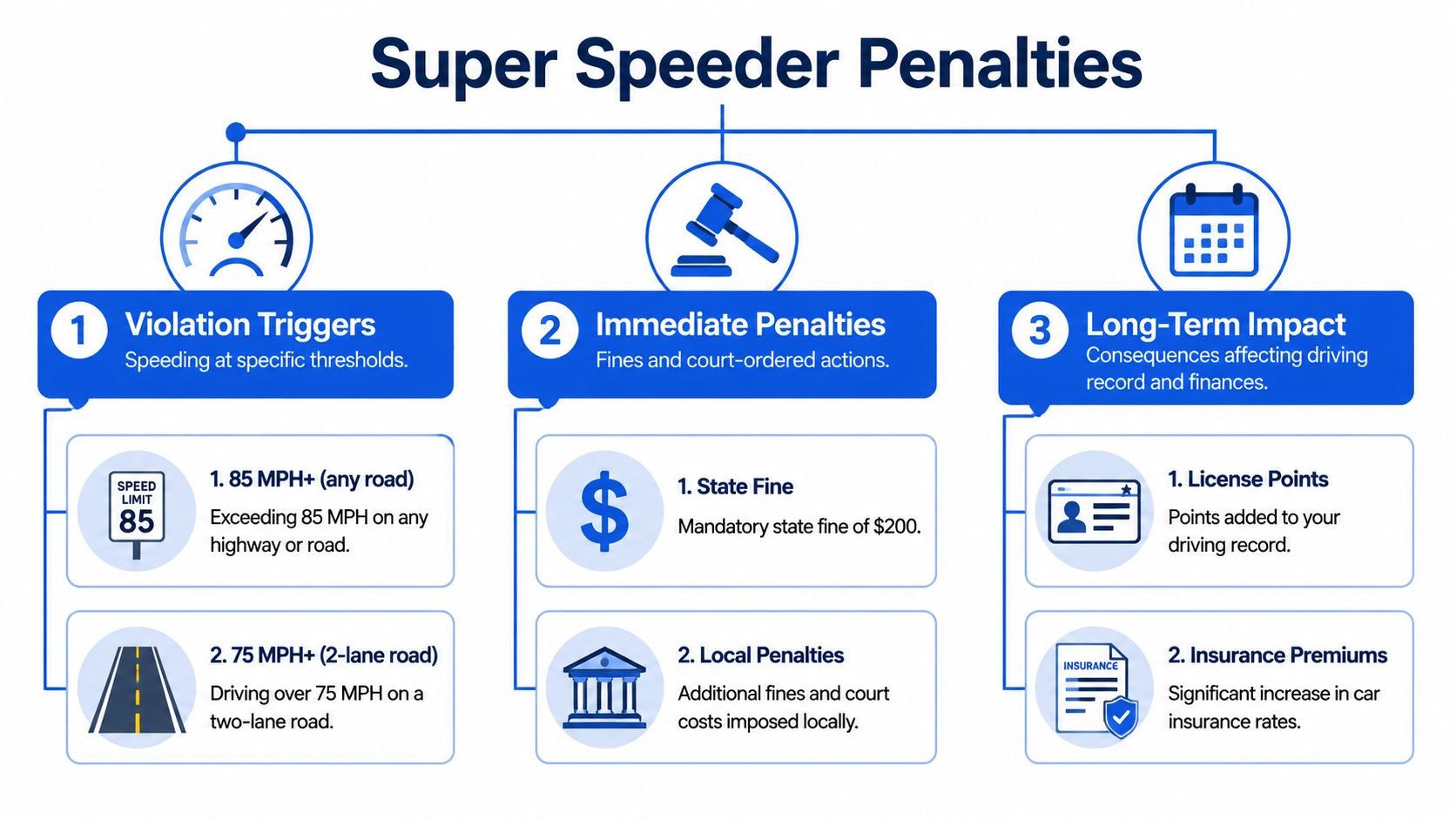
Under Florida Statute § 316.1922, prosecutors can file this charge if you:
Drive 50 MPH or more over the posted speed limit
Drive 100 MPH or more, regardless of the posted limit
Those are the two trigger points. If your citation hits either one, treat it like a criminal case from day one. Our Florida super speeder law guide explains how Florida uses this statute to prosecute extreme speeding as a misdemeanor offense.
What the court can do to you
This charge puts you in criminal court. That means a mandatory appearance, misdemeanor exposure, fines that can start at $500, and up to 30 days in jail for a first offense under the statute. A repeat offense raises the stakes even higher.
Here is the practical breakdown:
Issue | What it means for you |
|---|---|
Criminal charge | The case goes through the court system like a misdemeanor, not a standard traffic payment portal |
Mandatory court | You or your lawyer must address the charge before a judge |
Jail exposure | Sentencing is on the table if the case is not resolved correctly |
Financial penalties | The court can impose significant fines and court costs |
License consequences | Your driving privileges can be affected depending on the outcome and your record |
Apps are built for convenience. This charge is built for court. An automated service cannot cross-examine an officer, challenge a speed reading, negotiate with a prosecutor, or stand next to you when the judge is deciding what happens to your record.
Act accordingly. If you plead guilty before the evidence is examined, you make the prosecutor’s job easy and your own problem harder.
How Will a Conviction Impact Your License and Insurance?
You leave court thinking the worst part is over. It is not. A super speeder conviction can keep costing you for years through insurance increases, record checks, and job-related consequences that a simple payment app will never warn you about in time.
Why your driving record becomes a financial problem
Insurance companies treat criminal-speeding behavior as a serious risk issue. That usually means higher premiums, harder renewals, fewer carrier options, and more scrutiny every time your policy comes up for review.
For a baseline, review this breakdown of the insurance increase after a Florida speeding ticket. A super speeder conviction can hit harder because the case carries criminal exposure and creates a record that looks worse than an ordinary moving violation.
Your license record also gets more dangerous in practical terms. Future stops are judged against that history. Prosecutors see it. Judges see it. Employers and licensing boards may see it too.
Why gig drivers and licensed professionals get hit fast
If you drive for rideshare, delivery, or courier apps, a criminal traffic conviction can interfere with your income almost immediately. These companies use automated background and safety reviews. They do not appear in court for you, challenge the officer, or explain the case to a judge before your account is flagged.
That is the problem with trusting an app to solve an issue that can damage your ability to keep working. Florida’s super speeder law creates a court problem first, then a record problem, then an income problem.
The same pressure applies to people in security-sensitive jobs, positions that require a clean driving history, and roles subject to periodic employer screening. A conviction can become the fact that follows you into the next stop, the next application, and the next policy renewal. If your case is pending in Central Florida, those consequences can feel very real by the time you are standing in or around the Orange County Courthouse trying to explain why this was “just speeding.”
A short video may help you understand how quickly a traffic case can turn into a larger record problem:
What Are Your Legal Defenses Against This Charge?
A criminal speeding charge is won or lost in the file, not in your explanation on the roadside. Drivers get into trouble when they assume the officer’s speed reading ends the case. It does not. These charges often look airtight during the stop and much less convincing once the records are pulled and examined.
The first move is simple. Get the evidence. Fast.
A real defense starts with the state’s proof. That means the radar or lidar records, the officer’s training history, the citation details, video, dispatch timing, and the legal basis for the stop. If any part of that chain is weak, the charge may be reduced, excluded, or dismissed. If you want a broader look at how lawyers challenge speeding ticket evidence in Florida, start there. Then understand the stakes here are higher because this is a criminal case with court dates and record consequences.
Where the state’s speed evidence often breaks down
Speed cases fail for specific reasons. The device may have missing or outdated maintenance records. The officer may lack current certification or may have used the equipment outside proper procedure. The wrong vehicle may have been tracked in heavy traffic. The stop itself may rest on facts that do not hold up once video and reports are compared.
That is why early document review matters so much. Officers issue citations. Judges decide whether the evidence is admissible and whether the state has proved the charge.
What a real defense file should target early
Your lawyer should be checking these issues immediately:
Was the radar or lidar properly maintained and documented? Missing, incomplete, or stale records can damage the state’s case.
Was the officer trained and current on the device used? Certification and compliance problems matter when speed is the central fact.
Did the officer identify the correct vehicle? Multi-lane traffic, distance, angle, and roadside confusion create real errors.
Was the stop lawful from the start? A weak stop can undermine everything that came after it.
Does the video match the report and citation? Inconsistencies create an advantage in negotiations and at hearing.
Keep your mouth shut on the shoulder. Save your defense for court.
Some cases also involve pacing problems, weak visual estimates, bad weather, obstructed views, or necessity facts that need to be framed carefully and backed with evidence. The right strategy depends on what the file shows. Apps do not do that work. A lawyer does.
Why Do You Need an Attorney Instead of an App?
An app is built for convenience. A criminal traffic case is built for confrontation.
An app can’t defend a criminal case
Within the first ten months of the law, the Jacksonville Sheriff’s Office issued 46 super speeder citations and made 13 arrests, while St. Johns County charged over 60 people, according to this report on early Florida super speeder enforcement. Enforcement is active. Real agencies are filing real criminal cases.
A phone app can’t stand next to you at the Richard E. Gerstein Justice Building in Miami or argue a motion in front of a judge. It can’t cross-check officer records, negotiate directly with a prosecutor, or make strategic decisions based on the local court’s tendencies.
It also can’t tell the difference between a case that needs a fast negotiated reduction and a case that should be challenged aggressively on the evidence. That judgment comes from a lawyer.
What direct attorney access changes
When you hire counsel for a charge like this, you need direct communication. Not a chatbot. Not a case manager relaying messages. Not a middleman reading from a script.
A lawyer-led defense matters because criminal traffic cases change quickly. Court dates move. Discovery issues come up. Prosecutors make offers that require real legal judgment. If you can’t reach the person who is defending you, you’re exposed.
One option Florida drivers use is Ticket Shield, PLLC, a lawyer-led firm where clients communicate directly with their attorney by phone or text. That model fits criminal traffic defense far better than automated apps or ticket mills because the work involves legal strategy, not just intake.
If your case carries a mandatory court appearance, you need a lawyer, not a workflow.
Take Action to Protect Your Driving Record Now
You don’t need more panic. You need a plan.
A super speeder charge under Florida Statute § 316.1922 is the kind of case where delay costs you advantage. Waiting usually means missed deadlines, lost evidence opportunities, and bad early decisions.
Immediate steps to take
Save every document: Keep the citation, bond paperwork, court notice, tow paperwork, and any release papers in one place.
Write down the stop: Record the road, traffic conditions, what the officer said, whether other cars were around, and anything unusual about the speed reading.
Do not plead guilty quickly: Fast resolutions often feel efficient, but criminal traffic consequences can outlast that moment.
Do not rely on an app: Automated systems are built for volume. Your case needs legal analysis.
Get your case reviewed promptly: You can submit your matter through the Florida traffic case intake form so counsel can evaluate the charge before your options narrow.
What your goal should be
Your goal is not to “just get it over with.” Your goal is to avoid the worst outcome possible. That means fighting for a result that protects your record, limits insurance damage, and avoids points if the facts and procedure support that path.
If your hearing is in Tampa, that urgency follows you straight to the Edgecomb Courthouse. If it’s in Fort Lauderdale, the same applies at the Broward County Judicial Complex. Different courtrooms. Same problem. A criminal-speeding charge is not self-solving.
You don’t need slogans. You need defense.
If you’ve been charged under Florida’s super speeder law, get legal help now. Visit Ticket Shield, PLLC for a free consultation focused on the goal that matters most: No Points.