
Florida Super Speeder Law: Fight Your Charge
Charged under Florida's Super Speeder law? Know the impact on your license & insurance. Get a strategic defense from an experienced attorney today.

A Florida Super Speeder charge is a criminal case, not a simple ticket. If you're accused of driving 50+ MPH over the limit or 100+ MPH or more, you face mandatory court, serious fines, and possible jail under Florida law.
You got pulled over. The lights hit your mirror. The officer walked up, took your license, and the conversation changed fast. You expected a bad speeding ticket. Instead, you may have been handed a criminal citation, or arrested, for a Florida Super Speeder charge.
That changes everything.
You are no longer dealing with something you can casually pay online and forget. You are dealing with a criminal traffic offense that can put you in front of a judge in a courthouse like the Orange County Courthouse in Orlando. Your license, your record, your insurance, and in some cases your job are all in play now.
Table of Contents
You Were Charged with Extreme Speeding What Happens Now
The first mistake drivers make is treating this like an expensive ticket.
It isn't.
Under Florida law, a Super Speeder allegation can move you straight into the criminal court system. That means a court date, a prosecutor, a judge, and a permanent record risk if you handle this badly. If your case is in Tampa, for example, you may be dealing with proceedings at the Edgecomb Courthouse, not a website payment portal.
When clients call after a stop like this, they usually say the same thing. They were driving fast, but they didn't think they were committing a crime. Then the officer mentioned mandatory court, possible arrest, or a criminal citation. Panic sets in.
That reaction is normal. The next move matters more.
What changes the moment you're charged
A regular speeding infraction is usually about money and points. A Super Speeder case is about exposure.
You may now be facing:
A criminal allegation instead of a civil citation
A mandatory court appearance
A prosecutor reviewing your case
A judge with power to impose penalties that affect your freedom and license
Practical rule: Stop thinking like a ticket defendant. Start acting like someone protecting a criminal record.
What you should understand immediately
You don't need to prove you're a bad person to get charged. The state only needs to claim your speed crossed the legal threshold. Once that happens, the process gets much harsher.
That is why delay hurts you.
The right response is calm, fast, and strategic. Preserve facts. Stay quiet about the incident. Get a lawyer involved before you make admissions, miss a court date, or lock yourself into a bad outcome.
What Exactly Is Florida's Super Speeder Law
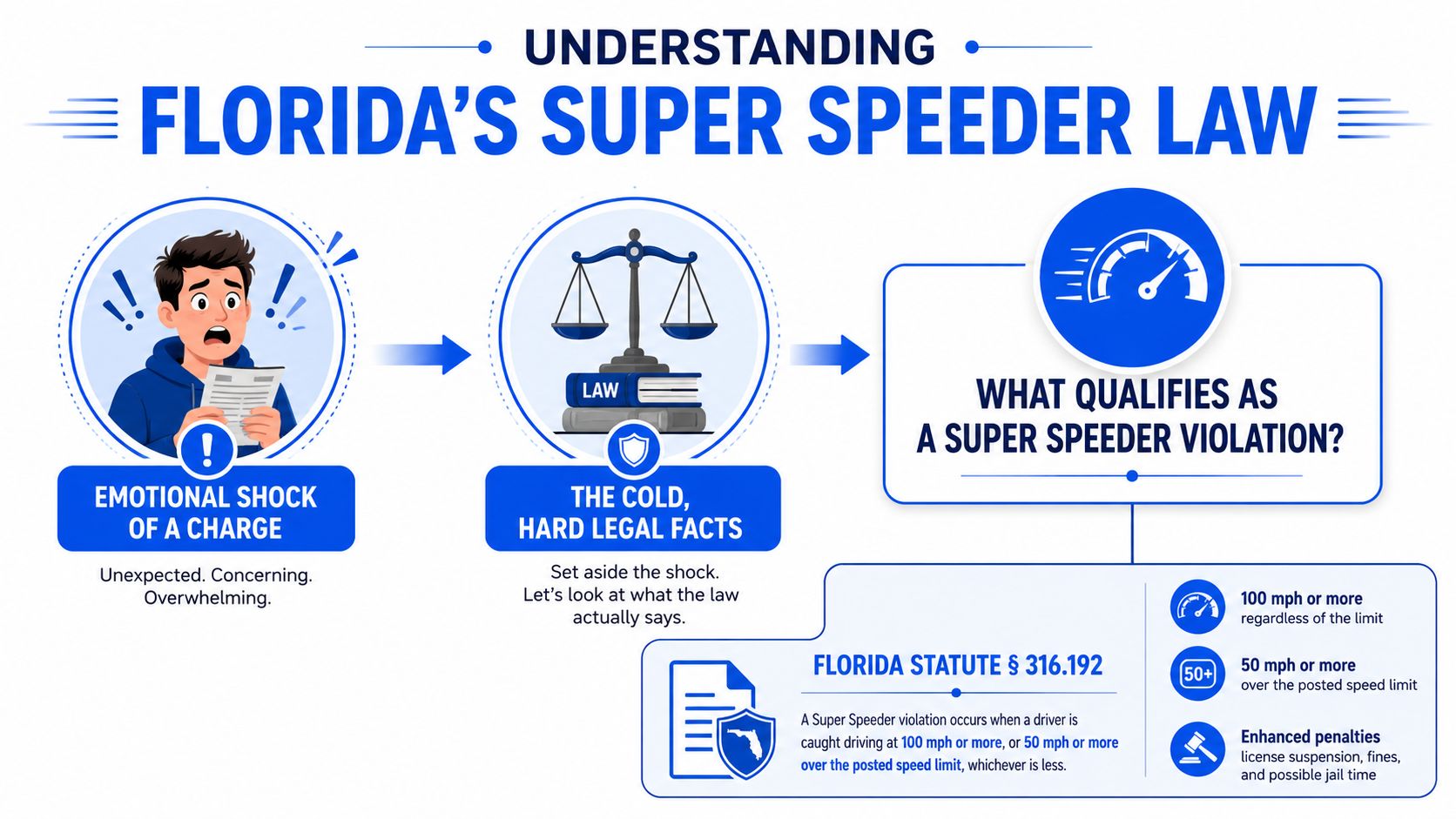
Florida doesn't use the phrase casually. This is tied to a specific criminal speeding framework in Florida Statute § 316.192 and related enforcement for dangerous excessive speed.
What speed triggers the charge
In Florida, the danger zone is clear. A Super Speeder charge applies when the allegation is that you were driving 50+ MPH over the posted speed limit or at 100+ MPH. Florida enforcement materials and statutory discussion describe this as a criminal traffic offense with mandatory court appearance, fines starting at $1,000, and potential incarceration under Florida Statute § 316.192.
Those numbers matter because they mark the line where the state stops treating the case like routine speeding.
If you crossed that line, you can't treat this like a citation you can mail in and move on from.
Why this is different from a regular ticket
Most speeding tickets are civil matters. You pay, contest, or resolve them through standard traffic procedures. A Florida Super Speeder allegation changes the prosecution path.
You are accused of conduct the state treats as criminally dangerous. That means:
No simple pre-trial payment option
Mandatory court handling
A misdemeanor-level threat to your record
A case that requires legal strategy, not form-filling
One useful starting point is Ticket Shield's discussion of Florida's new Super Speeder law and how it affects drivers, because it frames the issue the way drivers need to see it. As a criminal case first.
If the officer or clerk told you to appear in court, believe them. This isn't an administrative inconvenience. It's the center of the case.
The practical takeaway is simple. Once you're charged, you need to assess the stop, the speed measurement method, the paperwork, the court date, and the prosecution posture immediately. Waiting to "see what happens" is the wrong move.
What Are the Penalties for a Super Speeder Conviction
At this point, many drivers finally realize the charge is bigger than they thought.
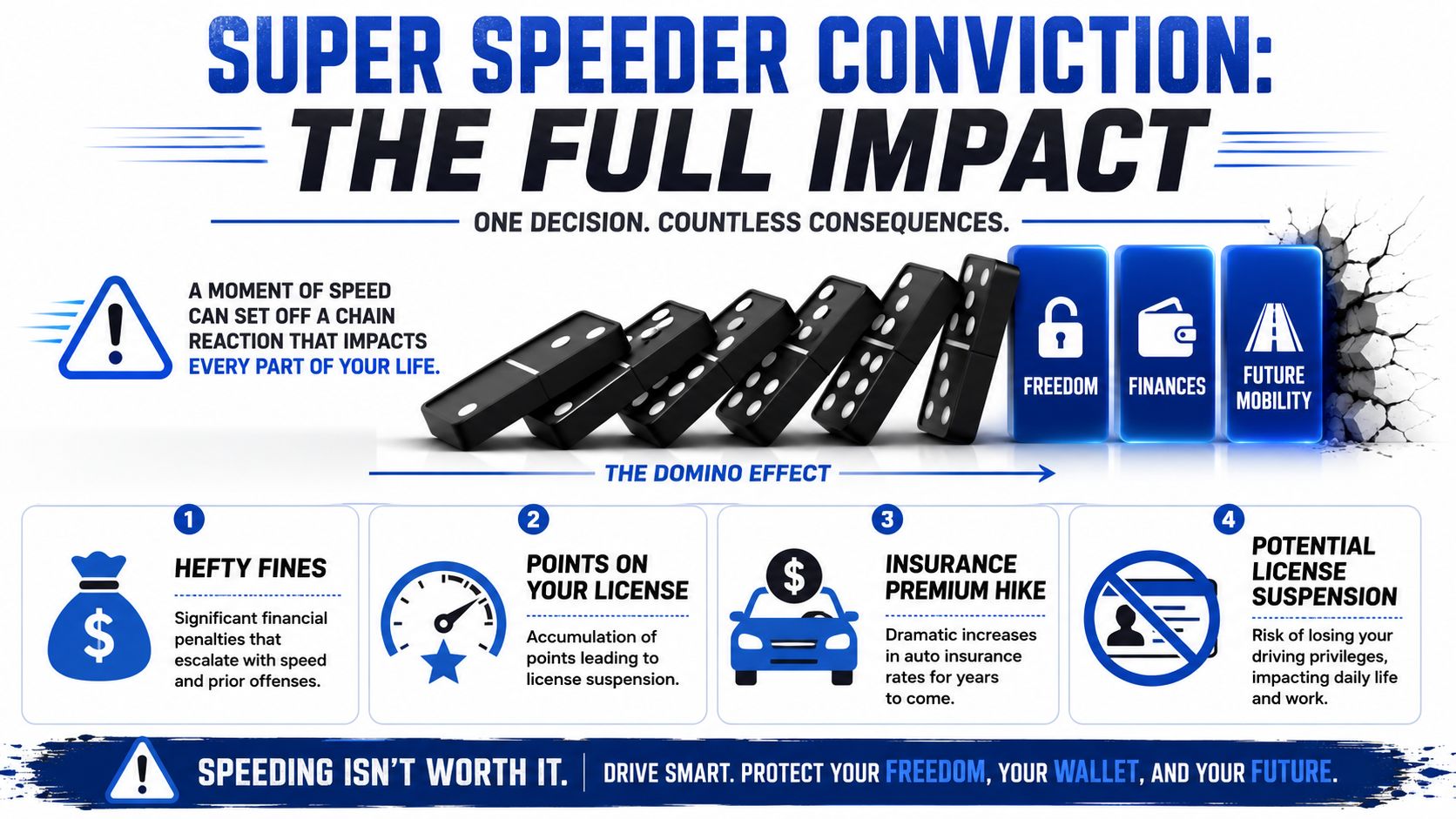
A conviction can hit you in layers. Court penalties. License consequences. Insurance damage. Employment problems. If you drive for a living, hold a professional role, or need a clean record for military or security-related reasons, the pressure gets worse fast.
What the court can do to you
Florida enforcement guidance tied to this law describes fines ranging from $1,000 to $2,500 and potential incarceration of up to 90 days for qualifying dangerous excessive speeding cases. It also notes that the charge can lead to 6+ points and immediate license suspension risks in the right circumstances under the criminal speeding framework described in the verified data above.
That means you are not just paying money. You are defending against a result that can follow you.
A statewide crackdown also shows how seriously agencies are taking these cases. Florida law enforcement agencies reported more than 550 arrests statewide for super speeding after the law took effect, according to this Florida enforcement report on super speeding arrests. The same report notes that speeding was a contributing factor in 29% of all traffic fatalities in 2024.
Judges know that context. Prosecutors know it too.
What a conviction can do outside court
Most drivers focus on fines. That is a mistake.
The hidden damage often includes:
Insurance fallout that can linger long after the case ends
License risk from points and related administrative action
Employment trouble for drivers, delivery workers, and professionals who must maintain clean driving histories
Security clearance concerns for military members and contractors
Account deactivation risk for gig work tied to background or motor vehicle checks
If you're trying to understand when a traffic case becomes criminal, this guide on whether speeding tickets can be misdemeanors is useful because it shows why the label matters so much.
A conviction doesn't stay in the lane you think it will. It can reach your paycheck, your insurance file, and your ability to drive for work.
Why fighting the charge is usually the smart financial move
Drivers sometimes hesitate to hire counsel because they're focused on the upfront cost.
That is backwards.
When the case carries criminal exposure, mandatory court, and the possibility of fines, points, and license trouble, a defense strategy is often the most rational way to protect your long-term position. Paying the price of a conviction over time is usually far worse than dealing with the case correctly now.
What Are Your Immediate Steps After Being Charged
Panic makes people talk too much, miss deadlines, and trust the wrong service.
Don't do that.
Start with control. Then move fast.
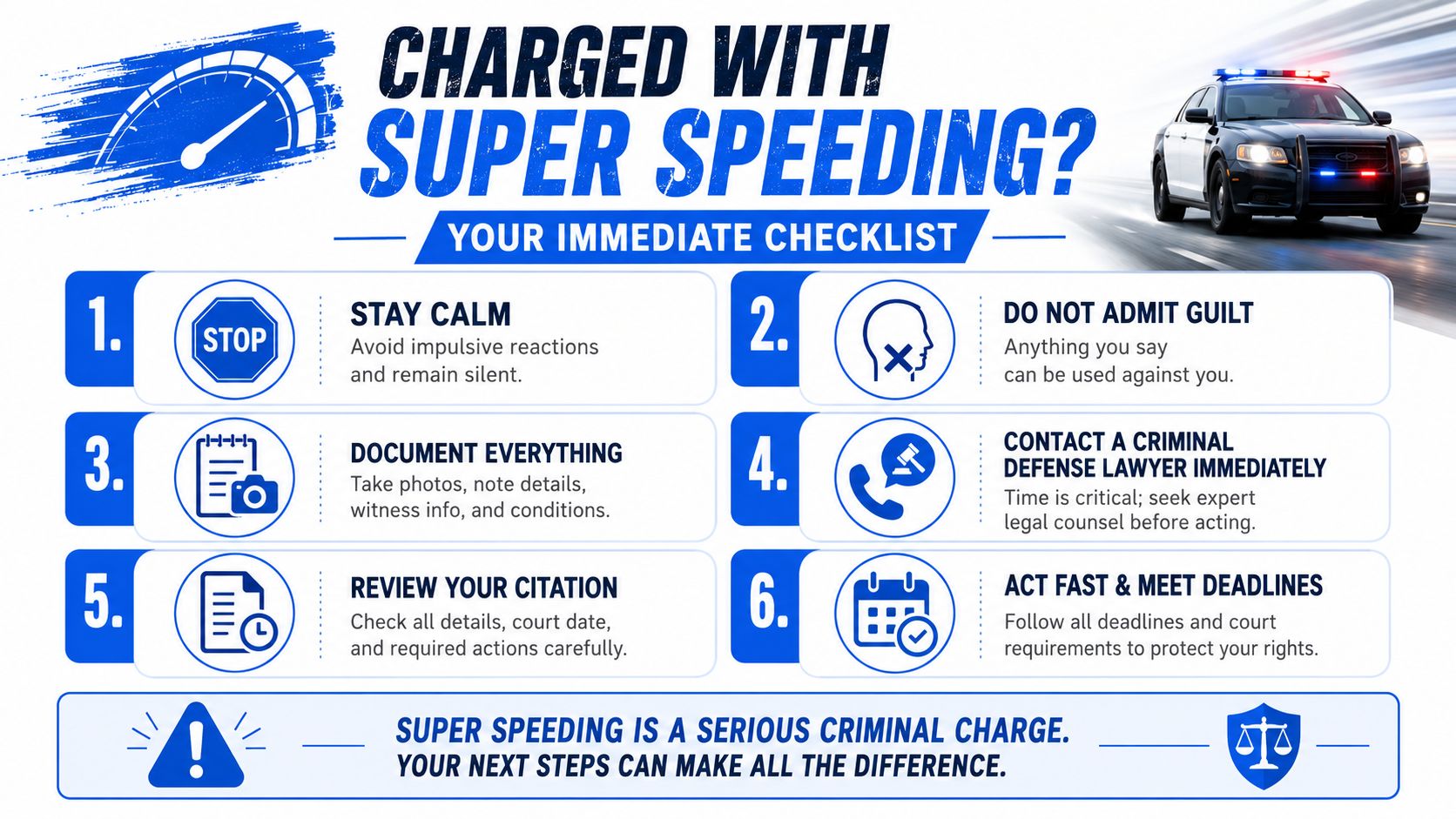
Immediate Steps to Take
Read every line of the citation: Confirm the charge, court date, county, and any language showing this is a criminal traffic matter.
Write down everything you remember: Note where the stop happened, traffic conditions, your lane, the officer's statements, whether radar or laser was mentioned, and whether there were witnesses.
Save every document: Keep the citation, bond paperwork, towing paperwork if any, and any notice tied to your court appearance.
Talk only to your lawyer about the facts: Don't explain the incident to friends, coworkers, or your insurance company without legal advice.
Act quickly: Verified Florida guidance tied to this law describes a critical short response window because the case requires court handling and doesn't allow a simple payment-by-mail resolution.
Get legal help before court: Review practical first moves in this guide on what to do when you get a ticket, then apply them at a criminal-case level.
Here is a quick overview of the kind of immediate response that helps drivers avoid unforced errors:
What to avoid right now
Do not post about the stop on social media.
Do not message someone, "I know I was doing over 100." Do not try to explain it away in texts. Do not call the court and start telling your side of the story. Do not assume being polite at the stop means the case will disappear.
Silence is not weakness here. It's protection.
The goal in the first stage is simple. Preserve facts. Avoid admissions. Put a lawyer between you and a bad outcome.
How Can You Defend Against a Super Speeder Charge
A charge is not the same thing as a proven case.
That matters because many drivers assume the officer's statement ends the discussion. It doesn't. The state still has to prove the allegation, and your lawyer's job is to test the foundation of that proof.
Where strong defenses often start
A real defense begins with the evidence, not with excuses.
An experienced attorney will usually examine:
How speed was measured through radar, laser, pacing, or observation
Whether the device and method can be challenged
Whether the officer's report is complete and internally consistent
Whether the stop and citation paperwork contain errors
Whether the alleged speed fits the charged statute
If the state can't prove the exact legal threshold, the case may become negotiable in a much more favorable way. That is especially important in an extreme-speed case because the threshold is what transforms the matter into a criminal prosecution.
Why negotiation still matters
Not every defense is a technical knockout. Sometimes the best outcome comes from pressure applied in the right place.
A strategic lawyer may push for:
A reduction to a less serious offense
An outcome designed to protect your license
A resolution aimed at avoiding the harshest criminal consequences
A court presentation that emphasizes mitigation without conceding more than necessary
This is where experience matters. Negotiation in a criminal traffic case is not paperwork. It is judgment.
One practical resource on the mechanics is this guide on how to beat a speeding ticket, but a Super Speeder case usually goes beyond ordinary ticket tactics. The stakes are too high for generic templates.
The right defense is built from the record, the stop, the speed proof, and the court handling your case. It is never one-size-fits-all.
For drivers who want direct access to counsel instead of layers of intake staff, Ticket Shield, PLLC handles Florida traffic defense with attorney communication by phone or text. That model fits criminal speeding cases better than a volume system because the details of the stop often decide the strategy.
Why You Need a Lawyer and Not an App for This Charge
If you were cited for a parking issue or a simple noncriminal infraction, an automated service might be enough to point you in a direction.
This is not that kind of case.
A Florida Super Speeder charge is a criminal matter. You need legal judgment, court advocacy, and someone who can evaluate evidence and speak for you in the courtroom. An app can't do that. A chatbot can't do that. A ticket mill built around mass processing can't do it well either.

What an app can't do
An automated platform can collect information. It can send reminders. It can present generic content.
It cannot:
Cross-check the officer's allegations against the statute
Spot weaknesses in proof and procedure
Negotiate with a prosecutor in a county-specific way
Stand next to you in a criminal courtroom
Make real-time judgment calls when the case shifts
That last point is critical. Criminal traffic cases change fast. A clerk issue, an amended allegation, a prosecutor's offer, or a hearing problem can all affect your risk.
What lawyer-led defense looks like
You should expect direct communication with an attorney. Not a sales funnel. Not a support queue. Not a chatbot answering criminal-law questions.
If you're weighing the difference, this piece on why a local lawyer beats an app explains the practical gap well. Human legal analysis matters more when the charge carries mandatory court and criminal exposure.
The right lawyer gives you three things an app never will:
Case-specific advice
Courtroom representation
Accountability for strategy
When the state says you committed a crime with your car, don't respond with software.
Frequently Asked Questions About Super Speeder Charges
Florida Super Speeder FAQ
Question | Answer (Ticket Shield, PLLC) |
|---|---|
Will I definitely go to jail if convicted? | No. Jail is a possibility in these cases, not an automatic result. The right defense focuses on reducing exposure and avoiding the harshest outcome. |
Can a first-time offense be reduced? | Sometimes, yes. Reduction depends on the facts, the proof, the county, and how the case is presented. First-time status can help, but it doesn't solve the case by itself. |
Can I just pay this ticket online? | No. A Florida Super Speeder charge is handled as a criminal traffic matter with mandatory court handling, not a routine mail-in citation. |
What if I have an out-of-state license? | You still need to take the Florida charge seriously. Florida can report driving-related outcomes, and consequences may affect your home-state record or driving status. |
Will this affect my job? | It can. That risk is especially serious if you drive for work, rely on app-based delivery or rideshare income, or hold a role where driving history or criminal records matter. |
How long will this stay on my record? | That depends on the final outcome. A conviction is far more damaging than a reduced or dismissed case, which is why the defense strategy matters from day one. |
Should I talk to the prosecutor myself? | Usually not without legal advice. Casual statements can hurt your position and close off defenses before your lawyer reviews the case. |
You don't need to panic. You do need to act like this is serious, because it is. The fastest way to improve your position is to stop treating this like a routine ticket and start building a defense immediately.
If you were charged with Florida Super Speeder, protect the No Points goal before this case gets away from you. Visit Ticket Shield, PLLC for a free consultation and speak directly with a lawyer, not a middleman or chatbot.
