
How to Reduce Speeding Ticket: Your Florida Guide 2026
Got a Florida speeding ticket? Learn how to reduce speeding ticket points, avoid penalties, and protect your license in 2026 with our expert guide.
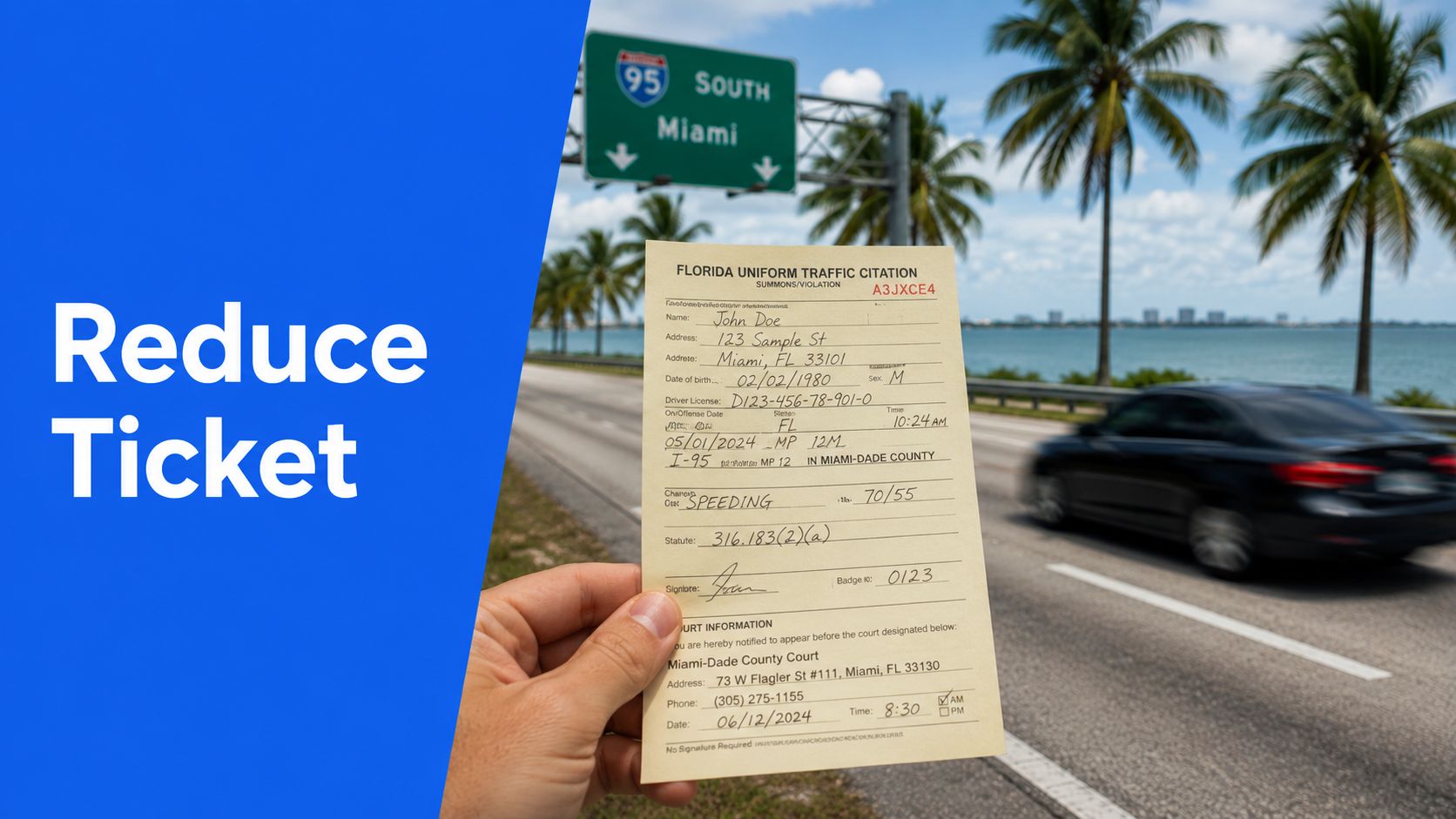
A Florida speeding ticket can often be reduced by contesting it. Don't pay it online. That's a guilty plea. Act fast, preserve evidence, and use a real attorney to protect your record, your license, and your No Points outcome.
You're probably reading this with the ticket still sitting on your passenger seat, kitchen counter, or inbox. You're annoyed, maybe embarrassed, and tempted to make it disappear by paying it. That's the wrong move.
A speeding ticket in Florida is not just a bill. It's a legal allegation under Florida Statute §316.187, which addresses unlawful speed. If you handle it casually, you can turn a manageable problem into a lasting one.
I'll be direct. If your goal is to reduce a speeding ticket, keep points off your record, and avoid making your insurance situation worse, you need a legal strategy. Not wishful thinking. Not a chatbot. Not a volume-driven ticket service that treats your case like a spreadsheet entry.
Table of Contents
What Should I Do Immediately After Getting a Speeding Ticket?
How Do I Understand the Consequences of My Florida Speeding Ticket?
What Should I Do Immediately After Getting a Speeding Ticket?
The first hour matters. The first day matters more. If you want to reduce a speeding ticket, you need to stop thinking like a customer paying a bill and start thinking like a defendant preserving evidence.
What should I avoid doing right away
Don't pay the fine online just because it feels efficient. In most cases, that closes the door on better outcomes. Don't call the clerk's office looking for legal advice either. They process cases. They don't defend them.
Don't post about the stop on social media. Don't text exaggerated versions of what happened. Don't email yourself a “confession” in frustration. Keep your facts clean and private.
Practical rule: The moment you get cited, your job is to preserve options, not to explain yourself.
Here are the immediate steps I'd tell a Florida driver to take:
Secure the citation: Put the ticket somewhere safe and take clear photos of both sides.
Write down the stop details: Record the road, time, lane position, traffic conditions, weather, and what the officer said about how your speed was measured.
Mark the location: Save the exact stop point on your phone map.
Check for video: If you have dashcam footage, save it immediately so it doesn't auto-delete.
Take roadway photos: Capture speed limit signs, obscured signs, lane layout, curves, hills, and anything that affected visibility.
Stay off payment portals: Once you pay, your negotiating power usually drops hard.
Get legal guidance quickly: Early action helps preserve records and deadlines. Review what to do when you get a ticket before you make any move that can't be undone.
What evidence should I preserve today
Drivers often think the case will come down to one question. “Was I speeding or not?” That's too simple. Real ticket defense turns on documentation, procedure, observation quality, and whether the state can prove its case cleanly.
Start building your own file now:
Item | Why it matters |
|---|---|
Ticket copy | Confirms the charge, court, and officer notes |
Photos of signs and roadway | Can support visibility or signage issues |
Dashcam footage | May show traffic flow, pacing issues, or stop details |
Weather notes | Can matter if visibility or observation quality is disputed |
Your timeline | Helps you remember facts accurately later |
If you were stopped near Orlando, your case may end up tied to the Orange County Courthouse process and calendar. That means timing and local handling matter. Delay helps nobody except the prosecution.
How Do I Understand the Consequences of My Florida Speeding Ticket?
That paper in your hand looks routine because traffic enforcement is routine. But common doesn't mean harmless. A national insurance-data analysis found that 10.5% of U.S. drivers had a speeding ticket on their record, which is roughly 1 in 10 drivers, based on 2021 data compiled from insurance-platform information, according to this speeding ticket prevalence analysis.
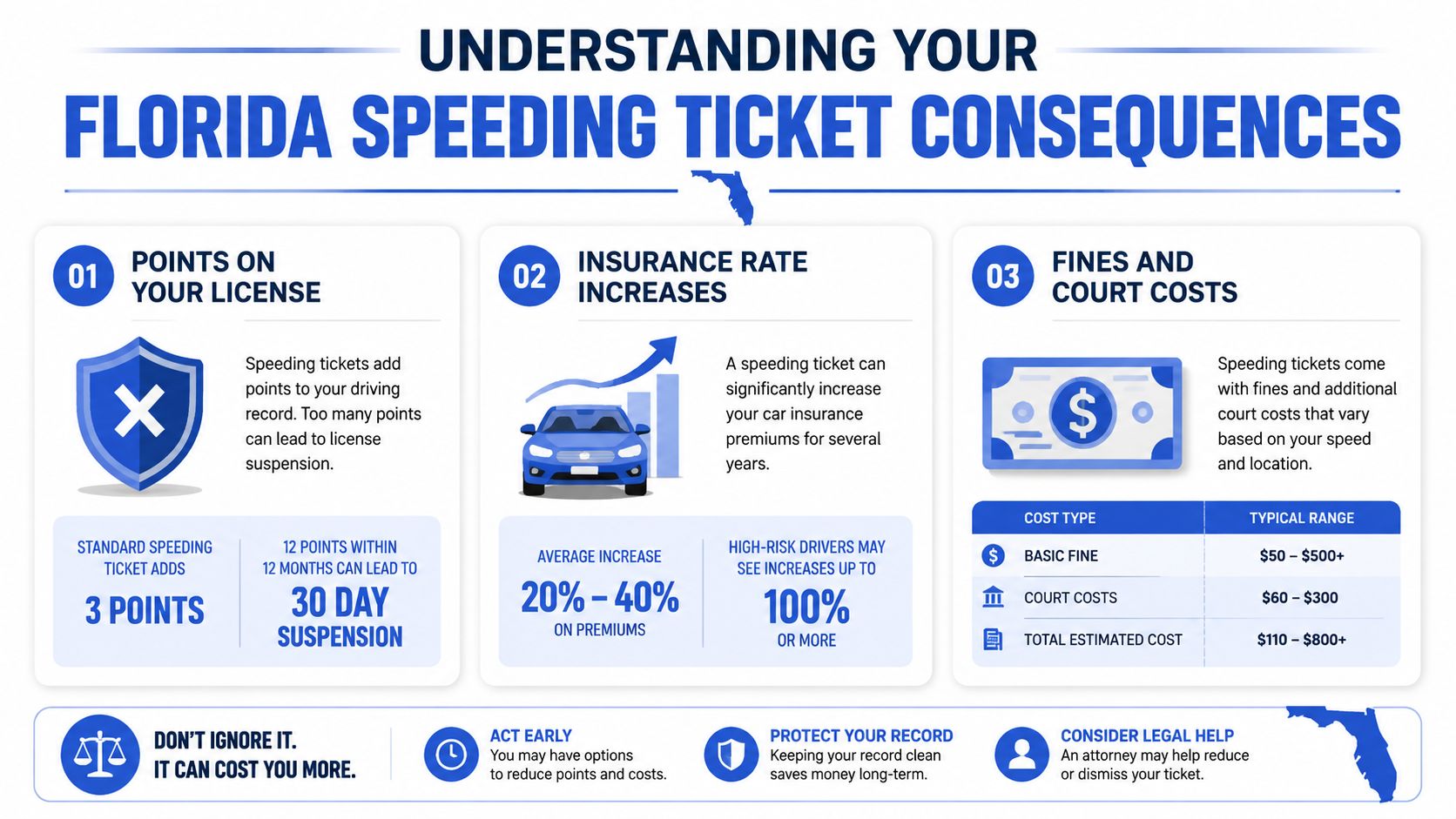
The point is simple. You are not dealing with some exotic legal event. You are dealing with one of the most common ways drivers damage their records because they underestimate it.
Why the fine is rarely the real problem
The fine gets your attention first because it's immediate. It's visible. It feels solvable. But the fine is often the smallest part of the damage.
What matters is the record. A conviction can affect how insurers view you. It can matter if you drive for work. It can matter if your job checks driving history. If you're a gig driver, one bad entry can create stress that lasts far longer than the payment itself.
That's why “I'll just pay it and move on” is usually not a strategy. It's surrender.
For Florida drivers, it also helps to understand the practical side of local court handling. If your case is in Tampa, you may be dealing with procedures tied to the Edgecomb Courthouse. That's another reason you shouldn't treat this like a one-click transaction.
What law are you actually accused of violating
You should read the citation like a legal document, because that's exactly what it is. In many Florida speeding cases, the allegation is tied to Florida Statute §316.187, the unlawful speed statute.
That matters for two reasons:
The state has to prove the allegation properly: Not just assert it.
Your defense has to fit the accusation: A smart challenge attacks proof, method, paperwork, and procedure.
If you don't know how points work or how a conviction affects your Florida record, read how speeding ticket points work in Florida. Drivers get into trouble when they react to the fine and ignore the record.
The right question isn't “How much is this ticket?” It's “What happens to my record if I handle this the wrong way?”
What Are My Legal Options for a Speeding Ticket in Florida?
You have options. They are not equal. One protects convenience. One preserves a fallback. One gives you a real chance to reduce a speeding ticket or do better.
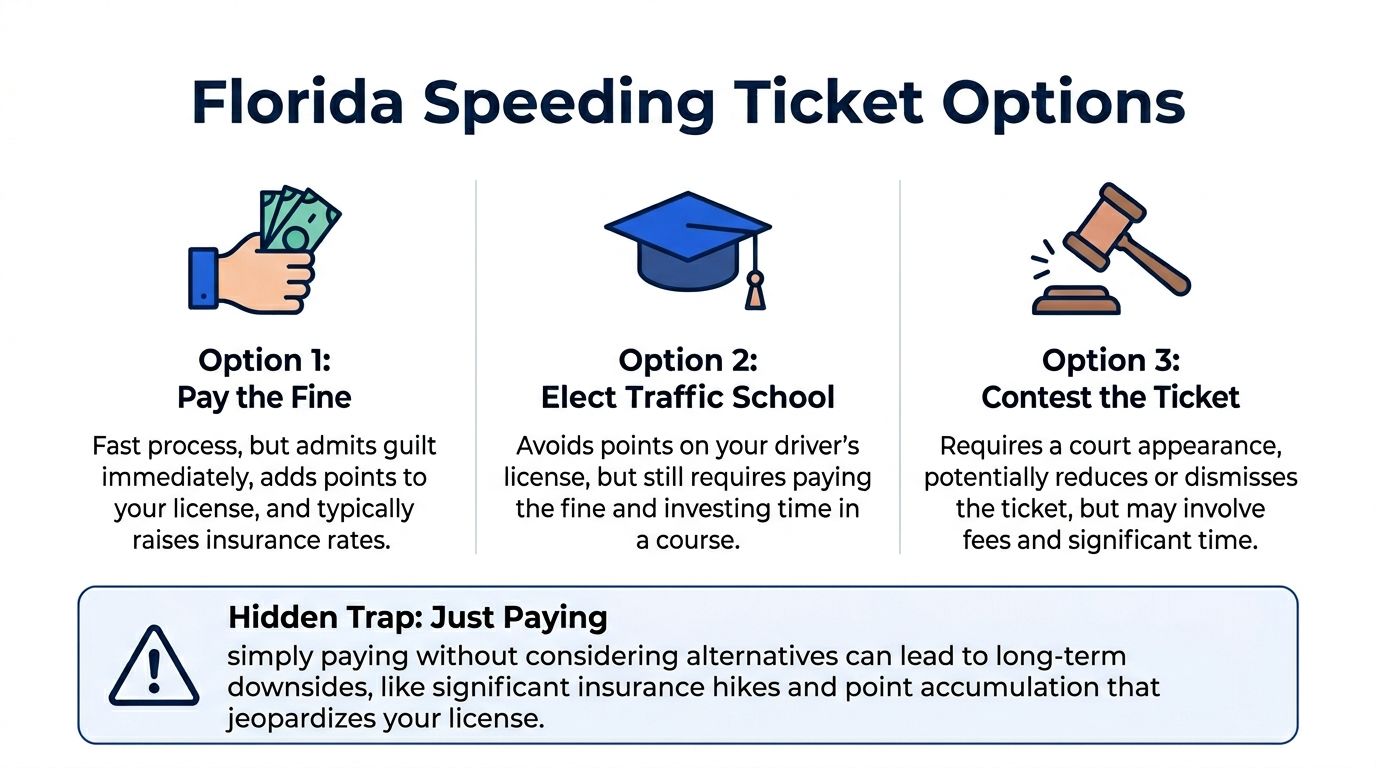
Which option hurts you the most
Here's the clean comparison:
Option | What it does | My view |
|---|---|---|
Pay the ticket | Ends the case fast, but treats the citation as admitted | Usually the worst option |
Elect traffic school | Can help in the right case, but uses a limited tool | Sometimes useful, often overused |
Contest the ticket | Preserves your chance to challenge proof and negotiate strategically | Usually the strongest opening move |
Paying is attractive because it's easy. Easy is expensive when it hands over your defense.
Traffic school can make sense in some cases. But many drivers burn that option without first asking whether the ticket could have been challenged more effectively. Once you use a fallback too early, you may regret it later.
When contesting the ticket creates leverage
Real advantage comes from facts and timing. A strong defense often involves documenting the stop location, traffic density, and weather, then using those facts to argue for measurement uncertainty and pressure the prosecutor into a reduced charge or safer disposition, and that negotiation is often time-sensitive, as explained in this discussion of scene-based speeding ticket defense strategy.
That principle applies directly to Florida practice even though your case must be handled under Florida law and local court procedure. You don't gain an advantage by saying, “I'm a safe driver.” You establish a strong position by identifying weak points in the proof.
If your case is in Miami-Dade, that work may play out through a courthouse process tied to the Richard E. Gerstein Justice Building. Local handling matters. Prosecutors, calendars, and courtroom expectations matter.
This video gives a useful overview of why a response strategy matters before you lock yourself into a bad option.
If you're thinking beyond the first hearing, review how to appeal a speeding ticket. Even if an appeal never becomes necessary, understanding the litigation mindset will help you avoid weak early decisions.
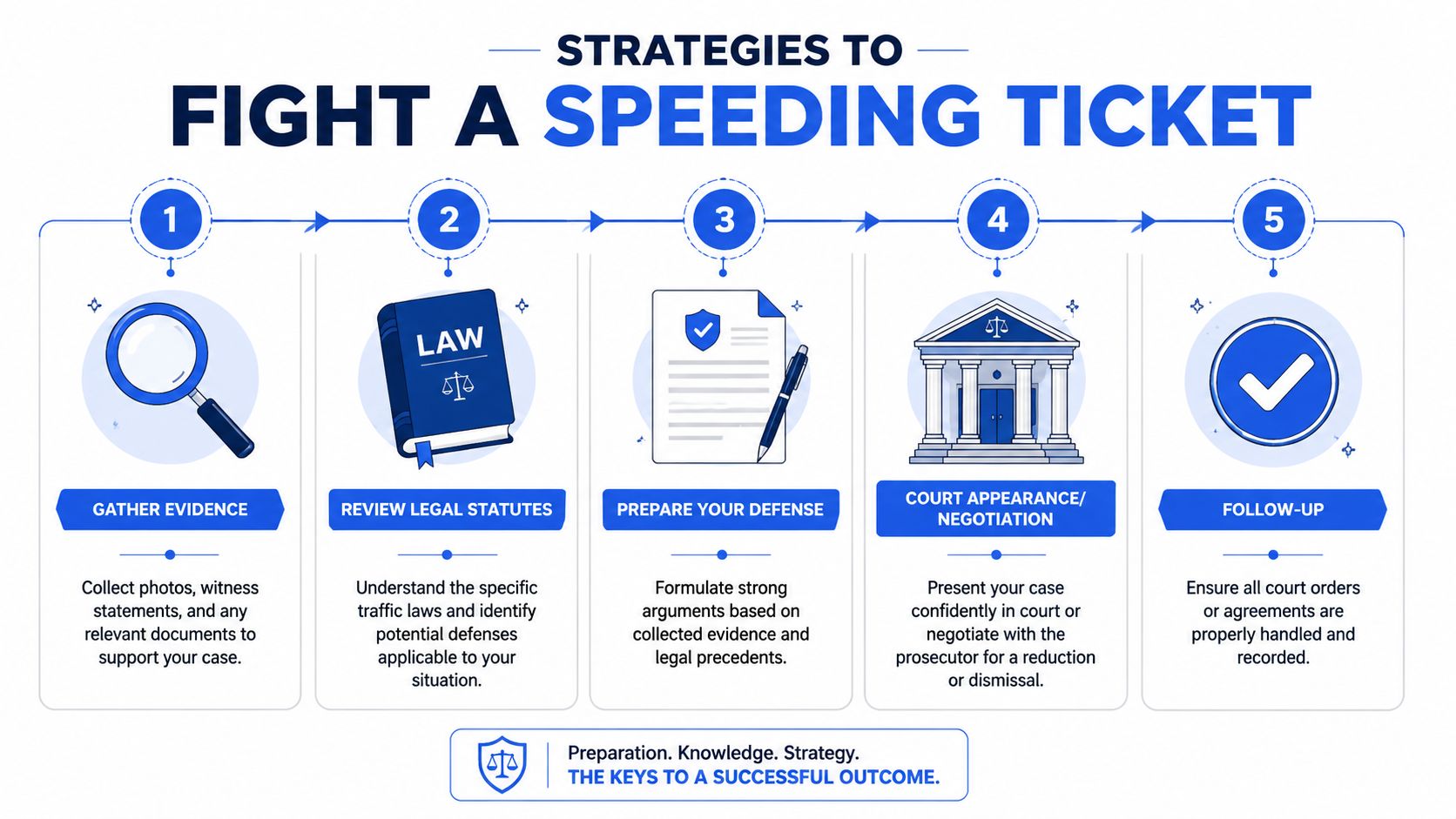
What Are the Best Strategies to Fight a Speeding Ticket?
A good defense is technical. That's the part many drivers miss. You are not walking into court to tell a dramatic story. You are testing whether the state can prove speed with reliable evidence, proper records, and a credible chain of documentation.
How do you challenge the speed reading
One of the strongest strategies is to demand the officer's training certificate for the specific speed-measurement device and the device's calibration logs. A missing or expired record can undermine the state's case and provide grounds for dismissal or charge reduction, as discussed in this analysis of challenging radar and measurement records in Florida traffic cases.
That's the kind of issue that moves cases.
A proper technical review usually starts with the measurement method:
Radar: Was the unit properly maintained and documented?
Lidar: Was the officer certified on that specific device?
Pacing: Was the pacing method described clearly and consistently?
Visual estimation: Was the observation credible under the scene conditions?
A weak defense says, “I wasn't speeding.” A strong defense asks, “Can the state prove this reading was obtained and documented correctly?”
If you want to understand the mechanics behind these devices, read how radar speed guns work. You don't need to become an engineer, but you do need to know why these cases are vulnerable to record-based challenges.
What scene facts can weaken the state's case
The roadway itself can matter. So can angle, traffic density, target confusion, weather, and officer positioning. Drivers often remember those details clearly right after the stop and then lose them weeks later. That's why immediate documentation matters.
Use this short checklist:
Pinpoint the officer's location: Was the patrol car hidden, angled, moving, or positioned near multiple vehicles?
Capture sight lines: Trees, curves, overpasses, and traffic clusters can affect observation quality.
Record sign conditions: If a sign was obscured or poorly placed, photograph it before conditions change.
Preserve your data: Dashcam clips and GPS records can support a written defense.
Compare the narrative: If the officer's description and the physical scene don't line up, that gap matters.
Lawyer-led defense also means somebody is connecting those facts to procedure, discovery, and negotiation. Ticket Shield, PLLC handles Florida traffic defense with direct lawyer communication by phone or text, which is materially different from automated intake systems that collect data and move it down a pipeline.
Should I Use an App or Hire a Real Traffic Lawyer?
I'll give you the blunt answer. If you're serious about protecting your record, an app is not a legal strategy.
Automated services are built for scale. Your case is not. A speeding ticket defense can turn on scene evidence, local court habits, officer documentation, equipment maintenance, and the timing of a negotiation. That requires judgment. Judgment comes from a lawyer, not a workflow.
What apps and ticket mills usually miss
Many drivers are unaware of asynchronous defense tools, like submitting dashcam video or GPS data, and procedural weaknesses, such as officer memory or equipment maintenance logs, which a lawyer can strategically use to build a defense case without the client needing to appear in court, according to this overview of written and remote speeding ticket defense tools.
That's exactly why automated systems fall short. They can collect your upload. They can't think strategically about what the upload means.
Here's the difference in practical terms:
Issue | Automated app approach | Real lawyer approach |
|---|---|---|
Dashcam footage | Upload and store | Review for target confusion, pacing issues, and timeline support |
GPS data | Treat as attachment | Use to support a coherent defense position |
Officer paperwork | Minimal review | Test for gaps, inconsistencies, and missing records |
Court procedure | Generic instructions | Adjust strategy to county practice and timing |
Questions from you | Customer support response | Legal judgment tailored to your case |
A volume service wants your case to fit its system. A real attorney makes the system respond to your case.
Why direct access to your lawyer matters
If you have a question about the officer's notes, a hearing date, or whether to accept an offer, you should be speaking to the person responsible for your defense. Not a middleman. Not a call center. Not a chatbot pretending to be reassuring.
That matters more than drivers think. Cases move. Offers change. Records arrive late. Local expectations differ from courthouse to courthouse. In Fort Lauderdale, for example, your handling may involve procedures linked to the Broward County Judicial Complex. You want a person making judgment calls, not pushing canned responses.
Read why a local lawyer beats apps for Florida traffic cases if you're weighing convenience against actual protection.
If the service can't explain your evidence, challenge the paperwork, and answer your legal questions directly, it isn't protecting you. It's processing you.
Protect Your Record and Secure Your Peace of Mind
A Florida speeding ticket is a legal problem. Treat it like one.
You do not reduce a speeding ticket by hoping for mercy. You reduce it by acting early, preserving evidence, understanding the charge under Florida Statute §316.187, and using a defense built on proof problems, procedure, and advantage.
What a protective response looks like
A protective response is simple:
Don't plead guilty by paying online
Preserve every fact you can while it's fresh
Get legal advice before you use up options
Push for the outcome that matters most, which is No Points
If dismissal is available, pursue it. If reduction is smarter, pursue that. If the evidence is weak, expose it. If the paperwork is missing, use it. The point is not to “say your side.” The point is to make the state carry its burden and to protect your driving record in the process.
If your priority is keeping the matter off your record or avoiding a conviction that follows you, review how to get a speeding ticket dismissed. Then act.
You don't need an impersonal app for this. You need a lawyer who will treat the case like it matters, because it does.
If you want a lawyer-led Florida traffic defense focused on a No Points outcome, visit Ticket Shield, PLLC for a free consultation.

