
How to Get Speeding Ticket Dismissed in Florida
Need to get speeding ticket dismissed in Florida? Our lawyer-led firm explains legal grounds, court procedures, & how to protect your license from points.
TL;DR: To get speeding ticket dismissed in Florida, you need to fight it on legal grounds under Florida Statute 316.187, not just explain why you were speeding. In Miami-Dade, 55% of contested non-criminal moving violations were dismissed outright, while only 21% paid in full and accepted the consequences (Miami dismissal data).
You’re probably looking at your ticket right now, wondering if it’s easier to just pay it and move on.
That’s the mistake.
Paying a Florida speeding ticket is often the fastest way to create a much bigger problem. You can end up with points, insurance fallout, and a record issue that follows you long after the ticket itself is gone. If your citation falls under Florida Statute 316.187, the right question isn’t “How fast can I pay this?” It’s “How do I stop this from hurting me?”
A speeding ticket gets dismissed when somebody attacks the case the right way. That means evidence. Procedure. Timing. Court strategy. Not excuses. Not wishful thinking. And not some automated app sending a template into a Florida courtroom.
Table of Contents
What Is Truly at Stake After a Florida Speeding Ticket
You get stopped on your way to work. The officer hands you a ticket. By lunch, you are thinking about paying it online just to make it go away.
That is the mistake.
In Florida, paying a speeding ticket usually means admitting guilt. You give up defense options, put points and insurance consequences in motion, and create a record that can follow you long after the fine is forgotten.
Why paying the ticket is the wrong default
The fine is usually the smallest part of the problem. Insurance is where many drivers get hit hardest. A paid speeding ticket can raise premiums for years. If you want a clearer picture of that exposure, read this guide on the cost of insurance increase after a Florida speeding ticket.
Then there is your driving record.
A conviction can affect job applications, employer driving reviews, fleet eligibility, and any situation where someone checks whether you are a safe risk. Drivers with commercial responsibilities or a lot of time on the road feel this faster than everyone else, but ordinary drivers get hurt too. One bad decision at the clerk’s window can cost far more than the amount printed on the citation.
I tell drivers the same thing every day. Do not treat a speeding ticket like a parking receipt. It is a legal case with financial consequences attached.
Why working drivers face more than a traffic problem
Many drivers are blindsided by the non-financial consequences. If driving is part of how you earn a living, a ticket can threaten more than your wallet.
Rideshare drivers, delivery drivers, salespeople, home health workers, contractors, and anyone who depends on a clean record can lose work opportunities after a conviction. Some platforms and employers care less about the fine than the fact that the violation appears on your record at all.
That is why a lawyer-led defense matters. A real attorney looks at the facts, the court, the officer, and the best outcome for your specific record and job. A ticket app or high-volume ticket mill pushes cases through a system. You get automation, limited communication, and generic handling. That is not good enough when your insurance, income, and driving status are on the line.
Direct attorney communication changes the result because strategy changes the result. If your livelihood depends on driving, you need someone who can answer your questions, spot the pressure points in the case, and make decisions based on your priorities, not a script.
What to do right now
Do not pay the ticket first: That usually locks in the worst result.
Preserve the facts: Keep the citation, note the location, time, traffic conditions, signage, and anything you remember about the stop.
Act quickly: Early case review gives your lawyer more room to protect your record.
Focus on the main risk: Insurance, points, work consequences, and your long-term record matter more than the fine.
If your job depends on driving, inaction is expensive. Get a lawyer involved before you make the ticket harder to beat.
What Are the Legal Grounds for Dismissal
A speeding ticket gets dismissed when the state cannot prove the charge with admissible evidence. That is the standard. Your job is not to tell a sympathetic story. Your lawyer’s job is to find the defect that breaks the case.
That defect may be in the speed reading, the officer’s training, the paperwork, the stop, or the prosecution’s failure to produce records on time. In busy courtrooms like Miami’s Richard E. Gerstein Justice Building, those details decide outcomes every day.

How speed evidence gets attacked
Under Florida Statute 316.187, the state still has to prove speed with reliable evidence. If the speed measurement does not hold up, the case weakens fast.
Radar and LIDAR cases often turn on records, not opinions. Calibration logs, maintenance history, and proof that the officer was trained to use the device all matter. Missing records or sloppy records can make the reading hard to admit or hard to trust, as explained in this discussion of how lawyers dismiss traffic tickets through calibration and procedural challenges.
Common attack points include:
Radar or LIDAR calibration: Missing, outdated, or defective maintenance records can undercut the reading.
Officer training records: The state may need to prove the officer was properly trained on the device used in your stop.
Pacing problems: If the officer says they paced your car, distance, traffic flow, and speed consistency all become fair targets.
Visual estimation limits: Heavy traffic, poor visibility, lane confusion, weather, and obstructions can all raise doubt.
Good defenses are built from documents. Notes, certifications, calibration logs, dashcam footage, bodycam footage, and dispatch records can all matter. In the right case, counsel may also file a motion to suppress evidence if the stop or the evidence collection violated the law.
Which procedural mistakes can break the case
The speed reading is only part of the file. The citation and the prosecution’s follow-through matter too.
Here are common procedural weaknesses:
Wrong statute or flawed citation details: Bad location data, incorrect vehicle information, or a defective charging document can create grounds to challenge the ticket.
Discovery failures: If the state does not produce required records, the defense can ask the court to exclude evidence or dismiss.
Improper stop issues: If the officer lacked a lawful basis to stop you, later evidence may be vulnerable.
Officer nonappearance: In some cases, if the officer does not show when required, the prosecution cannot carry its burden.
Courts dismiss tickets when the state misses legal steps.
Drivers often get burned by ticket mills and apps. These services treat every case like the same form with a different name at the top. A real lawyer reviews your citation, your county, your judge, your deadlines, and the weak points in your specific file. That personal review is not a luxury. It is how dismissals happen.
Why timing wins cases
Timing changes traffic cases. A challenge filed too late, aimed at the wrong issue, or missing the right records usually goes nowhere.
Experienced counsel uses procedure with purpose. Continuances, discovery demands, suppression issues, and hearing strategy all have to match the court and the facts. An app cannot adjust when the prosecutor suddenly produces records, when the officer’s notes conflict with the ticket, or when a hearing date creates a better opening for your defense. Your lawyer can.
A strong file review usually focuses on five questions:
Issue | Why it matters |
|---|---|
Speed measurement method | The state must present admissible proof of speed |
Calibration and maintenance | Missing records can weaken or block the reading |
Citation accuracy | Errors can create negotiating power or dismissal grounds |
Officer attendance | The state may still need a witness to prove the case |
Stop legality | An unlawful stop can support suppression arguments |
If you want to get speeding ticket dismissed in Florida, do not rely on automation or a volume practice that treats you like a case number. The strongest defense is lawyer-led, fact-specific, and built around legal defects the court can act on.
To see how these arguments are framed in court, watch this overview of procedural tactics and no-show strategy:
How Does the Florida Traffic Court Process Work
A lot of drivers make the mistake after they get home.
They toss the citation on the counter, plan to deal with it later, and miss the deadline to respond. By the time they act, they have already given up options that could have protected their record, insurance, and license. That is how a manageable ticket turns into a longer, more expensive problem.
Florida traffic court is procedural. Deadlines matter. The option you choose matters. The court also will not slow down because you were busy or confused by the back of the ticket.
Your first decision controls the rest of the case
A Florida speeding ticket usually gives you a few paths. Each one carries consequences.
Pay the ticket: Quick, but it usually functions as an admission and ends your chance to fight the charge.
Elect traffic school if eligible: Sometimes useful, but often treated as a default choice when it should be a strategic one.
Request a hearing: This keeps the case open and preserves your chance to challenge the ticket.
The easiest option is often the worst one.
If you want a practical walkthrough of hearing types, paperwork, and courtroom expectations, read this guide on what to expect in traffic court before you respond.
What the court process actually looks like
Once you request a hearing, the case shifts from payment processing to defense strategy.
That change matters. A lawyer can review the citation, check the officer’s allegations against the actual paperwork, identify filing or notice problems, and decide whether the right move is negotiation, motion practice, or a final hearing. A ticket app or ticket mill usually pushes every driver through the same system. A real defense does not work that way.
Some hearings are limited and administrative. Others put the actual charge in front of a judge. If you choose the wrong track, waive the wrong right, or miss the date to act, you can damage your own case before any defense is presented.
This is also the stage where direct attorney communication matters. You need to know what your court expects, whether counsel can appear for you, and what facts help. Firms that rely on intake scripts and volume processing often leave drivers guessing. Even the back office model used by an answering service for law firms shows the difference between handling calls efficiently and giving legal advice that fits your case. Those are not the same thing.
What to do right away
Read the citation carefully. Check the charge, the county, the deadline, and every instruction tied to your response.
Then act before the deadline passes.
Confirm the response date: Missing it can trigger added penalties or loss of hearing rights.
Do not assume traffic school fixes the problem: It may not protect the issue you most care about.
Get legal help early: Early review creates better options.
Find out whether your lawyer can appear for you: Do not make work or travel decisions based on guesswork.
Florida traffic court rewards drivers who act fast and get real legal guidance. It punishes delay, assumptions, and one-size-fits-all services.
How Does a Lawyer Beat a Ticket vs an Automated App
You get the ticket. You open an app. It asks a few questions, takes your payment, and sends canned updates while your license, insurance rates, and driving record stay on the line.
That is the problem.
A Florida speeding case is decided by judgment calls, local practice, and timing. A volume app is built to process files. A lawyer is paid to protect you.
What a real lawyer does that an app can't
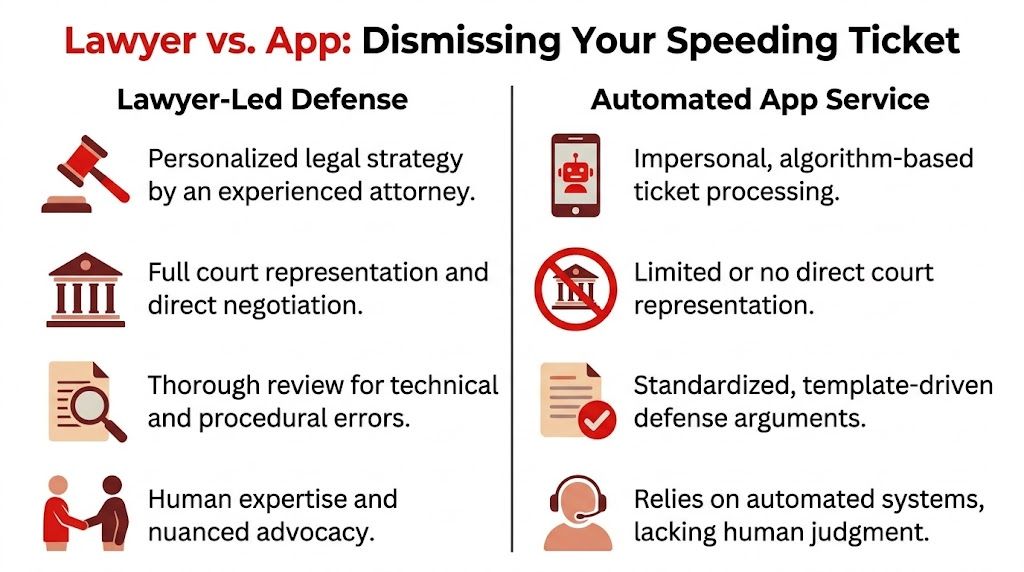
Automated services standardize everything. That is fine for form filling. It is a bad way to defend a traffic case.
Florida traffic defense turns on details that do not fit a template. Court preferences matter. Officer attendance matters. The wording on the citation matters. Small procedural mistakes matter. A lawyer can assess those moving parts and change course fast when the court, officer, or prosecutor changes the posture of the case.
That means a lawyer can:
Choose strategy instead of defaulting to a script: Some tickets should be challenged hard. Others should be positioned for a reduction that protects your record.
Spot weaknesses a form misses: Citation defects, proof issues, and local filing problems are easy to miss if nobody is reading the case like a lawyer.
Make tactical scheduling decisions: Timing can affect your position, hearing posture, and how the case develops.
Respond in real time: If something changes on the court's side, your defense should change with it.
The difference is personal judgment. That is why drivers comparing legal representation to app-based services should read why a local lawyer beats an automated ticket app.
Why direct attorney communication matters
The ticket mill model puts distance between you and the person making decisions. You get intake staff, generic text updates, and support channels that answer process questions but avoid legal advice.
That model protects the business. It does not protect the driver.
If you want to get speeding ticket dismissed, you need direct access to the lawyer handling the case. You need answers tied to your facts, your court, and your risk. If new information comes up, the attorney should hear it from you and use it. An app cannot do that. A call center cannot do that either.
Law firms that take client communication seriously build systems to respond quickly without replacing legal judgment. The operations side matters, and this look at an answering service for law firms shows how firms handle intake without turning clients into ticket numbers.
A speeding ticket defense should never feel anonymous.
One lawyer-led option in Florida is Ticket Shield, PLLC. The firm states that clients communicate directly with their attorney by phone or text. That matters because your case is handled like a legal defense, not a batch order. You are not buying software. You are hiring a lawyer to make decisions that can affect your record and your money for years.
The Ticket Shield Process From Start to Finish
You get the ticket. Then the clock starts.
Wait too long, miss a deadline, or pay it without understanding the consequences, and you can turn a defendable speeding case into points, higher insurance, and a permanent record problem. The process needs to move fast, and it needs to be handled by a lawyer who knows what to look for.
Ticket Shield, PLLC is built around that lawyer-led model. Your case does not disappear into a ticket mill workflow or an app queue. It gets reviewed by an attorney, and you get a direct line to the person making decisions on your defense.
What happens after you send in your ticket
The first step is simple. Submit your speeding ticket for attorney review with a photo of the citation and your contact information.
Then the legal work begins:
Your ticket gets reviewed promptly
The attorney checks the charge, the county, the court requirements, and the early pressure points that can shape the defense.
You get direct attorney communication
You speak with the lawyer handling your case. That matters. A real defense changes with the facts, and facts do not come through clearly when a client is filtered through call centers, intake staff, or software prompts.
A defense strategy is chosen
Depending on the citation and court, that can mean attacking defects in the ticket, preparing for a hearing, filing the right paperwork, or pushing for an outcome that protects your record.
The court side is handled
Filings, deadlines, appearances, and follow-up are managed for you. You do not have to learn Florida traffic procedure under pressure.
What you can expect while the case is pending
The biggest benefit is control. Instead of guessing what happens next, you know your case is moving and your lawyer is handling the details that trip drivers up.
At the Broward County Judicial Complex and in courts across Florida, that means someone is tracking dates, responding to court requirements, and showing up prepared. It also means you are not stuck with the impersonal support model used by high-volume ticket services that process cases like orders on a screen.
A lawyer-led process should reduce your risk and your workload.
The goal stays the same from start to finish. Keep damaging points off your record if possible. Fight for dismissal when the facts and procedure support it. Get the best outcome available before one speeding ticket becomes a longer, more expensive problem.
Frequently Asked Questions About Florida Speeding Tickets
A lot of drivers ask the same questions, but the core concern underneath them is usually this: “Is there still a way out of this?”
Often, yes. But only if you act before the easy mistakes become permanent.
Can my ticket be dismissed if I was actually speeding
Yes. Sometimes.
Dismissal is not only about whether you believe you were speeding. It’s about whether the state can prove the charge properly. If the speed reading is vulnerable, the citation is flawed, required records aren’t produced, or the stop raises legal problems, the case may still be beatable.
That’s why “I was probably speeding” is not the end of the analysis.
Do I have to go to court myself
Often, no.
In many Florida traffic cases, counsel can handle the court side for you. That is one reason busy professionals, military personnel, and gig drivers hire representation. If you want more detail on common client questions, the firm’s traffic ticket FAQs are a good starting point.
Is hiring a lawyer worth it for a minor speeding ticket
If all you look at is the fine, you’ll underestimate the case.
The smarter question is whether the ticket can affect your record, insurance, work, or license status. For many drivers, even a “minor” citation creates a record problem that costs more than the ticket itself. If your livelihood depends on driving or your schedule makes court a major burden, representation becomes a practical decision, not a luxury.
How long does it take to resolve a speeding ticket case
It depends on the court, the hearing track, and the strategy.
Some cases move quickly. Others take longer because motion practice, continuances, court calendars, and negotiation all affect timing. That delay is not always bad. In the right case, timing can provide an advantage. The key is making sure someone is managing the file actively instead of letting it drift.
What should I do right after getting the ticket
Do these things in order:
Put the deadline on your calendar: Missing it can cost you options.
Take photos and notes: Record what you remember while it’s fresh.
Do not mail payment just to get it over with: That can become the most expensive shortcut you take.
Get the case reviewed early: Speed matters after a citation.
Can a case still end well if dismissal doesn’t happen
Yes.
A strong result is not limited to outright dismissal. In some cases, the priority is avoiding points, avoiding a conviction entry, or negotiating a result that protects employment and insurance exposure more effectively than a straight payment would.
Why shouldn't I use a generic ticket service
Because generic services handle your case like it’s interchangeable with every other case.
Florida traffic defense is local, procedural, and fact-sensitive. A one-size-fits-all filing can miss the issue that matters. If your record matters, your defense should be personal.
If you want to protect your record and fight for the outcome that matters most, No Points, talk to a lawyer now. Visit TicketShield.com for a free consultation.

