How to Appeal a Speeding Ticket: 2026 Florida Guide
How to appeal a speeding ticket - Learn how to appeal a speeding ticket in Florida with our 2026 guide. Navigate the legal process, file notices correctly, and

A speeding ticket appeal in Florida requires filing a Notice of Appeal within 30 days of conviction and proving a legal error in the original case. If you try this alone, you risk losing on procedure before the court even reviews the merits.
You already paid enough attention to the ticket itself. Now the conviction is staring back at you, and the actual stress starts. Points. Insurance. Work consequences. For some drivers, one bad result can affect a job, a clearance, or a driving-based income stream.
Florida is writing more speeding tickets, not fewer. Law enforcement issued nearly 1 million speeding citations in 2025, up 29% from 744,000 in 2024, according to Florida speeding enforcement trend data. That means more drivers are ending up in the same position you're in now, trying to figure out how to appeal a speeding ticket without making the problem worse.
If you want a broad comparison point on how other states discuss contesting traffic citations, Bryan Fagan's Texas traffic citation guide is a useful outside reference. But your case lives and dies under Florida rules, Florida deadlines, and Florida court procedure.
Table of Contents
Your Guide to Fighting a Florida Speeding Ticket Conviction
A speeding conviction in Florida is not just a receipt for a fine. It is a court result tied to your driving record. If your ticket involved Florida Statute § 316.187, the court has already decided the speeding allegation against you unless that result is challenged properly.
That is why drivers need to stop thinking in terms of “I already explained what happened.” An appeal is not about whether you feel the stop was unfair. It is about whether the court made a legal mistake serious enough to justify relief.
Why this stage is different
The hearing you already had was the fact phase. The appeal phase is the error phase.
At this point, the court will not care that you were late for work, that traffic was moving with you, or that the officer seemed aggressive. The issue becomes narrower and more technical. Was evidence handled incorrectly? Did the judge apply the wrong standard? Did the record preserve a legal problem worth reviewing?
Practical rule: If you treat an appeal like a second chance to retell your story, you will likely lose.
Why urgency matters
Drivers often freeze after conviction because they assume they have time to think. In Florida traffic matters, delay is dangerous. The paperwork and timing rules matter as much as the legal argument itself.
Use this quick reality check:
Issue | What it means for you |
|---|---|
Conviction entered | Your record is now exposed to long-term consequences |
Appeal window starts | Delay can destroy your right to review |
Court focuses on legal error | Personal fairness arguments usually won't carry the case |
If you're searching for how to appeal a speeding ticket, start with the hard truth. A bad appeal is often worse than no appeal, because drivers waste time chasing the wrong argument while the deadline closes.
Should You Appeal Your Speeding Ticket Conviction
You should appeal only if there is a real legal basis to do it. But you should never assume paying or accepting the conviction is the safer path. In many cases, that is the more expensive decision over time.

What a conviction really costs
Under Florida Statute § 316.187, a speeding citation may look simple on paper. It isn't. A conviction can follow you far longer than the court date.
That is why many drivers should fight before they surrender. In Florida, approximately 20 to 30% of contested tickets are dismissed when the officer fails to appear, and drivers who contest have roughly a 40% chance of a favorable outcome, including dismissal or reduced charges, because the burden of proof remains with the state, according to Florida ticket contest outcome data.
That data matters because it shows something most drivers miss. Fighting back is not irrational. Folding immediately often is.
For a closer look at the practical decision, review whether it's worth contesting a speeding ticket in Florida.
When fighting back makes sense
Appealing makes the most sense when the original hearing produced a result that looks legally flawed, not merely frustrating. The right question is not “Was I unhappy with the result?” The right question is “Did the court get the law or procedure wrong?”
Appeal may be worth serious consideration if:
The judge admitted questionable evidence: Radar, pacing, or officer testimony can raise legal issues if handled improperly.
The ruling ignored the state's burden: The state must prove the violation. You do not have to prove your innocence.
The conviction threatens more than a fine: Drivers with CDL-related concerns, professional licensing concerns, or record-sensitive employment often have more to protect.
A speeding conviction is rarely just about the day you got stopped. It becomes a record problem.
The mistake I see most often is emotional decision-making. Drivers either rush into an appeal because they feel wronged, or they give up because they feel intimidated. Neither response is strategic. Strategic means this: challenge weak cases early, appeal only when the record supports it, and keep your focus on avoiding points and protecting the record.
What Are the First Steps to File an Appeal in Florida
If you miss the deadline, your appeal can die before it starts. That is the first thing you need to understand.
Under Florida Rule of Appellate Procedure 9.110, you have 30 days from conviction to file a Notice of Appeal, and 40% of Florida traffic appellants fail because of procedural errors, including missing that strict deadline, according to the cited appeal deadline discussion. If your case came through Miami-Dade, that means moving fast with the clerk process tied to the Richard E. Gerstein Justice Building.
What you must do immediately
Do these things now, not next week:
Confirm the conviction date: Your appeal clock runs from the conviction, not from when you finally calm down enough to deal with it.
Contact the clerk of court: Get the exact filing requirements for your county. Never assume one county's practice matches another's.
File the Notice of Appeal on time: This is the document that preserves your right to appellate review.
Secure the case record: You will need the documents, rulings, and hearing materials that show what happened below.
Locate your citation and court details: If you're scrambling for the basic case information, use a practical resource on how to look up a Florida citation number.
Where drivers get trapped
Drivers lose appeals in predictable ways. They use the wrong form. They file in the wrong place. They think a phone call to the clerk “counts.” It doesn't.
Here is the plain version:
Early mistake | Likely consequence |
|---|---|
Waiting past the deadline | Appeal rights can be lost |
Filing incomplete paperwork | Delay, rejection, or dismissal |
Failing to organize the record | No usable basis for review |
Your first filing does not need to tell your whole story. It does need to be timely and correct.
This is why self-representation is risky. The court will not relax the rules because you are not a lawyer. The court expects compliance. If you want to know how to appeal a speeding ticket in Florida, start with discipline. Deadlines first. Arguments second.
How Do You Build a Winning Appeal Strategy
Most drivers build the wrong case because they misunderstand what an appeal is. They think they get another chance to prove they weren't speeding. Usually, they don't.
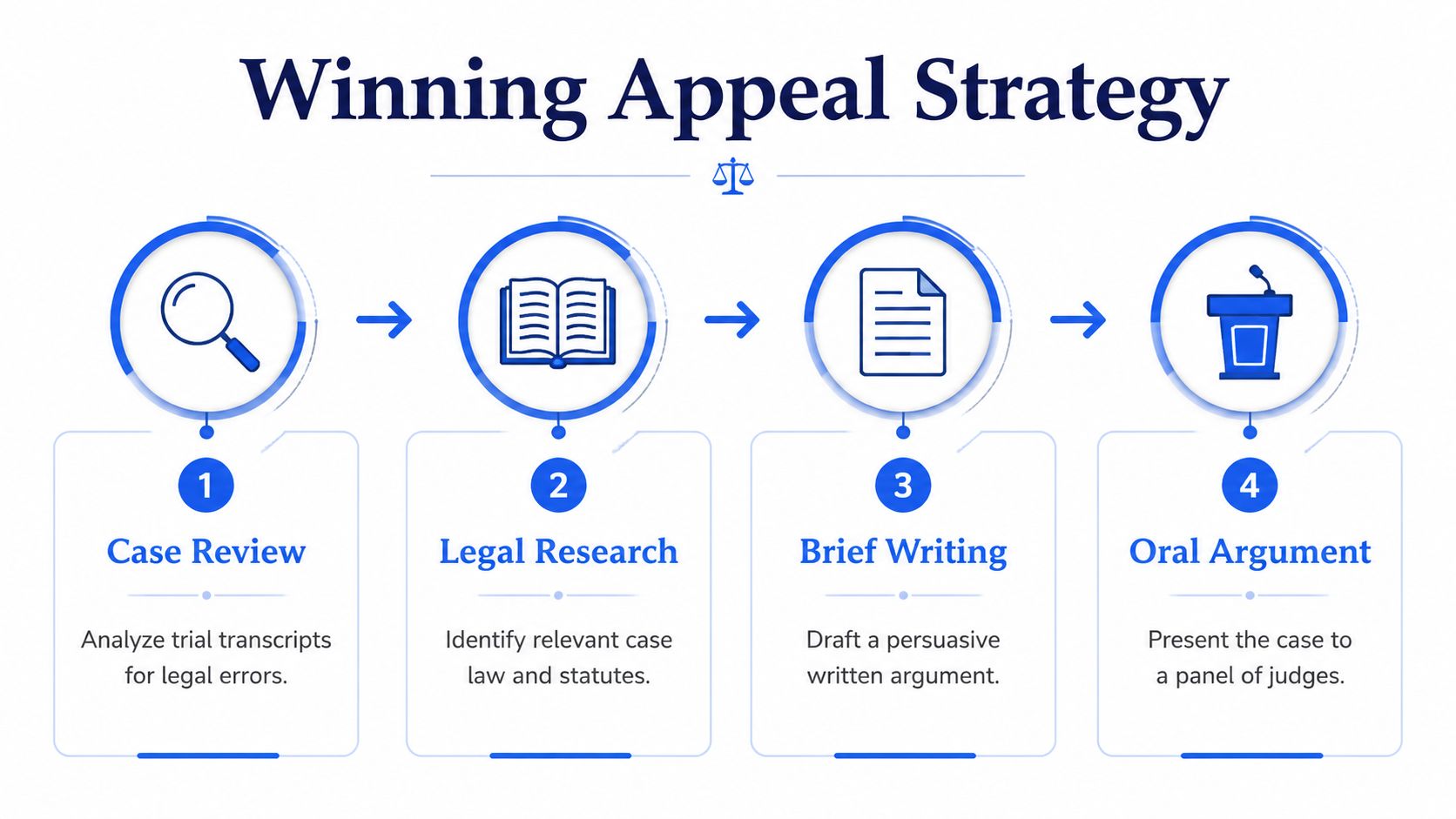
An appeal is not a new trial
This is the central rule.
The appellate court reviews the trial record for legal error. It does not re-hear your traffic stop from scratch.
If your argument is “the officer was mistaken,” that may have mattered at the original hearing. On appeal, the useful question is different. Did the judge allow improper evidence? Did the judge misapply the law? Did the record show a preserved legal issue that affected the outcome?
That distinction matters in speeding cases under § 316.187 because technical proof issues often drive the dispute. If speed was measured by a device, then the legal handling of that evidence may matter more on appeal than your memory of the stop itself.
For background on the underlying enforcement technology, read how radar speed guns work. That won't replace appellate analysis, but it helps drivers understand where evidentiary issues can begin.
What belongs in a real strategy
A serious appeal strategy usually includes these elements:
Review the hearing record carefully
You need to know exactly what was said, admitted, objected to, and ruled on. Memory is worthless here. The record controls.Identify legal error, not emotional unfairness
“The judge seemed against me” is not an appellate issue by itself. A misapplied evidentiary ruling may be.Check whether the issue was preserved
Some arguments fail because they were never properly raised below. Appellate courts usually want to see that the problem was put before the trial court.Frame the relief correctly
You are not asking the appellate court for sympathy. You are asking for a legal remedy tied to a legal defect.
A weak strategy says, “I still disagree with the ticket.” A strong strategy says, “The court committed a reviewable legal error reflected in the record.”
Critical shift: Stop asking whether the officer was right. Ask whether the court was wrong in a way the record can prove.
That is how a winning appeal starts. Not with outrage. With precision.
What Really Happens in an Appellate Court
Appellate court is quieter, stricter, and less forgiving than traffic court. If your first hearing felt stressful, this process feels more remote because it is built around rules, records, and legal argument.
What the hearing looks like
At a Florida appellate proceeding, you are not bringing in new witnesses. You are not cross-examining the officer again. You are not replaying the traffic stop.
The court reviews the record from the lower proceeding and considers whether a legal error occurred. Oral argument, if held, is short and focused. Judges ask pointed questions. They care about the standard of review, the preserved issue, and whether the alleged error mattered.
That's why appellate practice feels foreign to most drivers. It is not built for narrative. It is built for legal discipline.
Why self-represented drivers struggle
Appeals for speeding tickets are limited to the trial record and major legal errors. Florida appellate courts reverse only about 2 to 3% of traffic convictions annually, and pro se appeals fail over 80% more often due to procedural mistakes, according to traffic appeal success rate data.
That should reset your expectations immediately.
Here's what the court is evaluating:
Appellate focus | What the judges want |
|---|---|
The record | A clean, complete account of what happened below |
The legal issue | A specific, reviewable error |
The impact | A reason the error mattered to the result |
This is not a forum for “my side of the story.” It is a forum for legal analysis.
If your case arose in Broward, for example, you may associate court with the Broward County Judicial Complex and a standard hearing room. The appellate environment is different in tone and function. Drivers who walk in expecting a second ordinary traffic hearing usually leave disappointed.
Why Is an Attorney Essential for Your Appeal
Because Florida appeals punish small mistakes. That is the blunt answer.
A self-represented driver has to identify the issue, preserve the deadline, secure the right record, frame the right argument, and present it in a form the court will accept. That is not clerical work. That is legal work.
Lawyer-led defense beats clerical guesswork
There is a big difference between legal representation and administrative hand-holding. Many drivers don't realize that until it is too late.
An attorney reviews the conviction with one goal in mind. Is there a real appellate issue, or is the smarter move to focus on pre-appeal strategies and damage control? That judgment matters. It saves time, protects the record, and avoids hopeless filings.
If you want another example of how drivers in other regions look for targeted attorney guidance on appeals, legal advice for Alpharetta speeding tickets shows the same pattern. People need actual legal analysis, not a chatbot summary and not a middleman.
If you are weighing representation options in Florida, review what a speeding ticket lawyer handles. The key point is simple. Appeals require advocacy, not automation.
This matters even more if your income depends on driving
A bad appellate result can hit harder than most drivers expect. That is especially true for gig workers.
In Florida, Uber's data shows driver deactivation rates spike by 65% after points from an upheld speeding ticket appear on a driver's record, according to Ticket Shield's discussion of when hiring a lawyer is worth it. If you drive for income, the issue is no longer just the ticket. It is your livelihood.
That is also why lawyer-led defense matters more than automated apps or ticket mills. An app can send reminders. It cannot exercise legal judgment. A middleman can collect your information. That person cannot argue your case.
A real defense requires a lawyer who can spot the trap before you step in it.
If your case is in Tampa, Orlando, Miami, or Fort Lauderdale, the same principle applies. The courthouse changes. The procedural risk doesn't.
Protect Your Record and Avoid Points Today
If you're asking how to appeal a speeding ticket, you need to be honest about the stakes. A Florida appeal is technical, deadline-driven, and unforgiving. It is not a casual form you submit and forget.
The smarter goal is not “fight everything no matter what.” The smarter goal is protect your record and avoid points. Sometimes that means an appeal. Sometimes it means attacking the case earlier and more strategically. What you should not do is guess.
For drivers worried about long-term record damage, review how Florida speeding ticket points affect your license. Then act before a manageable case becomes a permanent headache.
Protect your license. Protect your record. Protect your options.
If you want a lawyer-led defense focused on the No Points outcome, contact Ticket Shield, PLLC for a free consultation. You'll speak directly with your attorney by phone or text, not a chatbot, not a call-center middleman, and not an automated app.