
Red Light Ticket Cost Florida
Confused about the red light ticket cost florida? Our attorneys explain 2026 fines, hidden insurance costs, points, and how to protect your license.
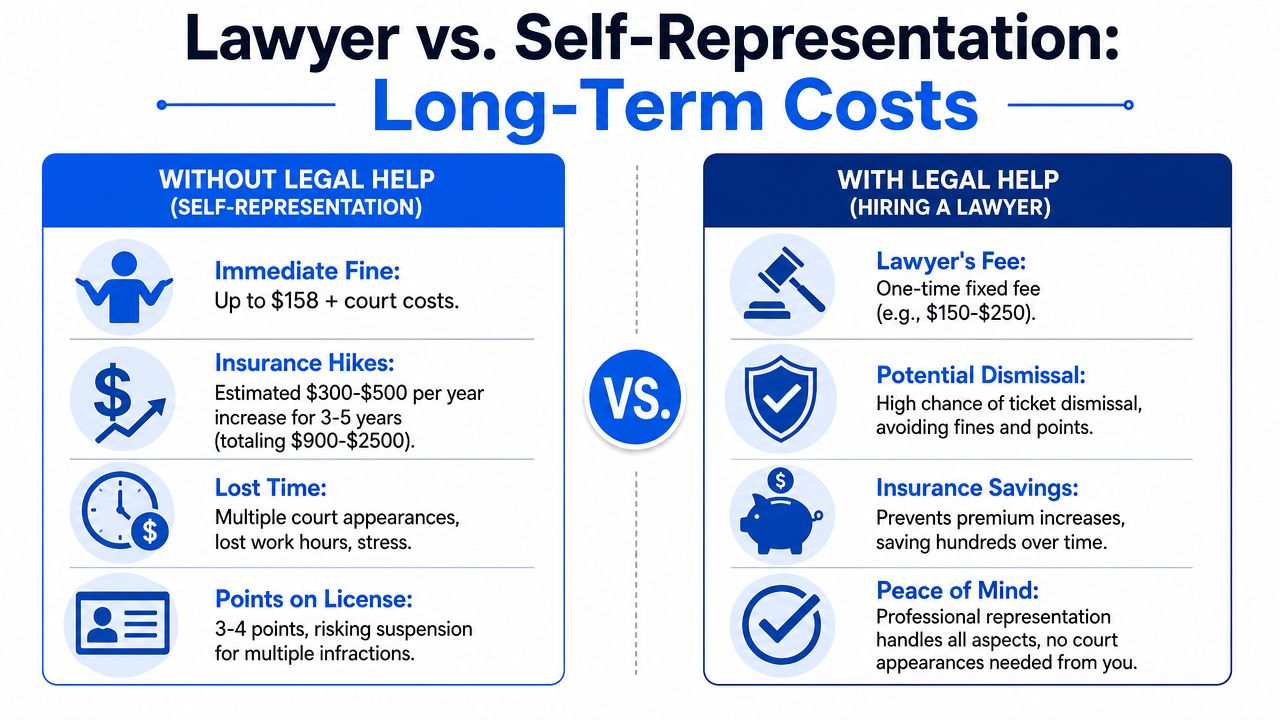
In Florida, a red light ticket can start at $158, but the greater danger is escalation. Ignore the notice and you may face roughly $262 to $277+, points on your license, years of insurance pain, and much more expensive consequences.
You open your mailbox and see the notice. Or an officer has already handed you a citation on the roadside. Your first instinct is usually the same. How much is this going to cost me?
That's the right question, but most drivers ask it too narrowly. The number printed on the paper is only the opening price. The critical issue is whether this stays a manageable problem or turns into a formal moving violation that follows you for years. You need to know which one you have, what Florida law states, and what to do before the damage spreads.
Table of Contents
What Is the True Cost of a Florida Red Light Ticket
You see a red light notice in the mail, glance at the amount, and assume this is a quick $158 problem. That is the mistake that turns a manageable issue into a much bigger one.
The true cost is not just the amount printed on the first page. It is the risk of escalation. A simple notice can turn into court costs, points exposure, insurance fallout, and record problems that follow you long after the deadline passes. If your job depends on a clean driving history, the price can climb fast. Our firm breaks down that progression in this Florida guide to the cost of a red light ticket.
Drivers get in trouble when they focus on the smallest number in the file instead of the consequences attached to it. Florida red light cases punish delay. They also punish guesswork.
Use this checklist to judge the actual cost:
Current cost: What you have to pay today if you do nothing else.
Escalation cost: Added amounts once the matter moves deeper into the system.
Record cost: Exposure to a formal violation that can affect your driving history.
Insurance cost: Premium increases that can outlast the ticket.
Career cost: Trouble for commercial drivers, job applicants, and anyone whose employer checks motor vehicle records.
Start with one question. What exactly did you receive?
That answer controls your risk level, your deadline, and whether you should fight the case before it becomes expensive in ways the notice never explains. A lawyer helps at the point where the problem is still containable. That is how you stop a small red light case from turning into a multi-thousand-dollar setback.
Is It a Camera Notice or an Officer Citation
Florida law treats these differently, even when the accusation sounds the same. If you're accused of running a red light, your cost exposure depends first on whether you got a mailed camera notice or a citation from an officer. Section 316.075, Florida Statutes, governs traffic control signal devices and gives the legal framework for red-light enforcement under Chapter 316.
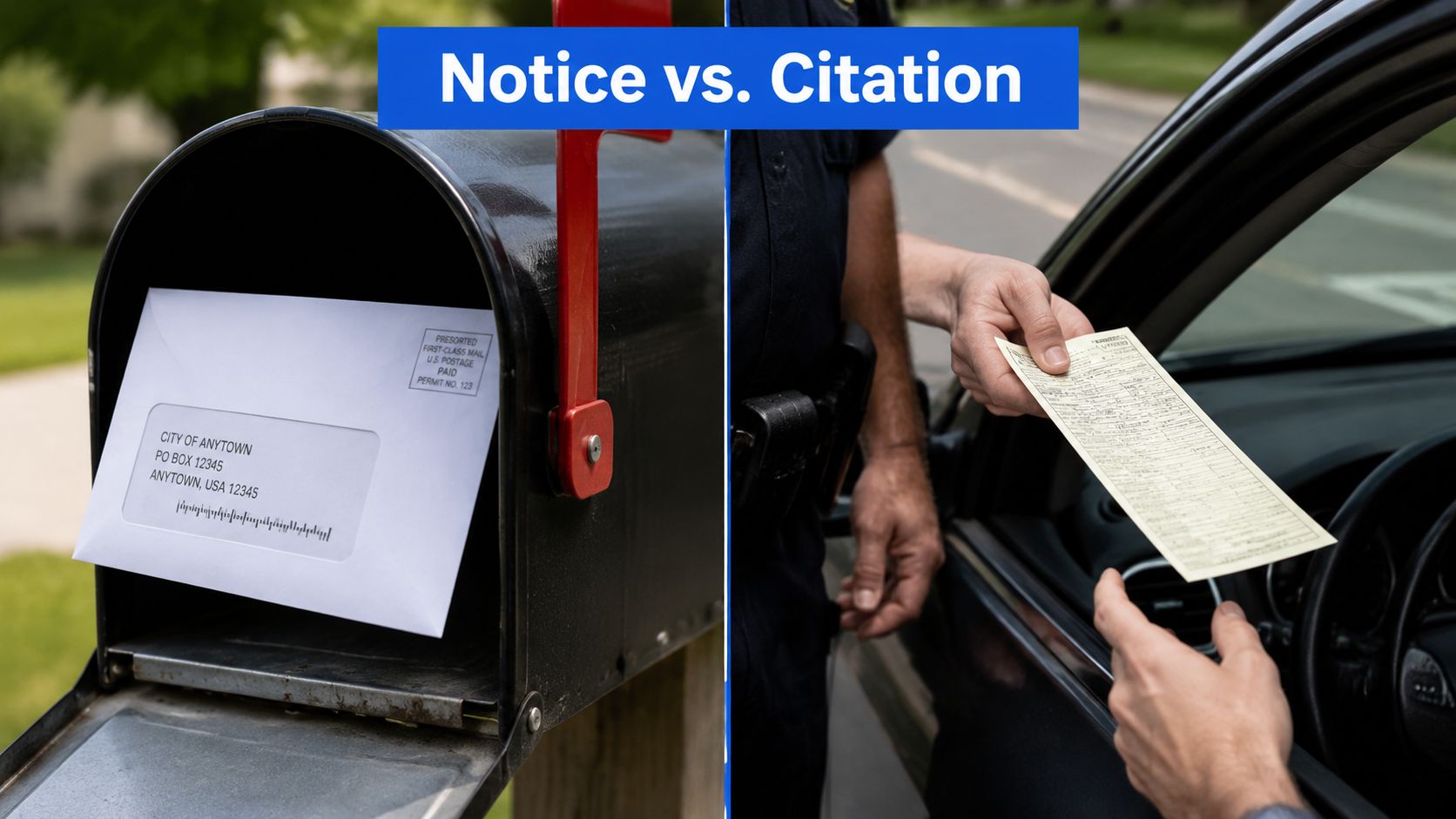
How to tell which document you received
A camera Notice of Violation is typically a civil penalty of $158 and, if paid on time, carries 0 points. Some local clerk schedules show a later red-light traffic-violation amount at $264 when the matter is processed as a court traffic violation instead of a mailed notice, according to Hillsborough County's red light fine information.
An officer-issued citation is different. It is already in the world of formal traffic enforcement. You are not just deciding whether to pay a mailed notice. You are dealing with a moving violation problem that deserves a defense plan.
Use this quick comparison:
Document type | Usual starting amount | Points if handled on time | Legal posture |
|---|---|---|---|
Camera Notice of Violation | $158 | 0 points | Civil penalty |
Court-processed red-light traffic violation | $264 in some clerk schedules | Points may become an issue depending on posture | Formal court traffic matter |
Officer-issued citation | Higher exposure than a simple notice | Risk is materially greater | Moving violation track |
Why Florida Statute 316 matters
Section 316.075 matters because it defines the underlying signal violation. But from a defense standpoint, the practical issue is not just whether the state says you ran a red light. It's how the case was initiated and what procedural path it is taking.
That is why two drivers can both say, “I got a red light ticket,” while facing very different outcomes.
A mailed notice is a warning shot. An officer citation is already a courtroom problem.
If you want a plain-English breakdown of how camera enforcement works, review this explanation of Florida red light camera cases. Then look back at your paperwork and identify what you have. That is the first serious decision point.
Why Ignoring the Notice Guarantees Higher Costs
Waiting is often the most expensive choice. In Florida red-light cases, the biggest cost jump happens at the moment of escalation.
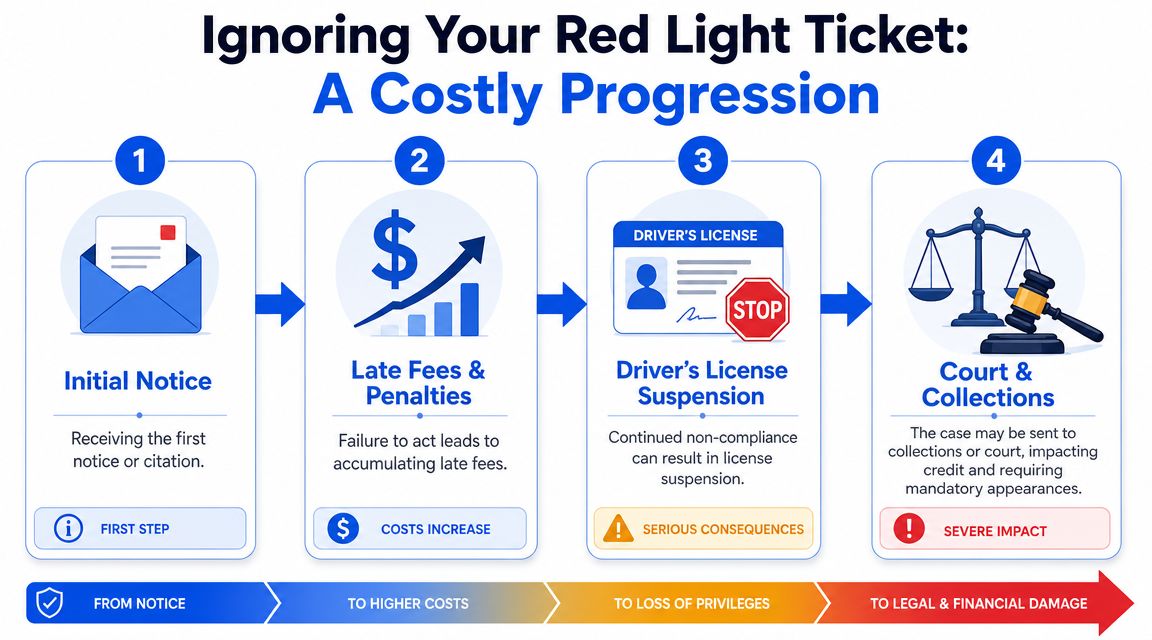
The first notice is the fork in the road
A lot of drivers assume a camera notice is harmless because it starts as a civil matter. That thinking is dangerous. The system is built to punish delay.
Florida guidance on red-light escalation shows that if the initial camera notice is ignored, the matter can convert into a Uniform Traffic Citation with a higher total of roughly $262 to $277+ and 3 to 4 points on the license, according to this Florida red-light escalation guide.
That is the point where your problem stops being administrative and starts affecting your driving record in a very real way.
What escalation changes immediately
Once the notice escalates, you are no longer comparing one payment option against another. You are dealing with a new category of risk.
The shift matters because:
The total rises: What began as a lower civil amount moves into a higher citation range.
Points become a threat: A clean record can turn into a marked record.
Court posture changes: The matter becomes harder to resolve casually.
Insurance exposure begins: Once points attach, outside financial consequences follow.
This is why I tell drivers not to “wait and see.” Florida's system is not designed to reward patience. It is designed to enforce deadlines.
If you do nothing, the county keeps moving. Your case doesn't stay frozen just because you haven't looked at it again.
Why inaction is worse than a bad first decision
You can usually fix a rushed decision faster than you can fix a missed deadline. Paying without advice may close off some options. Ignoring the notice can create an entirely worse case.
That's especially true for busy professionals, delivery drivers, military members, and anyone who can't afford a formal blemish on a driving record. By the time a driver shows up at the courthouse saying they “forgot,” the law has often already moved them into a more expensive lane.
If you want one hard rule from this article, take this one. Never let a Florida red light notice age without a response plan.
How a Ticket Impacts Your Insurance and Career
You pay the notice and try to move on. Then your renewal hits, your employer runs a motor vehicle check, or your driving app account gets flagged. That is when a Florida red light case stops looking like a small traffic problem and starts acting like an expensive record problem.
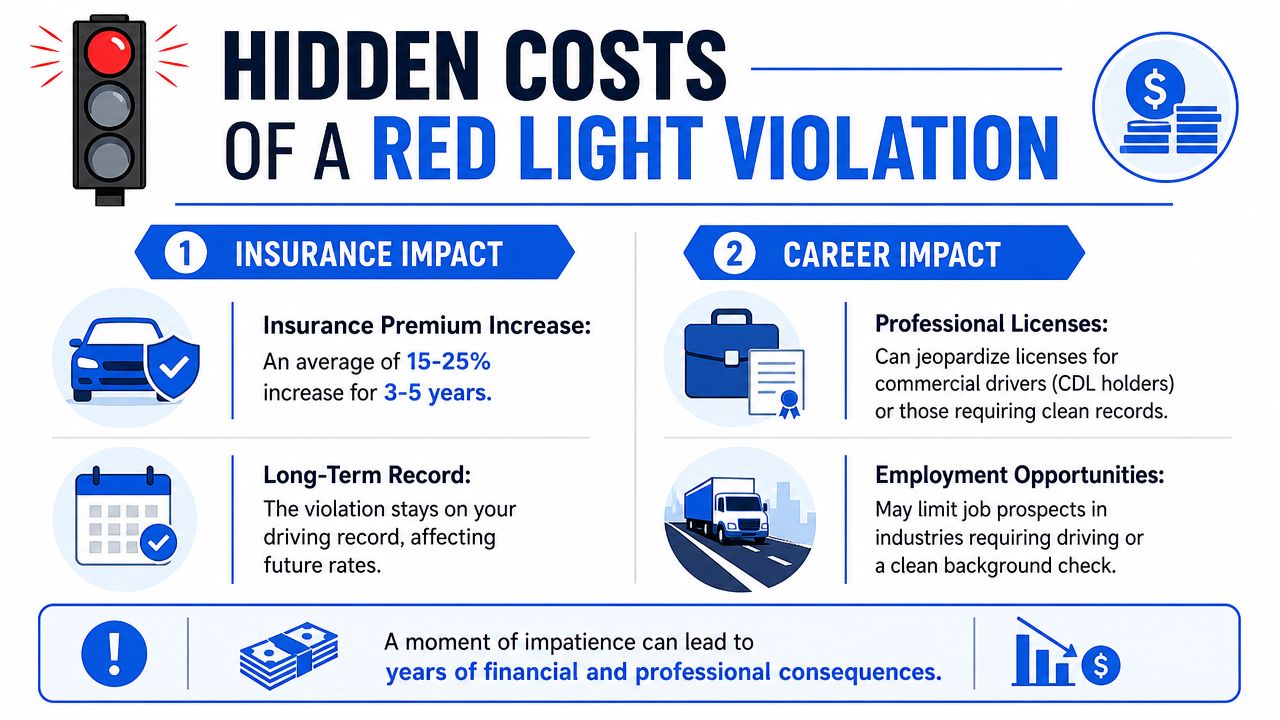
Insurance is often the biggest expense
The fine is only the front end. The most significant financial impact is on your insurance.
Once a red light matter turns into a conviction that affects your driving record, the extra cost can follow you for years. One ticket can mean higher premiums at each renewal cycle, and that total can easily outrun the original amount of the notice. If you want a broader look at how Florida traffic convictions can raise premiums, review this guide to insurance increases after a Florida ticket.
That is why waiting for the case to “work itself out” is a bad strategy. It usually works itself out against you.
A lawyer's job here is simple. Stop the case from turning into a record problem if there is a lawful path to do that. That matters because insurance companies do not care that the case started as a minor notice. They care about what ends up on the record.
Some careers take the hit immediately
For many drivers, this is bigger than a traffic fine. It affects income, job options, and credibility.
I see the risk most often with:
Rideshare and delivery drivers: A violation on the record can threaten platform eligibility and weekly income.
CDL holders and commercial drivers: Employers watch driving history closely, and added points bring scrutiny fast.
Salespeople, field technicians, and home service workers: A driving record issue can affect job assignments or continued employment.
Healthcare staff and regional workers: Travel between locations is part of the job, so a marked record creates avoidable friction.
Military members and clearance-sensitive employees: Extra legal and administrative issues are the last thing you need.
The career damage usually does not come from one dramatic event. It comes from a background check, an internal policy review, a supervisor asking questions, or an insurer raising the cost of keeping you on the road for work.
A red light case can move from a $158 notice to a much more expensive problem if it ends with a record entry that follows you into your insurance file and your workplace.
That is the point where hiring a lawyer becomes a cost decision, not a luxury decision. If your job depends on staying mobile, insurable, and clean on paper, protect the record before the case hardens into something harder to fix.
Can You Defend Yourself in Court
Yes, you can represent yourself. That does not mean you should.
At the Edgecomb Courthouse in Tampa, and in traffic courtrooms across Florida, the drivers who struggle most are usually not reckless people. They are people with decent arguments who don't know the procedural rules, the local expectations, or how to present a defense cleanly under pressure.
Valid defenses exist
Sometimes the driver wasn't the person operating the vehicle. Sometimes the evidence is weak. Sometimes the facts support a lawful explanation or expose a defect in how the case was processed.
Those issues matter. But they only matter if they are raised correctly, on time, and in the right format.
Common defense themes can include:
Identity issues: The registered owner may not have been the driver.
Evidence problems: The proof may not establish the violation as cleanly as the notice suggests.
Necessity or circumstances: There may be a factual reason that requires careful presentation.
Procedure failures: The government still has to follow the required process.
If you want a deeper look at defense options, review this guide on fighting a Florida red light ticket.
Procedure beats good intentions
Florida sources also show that while the statutory red-light camera penalty is $158 statewide, local agencies may add service fees or use different processing systems, and clerk data show a red-light violation can total around $264 in at least some counties like Hillsborough and Palm Beach, according to Palm Beach Clerk traffic violation fee schedules.
That local variation matters in court. The paperwork, payment structure, hearing process, and clerk handling are not always identical from one county to another.
A self-represented driver usually underestimates three things:
Deadlines: Missing one can compromise your position.
Presentation: Good facts badly presented often lose.
Local process: Every courthouse has habits, and local knowledge matters.
You don't win these cases by being indignant. You win by being organized, timely, and strategic.
Is Hiring a Lawyer a Cost-Effective Choice
In many Florida red-light cases, yes. It's often the more economical decision once you stop looking only at the first invoice.
Paying fast isn't always paying less
Courts and counties take these cases seriously for a reason. Independent safety research from the Insurance Institute for Highway Safety reports that red-light running caused 1,086 deaths in 2023 and more than 135,000 injuries, as cited by the City of Sunrise red-light safety camera page.
That safety backdrop affects how enforcement systems are built and why casual mistakes in handling a case can turn costly. A driver who pays to make the issue disappear may avoid immediate hassle, but may also give up the chance to protect the record that matters most.
A cost-effective legal decision looks at the whole file:
Choice | Short-term effect | Long-term risk |
|---|---|---|
Pay quickly without review | Fast closure | Possible record and insurance consequences |
Ignore it | Temporary avoidance | Escalation, higher totals, points exposure |
Get legal review early | Upfront effort | Better chance to control outcome |
If you want to compare legal fees against the broader cost of handling a traffic case alone, review this guide to Florida traffic lawyer costs.
Why direct attorney access matters
Service model is a critical factor. A lawyer-led firm is not the same thing as an automated app, a chatbot funnel, or a ticket mill that pushes your case through layers of non-lawyer staff.
With Ticket Shield, PLLC, clients communicate directly with their attorney by phone or text. That is materially different from a middleman model because your questions get answered by the person responsible for strategy, deadlines, and courtroom execution.
That matters when you need clear guidance on issues like:
Whether to contest or resolve
How your county is likely to process the case
What outcome protects a No Points goal
What to do immediately if the notice is close to escalating
A red-light case is not complex enough to justify confusion, but it is serious enough to punish sloppy handling. That is why direct attorney communication has real value.
What Are Your Immediate Next Steps
Handle this today. Not next week.
If you're holding a red light notice or citation right now, take these steps in order:
Read the document carefully: Confirm whether it is a mailed camera notice or an officer-issued citation.
Check the deadline immediately: Your options shrink fast once the response window closes.
Do not pay online just to get it over with: Fast payment can end the matter, but it can also eliminate your options for a strong defense.
Save everything: Keep the notice, envelope, screenshots, online payment instructions, and any related correspondence.
Write down the facts now: Note where you were, the lane, traffic conditions, and anything unusual while it is still fresh.
Do not ignore county-specific fees or instructions: Different processing systems can change the total amount due and the procedure you must follow.
Get legal guidance before escalation: The central goal is simple. Keep this from becoming a points case if there is a path to avoid that result.
Stay focused on your ultimate objective: Not just paying less today. Protecting your license, insurance profile, and record.
You do not need panic. You need speed, accuracy, and a clear plan.
If you want a lawyer-led strategy focused on the No Points outcome, visit Ticket Shield, PLLC for a free consultation. You'll speak directly with your attorney by phone or text, not a chatbot or middleman.

