
No Motorcycle Endorsement in Florida: What You Must Know
Cited for no motorcycle endorsement in Florida? It's a misdemeanor, not just a ticket. Learn the penalties and how our lawyers can protect your record.

You got stopped. The officer looked at your license, saw no motorcycle endorsement, and handed you a citation that sounds small enough to pay and forget. That instinct is dangerous.
In Florida, a no motorcycle endorsement charge is not the kind of ticket you casually mail in. It can put your license, your record, and your legal standing at risk. If there was a crash, the stakes get even higher because every statement you make can be used against you later.
A lot of riders get trapped by the same bad assumption. They think this is an administrative mistake. It isn't. Treat it like a legal problem from the first day.
Table of Contents
That Ticket Is Not What You Think It Is
Most riders hear “citation” and assume “minor violation.” That assumption gets people in trouble. If you were cited for no motorcycle endorsement in Florida, you're not dealing with the same kind of issue as a basic equipment warning or a fix-it matter.
The confusion gets worse because people use “ticket” and “citation” like they mean the same thing. They don't always carry the same practical consequences, and the difference between a citation and a ticket matters when you're deciding whether to fight or plead.
Practical rule: If the charge can affect your criminal record or driving privilege, stop thinking like a customer paying a bill and start thinking like a defendant protecting your future.
Florida riders also need to understand that motorcycle enforcement rarely happens in a vacuum. The same stop can involve lane position issues, speed allegations, equipment claims, or accusations under Chapter 316, including roadway rules such as Florida Statute 316.209, which governs motorcycle operation and lane use. Once an officer starts stacking allegations, a simple roadside stop turns into a case with real exposure.
Here's my advice. Don't call this “just a ticket” again.
If you pay it without understanding the charge, you may be handing the state an easy conviction. If there was an accident, you may also be weakening your position before you even know what defenses you have. That's why fast, disciplined action matters more than panic.
Florida Law on Motorcycle Endorsements
What the state actually requires
Florida law is direct. In Florida, operating a motorcycle with an engine displacement of 50cc or greater without a valid motorcycle endorsement is a direct violation of Section 322.03(5) of the 2025 Florida Statutes, which explicitly mandates that a person may not operate a motorcycle unless they hold a driver license authorizing such operation with the appropriate endorsement under Section 322.03(5).
That catches riders off guard because many assume a regular Florida driver license covers any two-wheeled vehicle. It doesn't. If the machine falls on the endorsement-required side of the line, a Class E license alone doesn't protect you.
If you're trying to understand how this issue intersects with broader riding risks after a crash, Navigating Florida motorcycle accident rules is a useful companion read. It helps frame how motorcycle law problems can spill into insurance and injury disputes.
The 50cc line matters
The simplest way to think about it is this:
Vehicle type | License requirement in Florida |
|---|---|
50cc or less | Standard Class E license may apply |
Over 50cc | Motorcycle endorsement required |
That 50cc line is technical, but it decides whether the state treats you as properly licensed for that vehicle. Riders often call everything a scooter and assume the label controls. It doesn't. Engine displacement controls.
You should also know what Florida requires to get legal. The state's own endorsement process and practical breakdown of requirements are summarized in this guide on whether you need a motorcycle endorsement. The point is simple. If you ride the wrong machine with the wrong license, the state says you're operating outside your legal authority.
A moped and a larger scooter may look similar in traffic. Under Florida law, they can put you in very different legal positions.
The Real Penalties for Riding Without an Endorsement
This charge can put a criminal case on your record
You got stopped on a bike, handed a citation, and figured you were dealing with a routine traffic matter. That assumption gets riders into trouble.
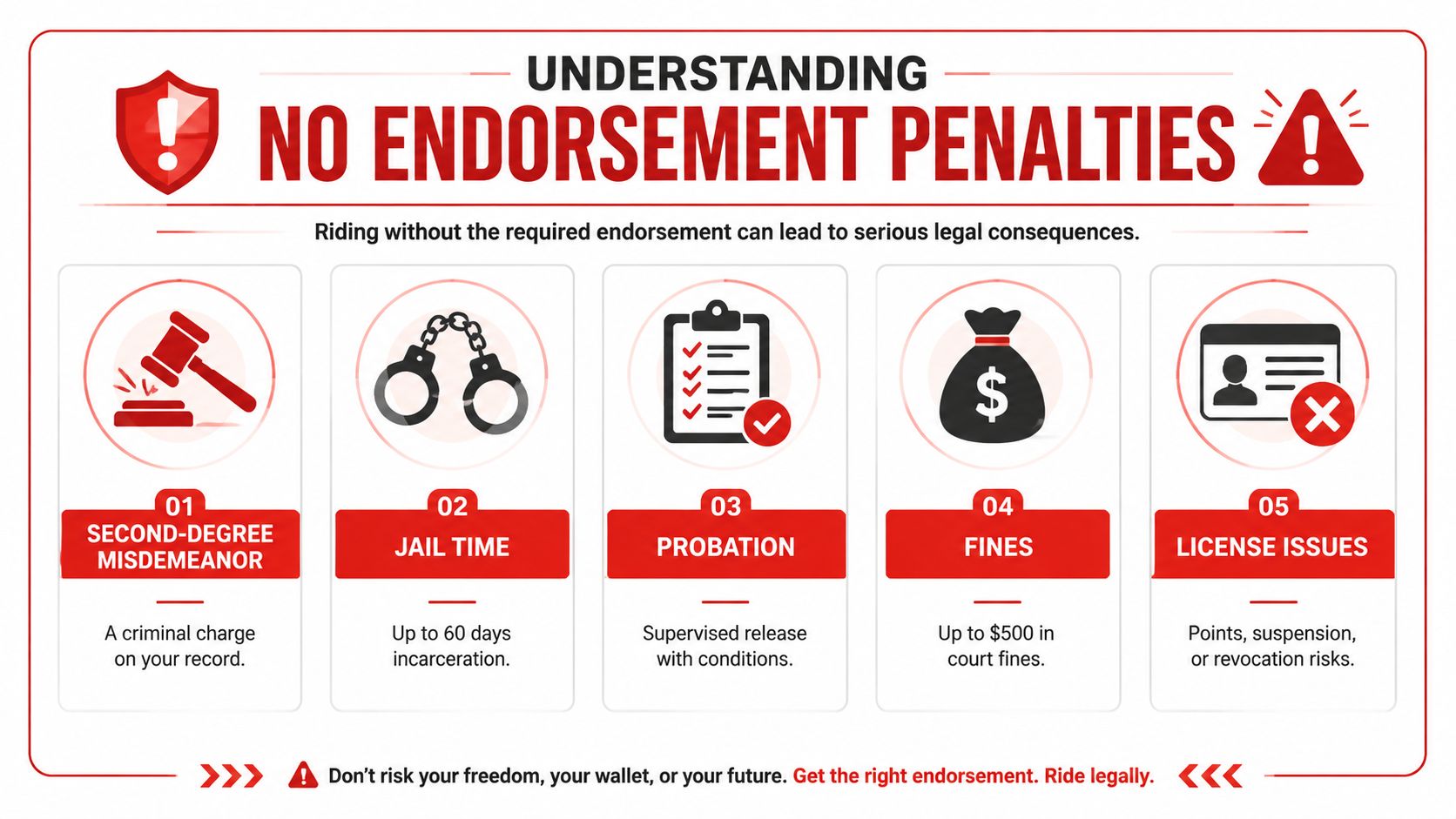
In Florida, riding a motorcycle without the required endorsement can be charged as a second-degree misdemeanor under Section 322.03. That means exposure to jail, probation, fines, court costs, and a criminal record if the case is handled badly. Call it what it is. This is a criminal accusation attached to a traffic stop.
That classification matters more than riders expect. A lot of people pay these citations the same day because they want the problem gone. What they do is hand the state a conviction and give up the chance to challenge the stop, the vehicle classification, the charging decision, or the final outcome.
A quick payment can trigger more than a fine
The court case is only part of the damage.
A conviction can affect your driving history and create added pressure the next time you are cited. If you want to see how related consequences can build from one case to the next, review Florida's traffic ticket point system.
If there was a crash, the missing endorsement can also be used against you in ways that have nothing to do with whether you caused it. Insurance companies and opposing lawyers look for facts they can exploit. A licensing issue gives them one more argument. If your citation came out of a collision, the Florida motorcycle accident guide shows how those parallel problems can develop fast.
Here is the practical point. Riders often treat this charge like something an app can clear with a few taps. That is the wrong approach. A second-degree misdemeanor deserves direct access to a lawyer who can evaluate the stop, the paperwork, the bike involved, and the prosecutor's options before you make a decision that follows you.
The expensive mistake is not the stop itself. The expensive mistake is pleading to a criminal charge before you understand what the state can actually prove.
Judges also do not have to minimize this just because the motorcycle was insured or nobody got hurt. The charge stands on its own. If the officer wrote it cleanly and you respond casually, you can end up with consequences that were avoidable from the start.
Your Immediate Action Plan After Being Cited
What to do today
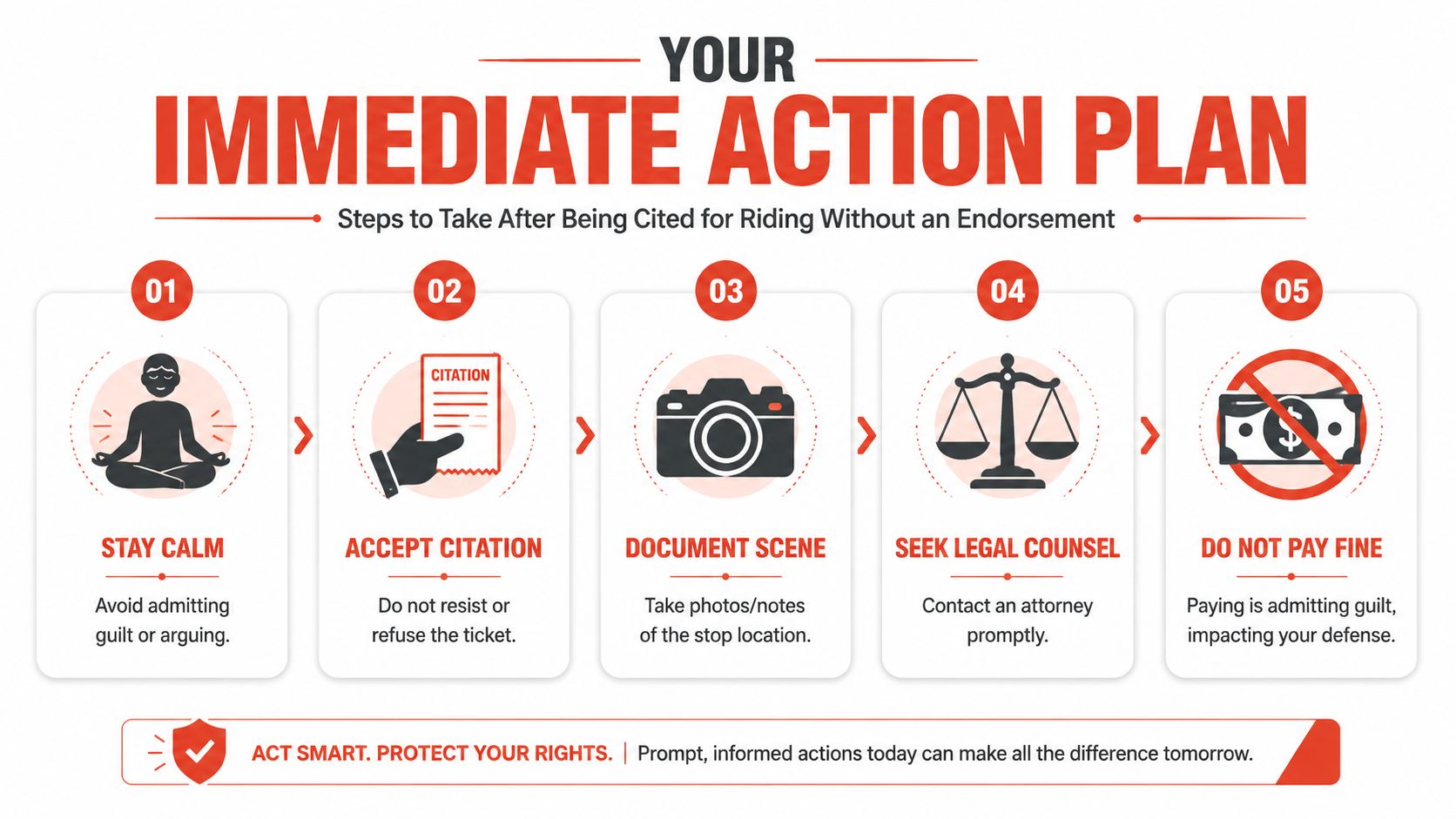
You need a clean response, not a reactive one. Handle it in this order.
Stay quiet about fault. Be polite. Don't explain. Don't try to talk your way out of the charge after the stop is over.
Preserve every document. Keep the citation, any court notice, your current license, registration, and insurance paperwork together.
Write down what happened. Note the time, location, officer comments, and what vehicle you were riding.
Do not pay the citation immediately. A quick payment can close off strategic options.
Get legal advice fast. Delay helps the state, not you.
For riders who were cited after a crash, this broader Florida motorcycle accident guide is worth reviewing because the scene, statements, and documentation can affect more than one legal issue at once.
Fix the licensing issue the right way
If you don't have the endorsement, get compliant. Just do it correctly.
To obtain a motorcycle endorsement in Florida, riders must complete the 15-hour Basic RiderCourse (BRC) and secure the endorsement within a strict one-year grace period after course completion. If the rider fails to do so, the completion card becomes invalid, requiring them to retake the entire safety course, according to the Florida Rider Training Program endorsement requirements.
Use this practical checklist after any citation:
Check your deadline: Court dates and response dates come fast.
Correct the underlying problem: If you're eligible, start the endorsement process.
Follow a proven response process: This guide on what to do when you get a ticket is a good framework for avoiding common mistakes.
Fixing the endorsement issue doesn't erase the charge by itself. It does show initiative and can matter in how a case is approached.
How a Dedicated Attorney Fights This Charge

Defense starts with facts, not excuses
A serious defense doesn't begin with “I didn't know.” It begins with the evidence. What vehicle was involved. How did the officer identify it. What was said during the stop. Was there a crash. Is the state trying to use the licensing issue as proof of negligence when it doesn't belong there.
That last point matters. A key defense strategy involves challenging the proximate cause element. The lack of an endorsement is often inadmissible as evidence of negligence unless a direct causal link to a collision is proven, meaning the charge can be contested even in accident scenarios where the lack of a license did not cause the crash, as discussed in this analysis of defenses involving motorcycle endorsement issues.
That means a disciplined attorney doesn't just react to the citation. The attorney tests the state's assumptions.
Was the machine in the endorsement-required category?
Did the stop lead to statements that should be challenged or limited?
If there was a crash, is the state overreaching by trying to equate no endorsement with fault?
For riders dealing with a broader motorcycle-related case, this resource on working with a Florida motorcycle lawyer gives useful context about how these cases are built and defended.
A short overview of legal strategy can also help frame what skilled defense work looks like in practice:
Direct lawyer access matters
Riders make another costly mistake when they hand a criminally significant case to an automated app, a ticket mill, or a call-center model where they never speak to the lawyer handling the file.
That's a bad fit for a no motorcycle endorsement charge.
You need legal judgment, not canned workflow.
A real defense often turns on details that don't show up in a checkout form. The vehicle category. The rider's licensing history. The timing of course completion. The context of a collision. The court's local tendencies. Those details matter, and they require direct attorney analysis, not chatbot intake and silence.
If you're facing this charge, choose representation where you can speak directly with your attorney by phone or text, get a straight answer, and make informed decisions quickly. That isn't a luxury. In this kind of case, it's the minimum standard you should accept.
Take Control Now and Protect Your Record
You still have options. But options disappear when you freeze, pay blindly, or trust a faceless system to “handle it” without strategy.
A no motorcycle endorsement charge can threaten your record and your license. If there was an accident, the situation is even more sensitive. Florida law does not automatically erase your rights just because you lacked the endorsement. In Florida's comparative negligence system, riders without an endorsement can still sue for damages after an accident, but their recovery may be reduced by their percentage of fault, as explained in this discussion of accident claims involving no motorcycle endorsement. That distinction matters. You are not automatically barred from recovery, and you are not automatically doomed in court.
What matters now is control. Control of your statements. Control of your deadlines. Control of the legal strategy before the case starts controlling you.
Protect the record first. Protect the license next. Fight the charge before it hardens into a conviction.
If you were cited for no motorcycle endorsement in Florida, act now. Visit Ticket Shield, PLLC for a free consultation and a lawyer-led defense focused on one goal: No Points on your license. With Ticket Shield, PLLC, you speak directly to your attorney by phone or text. No middlemen, no corporate answering services, no automated chatbots.
