
Motorcycle Lawyer Florida: Ticket Defense & Rights 2026
Need a motorcycle lawyer Florida? Facing a ticket? Get expert legal defense to protect your license & record. Free consultation from a real attorney.

Yes. In Florida, a motorcycle ticket or crash issue can threaten your license, record, insurance, and income fast. Riders face unique laws, targeted enforcement, and harsher practical consequences. You need a Florida motorcycle lawyer who knows rider-specific defenses and acts before small problems become expensive ones.
You were riding like you always do. Then the lights hit. Maybe the officer said you were weaving. Maybe it was lane usage. Maybe it was exhaust, equipment, speed, or a no-endorsement issue that suddenly turned into a much bigger problem. Now you're staring at a citation, a court date, or an insurance mess and wondering whether this is something you can just pay and move on from.
For Florida riders, that's often the wrong move.
A motorcycle ticket is rarely just a ticket. It can affect your points, your premiums, your driving privilege, and in some jobs, your paycheck. It can also create damaging facts that follow you into a later injury claim. Riders already face outsized danger on Florida roads. Motorcycle accidents in Florida are approximately 30 times more likely to result in death than accidents involving automobiles, according to Florida motorcycle crash statistics discussed here. That risk changes how every rider should think about legal protection.
If you're deciding between direct legal defense and an app, read this short comparison on why a local lawyer can beat automated ticket platforms. Florida motorcycle cases are too fact-specific for chatbots and middlemen.
Table of Contents
Why Do You Need a Specialized Motorcycle Lawyer in Florida
A general traffic approach often fails riders because officers, prosecutors, insurers, and even judges don't always view motorcycle facts the same way they view car facts. You need someone who understands how a rider moves in traffic, how visibility issues affect perception, and how a minor-looking citation can become the backbone of a larger case.
That matters across Florida, whether your case is headed into a local courtroom or tied to a crash investigation. A rider cited after a stop may later find that same allegation being used to question credibility, fault, or judgment.
Why does a rider's case escalate so fast
A rider gets cited for improper lane use. Then the language in the citation starts drifting toward aggressive operation. Then insurance gets involved. Then an employer asks questions. If the case involves a crash, every word in the officer's narrative starts to matter.
Practical rule: Never assume the officer's shorthand matches what actually happened on the road.
Florida riders also live under specific rules in Chapter 316, and those rules are often enforced without much sympathy for the nuances of motorcycle handling. A defense lawyer who knows the riding context can challenge the officer's interpretation instead of just negotiating around it.
Why does specialized defense matter more for motorcycles
Motorcycle cases turn on details that automated systems miss:
Road position matters: A rider may shift within a lane for visibility, surface hazards, or escape space. That can look suspicious to someone who doesn't ride.
Equipment issues get weaponized: Exhaust, lighting, mirrors, and helmet questions often become gateways to broader allegations.
Officer language matters: A poorly written citation can still damage your record if nobody attacks the factual basis.
Court strategy matters: The right defense in one county may not be the right defense in another.
To find a Motorcycle Lawyer Florida riders can trust, focus on someone who understands both the traffic side and the downstream consequences. You don't need vague reassurance. You need a strategic response.
Are You Facing These Common Florida Motorcycle Charges
Near Tampa's Edgecomb Courthouse, riders see the same pattern repeatedly. Stops that begin as a minor observation often turn into layered allegations. That's why you need to know what you're fighting.
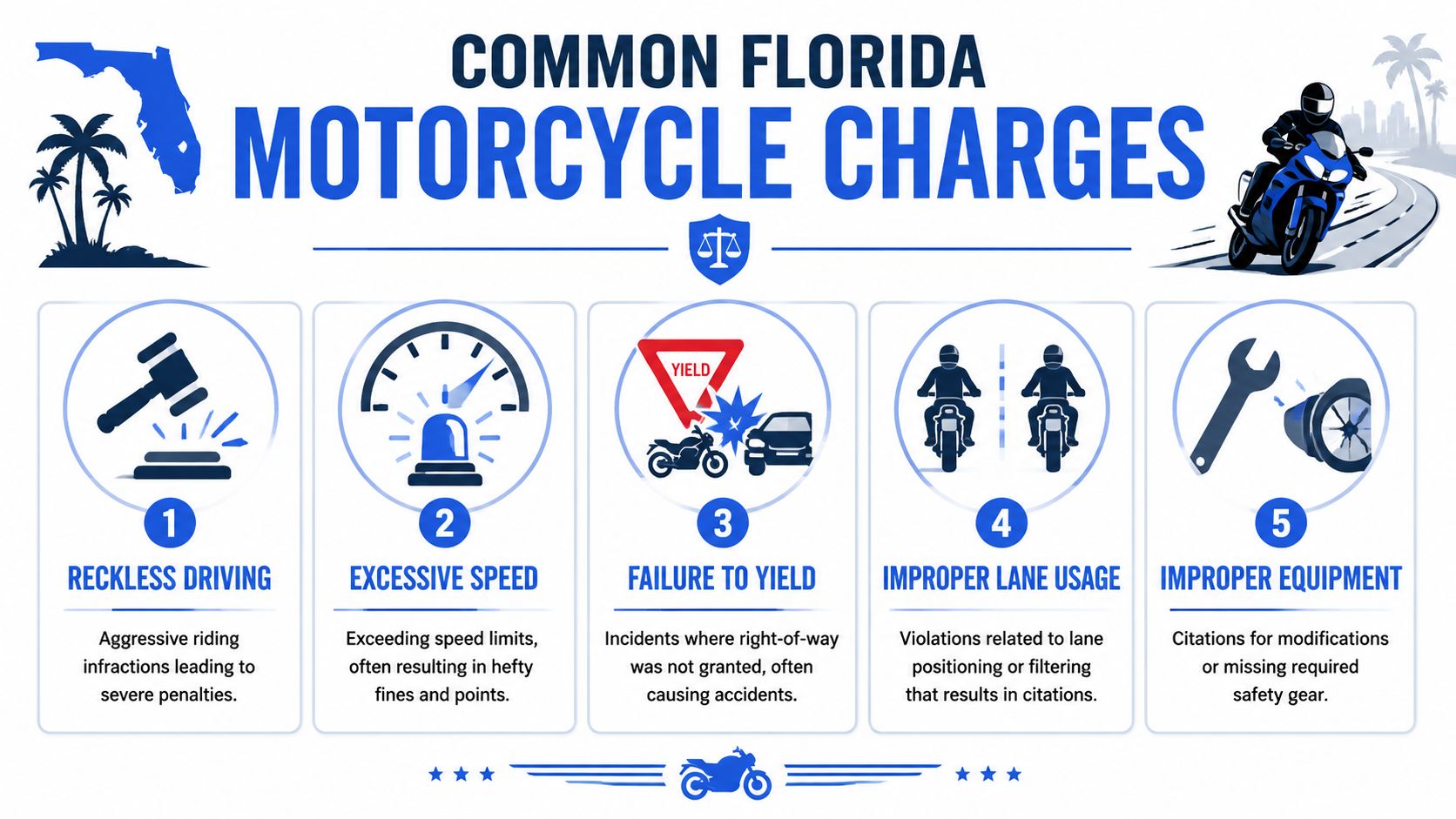
Which charges hit riders most often
Some citations are obvious. Others are inflated.
Charge type | What usually triggers it | Why it matters |
|---|---|---|
Reckless driving | Officer says your movement was aggressive | Can carry serious record and insurance consequences |
Speeding | Radar, pacing, or visual estimate issues | Points and premiums add up fast |
Failure to yield | Merge, intersection, or turn disputes | Often overlaps with crash blame |
Improper lane usage | Positioning, traffic gaps, filtering allegations | Easy to overstate in the report |
Improper equipment | Exhaust, lighting, mirrors, helmet questions | Often used to justify the stop |
Florida's lane filtering rule is a recurring flashpoint. Florida Statute §316.195(1) is frequently cited for the proposition that motorcycles can't pass between vehicles in a line of traffic, and rider-specific enforcement often grows from that starting point, as discussed in this Florida statute reference on motorcycle operation rules.
If you were also cited for endorsement issues, this guide on fighting a Florida no motorcycle endorsement charge is worth reading.
Why do these citations get overcharged
Because motorcycle movement looks different.
A rider may drift within the lane to avoid debris. A rider may accelerate to create space from a tailgater. A rider may adjust position near stopped traffic to stay visible. None of that automatically equals recklessness. But if the officer doesn't understand riding dynamics, the report can turn normal defensive conduct into something far worse.
Riders get cited on appearances. Good defense focuses on mechanics, position, visibility, and proof.
Look closely at any citation tied to Chapter 316. Was the stop based on a real statutory violation, or on assumptions about how motorcycles are "supposed" to move? That question drives many defenses.
Here are the charge patterns I tell riders to take seriously immediately:
A reckless label attached to a minor stop: This often means the officer escalated the language.
Multiple citations from one stop: That usually strengthens the state's position unless someone starts separating weak allegations from stronger ones.
Equipment plus behavior allegations: When both appear together, the stop may have been built backward from suspicion.
Any citation tied to your job: Delivery riders and other working riders can't treat these as routine.
What Makes a Motorcycle Case Legally Different in Florida
The biggest legal difference is simple and brutal. Florida doesn't treat injured motorcyclists like injured car drivers.
Why doesn't Florida no-fault protect motorcyclists
Motorcyclists are exempt from Florida's no-fault system, which means you can't use Personal Injury Protection (PIP) benefits for motorcycle injuries. Instead, you must pursue compensation directly from the at-fault driver, as explained by the Florida Highway Safety and Motor Vehicles insurance guidance.
That changes everything from day one.
A car driver may have an initial no-fault framework. A rider doesn't. Fault, evidence, statements, vehicle positioning, witness accounts, and scene documentation all become urgent immediately. If your crash case is weak on those points, there's no PIP cushion waiting in the background for your motorcycle injuries.
What other Florida rules put riders in a different position
Florida also puts riders under separate practical pressures that many people don't understand until it's too late.
For example:
Financial responsibility is still real: Florida doesn't require the same mandatory liability structure many riders assume, but riders still need to show financial responsibility if a crash occurs.
Helmet rules are narrow: Some riders are exempt, but only under specific conditions.
Claims timing is unforgiving: Delay can compromise a valid case.
Traffic citations spill into injury cases: A bad ticket result can become damaging context later.
If you're sorting through the injury side, this outside resource on motorcycle accident legal advice gives a useful overview of claim-building after a crash.
What matters most is this. In a Florida motorcycle case, nobody is going to simplify the process for you. The insurer won't. The officer won't. The court won't. You need to act as if every statement and every document matters, because it does.
Miami riders especially feel this pressure when cases move through high-volume venues like the Richard E. Gerstein Justice Building. In those environments, weak preparation gets exposed quickly.
What Is the Process for Fighting Your Motorcycle Ticket
The process should be deliberate. Not automated. Not outsourced to a call center. Not reduced to a form submission.
Start by understanding what a real defense looks like.
What should happen first after the stop
The first job is to control the facts before the citation controls you.
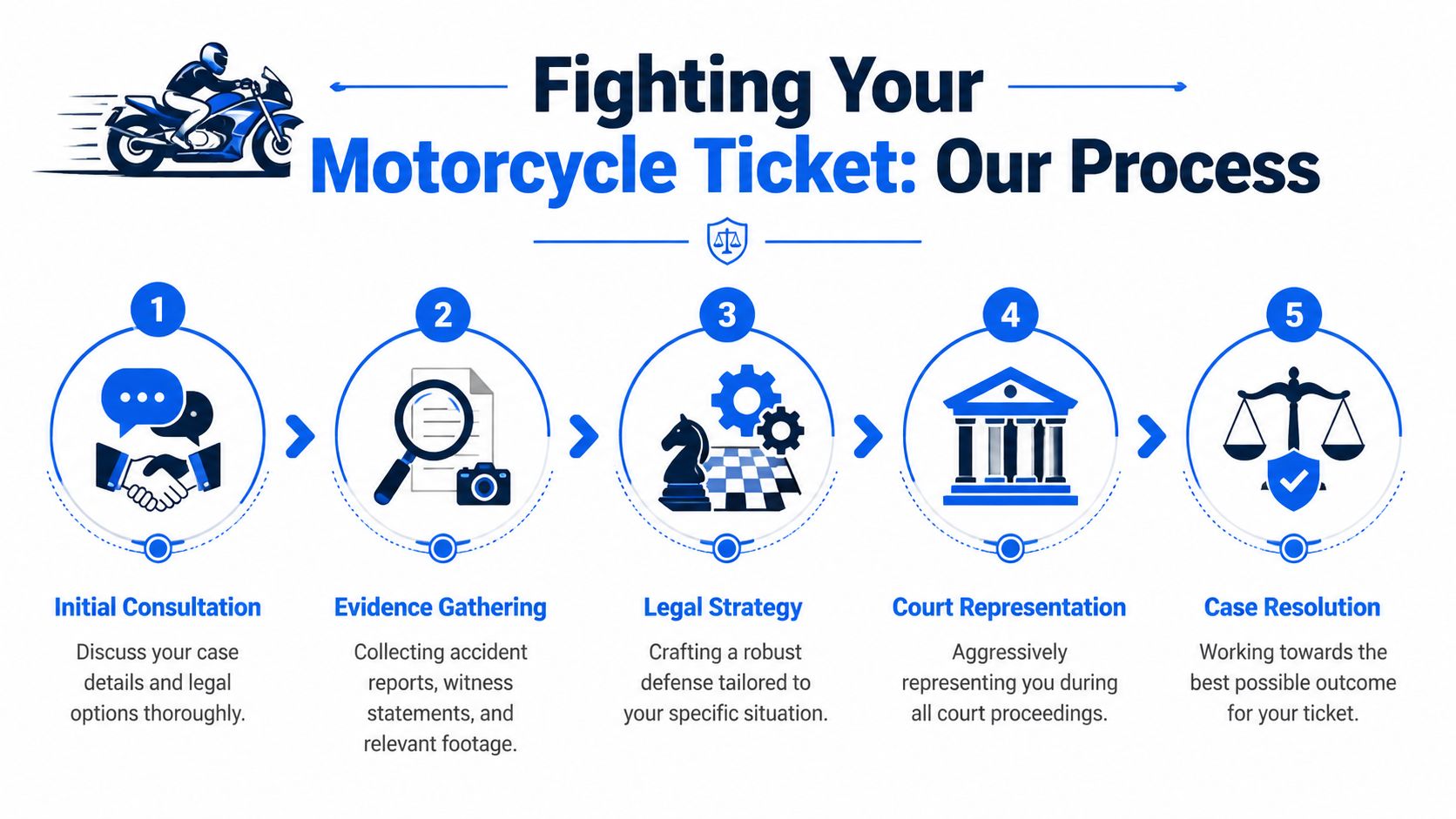
A proper defense usually includes:
A lawyer review of the citation and court deadline
The issue isn't just what the ticket says. It's what the state may try to argue from it.Evidence collection
Photos of the bike, helmet, lighting, lane markings, road conditions, body cam, dash cam, and any witness information matter.Statute-specific analysis
A defense under one part of Chapter 316 won't fit every motorcycle stop.Negotiation or hearing strategy
Some cases should be resolved early. Others should be pushed because the factual basis is weak.Record protection
The goal isn't just ending the case. It's avoiding points, damaging admissions, and preventable insurance fallout.
This overview of how lawyers dismiss traffic tickets in Florida helps explain why details and procedure matter so much.
How does a real defense differ from an app
A real lawyer asks questions that software doesn't.
Were you splitting lanes, or were you stopped and repositioning inside your lane? Did the officer personally observe the equipment issue, or repeat another officer's conclusion? Did the citation use broad language that doesn't match the statute? Was the stop tied to a crash, and if so, who controlled the scene narrative?
Those aren't chatbot questions. Those are defense questions.
Florida riders who work in the gig economy face even more risk. A critical but underserved problem is the vulnerability of gig economy delivery drivers whose employment can be terminated for a single non-vehicular traffic violation or motorcycle-specific citation, as noted in this discussion of Florida motorcycle law concerns for working riders.
That means a "minor" ticket may be an income emergency.
A short explainer can help if you're trying to see how the process unfolds in practice:
The right defense doesn't start with payment. It starts with scrutiny.
How Does Working Directly with a Lawyer Feel Different
The difference is speed, clarity, and control.
When you work directly with a lawyer instead of an automated app or a ticket mill, you stop wondering who's handling your case. You know. You can ask direct questions. You can send the photo, the citation, the court notice, or the officer's narrative by phone or text and get a legal answer instead of a scripted update.

What changes when you can text or call your lawyer
Here is what riders usually notice first:
Answers come faster: You don't wait on a support queue when a deadline or hearing notice appears.
Facts stay cleaner: You can correct a misunderstanding before it hardens into the defense file.
Strategy gets personalized: A rider with a commercial or gig-based livelihood has different priorities than someone with a one-time citation.
Stress drops: That matters more than people admit.
If you want to know what a serious first conversation should cover, this page on a criminal defense attorney consultation in Florida is a useful benchmark.
Why does speed of communication matter in Florida courts
Because Florida doesn't reward delay.
Florida gives you two years to file a personal injury lawsuit arising from a motorcycle accident under §95.11, and if you miss that window, you lose the right to seek compensation, according to the Florida statute on limitations periods.
That rule affects more than lawsuits. It shapes how quickly a lawyer should preserve evidence, evaluate exposure, and position your case. Delay makes records harder to get, memories weaker, and advantage smaller.
In busy venues like the Orange County Courthouse in Orlando or the Broward County Judicial Complex in Fort Lauderdale, fast and direct communication isn't a luxury. It's case management. Riders who can speak directly with counsel are better positioned than riders stuck behind intake staff, status portals, or automated messages.
When the facts are moving fast, access to your lawyer is part of the defense.
What Are Your Immediate Next Steps
If you just got stopped, cited, or dragged into a crash-related allegation, here's the answer. Act now. Don't wait to see if it "works itself out."
Immediate Steps to Take
Do not pay the ticket yet: Paying can close off defenses and may create consequences you didn't intend.
Document everything: Save the citation, court notice, helmet photos, bike photos, dash cam footage, repair records, and screenshots of anything tied to the stop.
Write down your memory now: Record where you were, traffic conditions, what the officer said, and where each vehicle was positioned.
Protect your job if you ride for income: If you deliver for an app-based platform, treat even a non-crash citation as a threat to your account.
Don't guess about Chapter 316: Motorcycle cases often turn on narrow statutory details, not common-sense assumptions.
Get legal advice immediately: Fast review can prevent small mistakes from becoming record problems.
If your situation also involves a crash, this outside resource on Mattiacci Law's motorcycle accident advice offers a practical checklist for the injury side.
You should also review this guide on what to do when you get a ticket in Florida. It's a good starting point for protecting your record before you make an avoidable decision.
The goal is simple. No points. No unnecessary admissions. No preventable damage to your license, insurance, or work. If you're looking for a Motorcycle Lawyer Florida riders can rely on, choose direct legal protection over apps, middlemen, and mass-processing systems. Riders need precision.
If you want a lawyer-led defense built around the No Points goal, contact Ticket Shield, PLLC now for a free consultation. You'll speak directly with a real Florida attorney by phone or text, not a chatbot, not a middleman, and not a ticket mill.
