Florida No Motorcycle Endorsement Laws and Defense 2026
No motorcycle endorsement - Cited for no motorcycle endorsement in Florida? This misdemeanor carries penalties. Learn about your defense options and how our
Yes. In Florida, a no motorcycle endorsement charge is usually a criminal misdemeanor, not a simple ticket. If you pay it without a defense, you can end up with a conviction, points, higher insurance, and a record that follows you long after the stop.
You were likely expecting a fine.
Then the officer handed you a citation, maybe mentioned court, and now you're trying to figure out whether this is something you can just pay online and move on from. It isn't. If you were riding a motorcycle that requires an endorsement and you didn't have one, you're dealing with a criminal traffic matter.
That changes everything.
A no motorcycle endorsement charge puts you in a different category than a routine civil violation under Chapter 316. Florida traffic law includes ordinary infractions and much more serious cases that can lead to court, a prosecutor, and a permanent record. If you don't know that distinction yet, read what counts as a criminal traffic violation in Florida. It matters right now because your next move can either protect your license or make the problem worse.
If this happened on your way to work, during a delivery shift, or on a weekend ride, the legal system doesn't care why you were on the bike. It cares whether you were legally endorsed to operate it. That's why your mindset needs to change immediately from "How much is this ticket?" to "How do I defend this charge?"
Table of Contents
Introduction You Have a Criminal Traffic Violation Not a Simple Ticket
If you got stopped in Florida for no motorcycle endorsement, you're not facing a casual payable citation. You're facing a charge that can put you in criminal court, expose your record, and threaten your license.
That shock hits people fast. One minute you're pulled over on a bike. A few minutes later you're looking at paperwork that sounds more serious than a speeding ticket because it is more serious than a speeding ticket.
A lot of riders make the same early mistake. They assume this is just another traffic fine. They wait. They talk themselves into thinking the court will be lenient if they explain they didn't know the rule. Then the deadline closes in, and the case is already moving.
Practical rule: If the charge involves operating a motorcycle without the required endorsement, treat it like a criminal case from day one.
You should also understand the practical reality. Prosecutors and judges hear excuses every week. "It was just a scooter." "I had a regular license." "I was only going a short distance." None of that fixes the legal issue once the citation is written.
What helps is a fast, strategic response. Preserve the facts. Avoid admissions. Get a defense plan in place before your court date sneaks up on you.
What Is a No Motorcycle Endorsement Charge in Florida
A lot of riders hear this charge and assume it means they forgot a license add-on. That reading will hurt you. Florida treats riding the wrong vehicle without the required endorsement as a criminal offense, and the fight usually starts with one basic question. Was the machine you were operating legally a motorcycle that required an endorsement?
Under Florida Statute 322.03(4), a person who operates a motorcycle without the proper endorsement on a driver license can be charged with a second-degree misdemeanor. The key issue is whether the vehicle falls into the category that requires the endorsement. If you need a practical licensing breakdown, review Florida motorcycle endorsement requirements for scooters, mopeds, and motorcycles.
Which vehicles trigger the charge
The vehicle classification matters as much as the stop itself.
In general, Florida draws the line at over 50cc. A moped or scooter at or below that threshold may fall under different rules. Once the engine size goes above it, the state expects a motorcycle endorsement on your Class E license. Riders get cited because they rely on appearance instead of legal classification. A scooter-style body does not protect you if the engine size puts it in the motorcycle category.
Florida law also applies this requirement to covered two-wheeled and three-wheeled motor vehicles. Autocycles are treated differently under a separate carveout.
Here is the practical breakdown:
Vehicle status | General Florida rule |
|---|---|
50cc or below | Often treated under ordinary driver license rules |
Over 50cc | Motorcycle endorsement required |
Autocycle | Exempt under a separate statutory exception |
Who gets charged under this law
This citation shows up in predictable situations. New Florida residents get stopped after moving here and assume their regular license is enough. Delivery riders get rushed, buy a larger scooter or bike, and never fix the endorsement issue. Weekend riders borrow or buy a bike from a friend and figure a valid Class E license covers them.
It does not.
Temporary visitors may have reciprocity protection from another state. Florida residents do not get open-ended time to put this off after relocating here. That fact matters, and officers write these cases every day.
One more point. The officer's description of the vehicle is not always accurate. Engine size, registration records, manufacturer classification, and the exact wording on the citation can all matter. That gives a lawyer something real to examine, which is exactly why this charge should be defended like a criminal case instead of handled like a routine traffic payment.
What Are the Real Penalties for a Conviction
You walk into court thinking this is a licensing mistake and walk out with a criminal conviction. That is the mistake that costs people the most.
The direct criminal penalties are serious
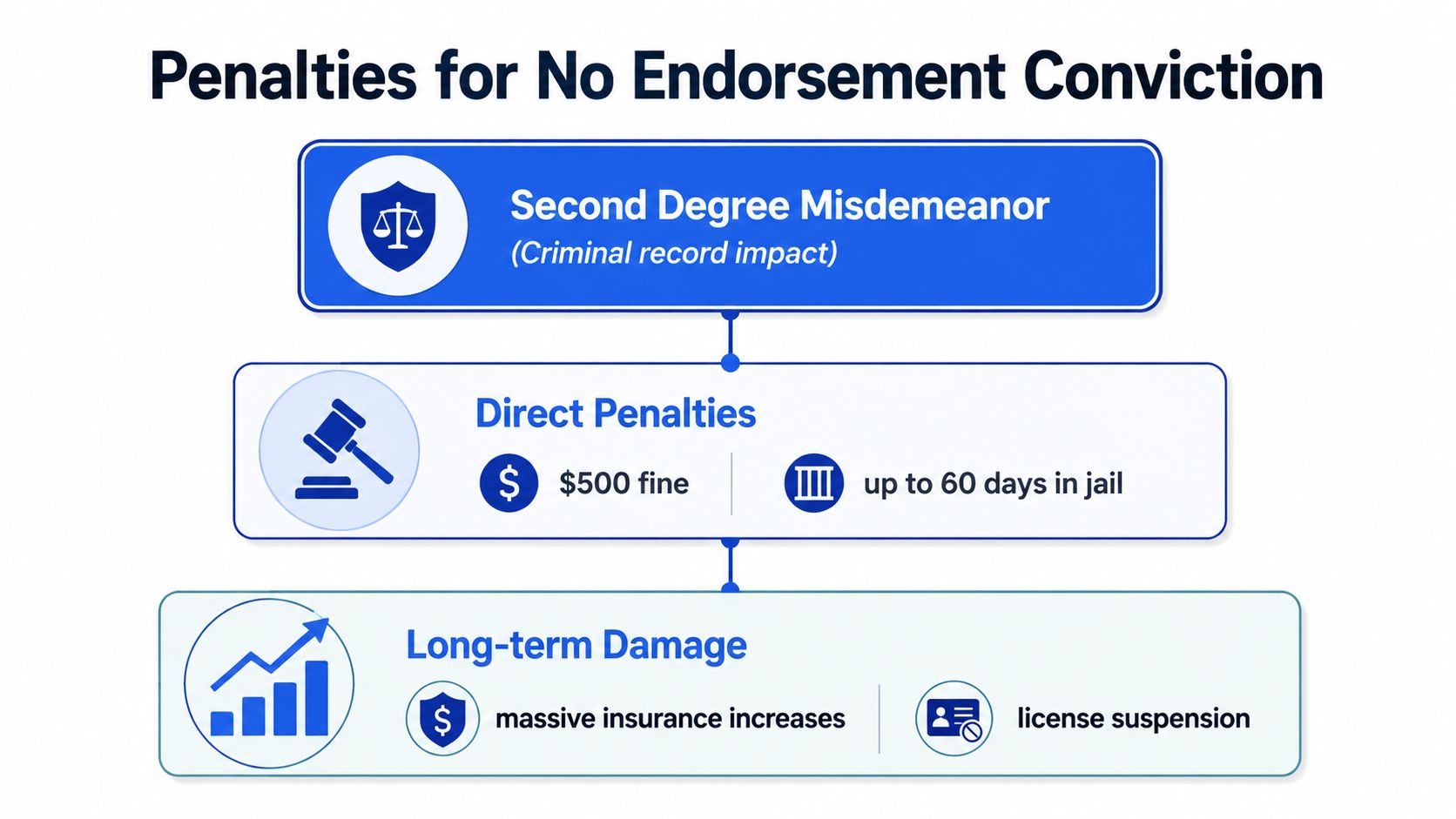
Florida treats no motorcycle endorsement as a second-degree misdemeanor. A conviction can bring up to 60 days in jail, up to $500 in fines, probation, court costs, and a criminal record.
That should control your next move.
In a courthouse like the Edgecomb Courthouse in Tampa, this case is handled like a criminal prosecution. A prosecutor is involved. A judge expects you to appear and address the charge properly. If you treat it like a payable ticket, you put yourself in a much worse position than necessary.
Many riders fixate on the fine. That is shortsighted. The criminal record is the problem.
The fallout outside the courtroom can hit harder
A conviction can follow you long after the court date is over. Employers run background checks. Landlords do too. Professional licensing boards care about criminal cases, even misdemeanor ones. If you hold a job that depends on driving, security clearance, military status, or internal compliance review, this charge can create trouble fast.
Insurance can become its own fight. A carrier may question coverage after a stop or crash involving an unendorsed rider. If the stop led to other evidence, a lawyer may need to attack the case early through tools like a motion to suppress evidence in traffic court.
The practical consequences often include:
A criminal history entry that shows up on background checks
License consequences if your driving record is already under pressure
Employment problems for jobs that require driving or a clean record
Insurance trouble after a citation, crash, or policy review
Higher overall cost once fines, court costs, missed work, and defense expenses pile up
This is why I tell clients the same thing every time. Your goal is not to shave down the fine. Your goal is to keep a criminal conviction off your record.
What Are Your Legal Defenses Against This Charge
Start with this assumption. The officer wrote the ticket. That does not mean the state can prove the criminal charge.
A no motorcycle endorsement case is often decided by small details that get missed at the roadside and exposed in court. Your defense should focus on whether the stop was lawful, whether the officer identified the right vehicle and rider, and whether the state can prove your license status on that specific date.
A defense starts with the stop and the state's proof
If the officer lacked a valid reason to stop you, the case may be vulnerable from the beginning. A weak stop can block key evidence from being used. If you want the legal background, read this guide on what a motion to suppress evidence means in traffic court.
Then look at the elements the prosecutor must prove. That includes who was operating the motorcycle, whether the vehicle legally required an endorsement, and whether your driving record showed the required endorsement at the time of the stop. If any one of those points is shaky, the case is not as clean as the citation makes it look.
A lawyer should also examine the charging documents line by line. Criminal traffic cases are full of sloppy paperwork, missing records, and avoidable officer errors.
Common defense angles include:
Unlawful stop: The officer had no proper basis to pull you over.
Wrong vehicle classification: The state cannot clearly show the bike required a motorcycle endorsement.
Identity problems: The evidence does not firmly establish that you were the rider.
License record issues: The state cannot present clear, admissible proof of your endorsement status on the date charged.
Defective paperwork: The citation or court filing contains errors that affect the prosecution.
Why early payment can wreck a winnable case
People hurt themselves here all the time. They see a ticket, assume it is routine, and pay it before any lawyer reviews it.
That is the wrong move in a criminal traffic case. Payment can cut off defenses, hand the state an easy result, and leave you with a misdemeanor outcome you may have avoided.
A charge that looks open-and-shut on the roadside can fall apart when the prosecutor is forced to prove every element with competent evidence.
Some cases should be challenged hard. Some should be pushed toward a reduction or another negotiated outcome that protects your record. You do not know which path fits your case until someone with criminal traffic court experience reviews the stop, the documents, and the state's proof.
That is the point many riders miss. This is not a simple infraction where an app helps you click through options. It is a misdemeanor criminal charge. Build your defense like one.
Your Immediate Steps After Getting This Ticket
You get stopped on the way home, glance at the citation, and assume you can deal with it later. That mistake costs people cases.
A no motorcycle endorsement charge in Florida deserves a same-day response because it is a misdemeanor traffic case, not routine ticket paperwork. Your job in the first day is simple. Protect the case, protect your record, and stop giving the state extra evidence.
What to do in the first day
Start here:
Do not pay the ticket online: In a criminal traffic case, quick payment can close off defense options and make a bad result easier to lock in.
Put every paper in one place: Save the citation, court notice, bond paperwork, tow receipt, and anything else you received during or after the stop.
Write down the facts while they're fresh: Note the time, location, weather, reason given for the stop, what the officer asked, and what you said.
Stop discussing the incident: Do not explain the stop to your insurer, your employer, or on social media.
Check your court date immediately: Missing a required appearance creates a second problem you do not need.
Verify your license record: Confirm what class of license you hold and whether any endorsement appears.
Talk to a lawyer fast: Early review gives your lawyer more room to control the case instead of reacting to it.
If you need a practical starting point, read what to do when you get a Florida ticket. Use it as a checklist, then treat this case with more urgency because the exposure is criminal.
Bring documents. Bring facts. Do not bring excuses.
Fix the licensing issue before you get stopped again
You have two separate problems now. The pending criminal charge is one. Your licensing status is the other.
If you plan to keep riding, start the process to become properly endorsed as noted earlier in this article. Taking care of that does not erase the current case, but it can prevent a second stop from making your situation worse. Repeated violations are hard to explain away and harder to negotiate.
This also matters outside court. If your job involves reporting obligations, internal reviews, or regulated work, a formal violation can create trouble that has nothing to do with points or fines. The Smart Receipts guide to corporate compliance gives a plain-English explanation of why documented violations can trigger workplace scrutiny.
Your priorities are straightforward:
Do not plead this out by mistake.
Get your license situation corrected.
Avoid another stop before the case is resolved.
Why a Lawyer Is Essential for This Criminal Charge
This is the part many riders get wrong. They treat a criminal traffic charge like a customer-service problem. It isn't. It's a legal problem that requires legal judgment.

This is not the place for an app or middleman
Automated apps and ticket mills are built for volume. Your case is not a volume problem. It's a criminal charge with facts, court procedure, negotiation strategy, and record consequences.
If you hire counsel for this, you should know who is responsible for the defense, whether you can speak directly to that lawyer, and whether that lawyer is evaluating motions, proof issues, and record protection. That direct-attorney model matters even more when the case can affect employment, licensing, or internal workplace reviews. If you deal with compliance-sensitive work, this plain-English Smart Receipts guide to corporate compliance is useful for understanding why documentation and formal violations can create consequences beyond the courtroom.
Florida also allows points exposure here. A conviction for unlicensed motorcycle operation can result in 4 points on your license under Florida Statute 322.61, according to the legal discussion linked earlier in the defenses section. For many drivers, that can be enough to push a fragile license toward suspension.
What lawyer-led defense actually changes
A lawyer can evaluate whether the stop was valid, whether the evidence is sloppy, whether the charge can be reduced, and whether you can avoid court personally in the process. If you're comparing options, review what Florida traffic ticket lawyers actually handle in serious traffic cases.
One practical option is Ticket Shield, PLLC, a Florida law firm that handles traffic and criminal traffic defense statewide through a lawyer-led model where clients communicate directly with their attorney by phone or text. That's a meaningful difference from systems that route you through intake staff, call centers, or chatbot-style updates.
You want one objective. No points if possible. No conviction if possible. No unnecessary damage to your record.
That's the right target.
If you were charged with no motorcycle endorsement in Florida, act now. A fast defense can protect your record, your license, and your insurance. Visit Ticket Shield, PLLC for a free consultation and fight for the No Points outcome.