New driving law in florida: Key rules and penalties
Learn about the new driving law in florida, including hands-free rules and penalties, and how to stay compliant.
Florida's traffic laws are always evolving, but a new driving law in Florida is making waves that will affect everyone from daily commuters to commercial drivers. These updates are bringing in much stricter penalties for things like extreme speeding and distracted driving, all part of a statewide push to make our roads safer. Getting a handle on these new rules is the best way to protect your license and steer clear of expensive tickets.
Decoding The New Florida Driving Law At A Glance
Trying to keep up with Florida’s traffic laws can feel like merging onto I-95 during rush hour in Miami-Dade—you have to pay close attention. With some major updates now in effect, it's essential to understand what's changed, how it impacts your daily drive, and what the new penalties look like. The main focus of this new legislation is to crack down on two of the most dangerous behaviors on the road: excessive speeding and distracted driving.

For a long time, many serious violations were treated as simple civil infractions. But the state is now reclassifying certain offenses as criminal acts, which dramatically raises the stakes for every driver in Florida. This shift means that something that used to just be a fine and some points could now land you with a mandatory court appearance, a criminal record, and even jail time.
Understanding The Core Changes
These aren't just minor tweaks; they represent a fundamental change in how Florida enforces traffic safety. The two biggest updates every driver needs to know about are:
Criminalization of Extreme Speeding: Driving at extremely high speeds isn't just a costly ticket anymore. The new law sets specific speed thresholds that turn a speeding violation into a criminal offense.
Stricter Hands-Free Mandates: Florida has had laws against texting and driving for a while, but the new rules are pushing toward a true hands-free requirement. It is now illegal to even hold a wireless device while driving through certain zones.
These changes are designed to be a powerful deterrent against reckless behavior. For a deeper dive into past and present regulations, you can learn more about Florida's state traffic laws in our detailed guide. The ultimate goal is to make all our roads, from major highways to local streets, safer for everyone.
A conviction for a traffic violation under these new laws could follow you for years. It's more important than ever to know your rights and understand the potential impact on your driving record and insurance rates.
To give you a crystal-clear picture of these updates, we've put together a table that offers a side-by-side comparison of the old rules versus the new ones. It breaks down the key differences in penalties, points, and legal requirements, giving you a quick summary of what to expect out on the road.
Florida Driving Law Changes: A Quick Comparison
This table compares old and new regulations for key traffic violations, highlighting changes in penalties, points, and requirements.
Violation Type | Previous Regulation | New Regulation (Effective Date) | Key Changes |
|---|---|---|---|
Extreme Speeding (50+ MPH Over) | Civil traffic infraction, fine, and points. | Criminal offense requiring a mandatory court appearance. | Elevates the violation from a civil matter to a criminal one, carrying potential jail time. |
Hands-Free Device Usage | Prohibited texting while driving (primary offense). | Prohibits holding a wireless device in school zones and active work zones. | Expands the scope of distracted driving laws to a stricter hands-free mandate in designated areas. |
"Move Over" Law | Required drivers to move over or slow down for emergency and service vehicles. | Expands to include any disabled vehicle displaying hazard lights. | Broadens driver responsibility to protect all stopped motorists on the roadside, not just official vehicles. |
Penalties for Repeat Offenders | Fines and points increased with subsequent offenses. | Can lead to license revocation and significant jail time for criminal violations. | Introduces much harsher penalties for habitual violators under the new criminal statutes. |
As you can see, the landscape has changed significantly. What might have been a simple mistake in the past now carries far more weight, making a proactive defense more critical than ever.
The Hands-Free Mandate and Distracted Driving
Florida is getting much tougher on distracted driving, recognizing it as one of the biggest dangers on our roads. The state is making a hard push toward a complete hands-free mandate, which means the days of casually holding your phone while driving are officially numbered. This is a huge shift aimed at cutting down the number of accidents caused by drivers who simply aren't paying attention.
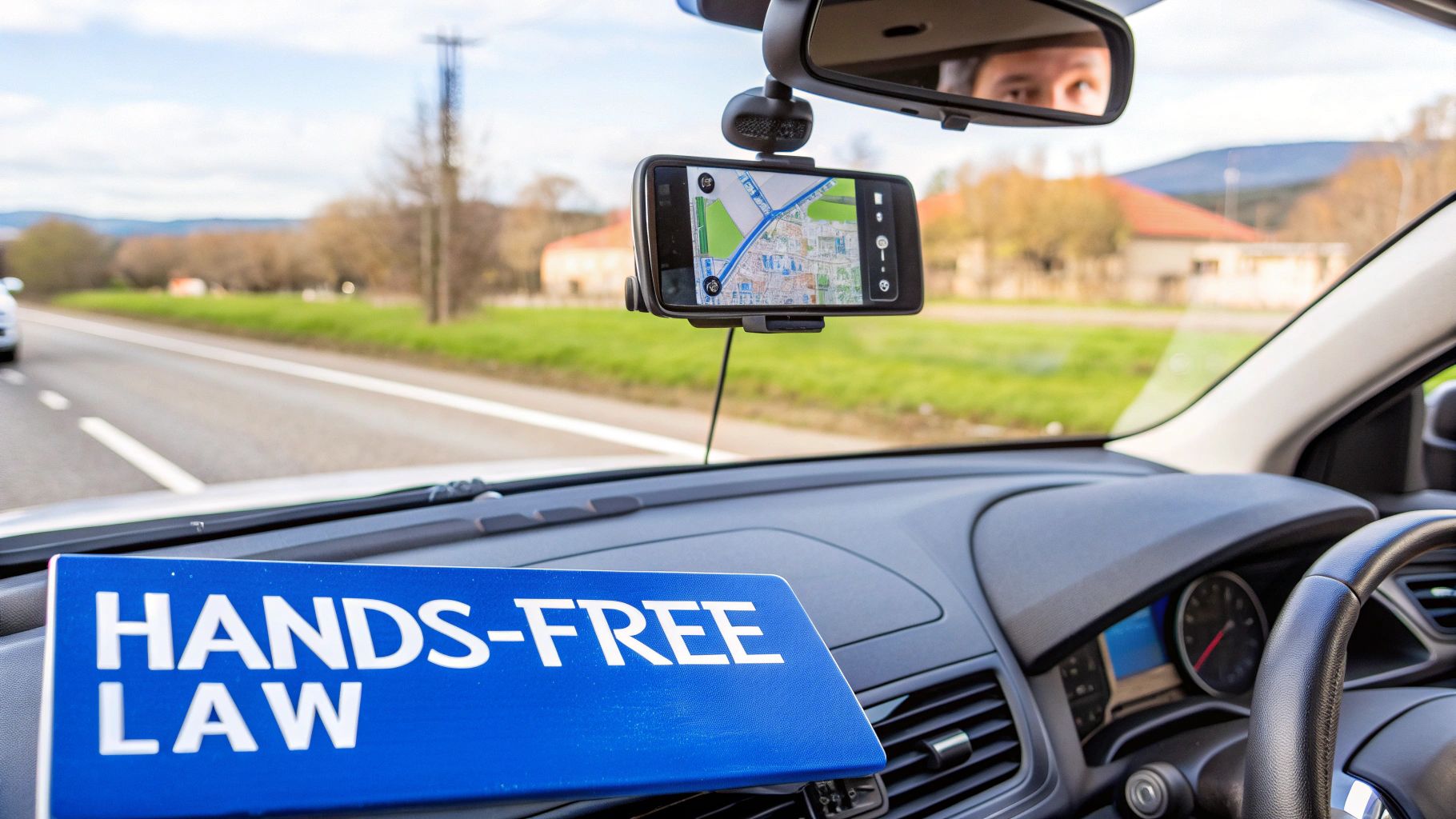
This new driving law in Florida zeroes in on the physical act of holding a device. It’s not just about whether you were texting anymore. Now, in certain areas, simply having that phone in your hand while the car is moving is enough to get you a ticket. For drivers in bumper-to-bumper traffic in places like Miami-Dade County, this is a critical change that demands constant awareness.
What Is Prohibited vs. Permitted
Knowing the difference between what you can and can’t do is the key to staying on the right side of the law. The goal here is simple: eliminate the need to manually fiddle with your phone, which is a massive source of distraction.
Under the new rules, these actions are prohibited:
Texting or emailing: Manually typing, sending, or even reading messages is a definite no-go.
Holding your phone to your ear: You can still talk on the phone, but it has to be through a hands-free setup.
Scrolling social media or browsing: Any activity that requires you to hold and poke at your device is off-limits.
Watching or recording videos: This is considered an extreme level of distraction and a clear-cut violation.
But the law isn't anti-technology; it just demands you use it safely. Permitted uses include:
Using a mounted GPS: Your phone is fine for navigation as long as it’s locked into a dashboard or windshield mount.
Making calls via Bluetooth: Hands-free systems, whether they're built into your car or an accessory, are perfectly legal.
Using voice commands: Activating Siri or Google Assistant to send a text or make a call is an acceptable—and much safer—alternative.
The core principle is simple: if you need to use your hands to operate the device, it's likely a violation. The goal is to keep your hands on the wheel and your eyes on the road.
Escalating Penalties for Violations
The consequences for breaking the hands-free law get steeper with each offense, making it an expensive habit for repeat offenders. Florida's Hands-Free Driving Law, which is set to take full effect in 2026 under Senate Bill 1152, is a major move to combat one of the state's most significant road hazards. In 2024 alone, distracted driving led to nearly 300 fatalities and over 2,200 serious injuries across Florida's busy highways.
First-time violators are looking at fines starting at $150. That jumps to $250 for a second offense, and a $500 fine plus a 90-day license suspension for the third. These penalties get even more serious if you're caught in a designated safety zone.
Increased Enforcement in School and Work Zones
The law puts a special emphasis on protecting vulnerable areas like school zones and construction sites. In these designated areas, holding a wireless device is a primary offense. That means an officer can pull you over just for that—you don’t have to be speeding or committing any other infraction.
This ramped-up enforcement reflects the massive risk to children and roadside workers in these zones. Getting a ticket here almost always means higher fines and more points on your license. For more details on how these violations are handled, check out our guide on what to do after receiving a texting and driving ticket. Our goal is to protect your license and record; remember that past results do not guarantee future outcomes.
How Florida Is Handling Extreme Speeding
Florida is getting much tougher on high-speed driving, and a new driving law in Florida is completely changing the consequences for anyone who treats our public roads like a private racetrack. Before, even a ticket for extreme speeds was usually just a costly civil infraction. Not anymore. The state has drawn a clear line in the sand, turning what was a simple citation into a serious criminal offense.
This shift means that drivers on major highways like I-95 through Broward County have to be more careful than ever. The stakes are no longer just about fines and points; a single instance of extreme speeding can now lead to a mandatory court appearance, the risk of jail time, and a permanent mark on your criminal record.
From Civil Infraction To Criminal Offense
The biggest change is how extreme speeding is classified. The law now sets specific thresholds that automatically bump a speeding ticket from a civil matter into a criminal one. This is designed to go after drivers who show a blatant disregard for public safety.
The state’s new speeding law, set to take effect in the summer of 2025, is a significant change. Driving 50 mph or more over the posted speed limit now requires a court appearance. Hitting 100 mph or higher anywhere is automatically considered a "threat to safety." This violation can trigger fines up to $1,000, potential jail time of up to 90 days for repeat offenders, and the creation of a permanent criminal record.
This is a critical distinction because a criminal conviction carries far more weight than a civil ticket. It can impact:
Employment Opportunities: Many employers run background checks, and a criminal record can be a major red flag.
Insurance Premiums: A criminal speeding conviction will almost certainly cause your insurance rates to skyrocket, if your provider doesn't drop you altogether.
Professional Licenses: Certain careers that require a clean record could be in serious jeopardy.
Consequences For Repeat Offenders
Florida is saving its harshest penalties for those who repeatedly engage in this dangerous behavior. The law creates an escalating scale of consequences, making sure that repeat violators face a lot more than just another fine.
For a second or subsequent criminal speeding offense within five years, the penalties get much more severe. A driver could face a driver’s license revocation lasting from six months to a year, on top of higher fines and a greater chance of jail time. This approach shows the state is serious about getting habitual high-speed offenders off the road. For more on how these new statutes are being put into practice, you can learn more about Florida's 'Super Speeder' law in our detailed article.
Related Safety Measures: The Expanded Move Over Law
To complement the crackdown on speeding, Florida has also broadened its "Move Over" Law to make our roadsides safer for everyone. This is all part of a wider effort to make drivers more aware of their surroundings and more responsible for the safety of others.
The expanded law now requires drivers to move over or slow down for any disabled vehicle that has its hazard lights on—not just emergency or service vehicles anymore. This simple change provides a crucial safety buffer for stranded motorists who are just waiting for help.
Key Takeaway: The updated "Move Over" Law isn't just for police cars and tow trucks. If you see any vehicle on the shoulder with its flashers on, you are legally required to give them space. Failing to do so can result in a ticket and points on your license.
These interconnected laws show a clear and decisive push by Florida lawmakers to create a culture of safety and accountability on our roads. Understanding these changes is the first step in protecting your driving record and avoiding the severe consequences that now come with high-risk driving.
New Rules for Young Drivers: A Guide for Florida Families
Florida is getting serious about how our youngest drivers learn, and it’s a change that affects families across the state. As part of a major update to driving laws, the state is rolling out tougher training requirements designed to build a safer foundation for teens behind the wheel. These changes are a direct response to the high crash rates among new drivers, ensuring they get more hands-on practice and better education before they ever get a license.
If you have a teenager counting down the days until they can drive, you need to know exactly what these new steps are. Understanding the updated process is the key to making sure everything goes smoothly.
The old way of getting a license is out. This new path is more involved, built to prepare teens for the real world of driving—from hectic intersections in places like Broward County to the constant temptation of distractions.
Stricter Educational and Practice Hour Mandates
The biggest shift is a complete overhaul of the initial training. New teen driver laws taking effect on July 1, 2025, are designed to curb the crash statistics among young motorists.
Teens aged 15 and up now have to complete a six-hour comprehensive driver education course. This replaces the old four-hour drug and alcohol class and dives much deeper into defensive driving, traffic signs, and the real dangers of distracted and impaired driving. On top of that, they now need a log of 50 hours of supervised driving practice, with at least 10 of those hours happening at night.
This isn't just about checking a box; it’s about making sure teens gain practical, real-world skills under a watchful eye. The new requirements include:
Expanded Driver Education: The new six-hour course goes far beyond the basics, covering critical safety topics that the old four-hour program only skimmed.
Increased Supervised Driving: Forcing teens to log 50 total hours, with 10 at night, means they’ll have to practice in all sorts of conditions. That’s how you build real skill and confidence.
This flowchart breaks down just how quickly the penalties for a single mistake—like speeding—can escalate. It’s a critical lesson for every new driver.
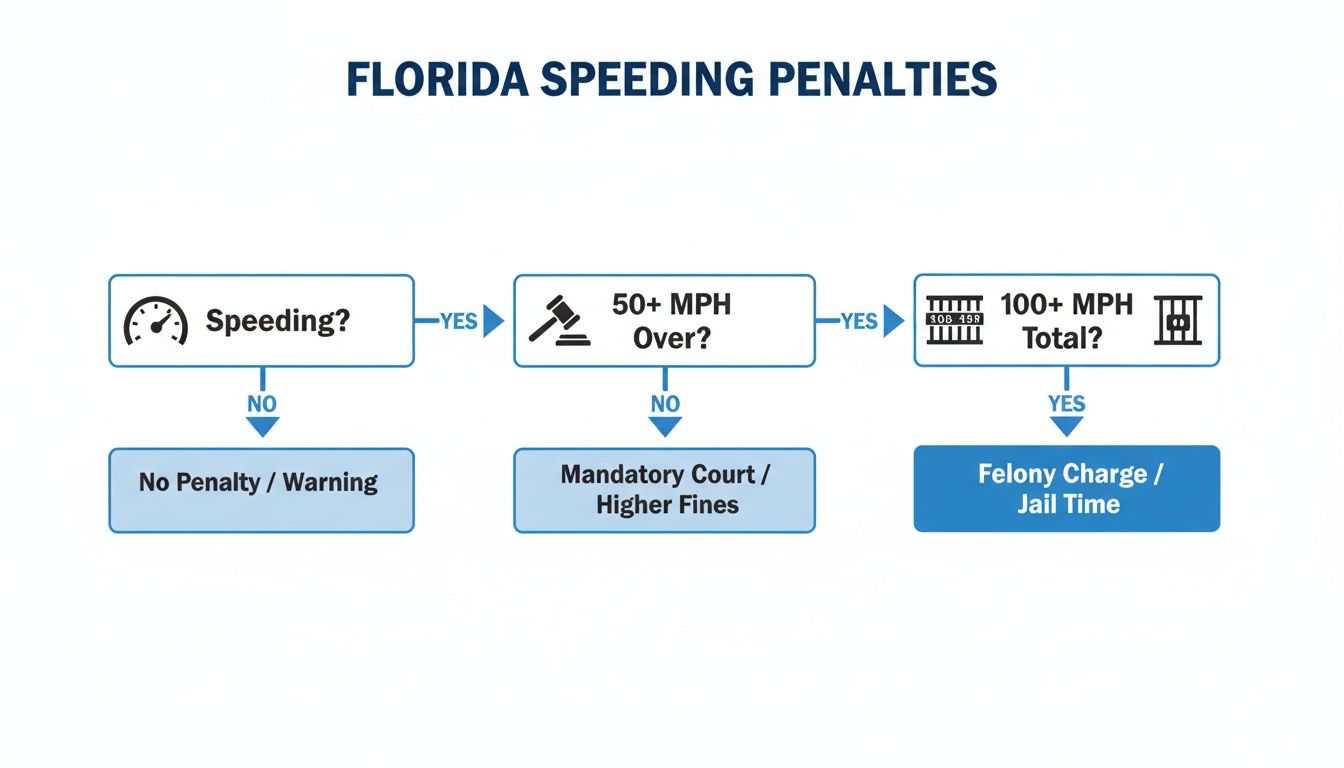
As you can see, what starts as a simple ticket can quickly spiral into a criminal charge with mandatory court dates and even the possibility of jail time.
Practical Advice for Meeting New Requirements
For parents and teens, getting through these new rules comes down to planning and good record-keeping. Tossing a practice log in the glove compartment isn't just a suggestion anymore—it's a required step in the process.
To make sure you’re on the right track, your family should:
Use a Driving Log: Grab a state form, a simple notebook, or a phone app and get religious about tracking every session. Log the date, how long you drove, and whether it was day or night.
Vary Driving Conditions: Don't just circle the block. Get out on the highway, tackle city traffic, and practice in the rain. The goal is to prepare for everything, not just pass the test.
Enroll in Courses Early: That six-hour course is the gateway to getting a learner's permit. Sign up for it well in advance to keep the licensing timeline on schedule.
The goal here is simple: arm young drivers with the experience they need to handle the massive responsibility of driving. Solid preparation is the one of the soundest defenses against a crash or a costly ticket.
The Impact of a Ticket on a Young Driver's Record
A single traffic ticket can hit a teen driver’s record hard. Under Florida's graduated licensing system, a violation can slow their ability to get a full license. It often means mandatory traffic school and, almost certainly, a spike in the family’s car insurance bill.
It's vital to understand what's at stake right from the beginning. To get a better idea, you might want to read our guide on what to expect with a first traffic ticket.
Protecting that clean driving record is everything. Our practice focuses on traffic and DUI defense across Florida, with the goal of protecting your license and record. Remember, past results do not guarantee future outcomes.
What These Laws Mean for CDL and Out-of-State Drivers
Florida’s new driving laws create serious considerations for two groups in particular: commercial drivers whose entire careers are on the line, and out-of-state visitors who might have no idea how strict enforcement has become. For both, a traffic stop is about a lot more than just a fine—it can put a career in jeopardy or follow a driver all the way back home.
A single ticket for what might seem like a minor mistake can have a significant ripple effect on a Commercial Driver's License (CDL). The new criminal speeding and hands-free laws are especially concerning for professional drivers.
The High Stakes for CDL Holders
For a professional driver, a license isn't just a piece of plastic in their wallet; it's their livelihood. A serious traffic violation—even one that happens in their personal car on a day off—can trigger a disqualification of their commercial license.
Under the new Florida driving law, violations that used to be a slap on the wrist are now being treated as serious offenses. For instance:
Criminal Speeding: A conviction for driving 50 mph over the speed limit is the kind of offense that can get a CDL disqualified.
Hands-Free Violations: It might seem minor, but a conviction for using a handheld device could be classified as a serious traffic violation under federal rules, especially if it's part of a reckless driving pattern.
Losing a CDL, even for a short time, means you’re out of work. Professional drivers have to be extra careful to follow these new rules to the letter. While our practice focuses on defending against traffic tickets in Florida, it's also important to remember that commercial drivers are subject to other regulations. For example, understanding drivers' hours rules gives a bigger picture of the requirements they face. We handle criminal traffic matters across Florida and can explain more about how we handle CDL speeding tickets in particular.
A single traffic stop can put a commercial driver's livelihood on the line. The goal is to protect your license and record, as past results do not guarantee future outcomes.
Navigating Florida Laws as an Out-of-State Driver
Tourists visiting Miami-Dade for the theme parks or enjoying the beaches often don't realize that a Florida traffic ticket can follow them home. It's a common and expensive mistake to think an out-of-state ticket won't affect your license or insurance.
Florida is part of the Driver License Compact (DLC), which is basically an agreement between most states to share driver information. This means if you get a ticket in Orlando, your home state’s DMV is going to hear all about it.
Imagine this scenario: a family is on vacation, driving through an unfamiliar area. The driver glances down at their phone for directions in a work zone and gets pulled over. Thanks to the DLC, that ticket doesn’t stay in Florida. It gets reported straight back to their home state's DMV.
The fallout could include:
Points added to their license based on their home state's rules.
A sudden spike in their car insurance premiums.
In some cases, a license suspension if that Florida ticket pushes them over the point limit back home.
This system makes it absolutely critical for visitors to take any Florida citation seriously. Just ignoring it and heading home is not an option—it will only lead to bigger problems down the road.
Our Approach to Contesting Your Florida Traffic Ticket
Getting a ticket under Florida's new driving law is unsettling. The risk of serious penalties—even criminal charges—is very real, and it's easy to feel overwhelmed. Knowing your options is the first step, and our entire process is built to give you clarity and support from the moment that ticket is in your hand. We handle traffic cases across all 67 Florida counties with one goal in mind: protecting your license and your record.
It all starts with our simple, no-obligation ticket submission. You can send us a picture of your citation online, 24/7. Once we have it, we’ll set up a free consultation to go over the details of your case. On that call, you’ll speak directly with an experienced member of our team who will explain the potential consequences and map out a defense strategy.
Statewide Defense From Our Broward County Office
From our office right here in Broward County, we represent drivers across the entire state. It doesn't matter if you got a speeding ticket on the I-4 corridor in Orlando or a hands-free violation in a Miami-Dade school zone—our team is ready to step in. Our statewide reach means we’re deeply familiar with the different court procedures in various counties, which is a huge advantage when building a solid defense.
Our practice is focused specifically on traffic and DUI defense. We dig into every citation, looking for weaknesses—procedural errors, insufficient evidence, you name it—and we challenge them for you. The objective is always to secure the most favorable outcome possible for your specific situation, whether that's getting the charges reduced, avoiding points on your license, or having the ticket dismissed completely.
Attorney Advertisement: This is an attorney advertisement. Office in Broward, Florida. Past results do not guarantee future outcomes. Our goal is to protect your license and record.
What It's Like to Work With Us
Once you decide to move forward, we take the wheel. The entire process becomes our responsibility, not yours. In fact, in over 99% of our cases, our clients never even have to show up in court. We handle the appearances, file the legal motions, and negotiate with the prosecutors on your behalf.
Here’s what you can expect:
Constant Communication: We keep you in the loop by phone, text, or email, so you’re never left guessing about the status of your case.
Direct Access: You get a direct line to our legal team, ensuring your questions are answered quickly and correctly.
Transparent Pricing: We lay out our fees clearly from the start. No surprises, no hidden costs.
Contesting a traffic ticket, especially under the tough new driving law in Florida, requires a focused and experienced approach. We’re committed to defending your driving privileges and minimizing the chaos a citation can cause in your life. If you’ve received a ticket, contact us for a Free Consultation to learn exactly how we can help.
Disclaimer: Submitting information through our website form does not create an attorney-client relationship. All communications are confidential.
Answering Your Questions About Florida's New Driving Laws
Whenever new traffic laws hit the books in Florida, it's natural to have questions. We hear from drivers all over the state who are trying to make sense of what's changed. This section tackles some of the most common questions we get. Think of it as a helpful starting point, but remember, every traffic stop is different. The only way to get advice tailored to your unique situation is by speaking directly with a licensed attorney.
Can I Still Use My Phone for GPS in Florida?
Yes, you can absolutely still use your phone for navigation, but the key is how you use it. The law now requires all use to be hands-free.
That means your phone needs to be in a cradle or mount on your dashboard or windshield. You can glance at the map, but you can't be holding the device. Voice commands are an excellent tool here. The goal is to keep you from physically typing or tapping on your phone while the car is moving, especially in school zones and work zones where the rules are ironclad.
What Happens if I Get a Criminal Speeding Ticket?
Getting a criminal speeding ticket is a whole different ballgame from a standard citation. Under the new law, this kicks in if you're caught driving 50 mph or more over the limit or at any speed of 100 mph or higher.
This isn't something you can just pay online and forget about. A criminal charge comes with a mandatory court appearance. If you're convicted, you're looking at significant fines, possible jail time for repeat offenses, and a permanent criminal record that can affect you when you apply for jobs or insurance.
How Does a Florida Ticket Affect My Out-of-State License?
A Florida traffic ticket will almost certainly follow you home. Florida is part of the Driver License Compact (DLC), which is basically an agreement between most states to share information on traffic violations.
When you get a ticket here, the details are sent to your home state's DMV. Your state will then likely apply its own rules, which usually means adding points to your out-of-state license and letting your insurance company know. That's when you may see your rates go up. Ignoring the ticket is not advisable—it can easily lead to your home state suspending your license.
Legal Disclaimer: The information provided here is for general informational purposes only and does not constitute legal advice. An attorney-client relationship is not formed by reading this content or contacting our firm.
What Should I Do After Receiving a Ticket?
First, take a breath and understand what you're up against. Do not just pay the fine. Paying it is an admission of guilt, and it guarantees you'll get points on your license and face the other penalties that come with it.
Your next step should be to get a free consultation with a law firm that focuses on traffic defense. An experienced attorney can look at the details of your ticket, walk you through your options, and start building a strategy to protect your driving record. Time is not on your side, so acting fast is key to a strong defense.
If you've been ticketed under Florida's new driving laws, you don't have to face the court system alone. At Ticket Shield, PLLC, our practice is dedicated to protecting drivers' licenses and records across all 67 Florida counties. We handle the court dates and legal headaches so you can get on with your life. Call us 24/7 for a free, no-obligation chat about your case. Let us put our experience to work for you. Get Your Free Consultation Today.