
Your Guide to a Florida Texting and Driving Ticket
Received a texting and driving ticket in Florida? Learn about the fines, points, and strategic steps you can take to protect your driving record.
Getting a texting and driving ticket in Florida can instantly ruin your day. Suddenly, your mind starts racing with questions about fines, points on your license, and how much your insurance is about to go up. A citation means the clock is ticking, and you have to make a choice that will affect your driving record for years. But just paying the fine isn't your only move. Our practice focuses on traffic and DUI defense, and our goal is to protect your license and record.
Your First Steps After Getting a Texting Ticket
Those first few moments after an officer hands you that piece of paper are critical. What you do next can set the tone for the entire process. The goal is to get from a place of uncertainty to having a clear, smart plan. That's what this guide is all about—giving you the clarity to protect your driving record right from the start.
It's easy to get fixated on the dollar amount of the fine, but a texting and driving ticket packs a much bigger punch. Understanding the full picture of what you're up against is the first step toward making a decision that's truly in your best interest.
Florida Texting and Driving Ticket at a Glance
This table breaks down the immediate and long-term consequences of a texting and driving citation in Florida. It's a quick look at how the penalties ramp up.
Consequence | First Offense Impact | Second (or Subsequent) Offense Impact |
|---|---|---|
Violation Type | Non-moving violation. | Moving violation. |
Base Fine | Typically starts at $30, but court costs and fees will increase the total you owe. | Base fine doubles to $60, plus significantly higher court costs and fees. |
Points on License | 0 points. No direct impact on your point total. | 3 points added to your license. This is a red flag for insurers and the FLHSMV. |
Insurance Impact | Unlikely to cause a rate increase since it's a non-moving violation with no points. | High probability of an insurance rate hike, costing hundreds of dollars over several years. |
Long-Term Record Impact | The citation will appear on your driving record, but it's less damaging than a moving violation. | A moving violation conviction stays on your record, putting you closer to a license suspension if you get more tickets. |
As you can see, the penalties get serious fast. What starts as a simple citation can quickly escalate, affecting both your wallet and your ability to drive.
The Real Consequences to Consider
The true cost of a texting ticket isn't just the number printed on the citation. It's a mix of immediate penalties and lingering effects that can follow you around for years.
Fines and Sky-High Court Costs: A first offense in Florida is a non-moving violation with a base fine of around $30. But don't let that small number fool you. Court costs and administrative fees can easily triple that amount. A second offense within five years doubles the base fine to $60, with even higher costs tacked on.
Points on Your License: While a first-time offense won't add points, a second one is a different story. It gets classified as a moving violation and dumps 3 points on your license. Accumulating points leads directly to higher insurance premiums and, if you get enough, a suspended license.
The Insurance Rate Spike: Insurance companies see distracted driving as a major risk. Even a single violation that adds points to your record can make your premiums jump, costing you hundreds of extra dollars every year for the next three to five years.
In busy areas like Broward County, law enforcement is on high alert for distracted driving. Trying to navigate the crowded traffic courts in a place like that without a solid strategy can be a challenging road.
What to Do Immediately
After getting a ticket, the worst thing you can do is make a quick, emotional decision. The most important thing is to understand your options and the strict deadlines you're facing. In Florida, you typically have just 30 days to respond to the citation. Ignoring it is not an option—that will only lead to bigger problems, like a suspended driver's license.
Your next steps should be to carefully check the ticket for any mistakes and get professional advice on how to handle it. A traffic ticket attorney can give you a clear-eyed assessment of your situation. Our practice is focused on traffic and DUI defense all across Florida, and our objective is to protect your license and your record. We handle criminal traffic matters and can help you make sense of the charges against you. Past results do not guarantee future outcomes.
Getting a Grip on Florida's Distracted Driving Law
To challenge a texting and driving ticket, you first have to understand the specific law they say you broke. In Florida, that’s Statute 316.305, officially called the "Florida Ban on Texting While Driving Law." It sounds simple enough, but the details are what can be pivotal in court.
The whole point of the law is to stop accidents caused by drivers staring at their phones instead of the road. It makes it illegal to drive a car while manually typing letters, numbers, or anything else into a phone or similar device. That also covers sending or reading messages and emails.
What Does "Manually Typing" Actually Mean?
The two most important words in that law are "manually typing." That’s the specific action an officer has to see to write a ticket. The law draws a clear line between actively tapping on your phone’s keyboard and doing other things with it.
Picture this: you're stuck in rush hour on I-595 in Broward County. If a cop sees you holding your phone and your thumbs are flying as you type a text, that's a clear-cut violation. But if you’re just holding the phone to your ear for a regular phone call, this particular law doesn't forbid that (for drivers over 18).
The burden is on the state to prove you were engaged in "non-voice interpersonal communication." That’s a legal way of saying they have to show you were texting, emailing, or messaging—not just punching in a new address on your GPS or picking a song on Spotify.
Primary vs. Secondary Offense: What's the Difference?
Florida's law has a critical detail that changes how it’s enforced. For most driving situations, texting while driving is a primary offense. This means a police officer can pull you over just because they see you texting. They don't need another reason, like you were speeding or had a busted taillight, to initiate a traffic stop.
But things get even stricter in school zones and active work zones. In those areas, the rules change completely.
Primary Offense (Everywhere Else): An officer just needs to see you manually typing on your device to pull you over.
Stricter Rules (School/Work Zones): In a designated school zone or an active construction zone, simply holding a phone in your hand is enough to get a ticket. The law demands you use a hands-free method in these areas.
Knowing the Exceptions Is Key
Understanding the exceptions to the law is just as important as knowing the rules themselves. The statute carves out several specific situations where it’s perfectly legal to use your phone, and these can be the foundation of a strong defense.
You are generally allowed to use a wireless device if you are:
Reporting an emergency or a crime to the police.
Receiving messages about navigation or safety, like traffic alerts or weather warnings.
Using the device for GPS navigation.
When your car is stationary and not in an active lane of traffic (like when you're stopped at a red light).
These details are everything. For example, if you were ticketed while stopped at an intersection in Fort Lauderdale, that citation might not hold up because the law allows you to use your device when the vehicle isn't moving. Traffic laws are always changing, and you can learn more about new Florida driving laws to see how they affect drivers. A sharp attorney can analyze the specifics of your stop to see if one of these exceptions fits your situation. Our practice is built around traffic and DUI defense, and our job is to protect your license and your record.
The True Cost of a Texting and Driving Ticket
That dollar amount printed on your texting and driving ticket is just the tip of the iceberg. The real cost goes far beyond that initial fine, creating financial ripples that can follow you for years. Before you decide how to handle the citation, you need to understand the full picture—from court fees and license points to soaring insurance rates.
When an officer hands you that ticket, you're not just dealing with a simple fine. You're facing a system where extra costs get tacked on at every turn. What starts as a seemingly small $30 base fine for a first offense can quickly balloon with mandatory court costs and administrative fees, often tripling the amount you actually owe.
The Financial Penalties Beyond the Fine
Many drivers are shocked when they see the final bill. That's because the base fine is only a small piece of what you have to pay. Florida’s court system adds various surcharges and fees to every single traffic citation, which dramatically inflates the final cost. And if you get a second offense within five years, the base fine not only doubles to $60 but also comes with even steeper associated costs.
These accumulating expenses are the immediate financial hit you'll feel. But the most significant and long-lasting damage often comes from a source many people forget about: their car insurance provider.
How a Texting Ticket Impacts Your Insurance Rates
The single biggest hidden penalty of a texting and driving conviction is a dramatic and sustained hike in your car insurance premiums. While a first-offense, non-moving violation might not trigger an immediate rate increase, a second offense absolutely will. That's because it adds 3 points to your license, signaling to insurers that you are a higher-risk driver.
A single moving violation for distracted driving can cause your insurance rates to spike by 20-50%. This isn't a one-time penalty; it can follow you for three to five years, potentially costing you thousands of dollars over the life of the policy.
This financial burden is especially tough on certain drivers:
Teen Drivers: Already facing the highest insurance rates out there, a teen driver with a texting ticket can see their family's premiums become almost unaffordable.
Commercial (CDL) Drivers: For anyone who drives for a living, a moving violation can put their employment and Commercial Driver's License in serious jeopardy.
The statistics paint a grim picture, which is why insurers react so harshly. Every day in the United States, texting while driving is linked to the deaths of 11 teens—a habit that is six times more dangerous than driving drunk. Cell phone use is a factor in an estimated 1.6 million crashes each year, with a quarter of all car accidents attributed directly to this distraction.
Florida’s Driver's License Point System Explained
Florida uses a point system to track driving infractions, and if you rack up too many, you're looking at serious consequences like a license suspension. While a first-time texting ticket is a non-moving violation with 0 points, a second offense within five years becomes a moving violation that adds 3 points to your record.
This is a critical distinction. Points are the main yardstick the Florida Highway Safety and Motor Vehicles (FLHSMV) and insurance companies use to judge your risk as a driver. Every point added to your license pushes you closer to a suspension. Understanding this system is vital.
A single point-adding violation can be the difference between a clean record and being labeled a "high-risk" driver—a designation that brings severe financial and legal pain. This is exactly why fighting to keep points off your record is so important.
Developing Your Action Plan After a Citation
Getting a texting and driving ticket is a frustrating experience, but what you do in the hours and days that follow is absolutely critical. Just shoving it in your glove compartment and hoping it goes away is not an option. Ignoring the citation will only guarantee much bigger problems, like a suspended driver's license. The key is to be deliberate and make a smart choice within that strict 30-day response window.
Your very first move should be to read the ticket from top to bottom. Look for any mistake, no matter how small it seems—an incorrect date, a misspelled name, or the wrong statute number can sometimes be a basis for a defense. This initial once-over is your first chance to spot a potential weakness in the case against you.
Your Three Main Options Explained
Once you have that ticket in hand, you're standing at a fork in the road. You have three paths forward, and each one comes with real, lasting consequences for your driving record, your insurance rates, and your wallet.
Pay the Fine: This is the fastest way to make the ticket go away, but it's also a direct admission of guilt. For a second offense, paying the fine guarantees points will hit your license, and your insurance company will almost certainly raise your rates.
Elect Traffic School: For certain non-criminal moving violations, you might be eligible to take a driver improvement course. This can be a good way to keep points off your record, but you can only use this option a limited number of times.
Fight the Ticket: This means pleading not guilty and challenging the citation in court. The objective here is simple: seek dismissal of the ticket or a reduction to a less serious offense, protecting your record from points and your wallet from those insurance hikes.
You have to understand the long-term impact of each choice. The infographic below shows just how quickly a simple ticket can snowball into escalating costs.
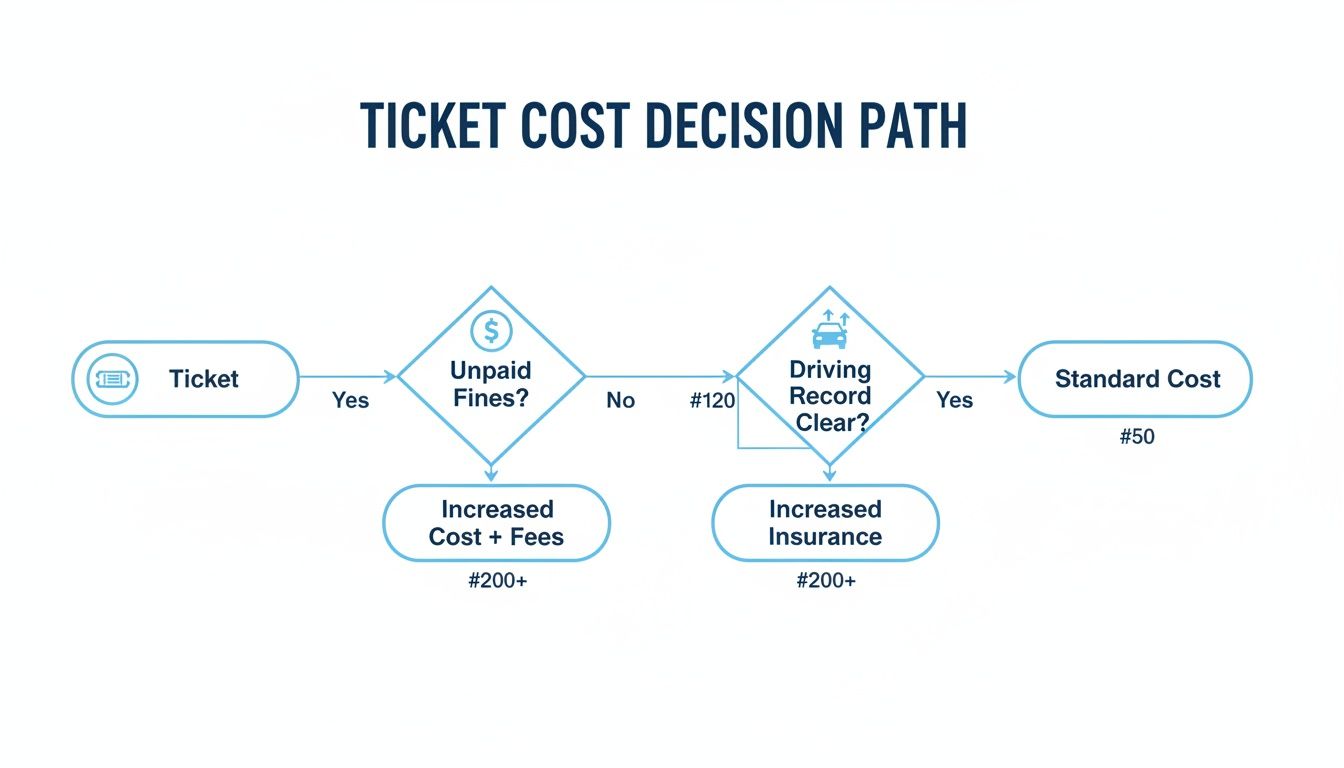
As you can see, the fine is just the beginning. The real financial damage usually comes from the years of higher insurance premiums that a conviction triggers.
Why Taking Action Is Non-Negotiable
Doing nothing is the worst possible choice. If you blow past the 30-day deadline, the court will find you guilty by default. That puts a conviction on your record and can lead straight to a driver's license suspension. Getting your license reinstated involves paying steep fees and navigating a bureaucratic process.
It is always better to face the citation head-on. Whether you pay it, go to school, or fight it, making a conscious decision keeps you in control and helps you avoid the harshest penalties.
Building Your Strategy
Your action plan should be built on a solid understanding of the risks and rewards of each option. For most drivers worried about points and insurance costs, fighting the ticket is a smart strategy. It’s also important to understand why law enforcement is cracking down so hard. National data shows that in 2021 alone, distracted driving led to 3,522 fatalities and over 362,000 injuries on U.S. roads. You can read the full research on these shocking texting and driving accident statistics to see why penalties are only getting tougher.
The most effective strategy often involves getting professional legal help. A lawyer who handles traffic cases every day can look at the details of your ticket, explain the likely outcomes, and recommend the best path forward.
Handling a texting and driving ticket can be tricky, and sometimes the best outcome is found through negotiation. In some cases, it may be possible to arrange a traffic ticket deferral, where the charge is held back and then dismissed as long as you keep your record clean for a set period. Our firm focuses on Florida traffic defense, and our primary goal is to protect your license and your record. Remember, past results do not guarantee future outcomes, but a well-planned defense is your best tool.
Attorney Advertisement. Office in Broward. Prospective clients may not obtain the same or similar results.
How to Challenge Your Florida Texting Ticket
Getting a texting and driving ticket in Florida doesn't mean you're automatically stuck with the penalties. That piece of paper is an accusation, not a conviction. You have the right to challenge it, and there are several solid ways to do just that. The key is to look closely at the details of the traffic stop and find the weak spots in the state's case against you.
To issue a valid ticket, an officer needs a clear, unobstructed view of you manually typing on a device. This is often the most important point to challenge. Was it really clear what you were doing? Could you have been adjusting your GPS, picking a new song, or just holding your phone? These questions can create the reasonable doubt needed to challenge the citation.
Questioning the Officer's Observations
The state's entire case is built on what the officer saw—or what they think they saw. A strong defense often starts by questioning just how reliable those observations really were. Police officers are human. They can make mistakes, especially when they're trying to see what a driver is doing in a moving car, from a distance, or in heavy traffic.
Think about these common situations:
Line of Sight Issues: Were other cars, trees, or road signs blocking the officer’s view? Did they see your actions through a tinted window or during tricky lighting conditions like dusk or rain?
Misinterpretation of Actions: An officer might mistake adjusting a phone in a dashboard mount for texting. From their perspective, the hand movements can look similar, but legally, they are two very different things.
The "Stationary" Exception: Florida law allows you to use your device when your vehicle isn't moving. Were you ticketed while sitting at a dead stop at a red light in a busy Broward County intersection? If so, the ticket might have been issued improperly.
A ticket is not a foregone conclusion. An experienced legal professional knows how to dissect the details of your traffic stop, from the officer's position to the exact wording on the citation, to build a defense aimed at protecting your record.
Asserting Valid Legal Defenses
Beyond just questioning the officer's point of view, Florida law carves out specific exceptions that can serve as a powerful defense against a texting and driving ticket. If your situation fits into one of these categories, you could have a strong case for getting the ticket dismissed entirely.
These legally protected exceptions include:
Using a hands-free device for voice-based communication.
Reporting an emergency or criminal activity to law enforcement.
Receiving safety-related messages, such as traffic or weather alerts.
Using your device for GPS navigation.
The rise in distracted driving citations is part of a national trend. Violations jumped 10% nationwide from 2022 to 2023, putting law enforcement on high alert. But this crackdown doesn't change your rights. You can learn more about cellphone-related distracted driving to see the data behind these enforcement campaigns.
Challenging a ticket takes a careful and strategic approach. It's about more than just showing up to court; it's about presenting a logical defense based on the specific facts of your case and the fine print of Florida law. For a deeper look at effective strategies, check out our guide on how to beat a traffic ticket in Florida. Our firm focuses on Florida traffic defense with the goal of protecting your license and record. Remember, past results do not guarantee future outcomes.
How a Traffic Ticket Attorney Can Help

Dealing with a texting and driving ticket can feel overwhelming, but you absolutely don't have to navigate it alone. Bringing in a law firm that focuses on Florida traffic defense can make a world of difference. The main objective is simple: protect your driving record, stop your insurance rates from climbing, and keep points off your license.
An experienced attorney knows the system inside and out, from the specific procedures in a Broward County courthouse to the statewide statutes. They know how to dissect your citation, spot potential weak spots in the state's case, and talk to prosecutors to work toward a better outcome. That experience is a powerful tool to have on your side.
The Convenience of Professional Legal Help
One of the biggest benefits of hiring a lawyer is convenience. We understand—you have a busy life, and a court date can throw a major wrench in your work and family schedule. In the vast majority of our cases, our clients never have to step foot in a courtroom. We handle it all for them.
We've designed the process to be as simple and stress-free as possible:
Free Consultation: It all starts with a no-obligation chat to go over your ticket and lay out your options.
Simple Ticket Submission: You can send us your citation in a couple of minutes online or right over the phone.
Dedicated Attorney: A lawyer takes over your case, managing every court filing and appearance from start to finish.
This whole approach saves you time and reduces the anxiety of trying to figure out the legal system on your own. You can reach your attorney directly by phone, text, or email, so you're always kept in the loop on how your case is progressing.
Protecting Your Driving Record and Future
At the end of the day, our mission is to get the best possible result for your specific situation. While every case has its own unique details, the goals are always the same: seek a dismissal, get the charge reduced to a less serious offense, or avoid points on your license. Even a ticket that seems minor can create long-term problems.
Our goal is to protect your license and record. We handle traffic matters across all 67 counties in Florida, using our experience to fight for you. While past results do not guarantee future outcomes, a professional defense can significantly aid your case.
Deciding if you need legal help is the first big step. For a deeper dive into that decision, check out our guide on if you need a lawyer for a traffic ticket. With transparent pricing and a client-first focus, getting professional help is a straightforward way to defend your driving privileges.
Attorney Advertisement. Office in Broward.
Frequently Asked Questions
Drivers across Florida often have the same questions when they get a ticket. Here are some of the most common ones we hear, with straightforward answers. This is for general information and is not a substitute for legal advice about your specific case. Submitting information via any form on this website does not create an attorney-client relationship.
Is It Illegal to Text at a Red Light in Florida?
This is a common gray area. Generally, Florida law allows you to use a wireless device when your car is completely stationary. So, if you're fully stopped at a red light, you are typically in the clear to handle your phone.
But there's a catch. You're still expected to be aware of your surroundings. If you're so engrossed in your phone that you hold up traffic when the light turns green, an officer can still write you a ticket for impeding traffic or another related offense.
Do I Have to Go to Court for a Texting Ticket?
A court appearance is only mandatory if you decide to fight the ticket by pleading not guilty. One of the biggest advantages of hiring a traffic ticket attorney is that, in most cases, they can appear in court for you.
This service is a major benefit. It saves you the stress, the lost wages from taking a day off work, and the general hassle of showing up to a courthouse. Your legal representative handles all the proceedings on your behalf.
Will a Texting Ticket Actually Raise My Insurance Rates?
Any moving violation that adds points to your license is a huge red flag for insurance companies and is very likely to trigger a rate increase. Insurers see distracted driving as a high-risk behavior that points to a greater chance of future accidents.
Even a first-offense, non-moving violation could potentially lead to higher premiums depending on your provider and your driving history. A second offense that adds 3 points makes a rate hike almost a certainty.
How Are Second Offenses Different in Broward County?
The state law is the same across all of Florida, including Broward County, but the consequences jump significantly after that first ticket. A first texting and driving ticket is a non-moving violation and carries 0 points.
A second offense within five years, however, gets upgraded to a moving violation. This automatically tacks 3 points onto your driver's license, which leads to much harsher financial penalties and puts your driving privileges at greater risk.
Don't let a simple ticket disrupt your life. At Ticket Shield, PLLC, our practice is focused on defending Florida drivers against traffic citations. Our goal is to protect your license and your record. For a free consultation to discuss your case, visit us at https://www.ticketshield.com.
Attorney Advertisement. Office in Broward.
