Getting Your First Traffic Ticket in Miami-Dade: A Complete Guide
Facing your first traffic ticket? Learn how to read the citation, your options, and when to consult an attorney to protect your record.
That flashing blue and red light in your rearview mirror is a sight no one wants to see, especially on the busy streets of Miami-Dade County. Getting your first traffic ticket is stressful, but the key is to stay calm and handle the stop professionally. What you do in those first few minutes can genuinely shape the outcome of your case.
Your First Steps After Getting a Traffic Ticket
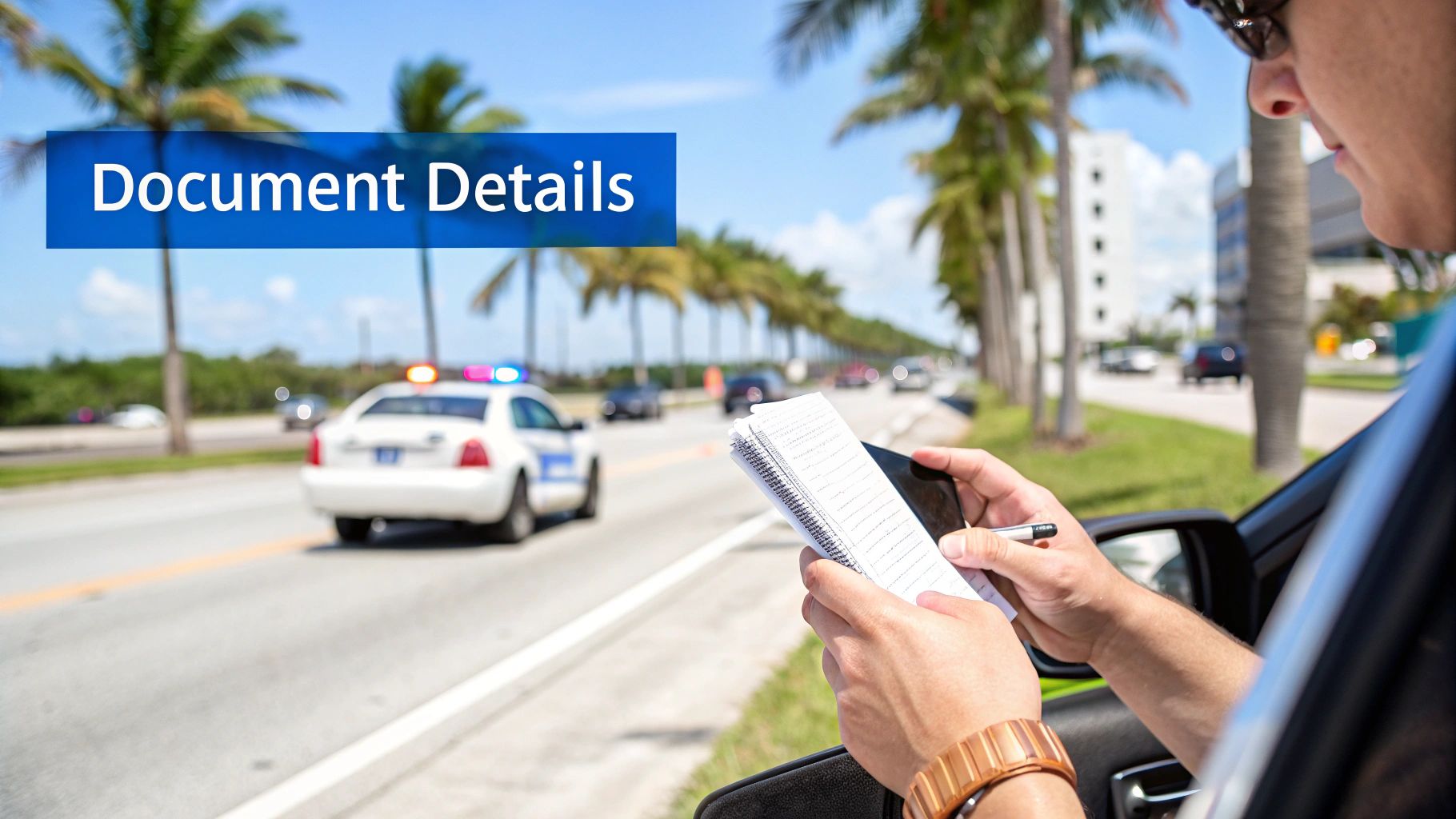
The moments right after an officer pulls you over are more critical than most drivers realize. The way you interact with law enforcement and what you choose to say (or not say) can set the entire tone. Keeping a clear head is your best approach from the very beginning.
This initial encounter is absolutely not the time to argue your side of the story or debate the officer's judgment. Your only job right then is to remain composed, be polite, and hand over your license, registration, and proof of insurance when asked.
Keep a Calm and Professional Demeanor
Your attitude during the stop matters. A lot. An officer is far more likely to make notes about confrontational or difficult behavior, and those notes do not help you in court. Simply being cooperative and respectful can keep the situation from escalating.
But being cooperative doesn't mean you have to admit fault. Steer clear of statements like, "I know I was speeding," or "Sorry, I just wasn't paying attention." Any admission of guilt can—and likely will—be used against you if you decide to contest the ticket.
Key Takeaway: You can be cooperative without incriminating yourself. Our goal is to protect your license and record by carefully navigating every step of the process.
Carefully Review and Sign the Citation
When the officer hands you that ticket, take a second to actually look at it. Check that your name, address, and vehicle details are correct. While a simple mistake on the citation won't automatically get it dismissed, it's an important detail to document.
You will almost certainly be asked to sign the ticket. It's a common point of confusion, but in Florida, your signature is not an admission of guilt. It's just your promise that you received the citation and will either pay the fine or show up in court. Refusing to sign can create a whole new set of unnecessary problems. You can learn more about why you have to sign a traffic ticket in our detailed guide.
Document Everything Immediately After
As soon as you’ve safely pulled away from the traffic stop, find a place to park and write down everything you can remember. Your memory of the event will start to fade surprisingly fast, so getting it all on paper (or in your phone's notes) right away is crucial.
Here’s a quick-reference table to guide you on what to do—and what to avoid—in those initial moments.
Immediate Actions After a Florida Traffic Stop
Action | Why It Matters |
|---|---|
Be Polite and Cooperative | A respectful attitude prevents escalation and avoids negative notes from the officer. |
Provide Your Documents | This is legally required. Have your license, registration, and insurance ready. |
Avoid Admitting Guilt | Don't say things like "I was speeding." This can be used against you in court. |
Review the Ticket for Errors | Check your personal and vehicle information for any mistakes. |
Sign the Ticket | It is not an admission of guilt in Florida, just a promise to respond. |
Document Details After | Write down the time, location, weather, and what was said while it's fresh. |
Following these simple steps helps protect your rights from the very start and gives you a solid foundation if you decide to contest the ticket later.
Try to capture these specific details:
Time and Location: Note the exact street, nearest cross-street, and time of day.
Weather and Traffic: Was it sunny or raining? Was the road packed or empty?
Your Conversation: Write down the back-and-forth between you and the officer as best you can remember.
The Circumstances: What were you doing just before the lights went on? Were you changing lanes? Following a truck?
This information creates a valuable record that can be a huge help if you decide to challenge your first traffic ticket. It helps you or your attorney build a clear, detailed picture of what really happened.
How to Make Sense of Your Florida Traffic Ticket
That yellow or white paper the officer just handed you is more than a simple fine—it’s a legal document called the Florida Uniform Traffic Citation. Getting a handle on what it says is your first, most important step toward making a smart decision. If you misread it or ignore it, you could miss crucial deadlines and even end up with a suspended license.
Believe it or not, this little piece of paper has a long history. The world's first speeding tickets were hand-written notes issued way back in 1904, a far cry from the detailed document you’re holding now. You can see how it all started and appreciate how much has changed.
Let's walk through the citation you have in your hand, piece by piece.
Finding the Most Important Details
Your personal info and the officer's details will be right at the top, along with where the stop happened. But the real meat of the citation is in the middle section. This is where the state lays out its case against you.
Look for a statute number. This is the specific law they say you broke. It will look something like §316.1925 for Careless Driving or §316.074(1) for running a red light.
Right next to that number, you'll see a description of the violation. The ticket will also state if it’s a "moving" or "non-moving" violation. Pay close attention to this part. Moving violations are the ones that add points to your driver's license, which is what really causes the long-term pain with your insurance company.
Deadlines and Court Info You Can't Afford to Miss
The single most critical piece of information on your ticket is the response deadline. In Florida, you have exactly 30 calendar days from the day you get the ticket to act.
Missing this deadline is a huge mistake. The court will automatically find you guilty, which can lead to a license suspension and a pile of extra fees.
Your ticket will also tell you which county court is handling your case. If you were cited in Miami-Dade County, for example, it will name the specific courthouse you need to deal with, like the Richard E. Gerstein Justice Building or a smaller district court.
Attorney Advertisement: Please be aware that this is for informational purposes only and does not constitute legal advice. Past results do not guarantee future outcomes. Our practice focuses on traffic and DUI defense matters across Florida. Office in Broward.
Finally, look to see if the box for a civil or criminal infraction is checked. Most tickets for things like speeding or rolling a stop sign are civil. But more serious offenses, like Reckless Driving or DUI, are criminal violations that require you to show up in court no matter what.
Taking a few minutes to really read and understand your citation gives you a clear picture of what you're up against. It’s the essential first step before you decide what to do next.
Weighing Your Three Legal Options
Once that ticket is in your hand, the clock starts ticking. You have exactly 30 days to make a choice that will have a direct impact on your driving record and insurance premiums for years to come.
This isn’t a decision to take lightly. Your first instinct might be to just pay it and move on, but that’s an automatic admission of guilt. Before you do anything, you need to understand the long-term ripple effects of each path you can take.
This guide breaks down the key details on your ticket so you can see which of the three options makes the most sense for your situation.
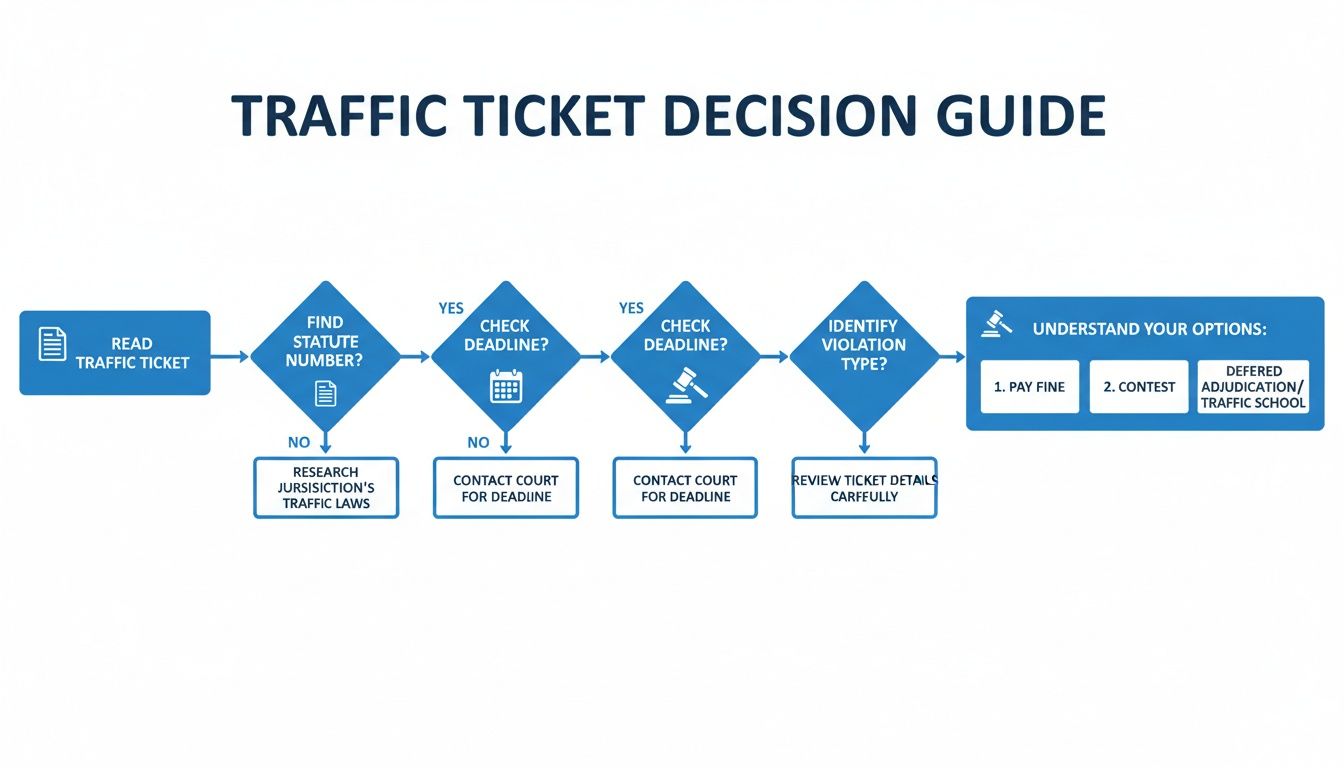
As you can see, understanding the specific statute, deadline, and violation type is the first step in figuring out your best move.
Pay the Fine and Accept the Consequences
Let’s be clear: paying the fine is an admission of guilt resulting in a conviction. It’s the fastest way to put the ticket behind you, but it comes with strings attached that can follow you for years.
The moment you pay, the Florida Department of Highway Safety and Motor Vehicles (FLHSMV) adds points to your license. For a typical speeding ticket, that’s usually three to four points.
These points are a huge red flag for your insurance provider. They see you as a higher-risk driver, which almost always leads to a painful jump in your annual premiums for the next three to five years. For many drivers, especially in busy places like Miami-Dade, the extra insurance cost quickly dwarfs the price of the original fine.
Elect Traffic School to Withhold Points
Florida law gives you an option to keep points off your license for certain civil tickets by electing a Basic Driver Improvement course, better known as traffic school. It sounds like a great deal, but this tool has some very strict limitations.
You are only allowed to use this option five times in your entire life and just once in any 12-month period.
Think carefully before you use it. Burning one of your precious five elections on a minor, first-time ticket might be a shortsighted move. You may need to save that option for a more serious violation down the road. Keep in mind, you still have to pay the full ticket fine plus the cost of the course itself.
Attorney Advertisement: This content is for informational purposes only. Past results do not guarantee future outcomes. Our practice focuses on traffic and DUI defense. Office in Broward.
Plead Not Guilty and Contest the Ticket
Your third route is to plead not guilty and contest the citation in court. This is the only option that gives you a chance at getting the ticket dismissed—meaning no fine, no points, and nothing on your record.
Contesting a ticket does not guarantee a specific result, but it puts the burden of proof back where it belongs: on the state. They have to prove their case against you.
An attorney with experience in traffic matters can go to court for you, handle the legal procedures, and look for weaknesses in the case, like problems with the officer's equipment or inconsistencies in their testimony. For a more detailed breakdown, check out our guide on whether you should fight your traffic ticket. Fighting your very first ticket is often a smart strategy to keep your clean record intact from the start.
To make the choice clearer, here’s a simple table comparing the potential outcomes of each option.
Comparing Your Options for a First Florida Traffic Ticket
Option | Points on License | Impact on Insurance | Long-Term Consequences |
|---|---|---|---|
Pay the Fine | Yes (Guaranteed) | Almost Certain Premium Increase | Conviction on your record for years; uses up no-point eligibility for future tickets. |
Elect Traffic School | No | Usually Avoids an Increase | Uses up one of your five lifetime elections; you still pay the fine and course fees. |
Contest the Ticket | Potentially None | Avoids Increase if Dismissed | The only chance to seek dismissal of the ticket entirely with no penalties. |
As you can see, what seems like the easiest path—just paying the fine—often comes with the heaviest long-term financial burden. Contesting the ticket is the only way to potentially walk away with no penalties at all.
The True Cost of a Traffic Ticket Conviction
That dollar amount printed on the citation? It’s only the beginning. For many drivers, especially those getting their first traffic ticket, the focus is on that immediate fine. What they don't see is the financial chain reaction a conviction kicks off.
When you pay that ticket, you’re officially pleading guilty. That single act can have financial consequences that stick with you for years, costing you far more than you ever expected.
A conviction for any moving violation in Florida means points on your license. Those points are a direct signal to your insurance company, telling them you're now a higher-risk driver. This is where the real financial pain begins.
The Impact on Your Insurance Premiums
Even a minor speeding ticket can trigger a significant hike in your auto insurance rates. And if you're in a busy area like Miami-Dade County, where premiums are already high, the increase can be especially impactful.
A single conviction can cause your rates to jump by 18-25% or more. That isn't a one-time hit, either—it’s an increase that typically lasts for three to five years. Think about it: if your premium goes up by just $30 per month, you're paying an extra $360 a year. Over three years, that's over $1,000 in extra insurance costs. All from one ticket.
Key Takeaway: The long-term insurance increase is almost always the most expensive part of a traffic ticket conviction, dwarfing the original fine. Our goal is to protect your record and shield you from these lasting financial penalties.
Understanding the Florida Points System
Florida uses a points system to track every driving infraction, and it doesn't take much to get into serious trouble. Once you accumulate too many points in a set timeframe, you're looking at a mandatory license suspension.
12 points within 12 months triggers a 30-day suspension.
18 points within 18 months triggers a 3-month suspension.
24 points within 36 months triggers a 1-year suspension.
Common moving violations, like speeding 15 mph over the limit, will tack three points onto your record. More serious offenses add even more. Fighting a ticket isn't just about one incident; it's about keeping your driving record clean and avoiding the risk of a future suspension. You can learn more about how points affect your Florida license in our detailed guide.
When Your Career Is on the Line
For some drivers, the consequences of a conviction go way beyond their wallet—they can threaten their entire livelihood. If you drive for work or hold a Commercial Driver's License (CDL), your job literally depends on maintaining a clean driving record.
A single conviction could disqualify you from certain jobs or even impact your current one. This makes challenging any ticket, especially your first, a critical investment in your career. The stakes are simply too high to just accept a conviction without fighting back.
While Florida's fines are serious, they're nothing compared to some international penalties. For instance, Finland’s income-based system once led to a single speeding ticket costing over $200,000. Discover more insights about these traffic ticket extremes and see why protecting your record here at home is so important.
When to Consult a Traffic Ticket Attorney
Trying to navigate the court system for your first traffic ticket can feel like an uphill battle all by yourself. The legal procedures, the endless paperwork, and the looming deadlines are confusing, and one small misstep can lock in a conviction.
This is where having a professional on your side can make all the difference, especially in a place as busy as Miami-Dade County.
An attorney who focuses on traffic defense can take the entire case off your shoulders. For most civil infractions, this means you probably won't ever have to step inside a courtroom, which saves you a ton of time and stress. The entire goal is to protect your license and your record by challenging the state's evidence and seeking a dismissal or a reduction of the charges.
When Legal Representation Is a Must
Not every ticket is created equal. A simple parking violation is a world away from a charge that puts your license—or even your career—on the line. When the stakes get high, hiring a lawyer becomes critical.
You should strongly consider getting legal help in these situations:
Serious Speeding Violations: If you were cited for driving 30 MPH or more over the speed limit, Florida law requires you to appear in court, and the penalties are much harsher.
Criminal Traffic Charges: Offenses like Reckless Driving, Driving with a Suspended License (DWLS), or Leaving the Scene of an Accident are actual crimes, not just civil tickets. A conviction can result in potential jail time, probation, and a permanent criminal record.
Commercial Driver's License (CDL): If you're a professional driver, even a minor moving violation can threaten your job. CDL holders are held to a much stricter standard and aren't allowed to elect traffic school to have points withheld.
Tickets Involving an Accident: Any citation tied to a car crash, especially one with injuries, opens you up to civil lawsuits and possible license suspension.
What to Look For in a Traffic Law Firm
Choosing the right legal partner is everything. You need a firm that focuses on traffic law and truly understands the local court system, from the judges to the unique procedures in counties like Miami-Dade. Look for a firm that is transparent about its pricing and communicates clearly.
During a free consultation, you should feel empowered to ask direct questions to get a solid understanding of their process and exactly how they can help with your specific ticket.
Attorney Advertisement: This content is for informational purposes. Past results do not guarantee future outcomes. Submitting information via a form does not create an attorney-client relationship. Our practice focuses on traffic and DUI defense. Office in Broward.
Fighting a ticket isn't a new concept. The world's first-ever speeding ticket was handed out way back in 1896 to a man named Walter Arnold. He was caught driving along at 8 mph—four times the legal limit of 2 mph! Just as his case set a new precedent, your first ticket sets the tone for your entire driving record. Discover more about this historical first traffic ticket and see just how much traffic law has evolved.
It can be a tough call deciding if you need a lawyer. For a much deeper dive into this decision, you can explore our guide on whether you need a lawyer for a traffic ticket.
Ultimately, hiring a professional is an investment in protecting your driving record and avoiding the expensive, long-term consequences that come with a conviction.
Frequently Asked Questions About Florida Traffic Tickets
Got questions after your first Florida traffic ticket? You're not alone. Here are some straightforward answers to the things drivers worry about most. Just remember, this is for your information—it’s not a substitute for legal advice tailored to your specific case.
Do I Have to Appear in Court for My Traffic Ticket?
For most standard civil traffic tickets, like a speeding ticket in Miami-Dade County, hiring an attorney usually means you can skip the courthouse trip. We can typically appear on your behalf, which saves you the headache of taking a day off work and dealing with the stress of a court hearing.
However, if you're facing a more serious criminal traffic violation—think reckless driving or driving with a suspended license—your personal appearance is often mandatory.
How Many Points Will I Get on My License?
The number of points that hit your license depends entirely on the violation you were cited for. Minor infractions come with fewer points, but more serious ones pack a bigger punch.
Here are a few common examples:
Speeding (less than 15 mph over the limit): Usually 3 points.
Running a Red Light: 4 points, especially if it causes a crash.
Reckless Driving: 4 points.
Keep this number in mind: racking up 12 points within a 12-month period can trigger a driver's license suspension. An attorney can give you a clear picture of the point risk tied to your specific ticket.
Attorney Advertisement: This content is for informational purposes only and not legal advice. Past results do not guarantee future outcomes. Our practice focuses on traffic and DUI defense matters across Florida. Office in Broward.
Can I Just Take Traffic School to Avoid Points?
You might be able to take a Basic Driver Improvement course (what most people call traffic school) to keep points off your record for some civil tickets. But in Florida, this option is a limited resource.
You're only allowed to use the traffic school election five times in your entire life and no more than once in any 12-month period. It's often smarter to save this option for a future ticket that might be more serious and fight the one you have now.
You can find more in-depth answers on our comprehensive Florida traffic ticket FAQs page.
What Happens if I Ignore the Ticket?
Ignoring your first traffic ticket is one of the worst mistakes you can make. If you miss the 30-day deadline to respond, the court will automatically find you guilty. This can lead to a driver's license suspension, on top of extra late fees and collections actions. It turns a manageable problem into a major mess.
Knowing the rules of the road is the best way to avoid tickets from the start. This includes being aware of local regulations and even state-specific rules on vehicle modifications, like the Ontario Tinted Windows Law, which can help you steer clear of common citations.
Your first ticket can be confusing, but you don't have to figure it out alone. At Ticket Shield, PLLC, our practice focuses on protecting your license and your record. Contact us 24/7 for a free, no-obligation consultation to understand your options. https://www.ticketshield.com