
How to Lower Points on License in Florida: A Driver's Guide
Learn how to lower points on license in Florida. Practical strategies, Florida statutes, and expert tips to protect your driving record.

You received a Florida traffic citation, and the easiest option appears to be paying it online. That decision can do more than close the case. A conviction may add points, affect your driving record, and push you closer to a license suspension. If your license is already carrying points, you need a strategy before you send money to the clerk.
Lowering points on your license starts with understanding what Florida law counts, what deadlines control your options, and which resolution protects your record. The objective isn't merely to finish a ticket. It's to pursue a No Points outcome whenever the facts and law allow it.
Table of Contents
The Hidden Cost of Ignoring Points on Your License
A driver pays a Florida traffic ticket online, receives confirmation, and assumes the problem is finished. The payment can resolve the citation while leaving a conviction and points on the driving record. Before paying, confirm the disposition and its effect on your license.
Florida assigns points according to the conviction. Speeding is commonly 3 points, reckless driving is 4 points, and failure to obey a traffic control signal is 4 points, according to the Florida Highway Safety and Motor Vehicles point-suspension guidance. One ticket may not trigger suspension, but it can push a driver closer to the applicable threshold when earlier points remain active.
Points remain on the driver record for at least five years from the date of disposition. That makes the decision larger than today's fine. The disposition can affect future licensing decisions and the record insurers may review.
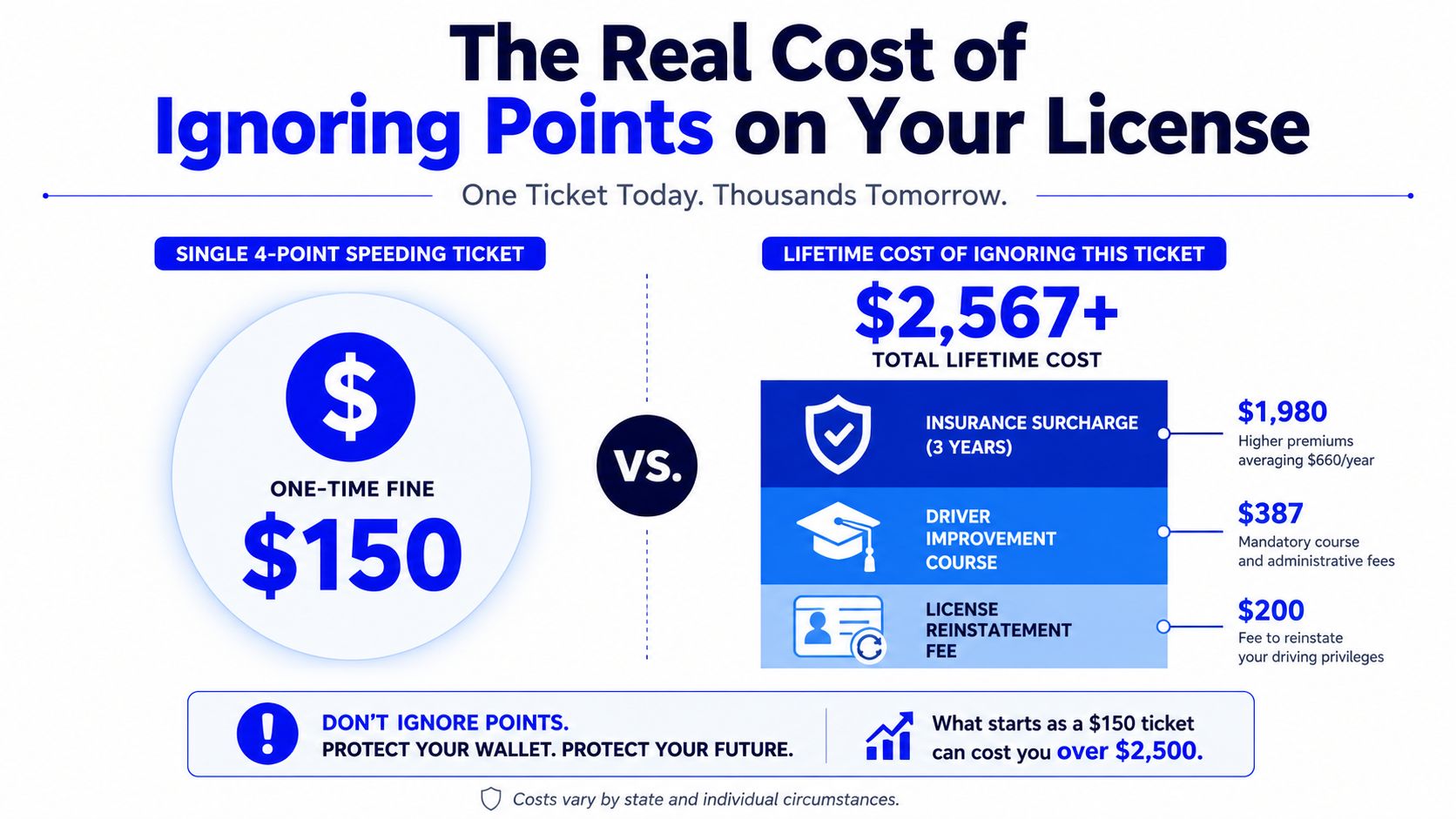
Why a conviction deserves careful review
Florida Statute 318.14 provides the framework for handling civil traffic infractions and identifies options that may prevent points in qualifying circumstances. Florida law also allows a qualifying driver improvement course to affect adjudication and point assessment for certain Chapter 316 violations, as described in the Florida Statutes provisions governing driver improvement courses.
That protection is not automatic. The driver must make the proper election, satisfy the requirements, and complete each required step. A Florida traffic defense attorney can review the charge, assess the existing record, and decide whether contesting the citation or pursuing a permitted resolution gives the best chance of a No Points result. Attorney-led help through phone and text also gives you a person tracking deadlines and explaining options, rather than an automated ticket app or ticket mill handling the file through a fixed process.
Practical rule: Treat the fine as only one part of the cost. Identify the disposition first, then determine whether it adds points and threatens your license.
Review this explanation of Florida traffic ticket costs and hidden consequences before choosing a response. Your existing points, the exact charge, and your distance from a statutory suspension threshold should control the decision.
How Florida's Point System Triggers Suspensions
A minor moving conviction can push your record toward suspension before you recognize the pattern. Florida uses a graduated point system for moving-violation convictions, with the suspension ladder set by Florida Statute 322.27:
Points Accumulated | Time Window | Suspension Length | Governing Statute |
|---|---|---|---|
12 points | 12 months | 30 days | |
18 points | 18 months | 3 months | Florida Statute 322.27 |
24 points | 36 months | 1 year | Florida Statute 322.27 |
The first threshold can arrive through several ordinary moving convictions. The Florida point-system overview explains why accumulated violations create a broader licensing risk than the fine attached to any single ticket. Review the Florida driver license points rules and suspension thresholds before deciding how to handle a new citation.
How points can stack
Do not assume a minor-looking ticket leaves room on your record. The exact offense determines its point value, and common moving violations carry different amounts. Several convictions can therefore create a licensing problem faster than expected.
Florida law also recognizes more serious consequences beyond a temporary suspension. Driving privileges can be revoked after 15 violations that each add points, or three major offenses within a five-year period.
Drivers under 18 face a stricter standard. Six or more points within a year triggers a one-year business-purposes-only restriction, and each additional point can extend that restriction by 90 days.
Your first citation is the right time to act. A Florida traffic defense attorney can review your current record, identify how the new conviction would affect the point ladder, and pursue a strategy aimed at No Points. Attorney-led access by phone and text gives you direct answers, deadline tracking, and case-specific decisions that automated ticket apps and ticket mills cannot provide. Waiting until your record nears a threshold limits those options and raises the cost of a mistake.
Four Strategies to Reduce or Avoid Points
Florida drivers generally have four strategic paths, but they aren't interchangeable. The right choice depends on the evidence, the exact offense, your existing record, and your distance from the 12-point suspension trigger.
Contest the citation
A formal contest is the strongest starting point when the facts are disputed or the citation contains weaknesses. Florida Statute 318.19 governs the procedures for certain civil traffic infractions and provides the framework for contesting a citation.
A defense attorney can review the officer's observations, available evidence, citation details, and procedural issues. The goal is dismissal, but the practical value also comes from preserving negotiating power before a conviction posts.
Seek withholding of adjudication
Florida Statute 318.14 provides a path under which adjudication may be withheld for qualifying violations and circumstances. When the legal requirements are satisfied, points may not be assessed.
This option can fit a driver who wants to resolve the case without proceeding through a full trial, but it still requires careful eligibility analysis. A withheld adjudication isn't the same as pretending the citation never happened, and it shouldn't be selected without considering your prior record and future licensing needs.
Elect a qualifying driver improvement course
For some Chapter 316 violations, Florida law allows a qualifying driver improvement course to affect adjudication and point assessment. The applicable statute also provides that the civil penalty may be reduced by 18 percent in the circumstances described by the Florida statutory course provisions.
This is usually a mitigation tool, not the first choice when you have a strong defense. It can be useful when contesting isn't viable and the course election is legally available.
Negotiate the charge
A lawyer may seek a negotiated amendment to a disposition that doesn't carry points, when the prosecutor and court permit that resolution. The exact available amendment depends on the county, charge, record, and evidence.
Don't choose a path based on the ticket's label alone. Florida law assigns different point values to different Chapter 316 offenses, as shown in the Florida Legislature's Chapter 316 statutes. If you're an out-of-state commercial driver, already above 12 points, or facing a 4-point offense, fight first, negotiate second, and elect school last.

For more detail on avoiding points without automatically choosing school, read how to remove points without traffic school.
Contesting a Florida Traffic Ticket Step by Step
Consider a Florida driver who receives a moving citation and already has points on the record. The driver can either accept the ticket's consequences or contest the charge before the case becomes a settled conviction.
The first decision is procedural. The driver must respond through the clerk of court within the applicable deadline, choose a not-guilty plea when contesting, and request the hearing process. Paying the fine instead may close the case without giving counsel an opportunity to challenge the evidence or seek a better disposition.
What happens before the hearing
The clerk's office processes the plea and schedules the case. Counsel can review the citation, request available discovery, examine the evidence, and identify whether a continuance or additional preparation is necessary.
A county court hearing officer may handle certain civil traffic matters, while other cases proceed before a judge. The governing court process depends on the case and county. Your attorney should tell you what appearance is required and whether counsel can appear for you.
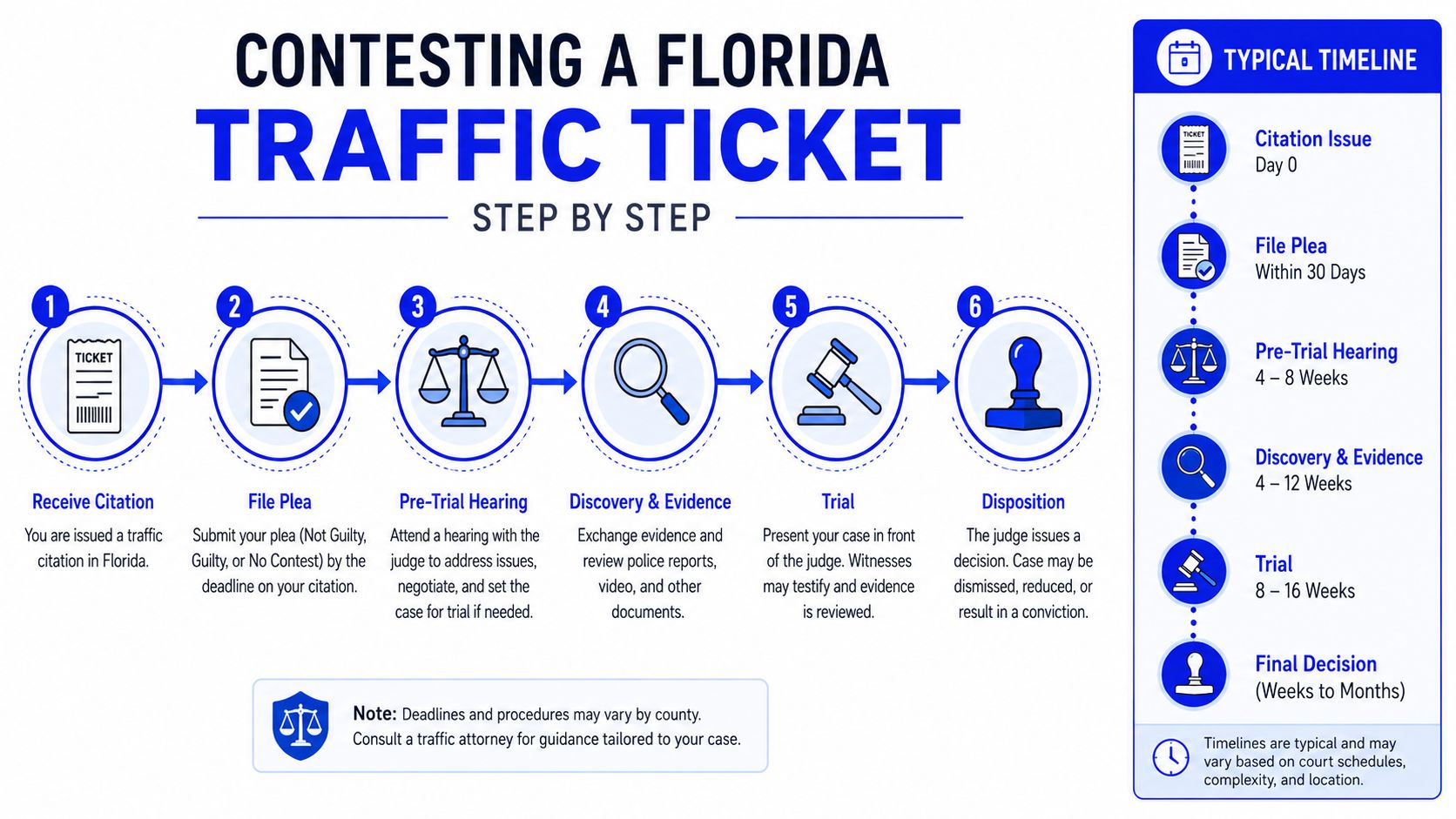
Discovery can reveal weaknesses that aren't visible from the citation alone. Counsel may also communicate with the State Attorney's Office about an amended disposition or withholding of adjudication before trial.
The hearing and final disposition
At trial, the State must present its case. If the officer doesn't appear, the court handles the absence according to the applicable procedure and circumstances. You shouldn't assume an officer's absence guarantees dismissal, but you also shouldn't surrender the opportunity to challenge the case.
A successful contest can prevent the conviction. A negotiated amendment can also avoid the point consequences of the original charge when the resolution is legally available.
Watch this Florida traffic ticket defense video for additional context about the contest process.
Direct attorney access matters at each stage. You need someone who can explain the discovery, answer a text before a deadline, and make a recommendation based on your actual citation rather than a generic workflow. The Florida traffic ticket contesting guide provides further guidance on the process.
Using a Driver Improvement Course to Your Advantage
A driver improvement course can help, but only when you elect it correctly. Florida Statute 318.14 provides the legal framework for qualifying course elections and the related treatment of adjudication and points.
Start with eligibility. The course option may not fit a driver with a commercial license, a driver who completed a qualifying course within the applicable period, or a citation involving a crash that caused injury or death. Confirm those facts with the clerk or a Florida traffic attorney before you pay or enroll.
The election and completion process
The election deadline is tied to the citation response period. Missing the 30-day deadline can eliminate the mitigation option, so don't wait until the last day.
Requirement | Florida Standard | Consequence if Missed |
|---|---|---|
Course election | Make the election within 30 days of the citation, subject to the applicable court process | The course option may be unavailable |
Provider | Use a state-approved provider | Completion may not qualify |
Instruction | Complete the qualifying course requirements | Points may still be assessed |
Documentation | File the completion certificate with the clerk and provide proof to the insurer when appropriate | The court or insurer may not apply the intended benefit |
The course must satisfy the applicable state requirements. The standard course requirement includes four hours of instruction, and the completion certificate must reach the clerk through the required filing process. Keep every receipt, certificate, and disposition document.
Mistakes that defeat the strategy
The most common errors are simple. A driver misses the election window, chooses a provider that isn't approved, or pays before properly electing the course. Another mistake is assuming a later course can erase points that already posted. It generally can't undo a completed record event automatically.
Use school when it fits the facts. If the citation is defensible, contesting may offer a cleaner path to No Points.
Why Lawyer-Led Defense Beats Ticket Mills
Automated apps and high-volume ticket services may offer a convenient upload screen. Convenience isn't the same as legal strategy. A ticket mill may assign your case to a person you don't know, provide limited updates, and rely on standardized actions that don't account for the details of your citation.
A lawyer-led model gives you direct access to the person evaluating the defense. Ticket Shield, PLLC describes a service model in which clients communicate directly with their Florida traffic attorney by phone or text, rather than navigating middlemen, corporate answering services, or automated chatbots.
What direct representation changes
An attorney can examine the actual case instead of processing only the citation number. That may include reviewing available body-camera evidence, identifying discovery issues, communicating with the State Attorney, and deciding whether to pursue dismissal, an amended charge, or withholding of adjudication.
Lawyer-led defense | Automated or high-volume service |
|---|---|
Personal review of the citation and record | Standardized intake |
Direct attorney communication by phone or text | Limited or indirect communication |
Strategic negotiation with the State Attorney | Often limited to routine procedural requests |
Court representation when permitted | May provide less individualized handling |
Defense aimed at reducing or avoiding points | Resolution may focus on closing the file |
Attorney-client privilege also matters. You should be able to discuss your record, employment needs, commercial driving concerns, and prior dispositions candidly with counsel.

A ticket isn't an administrative upload. It's a legal problem with a deadline, a record consequence, and a limited set of strategic choices.
A suspension can interfere with work, family responsibilities, and insurance coverage. The cost isn't limited to the fine. Paying for advice before accepting a conviction can be a cost-effective decision when the priority is protecting your license and pursuing No Points.
For a closer comparison, read why choosing a local Florida traffic lawyer over automated apps matters.
Protect Your License and Aim for No Points
Treat the first days after a citation as a decision window. Don't wait for a suspension notice or an insurance renewal before checking what the ticket may do to your record.
Your action checklist
Pull your driving record. Confirm the points already listed and review the dispositions that produced them. Florida says points remain on the driver record for at least five years from the date of disposition, so accuracy matters. Use FLHSMV's official points and suspension information as a starting point.
Choose contesting or mitigation before the deadline. Florida Statute 318.14 governs important civil-infraction options, including qualifying driver improvement elections. Don't let the 30-day response period pass without making an informed choice.
File the correct plea. If you're fighting the citation, submit the written not-guilty plea through the clerk and confirm the hearing process. Keep proof of every filing.
Use an approved course only when it fits. If you elect driver improvement, confirm provider approval, complete the required instruction, and file the certificate correctly.
Preserve your records. Save the course certificate, clerk receipt, final disposition, and any insurer documentation. These records help you challenge errors and explain the outcome later.
Commercial drivers need additional caution because licensing consequences can extend beyond Florida's point system. If your license is at risk, speak with a Florida traffic attorney before choosing a disposition.
The cleanest plan is usually the one made before points post. A direct phone or text consultation lets counsel evaluate the exact charge, review your record, identify whether contesting or negotiation makes sense, and handle the court process where permitted.
Visit Ticket Shield, PLLC for a free consultation with a Florida traffic attorney who can evaluate your citation and pursue the cleanest point-reduction strategy. Contact the firm by phone or text today, with the goal of protecting your license and achieving “No Points” on your record.
